
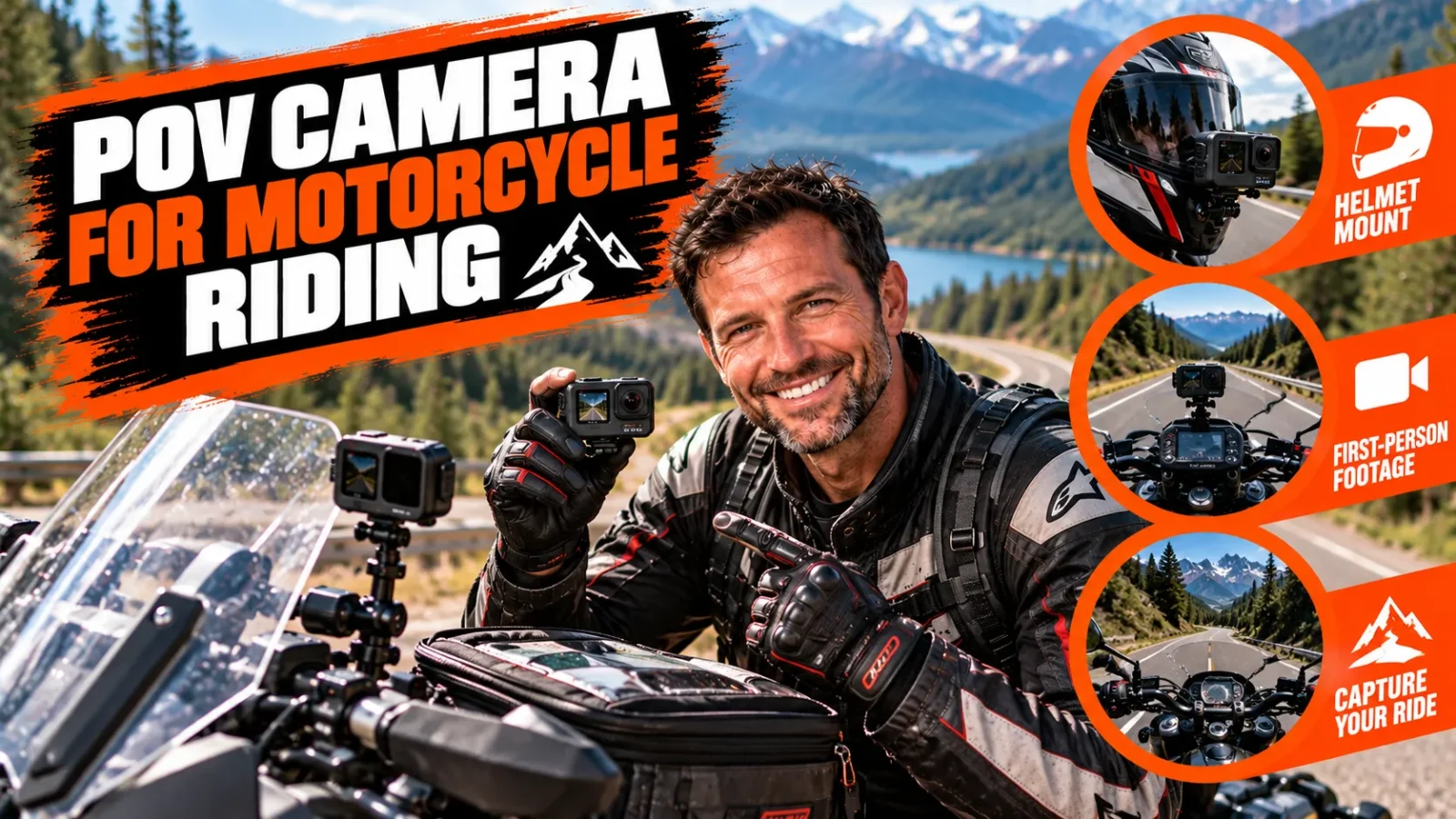
I’ve been strapping cameras to my helmet and bike for close to a decade now, and I’ve gone through more mounts, memory cards, and cracked camera housings than I’d like to admit. Finding the best POV camera for motorcycle riding isn’t just about picking whatever’s trending on YouTube — it’s about wind noise, vibration, battery life in the cold, and whether the thing survives a tip-over in the garage.
In this guide, I’m breaking down the eight cameras I’d actually put my own money on (and have). Whether you’re documenting canyon carves, commuting through city traffic, or building a YouTube channel from the saddle, one of these picks will fit your ride.
- The GoPro HERO13 Black remains my top all-around pick thanks to HyperSmooth stabilization and a huge mounting ecosystem.
- If you ride a lot at night or in low light, the DJI Osmo Action 5 Pro genuinely outperforms GoPro in dark conditions.
- Budget riders shouldn’t overlook the Akaso Brave 8 or last-gen GoPro HERO12 Black — both deliver excellent footage for less.
- Mount choice matters as much as the camera itself — helmet, chin, and adhesive mounts all change the story your footage tells.
- For riders who hate committing to an angle before the ride, a 360 camera like the Insta360 X4 lets you reframe everything in post.
1. GoPro HERO13 Black — Best Overall POV Camera for Motorcycle Riding
The GoPro HERO13 Black is still my go-to recommendation, and I say that after testing it back-to-back against every major competitor on real rides. It shoots up to 5.3K/60fps and 4K/120fps, and the HyperSmooth 6.0 stabilization handles handlebar vibration and helmet shake better than anything else on this list.
What really sold me is the new magnetic quick-release mounting system. GoPro finally ditched the fiddly buckle-and-latch design, so swapping the camera between my helmet, chest mount, and bike mount takes seconds — huge if you’re switching setups mid-ride.
Battery life sits around 70-100 minutes of 4K recording depending on temperature, which is respectable but not class-leading. I always carry a spare battery on longer rides. At roughly $399-$450 depending on the bundle, it’s not cheap, but the footage quality and reliability justify it for me.
Why It Works So Well on a Bike
The HERO13’s automatic horizon leveling keeps footage stable even when I’m leaned way over in a corner, which used to make older GoPros look drunk. It’s also rated for waterproofing up to 33 feet without a case, so rain rides aren’t a dealbreaker.
If you want the full rundown on how GoPro’s whole helmet-cam lineup compares, I wrote an entire breakdown of the best GoPro camera for motorcycle helmet use specifically, which digs deeper into HERO12 vs HERO13 differences.
2. DJI Osmo Action 5 Pro — Best for Low-Light and Night Riding
I didn’t expect to like a non-GoPro action camera this much, but the DJI Osmo Action 5 Pro genuinely surprised me. It uses a 1/1.3-inch sensor that’s noticeably larger than what GoPro packs into the HERO13, and it shows in dusk and nighttime footage.
If you commute early mornings or ride home after dark, this is the camera I’d point you toward. Streetlights, headlights, and shadowy backroads all look cleaner and less grainy than on competing cameras I’ve tested in the same conditions.
Battery life is another strong point — DJI rates it around 240 minutes in standard mode, which crushes most of the competition. I’ve done full-day rides without swapping batteries, something I can’t say for most cameras on this list.
Mounting and Compatibility
DJI’s magnetic quick-release mount system is compatible with most GoPro-style mounts using an adapter, so you’re not locked into buying an entirely new mounting ecosystem. It’s priced around $349, making it slightly cheaper than the GoPro HERO13 while matching or beating it in several categories.
3. Insta360 Ace Pro 2 — Best Image Quality for the Price
The Insta360 Ace Pro 2 uses a co-engineered 1/1.3-inch sensor and has genuinely impressive dynamic range for an action camera. I noticed the difference most in high-contrast situations — riding out of a tunnel into bright sunlight, for example, where cheaper cameras blow out the highlights instantly.
It records up to 8K resolution, which is honestly overkill for most riders, but it gives you serious cropping flexibility in post-production if you want to reframe a shot or punch in during editing. The flip-up touchscreen is also genuinely useful for checking your mount angle before you pull out of the driveway.
At around $399, it sits right in GoPro HERO13 territory price-wise, and I’d say it’s a legitimate alternative rather than a budget compromise. Battery life runs about 100-150 minutes depending on resolution settings.
Where It Falls Short
Insta360’s mounting ecosystem, while growing, still isn’t as deep as GoPro’s when it comes to motorcycle-specific accessories. If you’re building a multi-camera setup with lots of mount options, this is worth keeping in mind before you commit.
4. Insta360 X4 — Best 360-Degree Camera for Motorcycles
The Insta360 X4 is a completely different beast from everything else on this list, and it’s earned a permanent spot in my tank bag. It captures a full 360-degree sphere at up to 8K30fps, meaning you literally cannot miss the shot — you just reframe it afterward in the app.
This is huge for group rides. I mount the X4 on a tall pole attached to my tail rack, and it captures my bike, the riders behind me, and the scenery all at once. In editing, I choose whichever angle actually tells the best story.
The tradeoff is a steeper editing learning curve and a camera that looks a little unusual sticking up off your bike (people will ask about it, I promise). It retails for around $499, and the invisible-selfie-stick effect it creates is something I haven’t seen matched by a traditional action camera.
Battery and Durability Notes
Battery life runs about 135 minutes with the standard battery, and it’s rated IPX8 waterproof to 33 feet without a case. I’ve ridden through genuine downpours with mine and never had an issue.
5. GoPro HERO12 Black — Best Value Flagship
Since the HERO13 launched, prices on the GoPro HERO12 Black have dropped significantly, and it’s become one of the smartest buys in this entire category. You’re getting last year’s flagship stabilization and 5.3K recording for often $150-200 less than the newest model.
Honestly, unless you specifically need the HERO13’s new mounting system or slightly improved battery efficiency, I’d tell most riders to save the cash and grab the HERO12 instead. The image quality difference between the two generations is minimal in daylight riding conditions.
It’s compatible with GoPro’s entire existing mount ecosystem too, which matters a lot if you’re already invested in GoPro accessories from a previous camera. Pricing typically runs $299-$350 depending on the retailer and bundle.
A Great Entry Point
If this is your first POV camera purchase, the HERO12 is a low-risk way to figure out whether you’ll actually stick with helmet-cam footage before spending flagship money on the newest release.
6. Insta360 GO 3S — Best Tiny, Discreet POV Camera
The Insta360 GO 3S is genuinely tiny — about the size of your thumb — and it’s become my pick for riders who don’t want a bulky camera sticking off their helmet. It clips onto a magnetic pendant mount, meaning you can stick it practically anywhere on your gear.
Video quality tops out at 4K/30fps, which is lower than the flagship options on this list, but the form factor makes up for it. I’ve used mine clipped to a chest strap, jacket collar, and even my glasses for genuinely unique angles that a bulky action camera just can’t replicate.
It runs around $299-$399 depending on the bundle you choose, and the included Action Pod essentially turns it into a mini traditional action camera with a screen when you need one. Battery life is limited (around 45 minutes standalone), so I always pair it with the pod for longer rides.
7. Akaso Brave 8 — Best Budget Pick
Not everyone wants to spend $300+ on a camera that might get destroyed in a low-speed tip-over, and that’s exactly where the Akaso Brave 8 comes in. At around $130-150, it’s a fraction of the price of the flagship options, and it still delivers 4K/30fps recording with decent stabilization.
I wasn’t expecting much going in, but the Brave 8’s onboard “AI” stabilization does a surprisingly competent job smoothing out vibration on rougher roads. It won’t match GoPro or DJI in low light, and the touchscreen response is a bit laggy, but for casual commute footage or a first-time buyer testing the waters, it’s a smart choice.
It’s also waterproof to 33 feet without a housing and uses the standard GoPro-style mount system, so it’s compatible with the mounts you might already own. For the price, I genuinely think it punches above its weight class.
8. DJI Osmo Action 4 — Best Battery Life on a Budget
The DJI Osmo Action 4 has been replaced as DJI’s flagship by the Action 5 Pro, but that means prices have dropped to around $249-$279, making it an excellent mid-range option. It shares a lot of the same low-light sensor tech as its successor, just with a slightly shorter battery runtime.
I’ve found the Action 4’s magnetic mounting ball-joint genuinely faster to adjust than GoPro’s traditional buckle mounts, which matters when you’re trying to angle your helmet cam correctly with gloves on in a parking lot before a group ride departs.
It’s rated for cold-weather performance down to -4°F, which I can personally vouch for after a chilly mountain pass ride where my phone battery died but the camera kept rolling fine. If you want DJI’s image quality without paying flagship prices, this is the one to grab.
How I Actually Choose Between These Cameras
When I’m deciding which camera to grab before a ride, it usually comes down to three things: lighting conditions, how much editing time I want to commit to, and where I’m mounting it that day.
Stabilization Matters More Than Resolution
I’d rather have smooth, watchable 1080p footage than shaky, nauseating 5.3K. Every camera on this list handles stabilization reasonably well, but the GoPro HERO13 and DJI Osmo Action 5 Pro are the clear leaders when the road gets rough.
Vibration from your engine and road surface transfers directly into your footage unless the camera (or your mount) absorbs it. This is honestly a bigger factor in footage quality than megapixels ever will be.
Mounting Setup Changes Everything
Your camera is only half the equation — where and how you mount it determines the actual story your footage tells. A helmet-top mount gives you that classic POV feel that follows your head through every turn.
A chin mount, on the other hand, captures more of your dash, hands, and the road directly ahead, which a lot of riders (myself included) actually prefer for tutorial-style content. I’ve written a full comparison of the best GoPro mounts for motorcycle helmets if you want to nerd out on this further.
Adhesive mounts are another option entirely, and they’ve come a long way from the flimsy stick-on tabs of a decade ago. If you’re considering a low-profile, semi-permanent setup, check out my guide to the best GoPro adhesive mount setup for motorcycle helmet riding before you commit to drilling or sticking anything to your lid.
Battery Life in Real Riding Conditions
Manufacturer battery estimates rarely match reality once you factor in cold weather, 4K recording, and screen-on time for checking your framing. I always plan for roughly 70-80% of the advertised runtime and carry a spare battery or power bank on any ride longer than an hour.
Cold weather is the biggest battery killer I’ve encountered. The DJI cameras on this list have consistently outperformed GoPro in sub-freezing temperatures in my own testing, for what it’s worth.
Action Camera vs. Dedicated POV Camera: Does It Matter?
Technically, most of what I’ve recommended here falls under the “action camera” umbrella rather than a dedicated “POV camera” category, but for motorcycle riding, they’re functionally the same thing. The rugged, waterproof, helmet-mountable design is exactly what makes these cameras work for POV footage in the first place.
If you’re comparing action cameras more broadly and want a wider lens on the category beyond just motorcycle use, I’d point you to my deeper dive on the best action camera for motorcycle helmets, which covers a few additional models and use cases I couldn’t fit here.
What About Dash Cams and Bike-Mounted Systems?
I get asked about dedicated motorcycle dash cam systems a lot, and while they have their place (especially for insurance/incident documentation with front-and-rear coverage), they’re a different tool than a POV camera. Dash cam systems like the Cardo Packtalk-integrated cameras or dedicated dual-lens setups prioritize continuous loop recording over cinematic footage.
If your goal is simply insurance-grade evidence footage, that’s worth its own separate research. If your goal is footage you’ll actually want to edit and share, stick with the action camera picks above.
My Final Take
After years of trial, error, and a few cameras that didn’t survive their first rainstorm, my honest recommendation is this: grab the GoPro HERO13 Black if you want the safest, most versatile all-around option. Grab the DJI Osmo Action 5 Pro if low-light performance and battery life matter more to you than brand familiarity.
If budget is the deciding factor, the Akaso Brave 8 or a discounted GoPro HERO12 Black will serve you well without breaking the bank. And if you’re the type who wants total creative flexibility in the editing room, the Insta360 X4‘s 360-degree capture is worth the learning curve.
Whichever camera you choose, spend just as much time thinking about your mount as you do the camera itself. A great camera on a shaky, poorly-positioned mount will disappoint you every single time — I learned that lesson the hard way so hopefully you don’t have to.
Frequently Asked Questions
What is the best POV camera for motorcycle riding?
For most riders, I recommend the GoPro HERO13 Black. It balances stabilization, wind-noise handling, and mount compatibility better than anything else I’ve tested, though the DJI Osmo Action 5 Pro is a fantastic alternative if you ride mostly at dawn, dusk, or at night.
Should I mount my camera on my helmet or on the bike?
I run both, honestly. Helmet mounts give you that true first-person view and follow your head through corners, while a chin-mount or bike-mounted setup shows more of the bike and road. Check out my breakdown of the best GoPro mounts for motorcycle helmets to figure out which fits your riding style.
Do I need a chin mount or an adhesive mount for my helmet?
It depends on your helmet shape and riding position. Adhesive mounts are lower-profile and great for sportbikes and track days, while chin mounts work well on modular and dirt helmets. I go deep on this in my guide to the best GoPro adhesive mount setup for motorcycle helmets.
Is a 360-degree camera better than a traditional action camera for motorcycles?
Not necessarily better, just different. A 360 camera like the Insta360 X4 lets you reframe your shot after the ride, which is great if you’re not sure where the action will happen. A traditional camera like a GoPro or DJI Osmo is simpler to edit and usually delivers better resolution in the direction you’re actually pointing it.

Related Articles

6 Best Rear View Cameras for Motorcycle: Riders Who Want Eyes in the Back of Their Head
I've tested the top rear view cameras for motorcycles so you don't have to. Here are my real-world picks for…
 Jake Miller
12 min read
Jake Miller
12 min read

8 Best Cameras for Riding Motorcycle in 2026 (Rider-Tested Picks)
I've mounted, crashed, and rain-soaked dozens of cameras on my helmet and bike. Here are the 8 best cameras for…
Jake Miller
9 min read

9 Best Cameras for Motorcycle Travel: My Tested Picks for Long-Haul Rides
I've tested action cams, 360 cameras, and mirrorless bodies on thousands of touring miles. Here are the 9 best cameras…
Jake Miller
12 min read