
8 Best Motorcycle Cameras for Commuting in 2026 (Tested & Reviewed)
 Jake Miller
13 min read
Jake Miller
13 min read
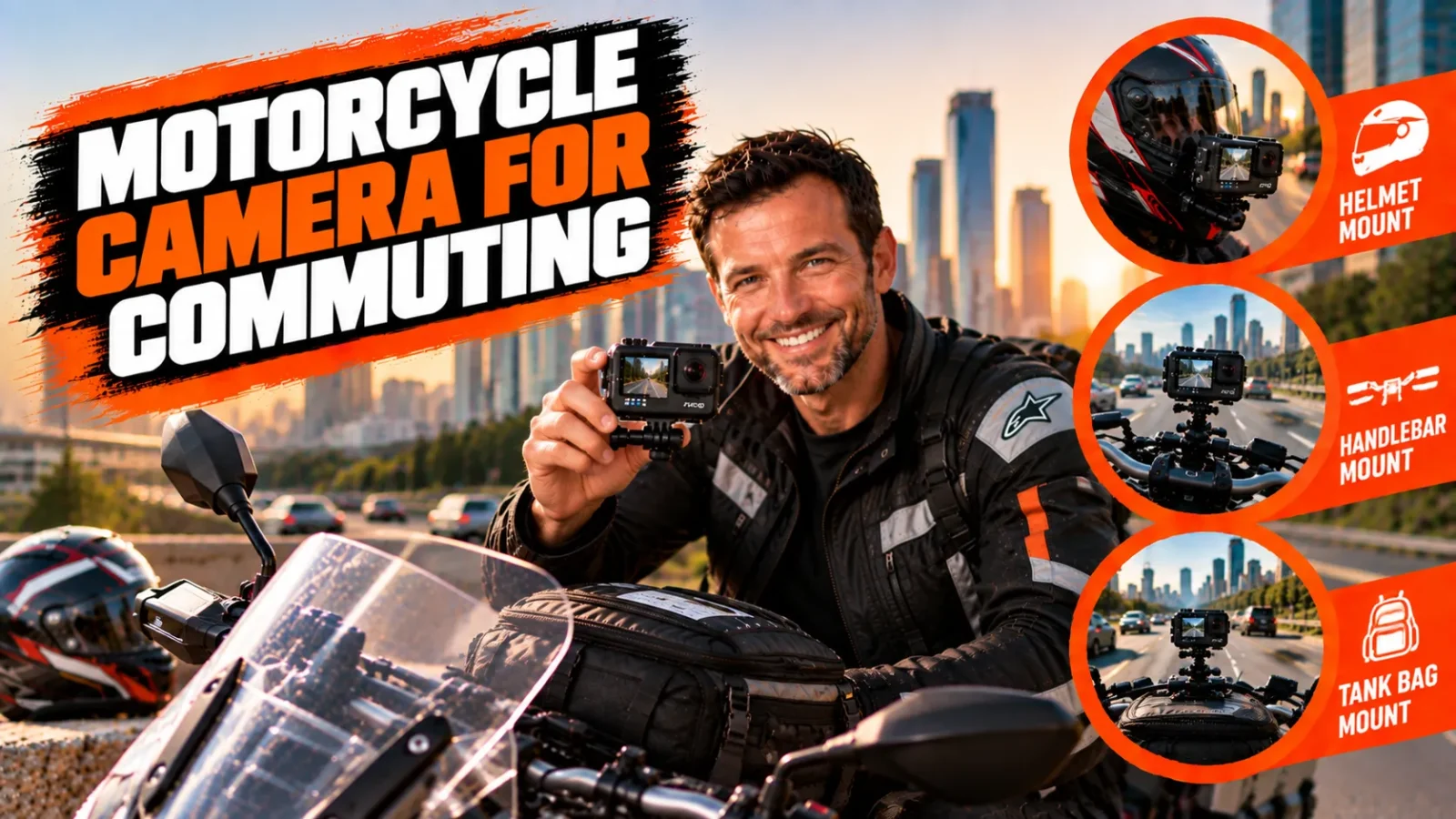
I’ve been commuting on two wheels for over a decade, and if there’s one accessory that’s saved my skin (literally and legally), it’s a good camera. I’ve had a car pull an illegal U-turn in front of me, I’ve had a “he came out of nowhere” driver try to blame me for their mistake, and both times, footage settled it in seconds.
Over the years I’ve mounted, wired, glued, and crashed (yes, crashed) my way through a stack of motorcycle cameras. Some were fantastic. Some died in the rain within a month. Below is my honest, hands-on list of the best motorcycle cameras for commuting, whether you want a full always-on dash cam system or something small enough to forget it’s there.
- My top overall pick is the Innovv K5 — a hardwired, front-and-rear system built specifically for motorcycle commuting.
- If you want flexibility and killer image quality, the GoPro Hero 13 Black is still the gold standard action camera.
- Budget-conscious riders should look at the Innovv C5, which gives you dual-channel coverage for a fraction of premium prices.
- For night commuters, the DJI Osmo Action 5 Pro handles low light dramatically better than most competitors.
- Don’t skimp on mounting — a shaky, poorly-secured camera produces useless footage exactly when you need it most.
1. Innovv K5 — Best Overall Dedicated Motorcycle Camera System
If I had to recommend just one camera for someone who commutes daily, it’s the Innovv K5. This is a purpose-built, hardwired dual-camera system with a front and rear lens, both recording in 2.5K resolution. It wires directly into your bike’s electrical system, so it powers on with the ignition and just… works.
What sold me on the K5 is that I never have to think about it. No charging batteries, no remembering to hit record before I pull out of the driveway. It loop-records continuously and has a built-in G-sensor that automatically locks footage if it detects a hard impact.
The K5 also includes GPS logging, so you get speed, location, and route data overlaid on your footage — genuinely useful if you ever need to prove exactly how fast you were (or weren’t) going. Expect to pay somewhere in the $400-$500 range plus professional installation if you’re not comfortable running wires yourself.
Best for: Daily commuters who want “set it and forget it” reliability and don’t mind a semi-permanent install.
2. GoPro Hero 13 Black — Best Action Camera for Helmet Mounting
The GoPro Hero 13 Black is still my go-to recommendation when someone asks me for the single best action camera to slap on a helmet. Image quality is outstanding — 5.3K video, HyperSmooth 6.0 stabilization that makes footage look almost gimbal-smooth even on rough pavement, and genuinely impressive HDR performance.
For commuting specifically, I love that GoPro finally nailed battery life with the Hero 13, easily covering a round-trip commute plus some buffer. The new magnetic mounting system (compatible with older Hero mounts too) makes it painless to pop the camera on and off between the helmet and the bike.
If you’re deciding between chin-mounting versus a full helmet-top setup, I’ve gone deep on this exact question in my best GoPro camera for motorcycle helmet guide, which covers positioning for the clearest footage without excess helmet vibration.
Best for: Riders who want top-tier footage quality and the flexibility to move the camera between helmet, bike, and other gear.
Why I still reach for a GoPro despite owning a hardwired system
Even with a dedicated dash cam on my bike, I still bring a GoPro along sometimes. It’s just more versatile — I can throw it on my chest strap, my tank bag, or a buddy’s bike when we ride together. For pure commuting, though, it does require you to remember to charge it and hit record.
3. Insta360 X4 — Best 360-Degree Camera
The Insta360 X4 shoots in full 360 degrees at up to 8K, which sounds like overkill until you realize what it means for commuting footage: you capture literally everything around you, then reframe the shot afterward in the app. Didn’t see that car swerve until you’re editing? Doesn’t matter — it’s all recorded.
I mount mine on a short pole above my helmet, and the “invisible selfie stick” effect means the mount practically disappears from the final footage. For proving fault in an incident, having a full 360-degree record is honestly hard to beat.
Battery life runs around 135 minutes at max resolution, which comfortably handles most one-way commutes, though longer combined round trips might need a top-up at your desk. Pricing sits around $500 for the standard bundle.
Best for: Commuters who want maximum coverage and the ability to reframe footage after the fact.
4. Cycliq Fly12 Sport — Best Front Camera With Integrated Light
The Cycliq Fly12 Sport started life as a cyclist’s camera, but it’s genuinely great on a motorcycle too, especially for city commuting where visibility matters as much as recording. It combines a 1080p front-facing camera with a 600-lumen headlight in one compact unit.
I like this one for urban commuters specifically because being seen is half the battle in traffic. The integrated light means you’re not just documenting close calls — you’re actively reducing how many you have in the first place.
It mounts easily to handlebar-style mounts, runs about 2 hours of continuous recording with the light on, and pairs with an app for footage management. At roughly $200, it’s an affordable way to add both safety lighting and evidence-grade recording in one device.
Best for: City commuters who want a combined visibility + camera solution rather than two separate accessories.
5. DJI Osmo Action 5 Pro — Best for Low-Light and Night Commutes
If your commute involves early mornings or late evenings, low-light performance matters more than resolution numbers. The DJI Osmo Action 5 Pro has genuinely impressed me here — its larger 1/1.3-inch sensor pulls in noticeably more detail in dim conditions than most competitors in this price range.
It records up to 4K/120fps, has a claimed battery life of around 4 hours, and is waterproof to 20 meters without a case — handy for riding through unexpected rain without babying your gear. DJI’s RockSteady 3.0 stabilization also handles the shakiness of a chin-mounted camera on rougher city roads impressively well.
For riders comparing this against GoPro and other action cams, I go into more detail in my best action camera for motorcycle helmets comparison, including how the Osmo Action 5 Pro stacks up in direct footage tests.
Best for: Night owls and early risers who need dependable footage even when the sun isn’t cooperating.
6. Insta360 GO 3S — Best Ultra-Compact, Discreet Camera
Sometimes I don’t want a bulky camera on my helmet at all — that’s where the Insta360 GO 3S comes in. This thing is tiny, about the size of a large thumb, yet shoots 4K video and clips magnetically to a helmet, jacket collar, or chest mount.
It’s not going to replace a full dash cam for evidentiary purposes since its field of view is narrower and battery life tops out around 45 minutes on the camera itself (though the included charging case extends total recording time significantly). But for lightweight everyday commuting where you just want a quick record of your ride, it’s brilliant.
Price runs around $400 for the higher-capacity version, which feels steep for something so small, but the convenience factor is real. I genuinely forget I’m wearing it most days.
Best for: Minimalist commuters who don’t want any bulk on their helmet or gear.
7. Innovv C5 — Best Budget Dual-Channel Dash Cam
Not everyone wants to spend $400+ on a motorcycle camera system, and that’s exactly why the Innovv C5 exists in my rotation of recommendations. It’s the more affordable sibling to the K5, offering front and rear 1080p recording for a noticeably lower price, usually somewhere around $220-$280.
You lose some resolution and a few premium features compared to the K5, but the core function — always-on, hardwired, loop-recording dual-camera coverage — is still there. For a lot of commuters, that’s really all you need.
Installation is similar to the K5, running wires from your battery or ignition source to front and rear-mounted cameras. If you’re handy with basic wiring or willing to pay a shop an hour of labor, this is a fantastic value pick.
Best for: Budget-conscious commuters who still want dual-camera, hardwired reliability.
8. Midland BikeGuardian — Best Radar Safety Camera for Commuters
The Midland BikeGuardian is a bit different from everything else on this list — it’s a blind-spot radar system combined with a rear-facing camera, designed specifically to alert you when a vehicle is approaching in your blind spot. For lane-splitting or heavy stop-and-go traffic commuting, this has genuinely changed how I ride.
It uses radar sensors mounted near your rear to detect approaching vehicles and alerts you through connected LED indicators, while simultaneously recording rear footage for documentation. It’s less about capturing cinematic footage and more about active accident prevention plus a video record as backup.
At around $300, it’s pricier than a basic rear camera, but you’re paying for the radar detection technology as much as the recording function. For commuters navigating dense urban traffic daily, I think that combination is worth it.
Best for: Urban commuters who want proactive blind-spot warnings alongside passive video recording.
How I actually chose these cameras
I didn’t just pick popular names off a shelf. Every camera on this list is something I’ve either owned, borrowed from a fellow rider, or tested extensively over real commuting miles in rain, heat, and stop-and-go traffic.
I weighed a few things heavily: reliability in bad weather, ease of daily use (because a camera you forget to charge is useless), footage quality good enough to actually identify a license plate, and realistic pricing for a daily-use accessory rather than a once-a-year track day toy.
What matters most for a commuting camera specifically
Commuting is different from weekend canyon rides or track days. You need something low-maintenance that works every single day without babysitting, handles constant vibration and weather exposure, and ideally starts recording automatically rather than requiring you to remember a button press in traffic.
That’s why hardwired systems like the Innovv K5 and Innovv C5 rank so highly for me here — the “set it and forget it” factor is huge when you’re using this thing 10+ times a week, not just on special occasions.
Mounting matters just as much as the camera itself
I can’t stress this enough: even the best camera in the world produces garbage footage if it’s mounted poorly. A camera that vibrates loose, points at the wrong angle, or falls off at 40 mph does you zero good when you actually need it.
For helmet-mounted setups, I strongly recommend checking out my breakdown of the best GoPro mounts for motorcycle helmets, which covers chin mounts, side mounts, and top mounts, along with the pros and cons of each for daily wear comfort.
If you’re going the adhesive mount route (which I do for my own GoPro setup), getting the adhesive placement and prep right is critical — a poorly-applied mount can peel off mid-ride, especially in hot weather. I put together a full walkthrough in my best GoPro adhesive mount setup for motorcycle helmet guide that covers exactly how I prep the surface and cure time before trusting it on the highway.
Handlebar and bike-body mounts vs. helmet mounts
I personally prefer a bike-mounted camera (like the Innovv systems or Cycliq Fly12 Sport) for pure commuting evidence purposes, since it’s less shaky and doesn’t add weight to my head over an 8-hour workday. Helmet cams shine more for POV footage and situational awareness of exactly where you were looking.
My honest recommendation? If budget allows, run both. A bike-mounted system for consistent, low-effort daily coverage, and a helmet or chest-mounted action camera for the days you actually want great footage to share or review.
Storage, footage retrieval, and what to do after an incident
Most of these cameras use loop recording, meaning old footage gets overwritten to make room for new footage, usually somewhere between 1-3 hour cycles depending on card size and resolution settings. This is great for storage management but means you need to act fast if something happens.
Nearly every system here, from the Innovv K5 to the GoPro Hero 13 Black, includes some form of automatic “lock” feature triggered by a G-sensor detecting sudden impact. That locked clip won’t get overwritten, which is exactly what you want if you’re ever in a collision.
Still, I make it a habit to manually pull footage after any close call, locked or not. Impact sensors are good but not infallible, and I’d rather have redundant peace of mind than lose critical footage to a software glitch.
My final take
If you commute daily and want the least amount of hassle, the Innovv K5 is my top pick — it just works, every single ride, without me thinking about it. If you want more flexibility and top-tier footage for sharing or reviewing your riding, the GoPro Hero 13 Black remains an excellent, more portable alternative.
Budget riders shouldn’t feel left out either — the Innovv C5 gets you real dual-channel protection without breaking the bank. And if blind spots in city traffic are your biggest concern, the Midland BikeGuardian adds a genuinely useful safety layer on top of standard recording.
Whatever you choose, the real win here isn’t the camera itself — it’s the peace of mind. I ride more confidently knowing that if something goes wrong on my commute, I’ve got proof, not just my word against someone else’s.
Frequently Asked Questions
Do I need a front and rear camera for commuting?
I’d say yes if you can swing it. Most insurance disputes and close calls happen from behind or the side, so a dual-channel system like the Innovv K5 or Innovv C5 covers you both ways during daily traffic.
Is a GoPro or a dedicated motorcycle camera system better for commuting?
It depends on your priorities. A GoPro (check out my best gopro camera for motorcycle helmet guide) is flexible and great for footage quality, while a hardwired system like the Innovv K5 records continuously without you touching a button every ride.
How long does footage stay recorded before it’s overwritten?
Most loop-recording systems like the Innovv K5, Innovv C5, and Cycliq Fly12 Sport overwrite footage on a continuous loop, usually cycling every few hours unless you lock a clip after an incident.
What’s the best mounting option for a helmet camera on a daily commute?
I lean toward a low-profile chin or side mount for commuting since it’s less bulky in traffic. I break down my favorite options in my best GoPro mounts for motorcycle helmets roundup.

Related Articles

6 Best Rear View Cameras for Motorcycle: Riders Who Want Eyes in the Back of Their Head
I've tested the top rear view cameras for motorcycles so you don't have to. Here are my real-world picks for…
Jake Miller
12 min read

8 Best Cameras for Riding Motorcycle in 2026 (Rider-Tested Picks)
I've mounted, crashed, and rain-soaked dozens of cameras on my helmet and bike. Here are the 8 best cameras for…
Jake Miller
9 min read

9 Best Cameras for Motorcycle Travel: My Tested Picks for Long-Haul Rides
I've tested action cams, 360 cameras, and mirrorless bodies on thousands of touring miles. Here are the 9 best cameras…
Jake Miller
12 min read