
8 Best Cameras for Motorcycle Vlogging That Actually Survive the Ride
 Jake Miller
11 min read
Jake Miller
11 min read
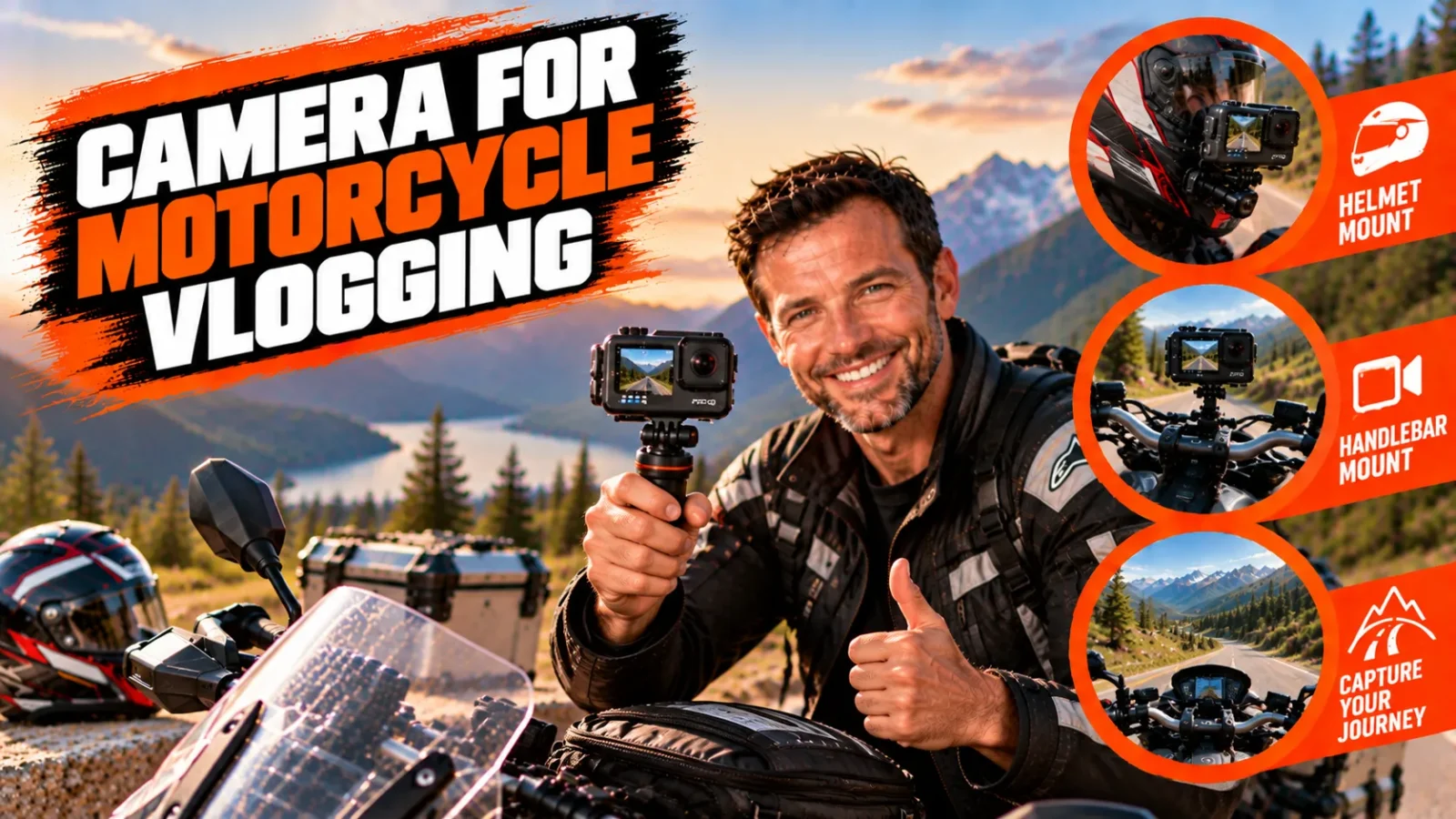
I’ve been strapping cameras to my helmet, chest, and handlebars for years now, and I’ve gone through more mounts, cameras, and SD cards than I care to admit. Finding the best camera for motorcycle vlogging isn’t just about resolution specs on a box — it’s about wind noise, battery life in the cold, and whether the thing survives a drop in a parking lot.
I’ve narrowed this list down to the cameras I’d actually recommend to a fellow rider, based on real trips, real weather, and real footage I’ve pulled off my own memory cards. Some are action cams, some are pocket gimbals, and one is a proper vlogging camera for when you hop off the bike.
- My overall favorite for motorcycle vlogging is the GoPro HERO13 Black — best image quality, best mount ecosystem, best all-around reliability.
- If you ride a lot at dusk or in low light, the DJI Osmo Action 5 Pro has noticeably better low-light performance and stabilization.
- Want to fix your framing after the ride instead of during it? The Insta360 X4 360° camera lets you reframe shots in post.
- On a tight budget, the Akaso Brave 8 gives you 90% of the action-cam experience for less than half the price.
- For gas station talking-head segments and off-bike b-roll, nothing beats the DJI Osmo Pocket 3 or a proper vlogging camera like the Sony ZV-1 II.
How I Picked These Cameras
I judge motorcycle cameras differently than I’d judge a camera for hiking or skiing. Wind noise at highway speed is brutal. Vibration from the engine and road can blur footage. And you need a camera that works with gloves on, because nobody’s taking their gloves off at a red light to hit record.
I also weighted battery life and heat management heavily. I’ve had cameras overheat and shut down mid-ride on hot summer days, which is infuriating when you’re trying to capture a canyon run. Every camera on this list has held up for me across multiple seasons.
1. GoPro HERO13 Black — Best Overall Camera for Motorcycle Vlogging
The GoPro HERO13 Black is the camera I reach for most often, and honestly, it’s not close. GoPro has been refining this form factor for over a decade, and it shows in every part of the riding experience — from the magnetic quick-release mounting system to the HyperSmooth 6.0 stabilization that eats up engine vibration.
Image quality is where this camera really shines. You’re getting 5.3K60 video, 27MP photos, and a new front-facing color screen that actually helps you frame a vlog shot before you pull off. The HB-Series lenses GoPro introduced with this model are also a big deal for anyone who films highway miles.
Battery life sits around 70-100 minutes of continuous 4K recording depending on temperature, which is solid but not incredible on a full-day ride. I always carry two spare batteries in my tank bag. Price runs around $399-$449 depending on the bundle.
If you’re deciding between GoPro generations or want a deeper breakdown of the whole lineup, I’ve written a full guide on the best GoPro camera for motorcycle helmets that goes into more detail on mounting and settings.
Why It Works So Well on a Bike
The HERO13’s mounting fingers are compatible with basically every third-party accessory I own, and that matters more than people realize. Once you build out a mount collection, you don’t want to start over with a new camera brand.
It’s also rated at a 33-foot waterproof depth without a housing, which means rain, road spray, and the occasional car wash don’t scare me anymore.
2. DJI Osmo Action 5 Pro — Best for Low-Light and Stabilization
I didn’t expect to like the DJI Osmo Action 5 Pro as much as I do, but it’s earned a permanent spot in my gear bag. The 1/1.3-inch sensor is noticeably larger than what GoPro packs into the HERO13, and it shows the moment the sun starts going down.
Dusk and dawn rides — which, let’s be honest, make for the best golden-hour footage — look dramatically cleaner on the Osmo Action 5 Pro. Noise stays controlled, and colors don’t get muddy the way they can on smaller sensors.
DJI’s RockSteady 3.0 and HorizonBalancing stabilization are also excellent for motorcycle use. HorizonBalancing in particular keeps the horizon level even when you’re leaning hard into a corner, which is a genuinely useful trick for canyon or track-day riders.
Battery life is the real standout here: DJI rates it up to 240 minutes in standard mode, and in my testing I comfortably got through a full day of stop-and-go riding without swapping batteries. It runs about $349 for the standard kit.
3. Insta360 X4 — Best 360° Camera for Reframing Your Ride
The Insta360 X4 shoots in every direction at once, which sounds gimmicky until you actually use it for motorcycle vlogging. You mount it on a small stick above your helmet, forget about aiming it, and then reframe the exact shot you want afterward in the Insta360 app.
This is a massive advantage if you tend to check your mirrors, look over your shoulder, or talk to a passenger mid-ride. Instead of losing the shot because the camera was pointed the wrong way, you just pull the angle you need in post.
It shoots 8K30 360° video and has an “invisible selfie stick” effect that makes it look like a drone is following your bike. That single feature alone has become a signature look for a lot of motovlogging channels I follow.
Battery life runs about 135 minutes, and it’s waterproof to 33 feet without a case. It retails around $499.99. The learning curve is real, though — expect to spend a weekend in the editing app before you get comfortable with reframing.
4. Insta360 GO 3S — Best Tiny Magnetic Camera for POV Shots
The Insta360 GO 3S is genuinely one of the more fun cameras I’ve used on a bike, mostly because it’s the size of my thumb. It clips magnetically to a jacket lapel, a chest mount, or even the edge of a helmet, and it disappears visually in a way a bulky action cam never will.
It shoots 4K video now (a big upgrade from the previous GO 2), and the included Action Pod acts as both a charging case and a viewfinder/handle when you need one. For quick clips of your gear, your bike, or a candid moment at a gas stop, it’s fantastic.
I wouldn’t use this as my only camera for a full-length motovlog — battery life caps around 45 minutes in standalone mode — but as a second or third angle, it adds a ton of variety to an edit. Pricing starts around $399.99 for the 64GB version.
5. DJI Osmo Pocket 3 — Best Gimbal Camera for Off-Bike Segments
Every good motovlog needs talking-head segments, and this is where the DJI Osmo Pocket 3 earns its spot on this list. It’s not built for helmet mounting, but for gas station updates, campsite chats, and walk-and-talk intros, nothing beats its built-in 3-axis mechanical gimbal.
The 1-inch CMOS sensor is a big jump over typical action cameras, giving you a shallow depth of field and that “real camera” look a lot of riders want for their intros and outros. The rotating touchscreen also makes vertical shooting for Reels and Shorts effortless.
I keep mine in my tank bag and pull it out at every stop. It’s genuinely changed how professional my off-bike footage looks compared to just using my phone. Expect to pay around $519 for the standard combo.
6. Sony ZV-1 II — Best Compact Camera for Off-Bike Vlogging
If you want something closer to a traditional vlogging camera for the moments you’re not actually riding, the Sony ZV-1 II is worth the investment. It’s not going on your helmet, but for interviews, gear reviews, and cinematic b-roll of your bike, the image quality is a different league entirely.
The updated 18-50mm equivalent zoom lens is wider than the original ZV-1, which makes a huge difference when you’re filming yourself in a tight motel room or a cramped garage. Sony’s autofocus and subject tracking are still some of the best in the business.
It’s got a flip-out screen designed specifically for vloggers, a built-in wind screen accessory, and a dedicated “bokeh switch” for quick background blur. It runs around $898, making it a bigger investment than any action camera on this list.
I treat this as a companion camera rather than a replacement — it lives in my luggage for hotel-room recaps and destination footage, not the ride itself.
7. Akaso Brave 8 — Best Budget Action Camera
Not everyone wants to spend $400 on a camera that might get knocked off a mount and run over by a truck. The Akaso Brave 8 is my go-to recommendation for riders who want to try motovlogging without a huge financial commitment.
For around $139.99, you get 4K30 video, a dual-screen design (front and rear), electronic image stabilization, and 10-meter waterproofing without a case. It’s not going to match GoPro or DJI in dynamic range or low light, but in good daylight conditions, the footage holds up surprisingly well.
I’ve handed this camera to riding buddies who were skeptical about vlogging, and it’s a great low-stakes way to figure out if you even enjoy the editing process before investing in flagship gear.
Its mount system is GoPro-compatible, too, so you’re not locked into proprietary accessories if you decide to upgrade later.
8. GoPro HERO12 Black — Best Budget GoPro Alternative
If you want GoPro’s ecosystem and reliability without paying flagship HERO13 prices, the GoPro HERO12 Black is still an excellent choice and frequently discounted below $300. I actually ran this as my primary riding camera for over a year before upgrading.
It shoots 5.3K60, has HyperSmooth 6.0 stabilization (the same generation as the HERO13), and supports the same mounting fingers and accessories that GoPro has used for years. The main things you’re giving up compared to the HERO13 are the HB lens options and the front color screen.
For most motorcycle vloggers, honestly, those omissions barely matter. If you’re just getting into helmet cameras and want something proven, I’d point you toward my full comparison of the best action camera for motorcycle helmets before you commit to a purchase.
What I Look for Before I Trust a Camera on a Ride
Wind Noise and Audio Quality
Built-in mics on action cameras are almost universally mediocre at highway speeds. I always plan on either using a lav mic clipped inside my jacket collar or replacing the audio entirely in post with a Bluetooth intercom recording.
If audio quality matters a lot to your channel, don’t judge a camera purely on its built-in microphone spec sheet — plan for external audio from day one.
Mounting Position Matters More Than the Camera Itself
I’ve found that where I mount the camera changes my footage more than which camera I’m using. A chin mount gives a more immersive, “rider’s eye” feel, while a top-of-helmet mount feels more cinematic and stable.
If you’re still deciding on hardware, I’d genuinely recommend reading through my guide on the best GoPro mounts for motorcycle helmets before buying more gear — sometimes a $20 mount change does more for your footage than a $200 camera upgrade.
Adhesive vs. Bolt-On Mounts
I get asked constantly whether adhesive mounts are safe at highway speed. In my experience, when installed correctly with fresh 3M adhesive pads and given 24 hours to cure, they’re extremely reliable — I’ve never had one fail above 40 mph.
Still, I always recommend a safety tether as a backup. I put together a full breakdown of my exact process in my GoPro adhesive mount setup for motorcycle helmets guide if you want the step-by-step.
Heat Management on Long Rides
Every action camera I’ve tested eventually throws a heat warning on a hot day if you’re recording continuously in 4K or above. Dropping to 1080p60 or 2.7K when you don’t need maximum resolution buys you significantly more recording time before a shutdown.
I also avoid mounting cameras directly against dark helmet shells in direct sun — even an inch of airflow gap from a mount arm makes a noticeable difference in overheating frequency.
My Final Take
If I had to recommend just one camera to a friend starting their motovlogging journey, it’s still the GoPro HERO13 Black. It balances image quality, mounting flexibility, and durability better than anything else on this list.
But I’d be lying if I said the DJI Osmo Action 5 Pro and Insta360 X4 haven’t earned permanent spots in my own riding kit for specific situations — low light and flexible reframing, respectively.
Whatever you choose, remember that the camera is only half the equation. The mount, the audio setup, and the editing habits you build matter just as much as the spec sheet. Ride safe, keep your lens clean, and don’t forget to actually enjoy the ride between takes.
Frequently Asked Questions
What is the best camera for motorcycle vlogging on a budget?
The Akaso Brave 8 is my top budget pick. It costs a fraction of a flagship GoPro but still delivers solid 4K60 footage and dual-screen usability for under $150.
Do I need a 360 camera or a regular action camera for motorcycle vlogging?
A 360 camera like the Insta360 X4 is great if you want to reframe your shot after the ride, but a standard action camera like the GoPro HERO13 Black is simpler and produces sharper native footage.
Is the GoPro or DJI Osmo Action better for motorcycle riding?
Both are excellent. In my experience, the DJI Osmo Action 5 Pro edges out GoPro in low-light and dusk riding, while the GoPro HERO13 Black has a slightly larger accessory and mount ecosystem.
What mount should I use for a motorcycle vlogging camera?
Chin mounts, helmet mounts, and chest harnesses all work well depending on the angle you want. Check out my breakdown of the best GoPro mounts for motorcycle helmets for specifics.

Related Articles

6 Best Rear View Cameras for Motorcycle: Riders Who Want Eyes in the Back of Their Head
I've tested the top rear view cameras for motorcycles so you don't have to. Here are my real-world picks for…
Jake Miller
12 min read

8 Best Cameras for Riding Motorcycle in 2026 (Rider-Tested Picks)
I've mounted, crashed, and rain-soaked dozens of cameras on my helmet and bike. Here are the 8 best cameras for…
Jake Miller
9 min read

9 Best Cameras for Motorcycle Travel: My Tested Picks for Long-Haul Rides
I've tested action cams, 360 cameras, and mirrorless bodies on thousands of touring miles. Here are the 9 best cameras…
Jake Miller
12 min read