
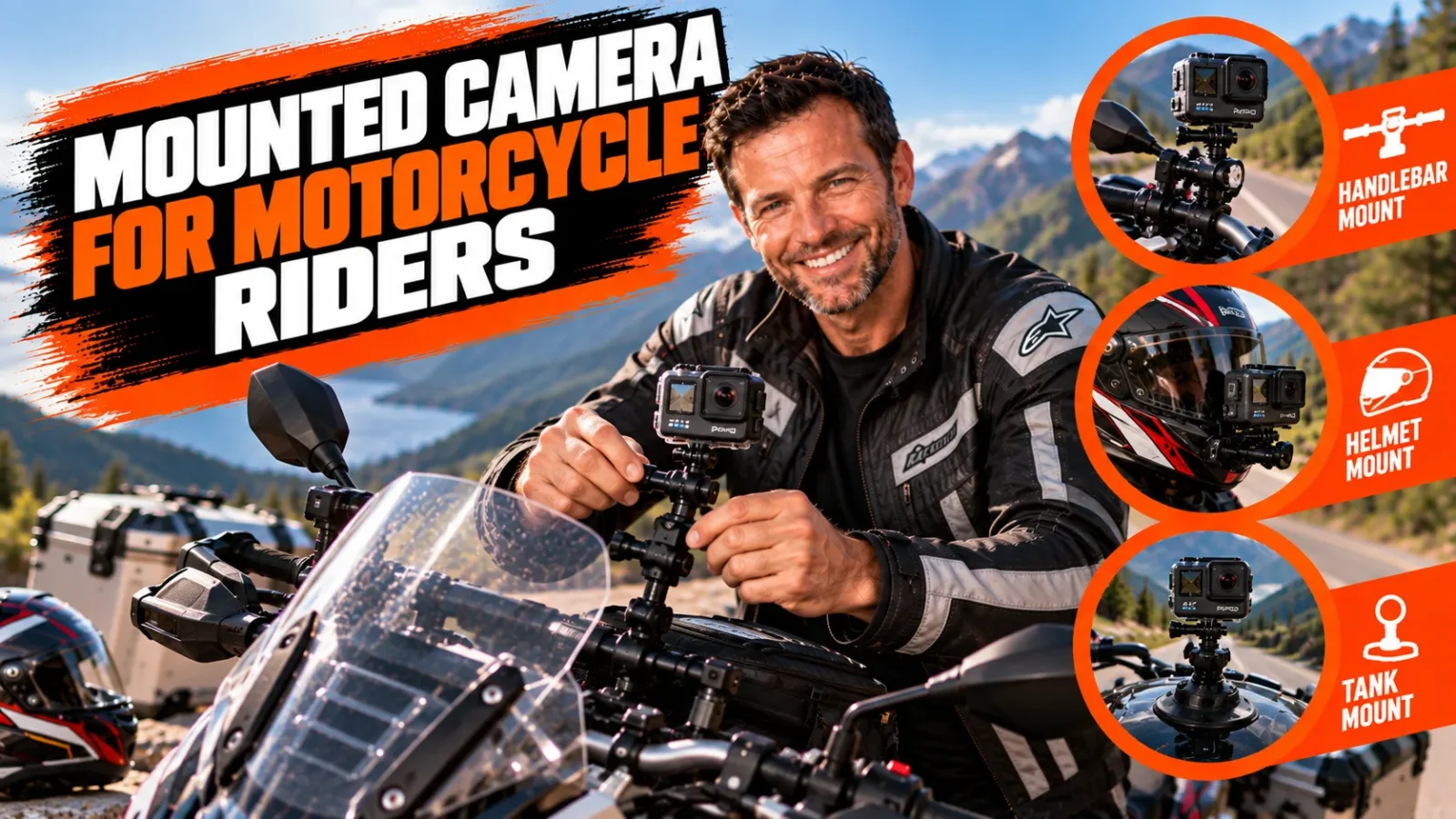
I’ve been strapping cameras to my helmet, tank, and handlebars for close to a decade now, and I’ve gone through my fair share of trial and error. I’ve fried a camera in the rain, lost footage to a cracked SD card, and even had a mount fail on the highway (not fun). So when I say I’ve learned what actually works, I mean it.
This list isn’t theoretical. Every camera here is something I’ve either owned, ridden with extensively, or watched close riding buddies rely on trip after trip. Whether you want cinematic canyon-carving footage or just insurance-grade proof for that one driver who cut you off, I’ve got a pick for you.
- The GoPro HERO13 Black remains my top all-around pick for image quality and mounting flexibility.
- For riders wanting front-and-rear coverage, the Insta360 X4 and Cycliq Fly12 Sport are the safest bets.
- Budget-conscious riders should look at the Akaso Brave 8 or DJI Osmo Action 4.
- Your mounting setup matters just as much as the camera itself — I link my full mount breakdowns below.
- A dedicated dash-cam-style option like the Cardo Packtalk Edge with camera is worth it if you want set-it-and-forget-it footage.
1. GoPro HERO13 Black — Best Overall Mounted Camera for Motorcycle Riders
If you asked me to recommend just one camera, I’d hand you the GoPro HERO13 Black without hesitation. I’ve used nearly every GoPro generation, and this one finally nails the combination of stabilization, battery life, and mounting versatility that motorcycle riding demands.
The HydroBoost lens mods are a genuine upgrade for riders — I’ve used the Ultra Wide lens mod to reduce the fisheye distortion you get from helmet mounts, which was always my biggest gripe with earlier HEROs. HyperSmooth 6.0 stabilization also handles vibration from the engine and road surface remarkably well.
Specs-wise, you’re looking at 5.3K60 video, waterproofing to 10 meters without a housing, and a swappable battery system that actually lasts through a full day of riding if you’re not shooting constantly. Expect to pay around $399-$450 depending on the bundle.
Why I still trust GoPro for helmet mounting
GoPro’s mounting ecosystem is honestly unmatched. I go into way more depth on this in my breakdown of the best GoPro camera for motorcycle helmet setups, but the short version is: no other brand has this many compatible mounts, clips, and third-party accessories.
2. Insta360 X4 — Best 360-Degree Camera for Motorcycle Footage
The Insta360 X4 changed how I think about motorcycle footage entirely. Instead of picking an angle before you ride, you shoot in full 360 degrees and reframe the shot afterward in the app. I didn’t believe the hype until I tried it myself on a twisty backroad.
It captures 8K30 360-degree video, which sounds like overkill until you realize you can crop that footage down into a perfectly stabilized, horizon-locked 4K clip in post. The invisible selfie stick trick also works great mounted on a handlebar extension — the pole essentially disappears from the final footage.
Battery life runs about 135 minutes of continuous 360 recording, and the unit itself is priced around $499.99. It’s pricier than a standard action cam, but for riders who post content or just want maximum flexibility, I think it’s worth every penny.
A quick note on mounting a 360 camera
Because the X4 needs to be elevated above your helmet or bike surfaces to avoid getting cropped into the shot, you’ll want a dedicated pole mount rather than the standard flush mounts. I’d pair it with a tank mount for the most dramatic wraparound footage.
3. Cycliq Fly12 Sport — Best Front-Facing Safety Camera
I actually discovered the Cycliq Fly12 Sport through cyclist friends before adapting it for motorcycle use, and it’s become one of my favorite “set and forget” safety cameras. It’s designed to run continuously and loop-record, which is exactly what you want for accident documentation.
It records in 1080p60 with a 135-degree field of view and has an integrated bright front light, which is a nice bonus for early morning or dusk rides. Battery life covers around 6 hours of continuous recording, more than enough for most day rides.
At roughly $219.99, it’s not the cheapest option, but I like that it’s purpose-built for exactly this “always-recording, handlebar-mounted” use case rather than being a general-purpose action cam I have to remember to turn on.
4. Cardo Packtalk Edge with Camera Module — Best Integrated Helmet Camera System
If you already use a Cardo Packtalk Edge communication system, the add-on camera module is genuinely clever. I like that it integrates directly with the same unit handling my intercom and music, so I’m not stacking multiple gadgets onto my helmet.
It records 1080p video and syncs footage automatically to the Cardo Connect app over WiFi, which saves me the hassle of pulling an SD card every time. The camera itself is compact and low-profile, sitting flush against the helmet shell rather than sticking out like a traditional action cam mount.
Pricing for the full Packtalk Edge with camera bundle runs around $479.95. It’s an investment, but for riders who want communication and camera in a single ecosystem, I think it’s a smart consolidation.
5. DJI Osmo Action 4 — Best Runner-Up to GoPro
I was skeptical of DJI entering the action camera space, but the Osmo Action 4 won me over fast. The dual-battery design with a massive 1/1.3-inch sensor genuinely outperforms GoPro in low-light riding conditions, which matters a lot for early morning commutes.
It shoots 4K120 video with RockSteady 3.0 stabilization, and I’ve found the HorizonSteady leveling feature especially useful when I lean the bike hard into corners — the footage stays level even when the bike doesn’t. Waterproofing goes to 18 meters without a case, deeper than the HERO13.
You’ll pay around $349.99 for the standard kit, which usually includes an extra battery and quick-release adapter. If you’re torn between ecosystems, I’d say the choice really comes down to whether you value GoPro’s mount variety or DJI’s superior sensor.
6. Akaso Brave 8 — Best Budget Mounted Camera
Not everyone wants to drop $400+ on a camera they’re going to expose to rain, dust, and inevitable drops, and I get that completely. The Akaso Brave 8 has genuinely surprised me for its roughly $150 price point.
It records 4K30 video with electronic image stabilization, and while it’s not going to match GoPro’s dynamic range, footage looks perfectly usable for casual ride logs or social clips. It comes with a solid array of mounting accessories in the box, which is a nice touch for budget buyers who don’t want to buy mounts separately.
Battery life is around 90 minutes of continuous 4K recording, so I’d recommend picking up a spare battery if you’re doing longer rides. For the price, I don’t think there’s a better entry point into mounted motorcycle cameras.
7. Sena 10C Pro — Best Camera-Communicator Hybrid
Before Cardo had its camera module, Sena was already doing this with the 10C Pro, and I still think it holds up well. It combines a Bluetooth communicator, FM radio, and a 1080p30 action camera all into one helmet-mounted unit.
The camera has a 130-degree field of view and supports simultaneous voice command control, so I can start and stop recording without taking my hands off the bars. It’s not going to compete with GoPro on footage quality, but the convenience factor is real.
Pricing sits around $319.99, which feels reasonable when you consider you’re getting a full communication system bundled in. I’d recommend this specifically to riders who ride in groups and want intercom functionality alongside their footage.
8. Garmin VIRB Ultra 30 — Best for Data Overlay Enthusiasts
This one’s a bit of a legacy pick, but I still see riders swear by the Garmin VIRB Ultra 30, and I understand why. It has a built-in GPS, plus sensors for speed, elevation, and G-force, all of which overlay directly onto your footage using Garmin’s VIRB Edit software.
Video tops out at 4K30, which is behind current-gen cameras, but the data overlay feature is still genuinely unique. I’ve used it to create footage showing my exact lean angle and speed through a corner, which is fantastic for track day analysis.
You’ll find these secondhand or in remaining retail stock for around $200-$300. If you’re a data nerd who wants more than just pretty footage, this is still worth tracking down.
9. Insta360 Ace Pro 2 — Best Low-Light Performer
Co-engineered with Leica, the Insta360 Ace Pro 2 has genuinely impressed me in dawn and dusk riding conditions where most action cameras struggle. The larger 1/1.3-inch sensor pulls in noticeably more light than competitors in this price range.
It records 8K24 and 4K120 for slow motion, with a flip-up touchscreen that makes framing a handlebar shot much easier than guessing blind. AI-powered editing in the companion app also speeds up my post-ride editing significantly.
Priced around $429.99, it sits right alongside the HERO13 and Osmo Action 4 in the premium tier. I’d lean toward this one specifically if you frequently ride in low-light conditions like early commutes or evening canyon runs.
Choosing the right mount matters as much as the camera
Here’s something I wish someone had told me years ago: the camera is only half the equation. A brilliant camera on a flimsy or poorly-placed mount will still give you shaky, unusable footage.
I’ve experimented with chin mounts, side mounts, and top-of-helmet mounts extensively, and each has tradeoffs in stability, wind noise, and field of view. I cover all of this in detail in my guide to the best GoPro mounts for motorcycle helmets, which walks through exactly which mount style works best for different riding positions.
Adhesive vs. strap mounts
I get asked constantly whether adhesive mounts are actually safe at highway speeds. In my experience, a properly applied 3M adhesive mount is incredibly secure, but surface prep and cure time are non-negotiable.
I put together a full walkthrough on the best GoPro adhesive mount setup for motorcycle helmet use, including exactly how long to wait before your first ride after applying a new mount. Skipping that cure time is the number one mistake I see riders make.
Action cameras vs. dedicated dash-cam style units
One question I get a lot is whether riders should just buy a traditional action camera or go with something more dash-cam-like, such as the Fly12 Sport or Cardo’s camera module. Honestly, it depends on your priority.
If content creation and flexibility matter most to you, I’d steer you toward an action camera like the HERO13 or Insta360 X4. If you mainly want continuous safety recording with minimal fuss, something purpose-built for looping and always-on recording serves you better.
I also did a much deeper dive comparing sensor quality, stabilization tech, and durability across brands in my article on the best action camera for motorcycle helmets, if you want to go further down this rabbit hole than I have room for here.
Battery life and memory card considerations riders often overlook
I learned this one the hard way on a multi-hour ride when my camera died an hour before the best scenery showed up. Battery life claims from manufacturers are almost always measured under ideal conditions, not the vibration, cold, and constant recording of actual riding.
My rule of thumb now: whatever battery life is advertised, I plan for about 20-25% less in real-world use. I always carry a spare battery or a portable power bank with a waterproof charging port adapter.
For memory cards, I exclusively use V30-rated or higher microSD cards for anything shooting 4K or above. A slower card can actually cause dropped frames or corrupted files, which is especially painful if that footage was meant to document an incident.
My final take on picking the right setup
If I had to boil this whole list down, I’d say most riders are best served by the GoPro HERO13 Black for its balance of quality and flexibility, with the Insta360 X4 as my pick for anyone chasing more creative, reframable footage. Budget riders shouldn’t feel bad going with the Akaso Brave 8 either — it punches well above its price point.
Whatever camera you land on, don’t skimp on the mounting setup. I’ve seen incredible cameras produce garbage footage because of a poorly seated mount, and I’ve seen budget cameras shine because the rider nailed their mounting position.
At the end of the day, the best mounted camera for motorcycle riders is the one you’ll actually remember to turn on before every ride. Pick something that fits your workflow, mount it properly, and get out there.
Frequently Asked Questions
Where is the best place to mount a camera on a motorcycle?
In my experience, the helmet chin or side mount gives the most natural point-of-view footage, but a tank or handlebar mount is more stable in high winds. I actually recommend checking out this guide on best GoPro mounts for motorcycle helmets before deciding.
Do I need a dual-camera system for motorcycle riding?
Not always, but I personally think a front-and-rear system like the Insta360 X4 or a dedicated dash-cam-style unit like the Cardo Packtalk Edge camera gives you crucial evidence if you’re ever in an accident.
Is a helmet mount or chest mount better for motorcycle footage?
I’ve used both, and helmet mounts give a more immersive point-of-view feel, while chest mounts are steadier and don’t add weight to your neck. It really comes down to personal preference and how you ride.
How long do adhesive helmet mounts actually last in real riding conditions?
A properly applied 3M adhesive mount has lasted me years through rain and heat, but surface prep matters enormously. I break this down in my GoPro adhesive mount setup guide.

Related Articles

6 Best Rear View Cameras for Motorcycle: Riders Who Want Eyes in the Back of Their Head
I've tested the top rear view cameras for motorcycles so you don't have to. Here are my real-world picks for…
 Jake Miller
12 min read
Jake Miller
12 min read

8 Best Cameras for Riding Motorcycle in 2026 (Rider-Tested Picks)
I've mounted, crashed, and rain-soaked dozens of cameras on my helmet and bike. Here are the 8 best cameras for…
Jake Miller
9 min read

9 Best Cameras for Motorcycle Travel: My Tested Picks for Long-Haul Rides
I've tested action cams, 360 cameras, and mirrorless bodies on thousands of touring miles. Here are the 9 best cameras…
Jake Miller
12 min read