
8 Best Small Cameras for Motorcycle Helmets That Won’t Weigh You Down
 Jake Miller
11 min read
Jake Miller
11 min read
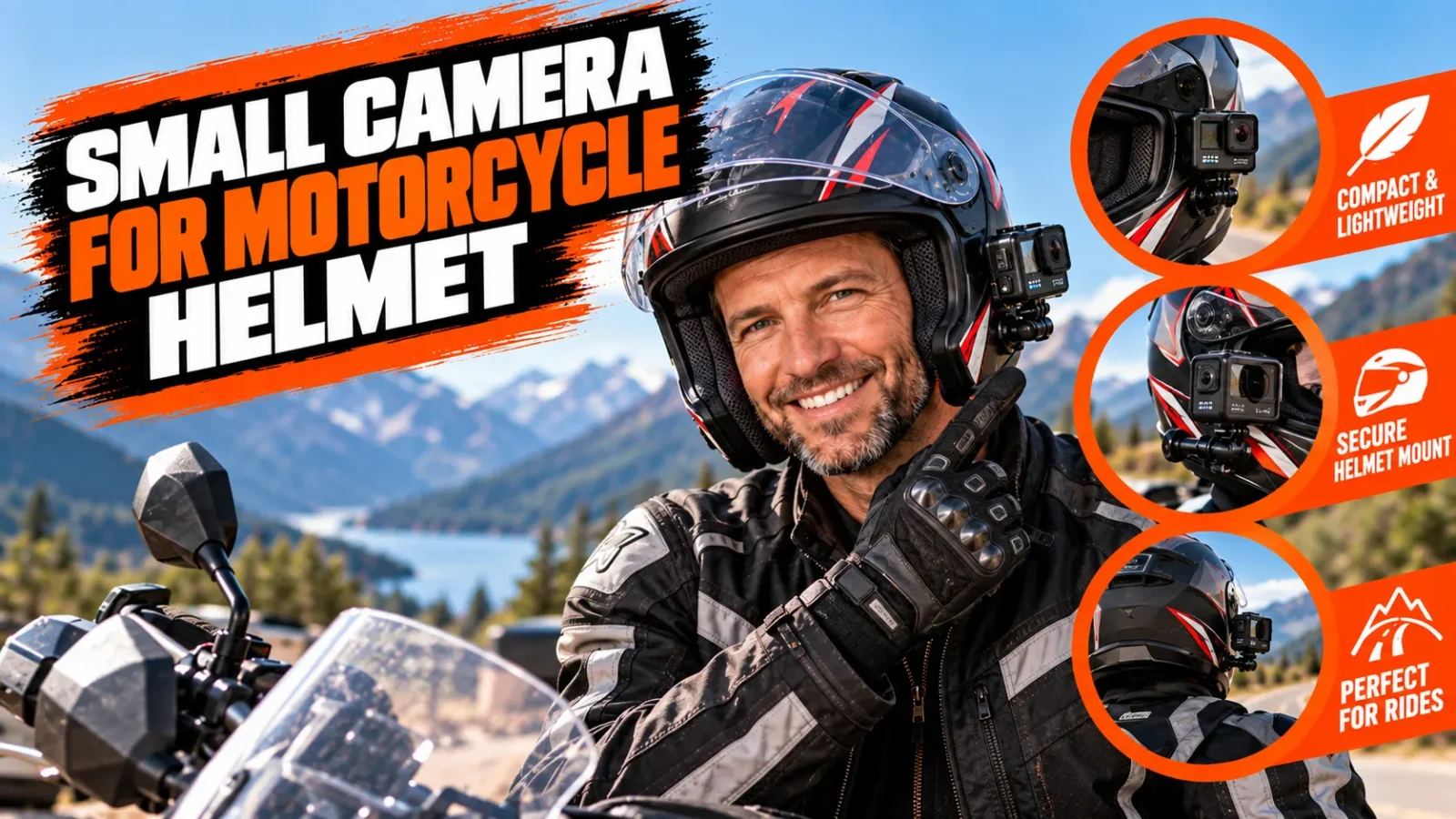
I’ve strapped more cameras to more helmets than I care to admit, and I’ve learned one lesson the hard way: bigger isn’t better when it’s bolted to your head at 70 mph. A bulky action camera creates wind drag, adds helmet fatigue on long rides, and honestly just looks clunky in your footage.
That’s why I’ve spent the last couple of years specifically hunting down the smallest, lightest cameras that still shoot footage I’m proud to post. Some are thumb-sized nubs you barely notice. Others are compact cubes that disappear into a low-profile mount. All of them earned a spot on this list because I’ve either ridden with them myself or watched fellow riders swear by them.
If you’re also curious about full-size options, I’ve got separate breakdowns on the best GoPro camera for motorcycle helmet use and the best action camera for motorcycle helmets overall. But today, we’re going small.
- My top pick overall is the Insta360 GO 3S — it’s thumb-sized, shoots 4K, and barely registers on your helmet.
- For the best image quality in a compact body, the DJI Osmo Action 5 Pro and DJI Osmo Pocket 3 punch way above their weight class.
- Budget riders should look at the SJCAM C100+ or Akaso Brave 7 LE — both deliver solid footage for a fraction of flagship prices.
- Weight, wind resistance, and mount placement matter just as much as resolution when picking a helmet camera.
- Whatever camera you choose, pair it with a proper low-profile mount to keep it safe and stable — I link my favorite setups throughout this guide.
Why Camera Size Actually Matters on a Helmet
Before I get into the list, I want to explain why I’m so obsessed with size here. A helmet isn’t just a camera stand — it’s the thing protecting your skull.
Every extra ounce mounted up top changes how your helmet moves in a crash or even just in strong crosswinds. I’ve felt the difference between a 30-gram camera and a 140-gram rig on a windy highway stretch, and it’s not subtle.
Smaller cameras also mean less wind noise bleeding into your audio, less visual bulk in your footage, and honestly, less chance of snagging the thing on a branch during an off-road detour. With that in mind, let’s get into my actual picks.
1. Insta360 GO 3S — Best Overall Tiny Camera
The Insta360 GO 3S is, without exaggeration, one of the smallest cameras I’ve ever mounted on a helmet — and I mean that as the highest compliment. It weighs around 35.5 grams and is roughly the size of my thumb, yet it shoots 4K video at 30fps with genuinely impressive stabilization.
What sold me on the GO 3S is the magnetic pendant mount system. I clip it to a tiny adhesive base on my helmet shell, and from a few feet away, nobody even notices there’s a camera there. It’s a stealthy setup that still captures wide, smooth footage of twisty backroads.
The GO 3S also comes with an Action Pod accessory that acts as a viewfinder, extra battery, and speaker all in one — handy for reviewing clips at a gas stop. Pricing typically runs between $300 to $460 depending on the storage bundle you choose, but I think the 128GB version hits the sweet spot for most riders.
Why I recommend it for helmet mounting specifically
Because it’s so light, I’ve never worried about it affecting helmet balance, even on long multi-hour rides. If you want the absolute lowest-profile setup, this is my top pick.
2. DJI Osmo Action 5 Pro — Best Small Camera With a Big Sensor
DJI’s Osmo Action 5 Pro proves you don’t need a massive body to get excellent low-light performance. It uses a 1/1.3-inch sensor, which is huge for a camera this compact, and it genuinely shows in dusk and dawn rides — my favorite times to shoot, honestly.
At about 154 grams with the housing, it’s not the lightest camera on this list, but it’s noticeably smaller and slimmer than most flagship action cameras. The dual color touchscreens make it easy to check framing before I clip my chin strap and head out.
Battery life is another reason I keep reaching for it — DJI claims up to 4 hours of continuous 4K recording, and in my own testing on multi-hour highway stretches, it’s held up impressively well even in cold weather. Expect to pay somewhere around $350 to $400 for the standard kit.
Standout features for riders
The built-in horizon leveling and HDR video mode make bumpy backroad footage look far smoother than it actually felt in the saddle. I also love that it’s waterproof to 20 meters without needing a separate housing.
3. SJCAM C100+ — Best Budget Cube Camera
If you’re not ready to spend flagship money, the SJCAM C100+ has become a bit of a cult favorite in the motorcycle and cycling communities, and I completely understand why. It’s a tiny cube, roughly the size of a matchbox, weighing in around 62 grams.
It shoots 4K at 30fps and 2.7K at 60fps, which honestly holds up better than I expected for a camera that typically retails between $60 and $90. The built-in magnetic mount base is a nice touch — it snaps on and off without fumbling with screws mid-ride.
I’ve used the C100+ on a helmet chin mount for a more immersive road-level view, and the wide field of view captured plenty of context without excessive fisheye distortion. It’s not going to out-resolve a GoPro, but for the price, I think it’s one of the smartest budget buys out there.
A great starter camera
If you’re new to helmet cams and just want to try the hobby before committing serious cash, the SJCAM C100+ is where I’d point a friend first.
4. Mobius Maxi 4K — Best Ultra-Compact Classic Pick
The Mobius Maxi 4K is the modern successor to a camera that’s been a staple in the moto-vlogging world for over a decade. I still see longtime riders swear by the original Mobius Action Cam design, and the Maxi 4K keeps that same tiny cylindrical shape while bumping up resolution.
It measures barely over 2 inches long and weighs around 60 grams, making it one of the more discreet options if you want a fixed, screw-mount style camera rather than a magnetic clip system. It records true 4K at 30fps with a wide-angle lens that’s well suited to road footage.
Priced typically in the $80 to $110 range, it’s another budget-friendly entry, though I’ll be honest — the app and firmware experience feels a little more old-school compared to Insta360 or DJI. Still, for pure stealth and reliability, it’s earned its reputation.
5. Akaso Brave 7 LE — Best Budget Full-Size Alternative
Not every rider wants the smallest possible camera — sometimes you want small-ish with a screen and easy controls, and that’s where the Akaso Brave 7 LE comes in. It’s compact compared to bulkier action cams but still has a flip-up selfie screen, which I find genuinely useful for framing shots before I take off.
It shoots 4K at 30fps, has electronic image stabilization, and is waterproof up to 33 feet without a housing. At around $100 to $130, it’s an accessible entry point if you’re testing the waters of helmet filming without breaking the bank.
I’ve found the battery life solid for shorter rides — around 90 minutes of continuous 4K recording — though I always carry a spare battery for all-day trips. The dual battery kit it usually ships with makes this less of an issue than with some competitors.
Good for beginners who want more control
The touchscreen and physical buttons make the Brave 7 LE more beginner-friendly than some of the tinier cube-style cameras, which often require an app for every adjustment.
6. GoPro HERO13 Black — Best for Riders Already in the GoPro Ecosystem
I’d be doing you a disservice if I left GoPro off this list entirely, even though the HERO13 Black isn’t the tiniest camera here. It’s genuinely one of the more compact flagship action cameras GoPro has released, and if you already own GoPro mounts, batteries, or accessories, the ecosystem compatibility alone is worth considering.
It shoots 5.3K video, has HyperSmooth 6.0 stabilization that’s honestly best-in-class for handling engine vibration, and supports interchangeable lens mods for wider or more macro shots. Pricing sits around $400, which is steep, but the image quality justifies it for serious content creators.
Weighing around 154 grams, it’s heavier than the true “tiny” cameras on this list, but its slim rectangular profile still sits lower and less bulky than older GoPro generations. If you’re deciding between GoPro models specifically, I’ve gone much deeper into that comparison in my best GoPro camera for motorcycle helmet guide.
Mounting considerations
Because of its slightly larger footprint, I’d strongly recommend pairing it with a proper low-profile curved mount rather than a bulky arm. My best GoPro mounts for motorcycle helmets guide walks through exactly which mounts keep things streamlined.
7. Insta360 Ace Pro 2 — Best Small Camera for Low-Light Rides
The Insta360 Ace Pro 2, co-engineered with Leica, is another camera that proves compact doesn’t mean compromised. It uses a large 1/1.3-inch sensor and has genuinely impressive low-light performance, which matters a lot if you commute at dawn or dusk like I often do.
It’s a bit bigger than the GO 3S — closer in size to a traditional action camera — but still noticeably slimmer and lighter than older flagship models, weighing around 179 grams with its case. The flip-up touchscreen is a nice bonus for quick framing checks.
At roughly $350 to $450, it’s a premium purchase, but the dual-native ISO sensor genuinely reduces noise in shadowy tunnel rides and night highway footage better than most cameras in this price range. If low-light clarity is your priority, I think this earns the extra cost.
8. DJI Osmo Pocket 3 — Best Small Gimbal Camera for Helmet Mounting
This one might surprise you, but I’ve had great results mounting the DJI Osmo Pocket 3 to my helmet using a gimbal-to-helmet mount adapter. It’s technically a handheld gimbal camera, but its built-in 1-inch sensor delivers noticeably crisper, more cinematic footage than most dedicated action cams.
The mechanical gimbal stabilization is a game-changer for smoothing out engine vibration — footage from bumpy roads comes out buttery smooth in a way electronic stabilization alone can’t fully replicate. It weighs about 179 grams, so it’s not the lightest, but the image quality trade-off feels worth it to me for showcase-worthy scenic rides.
Pricing starts around $520 for the base kit, making it the priciest camera on this list. It’s a niche pick, but if you’re chasing genuinely cinematic motovlogging footage rather than quick everyday clips, I think it deserves consideration.
A quick caveat
Because it wasn’t designed specifically for helmet mounting, you’ll need a compatible adapter and should test the mount thoroughly at low speeds before committing to a full ride. Safety first, always.
How I Actually Chose These Cameras
I didn’t just pick cameras because they’re small — plenty of tiny cameras shoot terrible footage. My criteria balanced weight, video quality, battery life, mounting compatibility, and real-world durability against wind, rain, and vibration.
Weight and aerodynamics
Anything under 100 grams barely registers on a ride, in my experience. Once you creep past 150 grams, you start noticing subtle helmet drag, especially at highway speeds or in gusty conditions.
Sensor size versus body size
This was the biggest surprise for me while researching this list. Cameras like the Osmo Action 5 Pro and Ace Pro 2 pack large sensors into surprisingly compact bodies, which wasn’t really possible a few years ago.
Mounting stability
A tiny camera is useless if it’s rattling around on a shaky mount. I always pair my picks with a dedicated low-profile setup — my best GoPro adhesive mount setup for motorcycle helmet guide covers exactly how I keep cameras rock-steady without damaging helmet shells.
My Final Take
If I had to grab just one camera off this list for my own helmet tomorrow, it’d be the Insta360 GO 3S. It disappears visually, shoots genuinely great footage, and I never think twice about its weight on long rides.
But if you want richer color science and better low-light handling, the DJI Osmo Action 5 Pro or Insta360 Ace Pro 2 are worth the extra bulk and cost. And if you’re just starting out, the SJCAM C100+ is a nearly risk-free way to try helmet filming without a big investment.
Whichever one you choose, remember that the mount matters just as much as the camera. Check out my dedicated guides on helmet mounts and action cameras before your next ride, and stay safe out there.
Frequently Asked Questions
Is it safe to mount any small camera on a motorcycle helmet?
Not exactly. I always recommend low-profile mounts and cameras under roughly 100 grams, since heavier setups can act as a lever in a crash and stress the helmet shell. Check out my guide on the best GoPro mounts for motorcycle helmets for safer mounting options.
Do small helmet cameras sacrifice video quality compared to bigger action cameras?
Not as much as they used to. Cameras like the Insta360 GO 3S and DJI Osmo Pocket 3 pack surprisingly large sensors into tiny bodies, though I still find full-size cams like the GoPro HERO13 Black edge them out in low light.
What’s the best way to attach a small camera to my helmet without adhesive damage?
I’ve had great luck with curved adhesive mounts designed specifically for helmets. My full breakdown is in this best GoPro adhesive mount setup guide.
Are chin mount or top mount positions better for small cameras?
I personally prefer top or side mounts for tiny cameras since they reduce wind noise and keep weight centered, but chin mounts can give a more immersive road view if the camera is light enough.

Related Articles

6 Best Rear View Cameras for Motorcycle: Riders Who Want Eyes in the Back of Their Head
I've tested the top rear view cameras for motorcycles so you don't have to. Here are my real-world picks for…
Jake Miller
12 min read

8 Best Cameras for Riding Motorcycle in 2026 (Rider-Tested Picks)
I've mounted, crashed, and rain-soaked dozens of cameras on my helmet and bike. Here are the 8 best cameras for…
Jake Miller
9 min read

9 Best Cameras for Motorcycle Travel: My Tested Picks for Long-Haul Rides
I've tested action cams, 360 cameras, and mirrorless bodies on thousands of touring miles. Here are the 9 best cameras…
Jake Miller
12 min read