
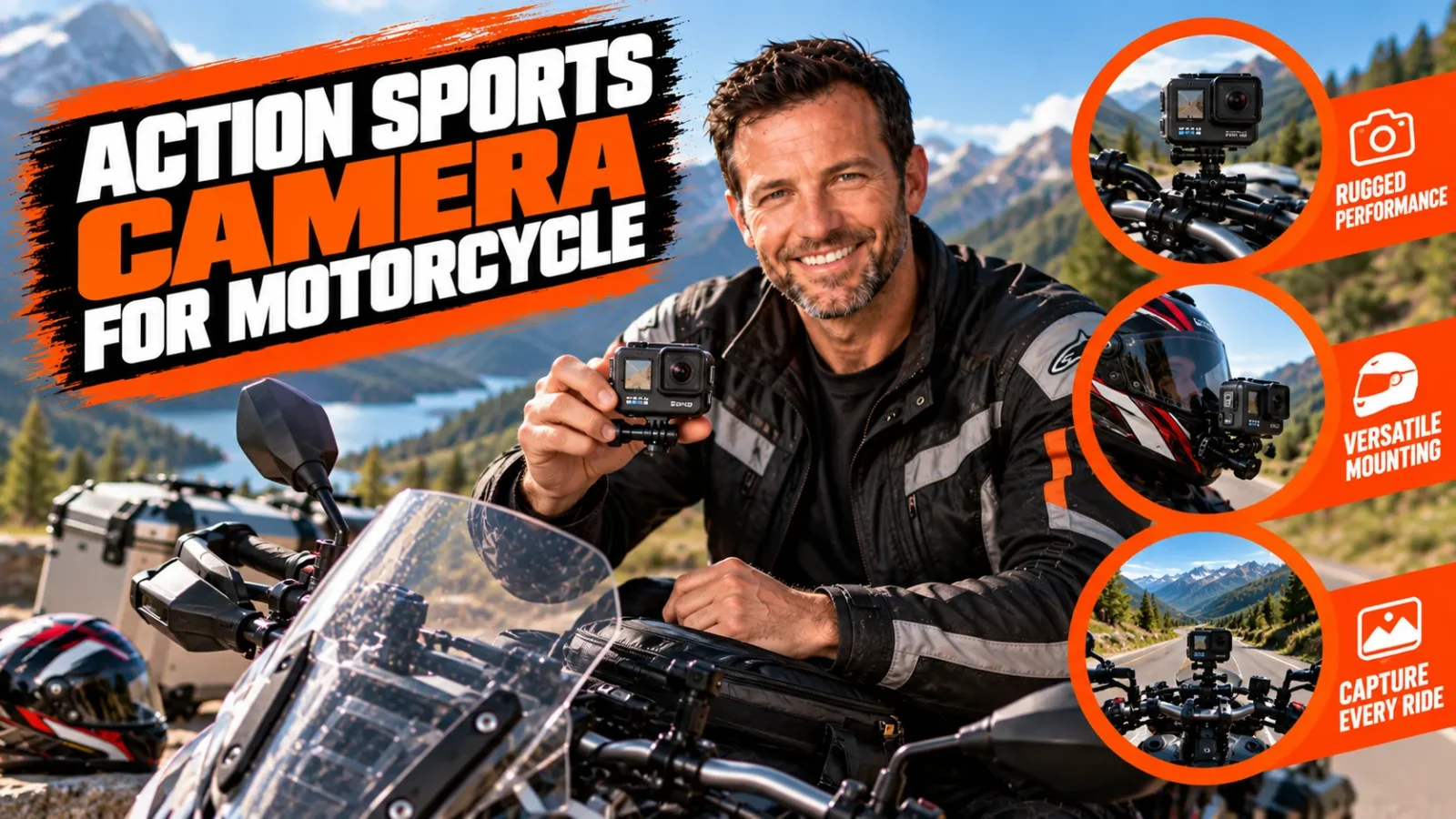
I’ve strapped a lot of cameras to a lot of helmets over the years, and I can tell you this: motorcycles are brutal on gear. Between vibration, wind noise, weather, and the occasional low-speed tip-over in a parking lot, your camera needs to be tougher than the average vlogger’s setup.
After testing gear across canyon carves, track days, and long highway hauls, I’ve narrowed down my picks for the best action sports camera for motorcycle riding. These aren’t theoretical recommendations — I’ve either owned, borrowed, or put serious saddle time behind each one of these.
- The GoPro Hero13 Black is my top overall pick thanks to unmatched stabilization and the best mounting ecosystem for riders.
- If you want to fix a crooked helmet mount after the fact, the Insta360 X4‘s 360-degree reframing is a game changer.
- Budget riders should look at the DJI Action 4 or Akaso Brave 8 — both deliver surprisingly good footage for the money.
- Stabilization matters more than resolution on a bike — vibration and wind buffeting will ruin footage faster than a lower megapixel count ever will.
- Your mount matters as much as your camera — a shaky mount ruins even the best sensor’s footage.
Why Your Camera Choice Actually Matters on Two Wheels
Action cameras get marketed toward surfers and skiers, but motorcycling is its own beast. You’re dealing with constant engine vibration, wind noise loud enough to drown out dialogue, and temperature swings that can fog a lens or drain a battery in minutes.
I’ve had cameras that looked amazing in a backyard test shoot completely fall apart at 70 mph on the highway — jittery footage, muffled audio, overheating warnings after twenty minutes. That’s why stabilization, heat management, and wind noise reduction matter more to riders than they do to the average action camera buyer.
Before you even pick a camera, it’s worth thinking about where you’ll mount it. I’ve written a full breakdown of the best action camera for motorcycle helmets if you want to go deeper on placement strategy once you’ve settled on a camera body.
1. GoPro Hero13 Black — Best Overall Action Camera for Motorcycle Riding
The GoPro Hero13 Black is my go-to recommendation when someone asks me for a single camera that does everything well. It shoots 5.3K at up to 60fps, and its HyperSmooth 6.0 stabilization is genuinely the best I’ve tested for smoothing out engine vibration and road chatter.
What really sold me is the new magnetic quick-release mounting system. It clicks onto compatible mounts instantly, which means less fumbling with cold fingers before a ride. Battery life sits around 70-80 minutes of continuous 5.3K recording, which is solid but not incredible for long touring days.
Price runs about $399 for the body, though bundles with extra batteries and mounts push it closer to $450. If you’re researching which GoPro specifically suits helmet use, I go into more detail in my guide to the best gopro camera for motorcycle helmet setups.
What I Liked
The horizon leveling feature is fantastic for canyon riding where you’re constantly leaning the bike. Footage stays level even when you’re deep into a corner, which makes a huge difference in watchability.
What Bugs Me
It runs hot in direct sun during summer rides, occasionally throwing an overheat warning during long highway stretches. A cooling accessory or a well-ventilated mount helps mitigate this.
2. DJI Osmo Action 5 Pro — Best for Low-Light and Night Riding
If you ride at dawn, dusk, or into the night, the DJI Osmo Action 5 Pro deserves serious consideration. Its 1/1.3-inch sensor is noticeably larger than most competitors, and it shows in low-light footage that stays clean instead of turning into a grainy mess.
It records 4K at up to 120fps and includes dual native ISO technology, which is the real secret behind its low-light chops. DJI’s RockSteady 3.0 stabilization is nearly on par with GoPro’s HyperSmooth, and in some low-contrast conditions I actually found it slightly better at avoiding jello effect.
Battery life is the standout here — DJI rates it around 240 minutes in some modes, though realistic 4K60 recording gets you closer to 100-110 minutes. At roughly $349, it’s a genuinely competitive price against GoPro’s flagship.
Why It Works for Riders
The dual screens (front and rear) make framing easier when you’re mounting it on a helmet chin bar and can’t easily check your shot mid-ride. I found this small feature saves a lot of guesswork before setting off.
3. Insta360 X4 — Best 360-Degree Camera for Fixing Mount Mistakes
The Insta360 X4 shoots in full 360 degrees at up to 8K resolution, which sounds like overkill until you realize what it actually solves: a crooked or slightly-off helmet mount no longer ruins your footage.
Because it captures everything around the camera, you can reframe the “correct” angle after the ride in the Insta360 app. I’ve saved multiple rides this way after realizing my mount had shifted slightly during a fuel stop.
It’s water-resistant to 33 feet without a housing, has swappable lenses for when they inevitably get scratched by bugs and road debris, and runs about $499 for the standard bundle. Battery life is roughly 135 minutes at 8K30, which is respectable for the file sizes it’s generating.
The Learning Curve
I’ll be honest — the reframing workflow takes some getting used to, and exporting big 360 files eats storage fast. It’s worth it for the flexibility, but budget extra time for editing compared to a standard action camera.
4. Insta360 Ace Pro 2 — Best Image Quality with a Leica-Tuned Sensor
The Insta360 Ace Pro 2 is co-engineered with Leica, and the color science shows immediately. Footage has richer, more natural tones straight out of camera compared to most competitors, which matters if you post ride videos without much color grading.
It features a 1/1.3-inch sensor, 4K120fps recording, and Insta360’s “AI Highlight Assist” which helps balance tricky exposure situations like riding directly into a sunset. I found the flip screen genuinely useful for framing chest mount shots.
At around $349-$399 depending on the bundle, it undercuts GoPro’s flagship while matching or beating it in still-image and color quality. Battery life is about 100-120 minutes depending on resolution settings.
Standout Feature
The dual-battery fast charging case is genuinely clever — it charges spare batteries even while you’re not near an outlet, which is great for multi-day touring trips where charging stops are unpredictable.
5. GoPro Hero12 Black — Best Value Flagship Camera
If the Hero13’s price feels steep, the GoPro Hero12 Black is still an excellent option and typically sells for $50-$100 less now that it’s a generation behind. I still use mine regularly and it holds up well against most current competitors.
It shoots 5.3K30 and 4K60, has HyperSmooth 6.0 (yes, the same stabilization tech as the newer model), and uses the same mount system as older GoPros, which matters if you already own compatible accessories. Battery life runs about 70 minutes at 5.3K.
One thing I appreciate: it added native Bluetooth audio support, so pairing it with a helmet intercom like a Sena or Cardo for cleaner audio is straightforward. Price typically sits around $299-$329.
Who Should Buy This Instead
If you already own GoPro mounts from a previous camera, sticking with the Hero12 saves you from buying an entirely new mounting kit. It’s the pragmatic choice for riders upgrading from something older.
6. Insta360 GO 3S — Best Ultra-Compact Camera for Minimalist Mounting
The Insta360 GO 3S is tiny — about the size of a large thumb — and that’s exactly why I recommend it for riders who don’t want a bulky camera on their helmet. It clips onto a magnetic pendant mount or tucks into the included Action Pod for extra battery life.
It shoots 4K30 or 2.7K60, and while it won’t match the Hero13 in raw quality, the discreet size makes it ideal for chest mounts or even clipping onto a jacket collar without adding visible bulk. Price runs about $399 for the 64GB version.
Standalone battery life is short (around 45 minutes), but the Action Pod extends total shooting time significantly by acting as both a charger and a grip. It’s a clever two-piece system I haven’t seen replicated elsewhere.
Best Use Case
I like this one for casual rides where I don’t want to look like I’m filming a documentary. It’s genuinely unobtrusive in a way that bigger action cameras just aren’t.
7. DJI Action 4 — Best Budget-Friendly Pick That Doesn’t Feel Cheap
The DJI Action 4 sits a tier below the Osmo Action 5 Pro but still punches well above its roughly $259 price point. It uses a 1/1.3-inch sensor (same size as the pricier Osmo 5 Pro), which gives it surprisingly strong low-light performance for the price.
It records 4K at up to 120fps, has excellent RockSteady 2.0 stabilization, and is rated to operate in temperatures as low as -4°F, which matters if you ride in cold climates or through mountain passes. Battery life is around 100-130 minutes.
Magnetic quick-swap mounting makes attaching and detaching it from a helmet mount fast, which I appreciate when I’m juggling gloves and a cold morning start.
Where It Falls Short
The app and ecosystem feel slightly less polished than GoPro’s, and third-party mount availability isn’t as extensive. Still, for the price, I have no real complaints about image quality.
8. Akaso Brave 8 — Best Budget Option Under $150
Not everyone wants to spend $300+ on a camera they’re going to bolt onto a motorcycle helmet. The Akaso Brave 8 is my pick for riders who want something functional without a flagship price tag, usually selling for around $130-$150.
It records 4K30 and includes electronic image stabilization that, while not in the same league as GoPro or DJI, does a respectable job smoothing out footage on smoother roads. It’s waterproof to 33 feet without a case and includes a removable lens that helps with glare during sunny rides.
Battery life is roughly 90 minutes, and it comes with two batteries in the box, which is a nice touch at this price point. I wouldn’t take this one to a track day, but for casual weekend rides, it delivers solid value.
Managing Expectations
Stabilization noticeably struggles on rougher roads compared to the pricier options on this list. If you ride mostly highway and smooth backroads, though, you likely won’t notice much of a gap.
Getting the Mount Right Matters Just as Much as the Camera
I can’t stress this enough: even the best sensor in the world produces garbage footage if it’s mounted poorly. Vibration transfers through a loose mount and turns smooth stabilization tech into jittery, unusable clips.
For helmet mounting specifically, I’d point you toward my breakdown of the best go pro mounts for motorcycle helmets, which covers chin mounts, side mounts, and top mounts and how each affects footage and wind noise differently.
If you’re going the adhesive route rather than a strap mount, surface prep and mount placement genuinely make or break the setup. I put together a full guide on the best go pro adhesive mount setup for motorcycle helmet use that walks through exactly how I’ve done it without ever losing a camera on the highway.
A Few Mounting Lessons I’ve Learned the Hard Way
Chin mounts give the most stable, least head-bobbing footage, but they pick up more engine and wind noise since they sit closer to the front of the helmet. Top mounts look more “cinematic” but amplify head movement significantly.
Always use a tether or safety cord regardless of camera brand. I’ve seen a $400 camera pop off during a pothole hit — thankfully mine was tethered and just dangled instead of disappearing into traffic.
How I’d Actually Choose Between These
If you want one camera that does it all reasonably well with the best resale value and accessory ecosystem, go with the GoPro Hero13 Black. It’s the safe, proven choice, and it’s what I recommend most often to riders who ask me directly.
If you ride mostly at dawn, dusk, or through tunnels and shaded canyon roads, the low-light advantage of the DJI Osmo Action 5 Pro is worth the switch from GoPro’s ecosystem. That larger sensor genuinely changes what’s usable footage versus what isn’t.
For riders who hate committing to a single angle before the ride even starts, the Insta360 X4‘s reframing flexibility is worth the learning curve. And if budget is the main constraint, both the DJI Action 4 and Akaso Brave 8 prove you don’t need to spend $400 to bring home watchable footage.
Final Thoughts From the Saddle
I’ve learned that the “best” camera really depends on how and where you ride. A track day rider prioritizes stabilization and frame rate for slow-motion replays, while a long-distance tourer cares more about battery life and weatherproofing.
Whichever camera you pick from this list, spend the extra ten minutes getting your mount dialed in correctly before you hit the road. It’s the single biggest factor separating great riding footage from footage you’ll never actually watch again.
Frequently Asked Questions
What is the best action sports camera for motorcycle riding overall?
In my experience, the GoPro Hero13 Black is the best all-around choice thanks to its excellent HyperSmooth stabilization, rugged build, and huge mounting ecosystem that works great with helmet and chin mounts.
Do I need a 360-degree camera for motorcycle rides?
Not necessarily, but a 360 camera like the Insta360 X4 lets you reframe your shot after the ride, which is a lifesaver if your helmet mount shifts slightly during a long day in the saddle.
Is it better to mount the camera on my helmet or my bike?
Both have advantages. Helmet mounts capture where you’re looking, which feels more immersive, while chest or bike mounts reduce wobble. Check out my guide to the best action camera for motorcycle helmets for mount-specific advice.
How much should I expect to spend on a good motorcycle action camera?
You can get a genuinely capable camera for $150 to $200, like the Akaso Brave 8 or DJI Action 4, but flagship models with the best stabilization and image quality run $300 to $450.

Related Articles

6 Best Rear View Cameras for Motorcycle: Riders Who Want Eyes in the Back of Their Head
I've tested the top rear view cameras for motorcycles so you don't have to. Here are my real-world picks for…
 Jake Miller
12 min read
Jake Miller
12 min read

8 Best Cameras for Riding Motorcycle in 2026 (Rider-Tested Picks)
I've mounted, crashed, and rain-soaked dozens of cameras on my helmet and bike. Here are the 8 best cameras for…
Jake Miller
9 min read

9 Best Cameras for Motorcycle Travel: My Tested Picks for Long-Haul Rides
I've tested action cams, 360 cameras, and mirrorless bodies on thousands of touring miles. Here are the 9 best cameras…
Jake Miller
12 min read