
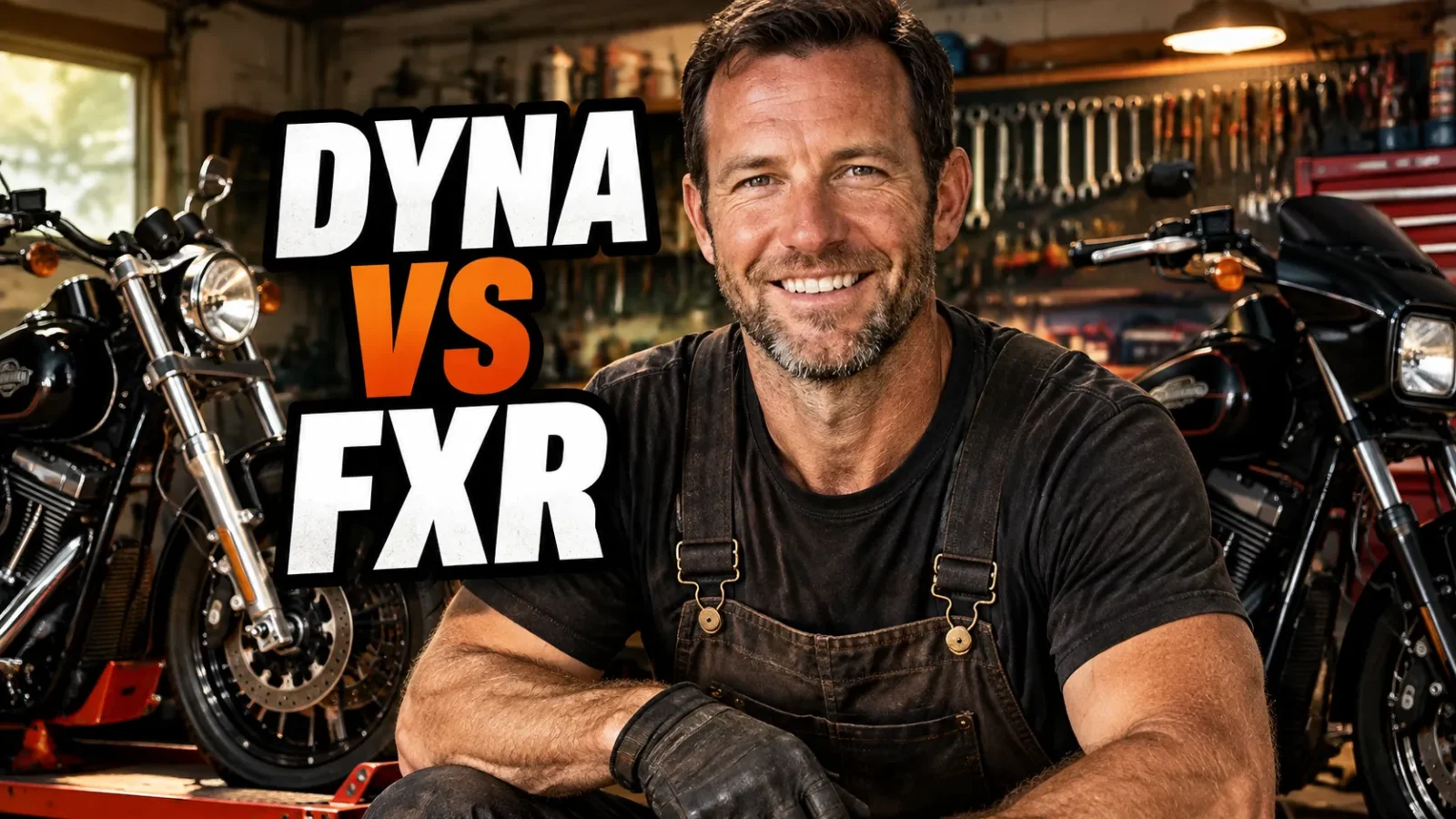
I’ve spent the last fifteen years throwing a leg over every Harley platform I could get my hands on, and no argument gets riders more fired up than dyna vs fxr. Ask ten bikers which one is better and you’ll get ten different answers, usually shouted over a beer.
I’ve owned a 2003 FXDX Super Glide Sport and a 1992 FXR. I’ve ridden both across state lines, through mountain passes, and down boring interstates. So let me give you the honest, unpolished truth about how these two machines actually compare.
- The FXR handles better thanks to its frame-mounted engine and triangulated swingarm — it’s the sharper bike in corners.
- The Dyna is more comfortable, easier to live with daily, and has a much bigger aftermarket for touring and customization.
- FXR values have climbed hard; Dynas are still the better value for most riders on a budget.
- If you want a canyon carver, buy the FXR. If you want a versatile cruiser you can tour on, buy the Dyna.
Why This Debate Never Dies
Both bikes came out of Milwaukee in the same era of Harley’s evolution, and both earned loyal followings for very different reasons. The FXR was the engineer’s bike. The Dyna was the people’s bike.
I remember the first time I rode a well-sorted FXR. I expected hype. What I got was a motorcycle that felt like it was carved from a single block of steel. That feeling never left me.
The Dyna, by contrast, felt familiar and forgiving. It didn’t demand anything from me. That’s exactly why so many riders love it.
The Frame Is Everything
Here’s the core difference, and everything else flows from it. The FXR uses a frame-mounted engine with a triangulated swingarm that pivots directly off the transmission case. The Dyna uses a rubber-mounted engine in a more conventional cradle frame.
That single design choice changes how each bike feels at speed.
FXR Rigidity in the Real World
On my FXR, I could trail-brake into a tight corner and the chassis stayed composed. The engine didn’t wiggle. The rear end tracked exactly where I pointed it.
I’ve chased friends on modern sport-tourers through the Blue Ridge Mountains on that bike, and I never felt out of my depth. That’s not something I can say about most cruisers from the early ’90s.
Dyna Flex and Why It’s Not Always Bad
My FXDX flexed. I could feel it in fast sweepers, especially with worn rubber mounts. But that flex also soaked up road imperfections in a way the FXR never did.
For 90% of the riding most people actually do, the Dyna’s compliance is a feature, not a bug. I’ll die on that hill.
Engine and Drivetrain: Same Heart, Different Soul
Both platforms ran the Evolution engine in their classic forms, and later the Twin Cam in Dyna guise. The Evo is bulletproof. I’ve put over 80,000 miles on Evo-powered bikes without a single top-end rebuild.
The difference is in how the power reaches the ground.
FXR Power Delivery
Because the FXR’s drivetrain is rigidly mounted, throttle response feels more direct. Crack the throttle and the bike lunges immediately. It’s visceral in a way that surprised me the first time.
Dyna Smoothness
The Dyna’s rubber mounts isolate vibration beautifully. At 75 mph on the interstate, my hands were never numb. On the FXR, after four hours, I wanted a break.
If you’re planning long days in the saddle, this matters more than any spec sheet will tell you.
Comfort and Ergonomics
I’m 5’10” with a 32-inch inseam, so take this with a grain of salt if you’re built differently. But here’s my experience.
The Dyna felt roomier from the factory. The seat was plusher, the bars were closer to neutral, and the foot controls sat in a natural spot. I could ride it all day without thinking about my posture.
The FXR felt more compact and more purposeful. The stock seat on my ’92 was basically a plank. I swapped it within a month.
Which One Tours Better?
Out of the box, the Dyna. It has a longer wheelbase, more fuel capacity on most trims, and vastly more aftermarket support for bags, windshields, and highway pegs.
The FXR can tour, and plenty of riders have crossed the country on them. But you’ll be building that capability yourself, part by part.
Aftermarket and Parts Availability
This is where the Dyna absolutely crushes the FXR, and I say that as an FXR guy.
Dyna parts are everywhere. Every independent shop stocks them. Every catalog has a Dyna section. If you break something on a Tuesday, you’re riding again by Thursday.
FXR parts take more digging. Some OEM pieces are genuinely hard to find. The aftermarket has stepped up, but you’ll pay a premium and wait longer for shipping.
The Cost of FXR Cool
FXR prices have gone through the roof. Clean examples that sold for $6,000 a decade ago now command $15,000 or more. The bike became a collector’s item, and that changed everything.
Dynas, meanwhile, are still the bargain of the Harley world. You can find a solid, low-mileage Dyna for a fraction of what an equivalent FXR costs.
Handling: My Honest Verdict
If pure cornering ability is your priority, the FXR wins. It’s not close. The chassis is stiffer, the geometry is sharper, and the bike communicates what the tires are doing with remarkable clarity.
But “handling” isn’t just about lap times. It’s about confidence, predictability, and how the bike behaves when you’re tired or the road is bad.
By that broader definition, the Dyna holds its own. It’s more forgiving. It’s less likely to bite you when you make a mistake.
Which One Should You Buy?
I get asked this constantly, and my answer depends entirely on what you want.
Buy the FXR If…
You want the best-handling Harley ever built. You appreciate engineering purity. You’re willing to pay a premium and hunt for parts. You ride twisty roads more than straight ones.
Buy the Dyna If…
You want a versatile, affordable, endlessly customizable cruiser. You plan to tour. You want parts availability that doesn’t require a scavenger hunt. You want a bike you can ride hard without worrying about resale value.
What About Modern Alternatives?
Here’s the thing nobody wants to hear. If you’re shopping in 2025, neither platform is made anymore. The Dyna was folded into the Softail line in 2018, and the FXR died in 2000.
That means you’re buying used, and you’re buying a bike with history. Inspect the frame. Check the rubber mounts on a Dyna. Look for cracked welds on an FXR. Do your homework.
I’ve seen too many guys buy a “clean” FXR that turned out to have a repaired frame. Don’t be that guy.
My Personal Pick
After all these years, I still own an FXR. But I ride a Dyna more often.
That’s the honest truth of it. The FXR is the better motorcycle on paper and in the canyons. The Dyna is the better motorcycle for the life I actually live.
If I could only keep one, I’d keep the Dyna. It does more things well, and it never makes me feel like I’m fighting it. That’s worth more to me than a few extra degrees of lean angle.
But ask me again after a good ride through the mountains, and I might change my answer.
Frequently Overlooked Details
A few things riders forget when comparing these two.
The FXR’s transmission is a five-speed in most years, while later Dynas got six-speeds. That matters for highway cruising.
The Dyna’s rubber mounts wear out and need replacing. Budget for that on any used purchase.
The FXR’s frame is more repairable in the event of damage, but finding a shop that knows how to do it right is harder than it should be.
Final Thoughts
The dyna vs fxr debate will never be settled, and honestly, that’s fine. Both bikes earned their place in Harley history for good reasons.
The FXR is the purist’s choice. The Dyna is the pragmatist’s choice. Neither is wrong.
Ride both if you can. Buy the one that makes you grin inside your helmet. That’s the only test that actually matters.
Frequently Asked Questions
Is an FXR better handling than a Dyna?
In my experience, yes. The FXR’s frame-mounted engine and triangulated swingarm make it noticeably more rigid in corners, especially at speed. The Dyna is stable, but it flexes more when you push hard.
Why did Harley-Davidson stop making the FXR?
The FXR was more expensive to produce and slower to sell than the Dyna, which shared parts with the Softail line. Harley killed it in 2000 to cut costs, not because it was a worse motorcycle.
Which is better for long-distance touring, a Dyna or an FXR?
The Dyna wins for touring straight out of the box thanks to its longer wheelbase, bigger tanks, and better aftermarket luggage support. The FXR can tour, but you’ll want to upgrade the seat and suspension first.
Are FXR parts hard to find?
Some OEM parts are getting scarce, but the aftermarket has stepped up big time. Companies like S&S Cycle and Baker Drivetrain still make FXR-specific components, so keeping one on the road is very doable.

Related Articles

CBR650R vs R7: Which Middleweight Sportbike Actually Won Me Over
I've ridden both the Honda CBR650R and Yamaha YZF-R7 back to back. Here's how they really compare on power, weight,…
 Jake Miller
9 min read
Jake Miller
9 min read

DRZ400E vs DRZ400S: I’ve Ridden Both, and Here’s the One I’d Actually Buy
DRZ400E vs DRZ400S: I break down carb, power, weight, street legality, and which of these two Suzuki dual sports I'd…
Jake Miller
9 min read

Ironhead vs Shovelhead: An Honest Wrench Turner’s Guide to Picking Your Vintage Harley
I've ridden and wrenched on both Ironhead Sportsters and Shovelhead Big Twins. Here's the honest difference in power, reliability, parts,…
Jake Miller
9 min read