
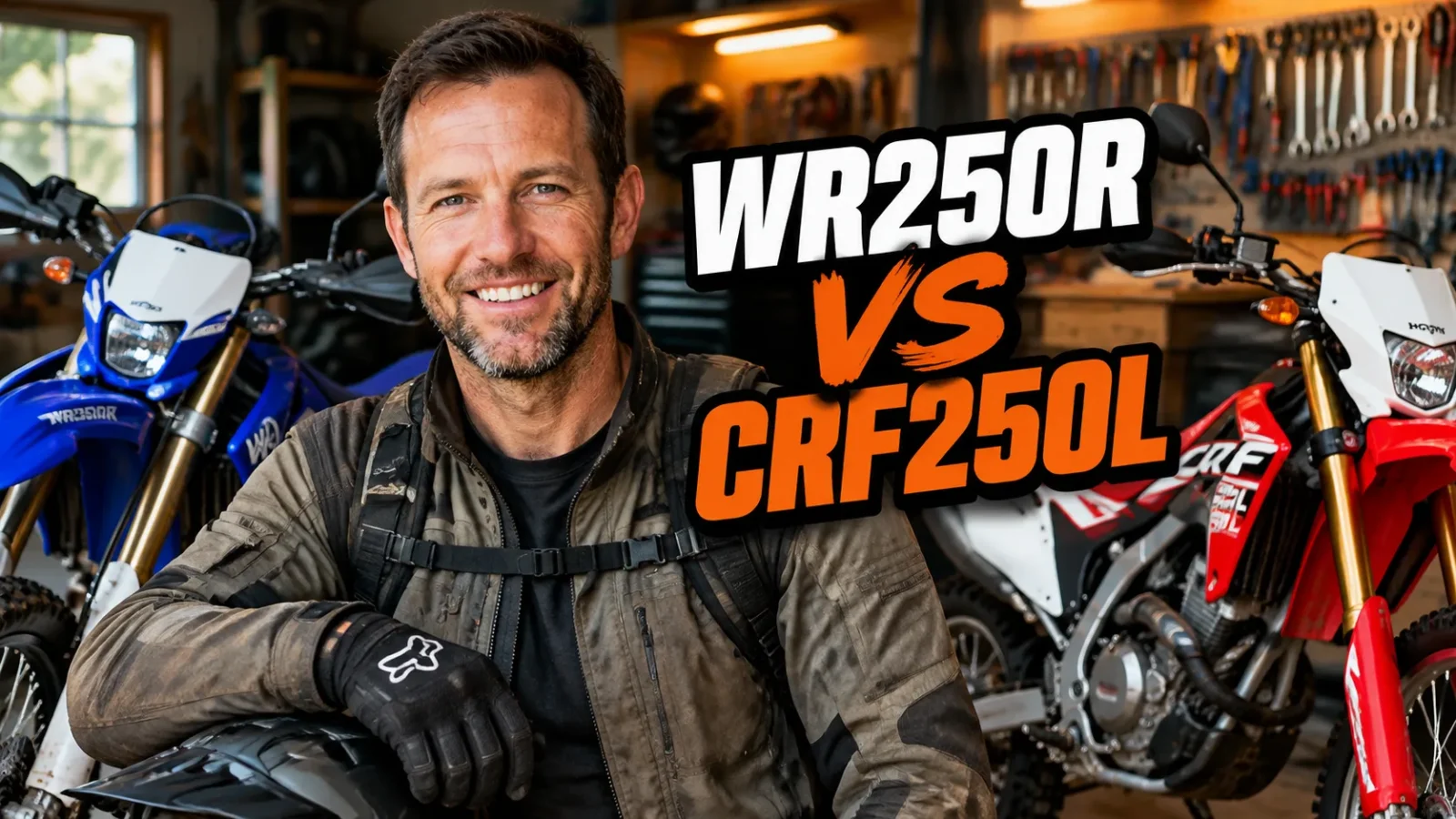
I still remember the day I handed over cash for my first WR250R. I’d spent three weekends chasing a buddy on his CRF250L through tight singletrack, and I was tired of watching his taillight disappear while I wrestled my heavier bike through the trees. What I didn’t expect was how much I’d miss certain things about the Honda once the Yamaha was sitting in my garage.
Since then I’ve put thousands of miles on both platforms, ridden them on highways, in sand, up rocky jeep trails, and through more commuter traffic than I care to admit. I’ve also bought and sold a few of each, which taught me things spec sheets never will.
So here’s my honest take on the WR250R vs CRF250L question. Neither one is “better” in a vacuum. They’re built for two different riders, and figuring out which one you are is the whole ballgame.
- The WR250R is the sharper off-road tool: more power, less weight, fully adjustable suspension, and a bulletproof engine with 26,000-mile valve intervals.
- The CRF250L is the friendlier all-rounder: lower seat, softer suspension, smoother fueling, and a much cheaper used price.
- Both are discontinued in the US (WR250R ended in 2020, CRF250L became the CRF300L in 2021), so you’re shopping the used market.
- If you ride mostly dirt and want to grow into the bike, buy the Yamaha. If you commute, ride trails casually, or have a shorter inseam, buy the Honda.
My Quick Verdict Before the Details
If you forced me to pick one bike with my own money and no idea what kind of riding I’d be doing, I’d take the WR250R. Every time. It’s the more capable machine, and it rewards you as your skills improve instead of holding you back.
But I’ve recommended the CRF250L to more friends than I can count, and I stand behind every one of those recommendations. It’s the bike that gets people into dual sport riding without scaring them, and that matters more than a dyno chart.
Engine and Power: Where the Yamaha Pulls Ahead
The WR250R runs a 250cc liquid-cooled DOHC four-valve engine with fuel injection and titanium valves. Yamaha built it to rev, and it does, pulling cleanly all the way to redline in a way that feels almost sportbike-ish for a dual sport.
At the crank you’re looking at roughly 30 horsepower, which works out to about 26 at the rear wheel on a dyno. That doesn’t sound like much until you remember the bike weighs around 295 pounds wet. The power-to-weight ratio is genuinely good.
The CRF250L makes closer to 24 horsepower at the crank. Honda updated the engine for 2017 with a bigger airbox, a larger throttle body, and revised cams to fatten up the midrange, and you can feel it. It’s torquey and predictable down low.
What it isn’t is exciting at the top end. My CRF250L always felt like it ran out of breath right when the WR250R was just getting started. On a fire road climb, that difference is obvious.
Transmission and Gearing
Both bikes use a six-speed gearbox, which is a huge deal for anyone planning to ride on the highway. Earlier dual sports with five speeds were miserable at 65 mph, and neither of these has that problem.
The WR250R’s gearing feels taller and more versatile to me. I can lug it in first on technical climbs and still cruise comfortably in sixth. The Honda’s ratios are a touch shorter, which helps in tight woods but makes freeway stints buzzier.
Chassis, Weight, and Suspension
This is where the two bikes separate most dramatically, and it’s the reason I eventually switched.
The WR250R uses an aluminum semi-double-cradle frame with a fully adjustable 46mm KYB fork and a fully adjustable shock. Travel is around 10.6 inches at both ends. You can dial in compression, rebound, and preload to suit your weight and terrain.
The CRF250L uses a steel frame and a 43mm Showa fork with essentially no damping adjustment. Travel is shorter, around 9.8 inches up front and 9.4 in the rear. The shock gets preload adjustment only.
On smooth trails, you’d never notice. On a rocky descent or a whooped-out sand road, the difference is night and day. I’ve bottomed the CRF250L’s fork hard enough to feel it through the bars, and no amount of fiddling fixes it without a revalve.
The Weight Difference Is Real
The WR250R tips the scales around 295 pounds wet. The CRF250L is closer to 320, and the Rally version adds another 25 pounds on top of that.
Twenty-five pounds doesn’t sound like much until you’re picking the bike up for the third time on a muddy hill. That’s when I stopped caring about the Honda’s lower seat height and started caring about mass.
Ergonomics and Seat Height
The WR250R’s seat sits at about 36.6 inches. The CRF250L’s is around 34.4, and the softer suspension sags more when you sit on it, so the real-world difference feels even bigger.
For me at 5’11”, the Yamaha was fine. For my 5’6″ riding buddy, it was a constant source of stress at stoplights on uneven ground. He bought the Honda and never looked back.
Both bikes have narrow chassis that let your legs reach the ground more easily than the numbers suggest. But if you’re under about 5’8″, I’d strongly push you toward the CRF250L or budget for a lowering link on the Yamaha.
Street Manners and Highway Reality
Here’s a place where the Honda genuinely wins, and I’ll admit it grudgingly.
The CRF250L is a better street bike. The softer suspension soaks up potholes, the fueling is glassy smooth at low speeds, and the lower seat makes city riding less work. I commuted on mine for a year and never once felt like I was fighting it.
The WR250R is firmer and more focused. Around town it feels a bit stiff and busy, and the throttle is snappier in a way that takes getting used to in stop-and-go traffic.
On the highway, both will sit at 70 mph, but neither is pleasant for long. The WR250R has more power in reserve for passing and climbs grades with less drama. Fuel range is similar too, roughly 100 to 130 miles on the stock tank, though the Yamaha has more aftermarket tank options.
Maintenance, Reliability, and Running Costs
Both engines are famously tough. I’ve seen WR250Rs with 50,000 miles on original internals, and CRF250Ls that have survived years of abuse with nothing but oil changes.
The difference is service intervals. Yamaha specifies valve clearance checks at roughly 26,000 miles on the WR250R. Honda calls for them much sooner on the CRF250L, in the neighborhood of every 8,000 miles.
That’s a meaningful ownership cost difference if you’re paying a shop. Doing it yourself closes the gap, but the Yamaha’s longer intervals are a real advantage for high-mileage riders.
Oil changes are simple on both, and parts are cheap and widely available. Neither bike has any notorious failure points I’ve run into or heard about from owners.
Aftermarket and Mod Potential
The WR250R’s aftermarket is deep. Exhausts, fuel controllers, suspension revalves, larger tanks, luggage racks, and big-bore kits are all easy to find. It’s a well-loved platform with a devoted following.
The CRF250L’s aftermarket is arguably even bigger in raw volume, partly because the CRF300L that replaced it shares so much. Big-bore kits that take it to 305cc are popular and transform the bike.
If I’m being honest, the Honda responds better to engine mods because it starts with less. Adding a few horsepower to a 24-horsepower bike feels dramatic. Adding the same to a WR250R is a smaller relative gain.
Used Prices and What I’d Pay
Neither bike is sold new in the US anymore. The WR250R ended after the 2020 model year, and the CRF250L became the CRF300L for 2021.
Clean used WR250Rs generally run higher, often in the $4,000 to $6,000 range depending on year and condition. The Yamaha holds value stubbornly, which is annoying when you’re buying and great when you’re selling.
CRF250Ls typically sell for less, frequently $3,000 to $4,500 for a nice example. That price gap is the Honda’s strongest argument, and it’s a big one for a first-time buyer.
What to Check on a Used One
On either bike, look at the chain and sprockets, check for fork seal leaks, and confirm the valve service history. Ask about the air filter, because a neglected filter on a dirt bike tells you a lot about the owner.
On the WR250R specifically, listen for timing chain noise and check that the fuel pump primes cleanly. On the CRF250L, look for corrosion around the steel frame and swingarm, especially if it lived near the coast.
So Which One Should You Buy?
Buy the WR250R If…
You ride mostly dirt, you want a bike you can grow into, and you’re comfortable with a taller seat. The suspension alone justifies the price difference for anyone serious about off-road riding.
It’s also the better choice if you plan to keep the bike for a decade and rack up serious mileage, thanks to those long valve intervals and the aluminum frame that won’t rust.
Buy the CRF250L If…
You’re new to dual sport riding, you split time between commuting and trails, or you’re shorter than average. The Honda is forgiving in every sense of the word, and forgiving is exactly what you want while you’re learning.
It’s also the smarter pick if your budget is tight. Saving $1,500 on the purchase price buys a lot of gas, tires, and gear.
My Final Take
After living with both, I’d still put my own money into the WR250R. It’s the bike that made me a better rider, and I never once felt like I’d outgrown it. Every time I got on it, I wanted to ride further and harder.
But the CRF250L is the bike I recommend to friends who are just getting started. It’s approachable, cheap, reliable, and genuinely fun in a way that has nothing to do with horsepower.
If you’re torn, ride both. Twenty minutes on each will tell you more than any spec comparison ever could, and your gut will know which one is yours before you get back to the parking lot.
Frequently Asked Questions
Is the WR250R faster than the CRF250L?
Yes. The WR250R makes noticeably more power and weighs about 25 pounds less, so it pulls harder everywhere. The CRF250L counters with softer, friendlier power delivery that’s easier to live with in traffic.
Which bike is better for a shorter rider?
The CRF250L. Its seat sits roughly two inches lower than the WR250R’s, and the softer suspension sags more under your weight. If you’re under about 5’8″, the Honda will feel far less intimidating at stops.
Are WR250R and CRF250L parts still available?
Absolutely. Both bikes sold in huge numbers and share very little with discontinued platforms. Aftermarket support is still excellent, and the CRF250L benefits from the huge parts ecosystem built around the CRF300L that replaced it.
Which one is better for commuting?
The CRF250L is the easier commuter thanks to its lower seat, smoother fueling, and plusher ride. The WR250R works fine too, but its firmer suspension and taller gearing demand more attention on rough city pavement.

Related Articles

CBR650R vs R7: Which Middleweight Sportbike Actually Won Me Over
I've ridden both the Honda CBR650R and Yamaha YZF-R7 back to back. Here's how they really compare on power, weight,…
 Jake Miller
9 min read
Jake Miller
9 min read

DRZ400E vs DRZ400S: I’ve Ridden Both, and Here’s the One I’d Actually Buy
DRZ400E vs DRZ400S: I break down carb, power, weight, street legality, and which of these two Suzuki dual sports I'd…
Jake Miller
9 min read

Ironhead vs Shovelhead: An Honest Wrench Turner’s Guide to Picking Your Vintage Harley
I've ridden and wrenched on both Ironhead Sportsters and Shovelhead Big Twins. Here's the honest difference in power, reliability, parts,…
Jake Miller
9 min read