
V-Rod vs Night Rod: What I Learned After Owning Both Harley Muscle Cruisers
 Jake Miller
9 min read
Jake Miller
9 min read
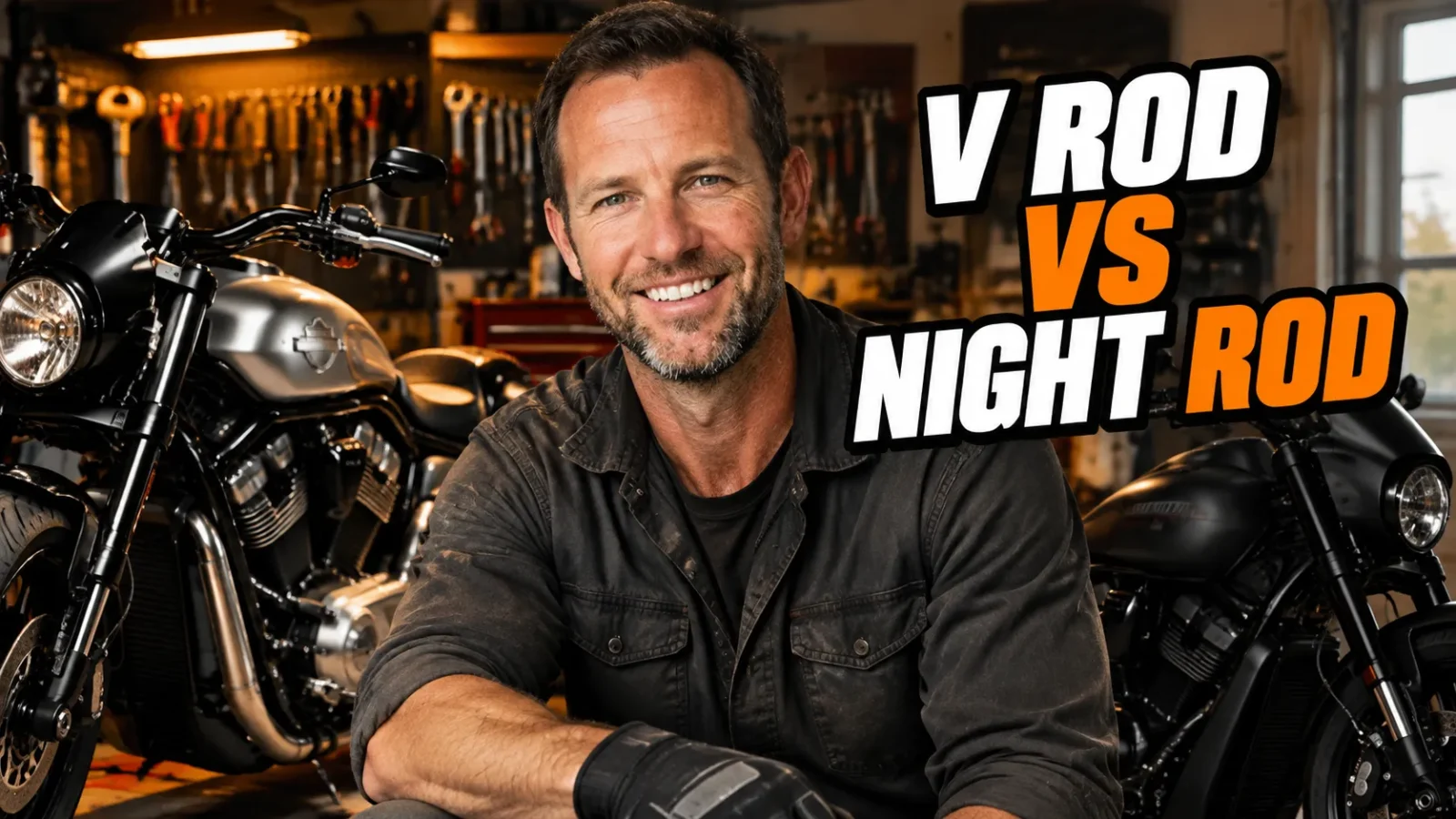
I still remember the first time I twisted the throttle on a V-Rod and watched the tach needle climb past 8,000 rpm. I had spent years on air-cooled twins that ran out of breath early, and here was a Harley that wanted to be revved like a sportbike. That moment hooked me, and it eventually led me to buy a Night Rod Special a few years later.
Since then I’ve put thousands of miles on both, wrenched on both, and answered the same question from friends at least a hundred times: what’s actually different between a V-Rod and a Night Rod? The honest answer surprises people, because these two bikes are far more closely related than the marketing ever let on.
So let me walk you through what I’ve learned, from the engine feel to the ergonomics to the one thing I’d check before handing over cash for either.
- The Night Rod is a V-Rod variant, not a separate model. Same engine, same frame, different attitude.
- Both use the Porsche-developed Revolution V-twin, and later 1250cc versions make around 120 to 125 horsepower.
- The Night Rod Special adds forward controls, drag bars, and a fat 240mm rear tire, which looks incredible but slows turn-in.
- The standard V-Rod is the better long-distance bike. The Night Rod Special is the better bar-hopper.
- Buy on condition, not model. Coolant leaks, belt wear, and bad aftermarket tuning matter more than chrome versus black.
They’re Both V-Rods Underneath
This is the part that trips up almost every buyer. The Night Rod isn’t a different motorcycle from the V-Rod. It’s a trim level within the same VRSC family, which Harley built from 2001 through 2017.
Same Revolution engine. Same hydroformed frame. Same belt drive. Same five-speed gearbox in the early years, later a six-speed on some variants. If you stripped the paint and bodywork off both, you’d struggle to tell them apart in a dim garage.
What changes is the personality Harley wrapped around that shared platform. The V-Rod leaned toward chrome, cruiser comfort, and a bit of showbike flash. The Night Rod Special leaned toward blacked-out menace and drag-strip posture.
A Quick History Lesson
The original V-Rod arrived in 2001 as the VRSCA, packing a 1130cc liquid-cooled 60-degree V-twin co-developed with Porsche. That engine was a genuine shock to the Harley faithful, and not everyone loved it at first.
In 2006 Harley added the Night Rod as a darker, stripped-down sibling. Then in 2007 came the Night Rod Special, which is the version most people mean when they say “Night Rod” today. It got the blacked-out treatment, forward controls, drag bars, and a 240mm rear tire.
From 2008 onward, the engine grew to 1250cc across the line, and power jumped to roughly 120 to 125 horsepower. The V-Rod Muscle joined in 2009 with its own take on the formula. By 2017, the whole family was gone.
Engine and Performance: Same Heart, Same Song
I want to be blunt here because I see a lot of misinformation online. Between a 1250cc V-Rod and a 1250cc Night Rod Special, there is no meaningful power difference. They make the same horsepower and the same torque from the same engine.
If a Night Rod Special feels faster, that’s ergonomics talking, not engineering. Sitting behind drag bars with your feet kicked forward, low to the ground, exaggerates every bit of acceleration. The V-Rod’s more upright position mutes the sensation.
What the Revolution Engine Actually Feels Like
The Revolution V-twin is unlike any other Harley I’ve ridden. It’s smooth, it’s liquid-cooled, and it genuinely enjoys revs. Below 4,000 rpm it feels almost tame, which surprises people expecting big-twin torque off idle.
Get it above 6,000 rpm and it comes alive. The power builds in a linear rush all the way to a redline north of 9,000 rpm. On a back road with the right gearing, that top-end pull is addictive.
My one gripe is the low-end. A traditional Harley big twin will pull cleanly from 2,000 rpm in top gear. The Revolution prefers to be downshifted and kept spinning. Around town, that means more shifting than you might expect.
Real-World Power Delivery
In my experience, the 1250cc versions feel noticeably stronger everywhere than the early 1130cc bikes. If you’re shopping used, that extra 120cc is worth paying for. It’s the difference between a quick bike and a genuinely fast one.
The six-speed gearbox found on later models is also a real upgrade over the original five-speed, especially for highway cruising. At 70 mph the engine settles into a far more relaxed rhythm.
Styling and Ergonomics: Chrome Versus Blackout
This is where the two bikes genuinely diverge, and it’s the reason most people pick one over the other. It has almost nothing to do with performance and everything to do with how you want to feel when you park it.
The V-Rod: Chrome, Comfort, and Flash
The standard V-Rod is the friendlier machine. It has mid-forward pegs that let you shift your weight around, taller bars that keep your shoulders in a neutral position, and a generally more livable riding triangle.
It also has the chrome. Lots of it. Polished forks, chrome wheels, shiny exhaust shields. I love the look, but I’ll admit it’s a lot of polishing on a Sunday morning.
The Night Rod Special: Drag Strip Menace
The Night Rod Special goes the other direction entirely. Matte black paint, blacked-out engine cases, black exhaust, dark wheels. It looks like it rolled straight out of a Mad Max film, and I mean that as a compliment.
Then there are the forward controls, which push your feet way out in front of you. Combined with the drag bars, it creates a stretched, aggressive stance that looks fantastic in photos.
It’s also less comfortable than it looks. After about two hours, your tailbone starts filing complaints.
Bars, Controls, and Seat Height
The Night Rod Special’s drag bars are low and narrow, which puts more weight on your wrists at slow speeds. Around town it’s fine. On a four-hour highway run, you’ll notice it.
Seat height on both is low, roughly 26 to 27 inches depending on the year and seat fitted. That makes them approachable for shorter riders, which is a genuine plus on a bike this heavy.
Handling and the 240 Tire Problem
Here’s something the brochures never tell you. That wide 240mm rear tire on the Night Rod Special looks spectacular, but it makes the bike noticeably slower to turn in.
I noticed it immediately after stepping off a standard V-Rod and onto the Special. The bike wants to stand up in corners and requires more deliberate input. You adapt, but you never forget it’s back there.
Neither bike is a sportbike, obviously. Both are heavy, around 640 to 680 pounds wet, with a long wheelbase. But the standard V-Rod’s narrower rear tire makes it the more willing dance partner on a twisty road.
Suspension on both is stiff and fairly short on travel. Rough pavement will let you know about it. I eventually upgraded the rear shock on my Night Rod Special, and it transformed the ride.
Comfort Over Distance
If you’re planning long trips, the standard V-Rod wins this category comfortably. The mid-forward pegs let you stand up on the pegs occasionally, and the taller bars keep your back in a more natural curve.
The Night Rod Special is a different story. Forward controls mean all your weight sits on your tailbone, and there’s no good way to shift it. I’ve done 300-mile days on mine, and I felt every one of those miles.
Small changes help. A different seat, a set of bar risers, or even just a windshield makes a huge difference. But if touring is your priority, the V-Rod is the smarter starting point.
Maintenance and Ownership Costs
Because the platform is shared, running costs are nearly identical. The Revolution engine uses hydraulic lifters, so there are no valve adjustments to budget for. That’s a genuine relief compared to some older twins.
Coolant changes matter. These are liquid-cooled bikes, and I’ve seen more than one neglected V-Rod weeping from a radiator seam. Check the coolant level and look for crusty residue around the radiator fins.
Belt drive is another thing to inspect. A worn belt will feel loose and may squeak. It’s not an expensive fix, but it’s not free either.
On early 1130cc bikes, the plastic fuel pump housing inside the tank is a known weak point. It can crack and cause running issues. If you’re looking at an early V-Rod, ask whether it’s been replaced.
Aftermarket exhaust and intake work is extremely common on both models. Make sure any tuning was actually done properly. A bike with a loud pipe and no fuel management will run lean and hot.
So Which One Would I Buy?
I’ve owned both, and my honest answer depends entirely on how you ride. There’s no universal winner here, just a better fit for your habits.
Buy the V-Rod If…
You want a muscle cruiser you can actually live with. If your rides regularly stretch past 100 miles, if you like the classic chrome look, or if you value being able to move around on the bike, the standard V-Rod is the better tool.
I’d also steer newer riders toward it. The more neutral controls and narrower rear tire make it a friendlier machine to learn on, even with all that horsepower on tap.
Buy the Night Rod Special If…
You want presence above all else. If your rides are short, your roads are straight, and you want a bike that turns heads at every stoplight, the Night Rod Special delivers in a way the standard V-Rod simply doesn’t.
Just budget for a better seat and possibly a shock upgrade. Think of those as part of the purchase price.
My Final Verdict
After living with both, I’d call the Night Rod Special the more emotional bike and the standard V-Rod the more sensible one. The Special is the one I walk out to the garage just to look at. The V-Rod is the one I’d grab for a long weekend.
But here’s the thing I always tell people asking about V-Rod versus Night Rod: condition beats model every single time. A well-maintained 1130cc V-Rod with fresh fluids and a clean belt will serve you far better than a neglected Night Rod Special with cracked plastic in the tank.
Ride both if you can. The difference in feel is something you have to experience, not read about. And when you do, I suspect you’ll know within five minutes which one belongs in your garage.
Frequently Asked Questions
Is a Night Rod basically the same bike as a V-Rod?
Mechanically, yes. The Night Rod and Night Rod Special are variants of the same VRSC platform, sharing the liquid cooled Revolution V-twin, frame, and belt drive. The differences come down to styling, controls, and on the Special a much wider rear tire.
Which is faster, a V-Rod or a Night Rod Special?
In a straight line they are nearly identical. Both later bikes use the 1250cc Revolution engine making roughly 120 to 125 horsepower, so the Night Rod Special only feels quicker because of its drag bars, forward controls, and blacked out attitude.
Is a Night Rod Special comfortable for long rides?
Not especially. The forward controls, low seat, and stiff suspension make it a short blast machine. The standard V-Rod with its mid forward pegs and taller bars is noticeably kinder to your back and tailbone over a full day.
What should I inspect on a used V-Rod or Night Rod?
Check for coolant and radiator leaks, a worn or noisy belt drive, cracked plastic fuel pump housings on early 1130cc bikes, and any aftermarket exhaust or intake work that was never properly tuned.

Related Articles

CBR650R vs R7: Which Middleweight Sportbike Actually Won Me Over
I've ridden both the Honda CBR650R and Yamaha YZF-R7 back to back. Here's how they really compare on power, weight,…
Jake Miller
9 min read

DRZ400E vs DRZ400S: I’ve Ridden Both, and Here’s the One I’d Actually Buy
DRZ400E vs DRZ400S: I break down carb, power, weight, street legality, and which of these two Suzuki dual sports I'd…
Jake Miller
9 min read

Ironhead vs Shovelhead: An Honest Wrench Turner’s Guide to Picking Your Vintage Harley
I've ridden and wrenched on both Ironhead Sportsters and Shovelhead Big Twins. Here's the honest difference in power, reliability, parts,…
Jake Miller
9 min read