
Milwaukee-Eight 107 vs 114: Which Harley Engine Wins in the Real World?
 Jake Miller
9 min read
Jake Miller
9 min read
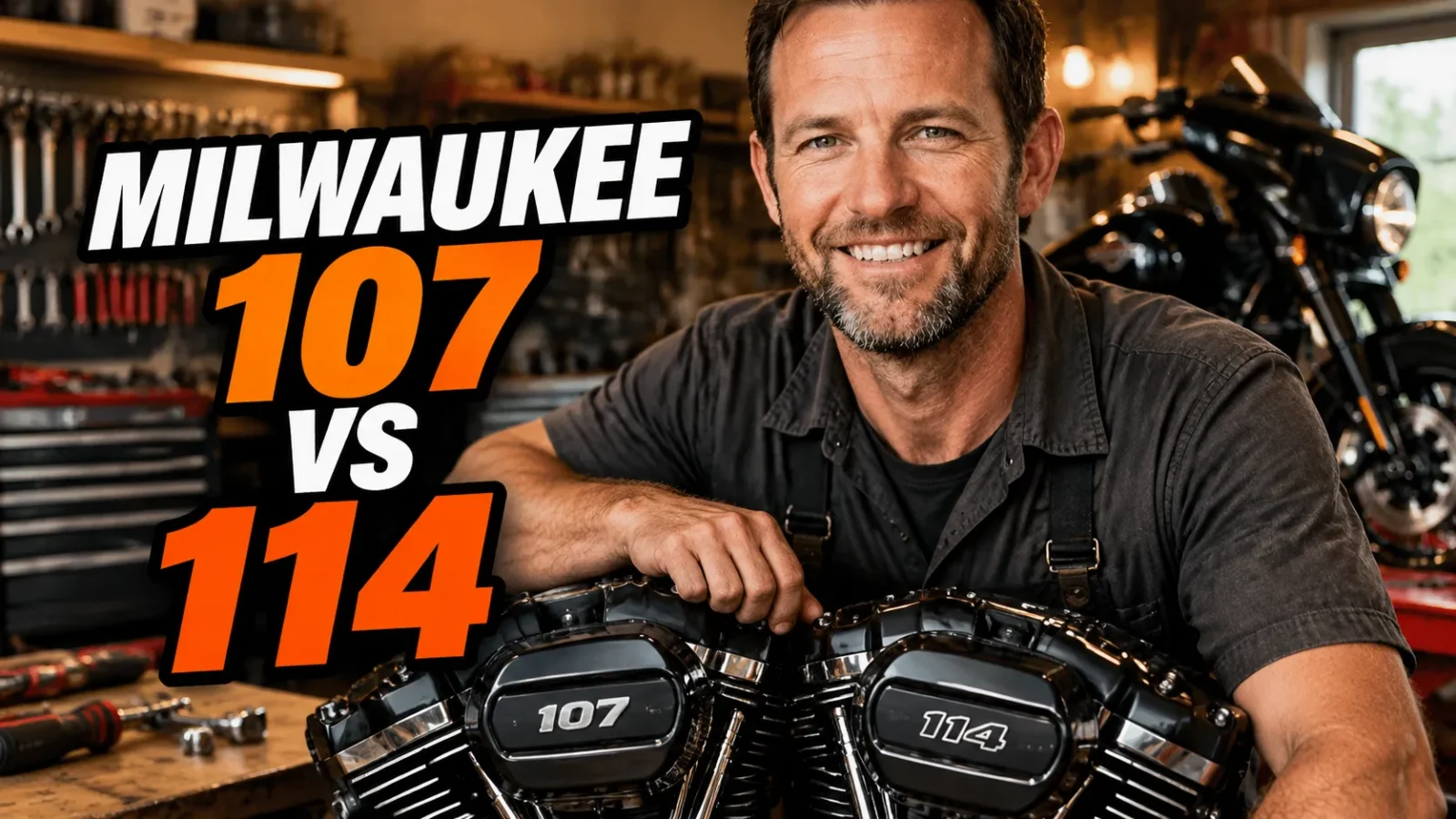
I still remember the first time I twisted the throttle on a Milwaukee-Eight 107. It was a rented Street Glide on a cool October morning, and I braced myself for the usual big-twin clatter and shake. Instead the thing pulled clean and smooth from about 1,800 rpm, and I found myself short-shifting just to feel that torque again.
Two summers later I spent three weeks on a friend’s Fat Boy 114, and honestly? I expected to be underwhelmed by an extra 61 cc. I wasn’t. The difference isn’t dramatic on paper, but you feel it every single time you roll on the throttle with a passenger aboard or point the bike at a long mountain grade.
So this is my honest, seat-of-the-pants comparison of the two most common Milwaukee-Eight displacements. No cherry-picked dyno charts pretending to be gospel — just what I noticed after genuinely living with both.
- The 114 makes roughly 8 to 11 lb-ft more torque than the 107, and you feel it most below 3,000 rpm.
- Both engines share the same basic architecture, transmission, and cooling design, so the difference is displacement, not design.
- The 107 is smoother-feeling and slightly more fuel efficient; the 114 is the better two-up and mountain engine.
- A Stage II cam in a 107 can get you close to a stock 114, but it costs money and it isn’t free horsepower.
- If I were buying today and rode loaded or two-up, I’d pay for the 114 without hesitation.
What Are the Milwaukee-Eight 107 and 114, Exactly?
Before I get into how they feel, it’s worth being clear about what these numbers actually mean. The “107” and “114” refer to cubic inches of displacement, not model years or trim levels. Harley-Davidson’s Milwaukee-Eight family replaced the Twin Cam starting in 2017, and it brought four valves per cylinder, a single camshaft, and noticeably better heat management.
Both engines are 45-degree V-twins with pushrods, air and oil cooling (or twin-cooling on some touring models), and a six-speed Cruise Drive transmission. They look almost identical sitting in the frame. The difference is entirely inside.
The 107 in plain numbers
The Milwaukee-Eight 107 displaces 1,746 cc, with a bore and stroke of about 100 mm by 111.1 mm. Compression sits right around 10.0:1, and Harley typically rated it somewhere between 107 and 111 lb-ft of torque, peaking around 3,250 rpm depending on the model and tune.
It arrived first, launching in the 2017 touring line before spreading to the Softail range in 2018. That matters for one simple reason: there are a lot of them out there, which means parts, tuners, and used examples are everywhere.
The 114 in plain numbers
The 114 bumps displacement to 1,868 cc, using a slightly larger 102 mm bore and a longer 114.3 mm stroke. Compression is essentially the same, but torque climbs to roughly 119 to 122 lb-ft, usually peaking a touch lower in the rev range.
It showed up first in the 2018 Softail line — the Fat Bob 114 and Fat Boy 114 being the obvious ones — and then spread into touring models like the Street Glide Special and Road Glide Special. If you see a 114 badge on a modern Harley, it’s almost certainly this engine.
How They Actually Feel on the Road
This is where the spec sheet stops mattering and the butt dyno takes over. I’ve ridden both engines in touring and Softail chassis, and the character difference is real, even if it’s subtle.
Low-end torque: the 114 wins, clearly
Rolling on from about 2,000 rpm, the 114 just digs in harder. It’s not a violent difference, but it’s the kind of thing you notice immediately when you’re climbing a grade at 65 mph in sixth gear and you don’t have to downshift.
On the 107, that same situation usually means a quick stab at the shifter. It’s not a problem — it’s just the reality of less displacement doing the work.
Revs, smoothness, and highway manners
Here’s the counterintuitive part: I actually find the 107 feels slightly smoother and a little more eager to rev. The shorter stroke means less piston speed at a given rpm, and in my experience that translates to marginally less mechanical commotion through the floorboards.
At a steady 75 mph, though, both engines are excellent. The Milwaukee-Eight’s rubber mounting and internal balance shafts do their job, and neither one will leave your hands tingling after a long day.
Heat and vibration
Both engines run noticeably cooler than the Twin Cam they replaced, thanks to better oil flow and four-valve heads. That said, I’ve noticed the 114 seems to build heat a touch faster in stop-and-go traffic, which makes sense given the extra displacement in the same basic package.
If you commute in a hot climate with a lot of traffic lights, that’s a small point in the 107’s favor. It’s not a dealbreaker either way, but it’s worth knowing.
Torque, Gearing, and Real-World Performance
Both engines use the same six-speed transmission and similar final drive ratios, so the extra torque in the 114 translates fairly directly into acceleration. The 114 also pulls taller gearing more comfortably, which is why it feels so relaxed at highway speed.
Where I notice it most is in the 40-to-80 mph roll-on. That’s the move you make constantly on two-lane roads when passing a truck, and the 114 simply does it with less drama and fewer downshifts.
Two-up and loaded riding
This is the single biggest argument for the 114. Add a passenger, saddlebags, and a weekend’s worth of gear, and the 107 starts to feel like it’s working harder than it wants to. It never feels slow, exactly, but you notice the throttle position creeping up.
My friend and his wife ride two-up almost exclusively, and he told me the 114 was the first Harley he’d owned where he stopped thinking about power entirely. That’s the highest compliment you can pay a touring engine.
Fuel economy and range
The 107 generally wins here by a small margin — usually somewhere in the 1 to 3 mpg range in my experience. Real-world numbers depend enormously on your right hand, load, and whether you’re fighting a headwind on the interstate.
On a bike with a small tank, that difference can mean 15 or 20 extra miles between stops. Annoying, but rarely a purchase decision on its own.
Which Bikes Got Which Engine
If you’re shopping used, knowing the rollout timeline saves you a lot of confusion. The 107 showed up in 2017 touring models and became the standard Softail engine in 2018. The 114 arrived in 2018 on select Softails and moved into touring bikes shortly after.
Above both of them sits the bigger Milwaukee-Eight 117, which showed up in CVO models and select special editions. It’s a different conversation entirely, but it’s worth knowing the hierarchy if you’re comparing listings.
Also worth remembering: the same engine can feel different in different chassis. A 107 in a light Softail is a genuinely quick bike. A 107 in a fully dressed touring rig is a totally different animal.
Reliability, Known Quirks, and Maintenance
Both engines share the same reputation, which is generally good. The Milwaukee-Eight platform has been solid overall, and the four-valve design means better breathing without the maintenance headaches of a more exotic layout.
That said, early Milwaukee-Eight owners reported a few things worth knowing about. Some bikes experienced oil migration issues that got nicknamed “sumping,” and there’s the well-documented valvetrain tick that shows up on a lot of M8s. Harley updated the oil pump on later models, and many of the noisy ones quiet down after a proper tune.
Regular oil changes with the right spec oil matter more on these engines than people realize. I do mine every 5,000 miles and I’ve never had an issue on either displacement.
Upgrades: Making a 107 Into a 114
Here’s the thing nobody tells you when you’re staring at two price tags: you can absolutely turn a 107 into a 114. Harley-Davidson sells big bore kits that swap the pistons and cylinders, and the aftermarket has options too.
The catch is cost. By the time you buy the kit, pay for labor, and get a proper dyno tune, you’re often within a few hundred dollars of just having bought the 114 in the first place. You also lose the factory warranty coverage on the affected parts.
If you want a middle path, a Stage II cam setup on a 107 is genuinely impressive. I’ve ridden one that felt nearly as strong as a stock 114, and it cost a fraction of a big bore build. If you want the full picture on how those packages stack up, my breakdown of Screamin’ Eagle stage kits walks through each level.
Cost, Resale, and Value
On the used market, the 114 typically commands a premium of a few hundred to a couple thousand dollars depending on the model. On new bikes, the gap is baked into trim levels rather than sold as a standalone option.
Resale holds up well on both. The 114 tends to be more desirable to touring buyers, while the 107 is often seen as the sensible choice — which keeps demand steady but caps the premium.
My honest take: if you’re financing, the monthly difference is usually small enough that you should buy the engine you actually want rather than the one that saves you twenty dollars a month.
My Verdict: Which One Should You Buy?
After living with both, I don’t think there’s a wrong answer here. There’s just a right answer for you, and it depends almost entirely on how you ride.
Buy the 107 if…
You ride solo most of the time, your terrain is mostly flat, and you value the slightly smoother feel and better fuel economy. You’ll also save money up front and have an easier time finding used examples.
The 107 is genuinely not a weak engine. It’s a big, torquey V-twin that will happily cruise all day at highway speeds. Don’t let anyone tell you it’s underpowered.
Buy the 114 if…
You ride two-up, you load the bike down, you live near mountains, or you just like having torque in reserve. The 114 is the engine I’d choose for any long-distance touring bike, and it’s the one that made me stop thinking about power altogether.
If you’re the kind of rider who always wants a little more, skip the 107 and go straight to the 114. You’ll spend less money in the long run than trying to upgrade your way there.
Final Thoughts
The Milwaukee-Eight 107 and 114 are more alike than different. Same architecture, same transmission, same basic character. The 114 just does everything with a little more authority, and you pay for that authority in dollars and a tiny bit of fuel economy.
For me, the deciding factor was always load. Solo and light, the 107 never once left me wanting. Two-up with luggage on a climb, the 114 was the difference between relaxed and working for it.
Ride both if you possibly can. A twenty-minute test ride on a loaded bike will tell you more than any spec sheet ever will — and that’s coming from someone who has spent way too long reading spec sheets.
Frequently Asked Questions
Is the Milwaukee-Eight 114 worth the extra money over the 107?
For most riders who tour two-up, carry luggage, or live near hills and mountains, yes. The 114 makes roughly 8 to 10 percent more torque and pulls noticeably harder below 3,000 rpm. If you ride solo on flat ground and rarely load the bike down, the 107 is plenty and you can pocket the difference.
How much more torque does the 114 make than the 107?
In stock form the difference is usually around 8 to 11 lb-ft, depending on model and tune. Harley rated many 107s at about 107 to 111 lb-ft and many 114s at about 119 to 122 lb-ft, both peaking somewhere between 3,000 and 3,250 rpm.
Can I upgrade a 107 to a 114 later?
Yes. Harley-Davidson and several aftermarket companies sell big bore kits that take the 107 out to 114 cubic inches using new pistons, cylinders, and often a cam. It’s a real option, but by the time you add labor and a proper tune you’re often close to the price gap between the two engines in the first place.
Which engine gets better fuel economy, the 107 or the 114?
The 107 generally wins by a small margin, usually 1 to 3 mpg in my experience. It’s rarely enough to change the math on a purchase, but it does matter a little on long trips with a small tank.

Related Articles

CBR650R vs R7: Which Middleweight Sportbike Actually Won Me Over
I've ridden both the Honda CBR650R and Yamaha YZF-R7 back to back. Here's how they really compare on power, weight,…
Jake Miller
9 min read

DRZ400E vs DRZ400S: I’ve Ridden Both, and Here’s the One I’d Actually Buy
DRZ400E vs DRZ400S: I break down carb, power, weight, street legality, and which of these two Suzuki dual sports I'd…
Jake Miller
9 min read

Ironhead vs Shovelhead: An Honest Wrench Turner’s Guide to Picking Your Vintage Harley
I've ridden and wrenched on both Ironhead Sportsters and Shovelhead Big Twins. Here's the honest difference in power, reliability, parts,…
Jake Miller
9 min read