
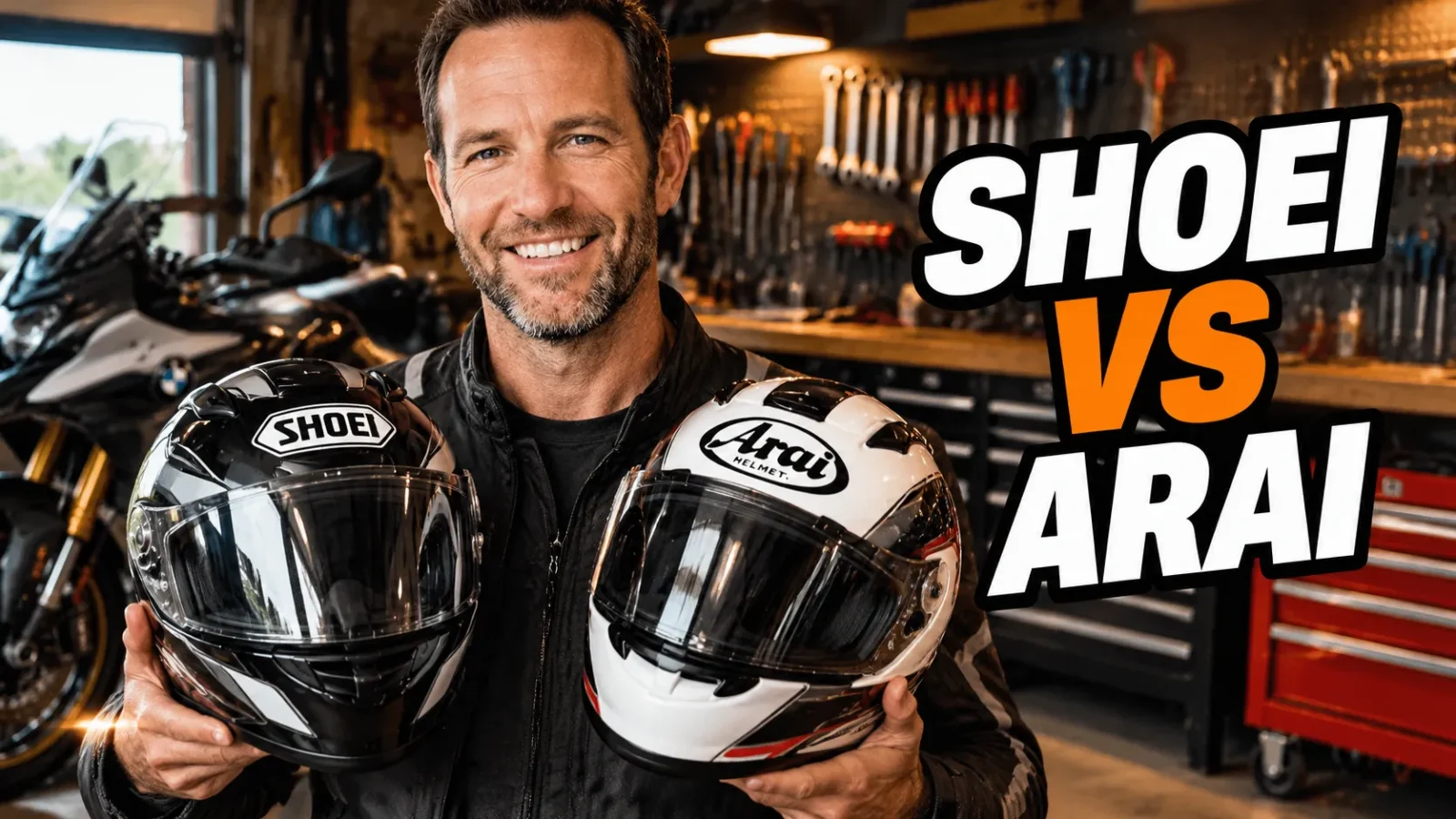
I still remember the first time I pulled on a proper premium helmet. I had been riding in a budget lid for three seasons, the kind where the liner packs down after a month and the visor rattles above 50 mph. Then a friend handed me his Arai for a track day, and something clicked. Helmets are not all the same, and the two Japanese giants at the top of the food chain build them in genuinely different ways.
Since then I have owned four Shoei helmets and three Arais. I have commuted in them, toured in them, done track days in them, and crashed in one of them. So when people ask me the eternal question of Shoei vs Arai, I do not reach for a spec sheet. I reach for my own scar tissue and my own credit card statements.
Here is the honest breakdown, from a rider who has paid full retail for both brands.
- Fit decides everything. Shoei is consistently intermediate oval; Arai offers Round, Intermediate, and Long Oval shells.
- Shoei wins on noise control and aerodynamics, thanks to heavy wind tunnel development and a tight neck roll.
- Arai wins on shell philosophy, with its rounder R75 shape, hand assembly, and legendary long term parts support.
- Arai refuses drop down sun visors, while Shoei embraces them in touring models like the GT-Air 3 and Neotec 3.
- Neither is objectively better. The right answer depends on your head shape, your riding, and your budget.
Why I Ended Up Owning Both Brands
My first Arai was a Corsair-X, bought because I convinced myself I needed a race helmet for track days. My first Shoei was an RF-1200, bought because the Corsair gave me a red mark across my forehead after ninety minutes.
That is the whole story in two sentences, honestly. I wanted the Arai to be perfect. It was not, because my head is an intermediate oval and the Corsair shell I picked was not. The Shoei slid on like it had been molded from my own skull.
But then I tried an Arai in the right internal shape, and the comfort was on another level entirely. Since then I have kept both brands in rotation. Neither one has fully won me over, and I think that is the most useful thing I can tell you.
The Fit Is the Whole Ballgame
If you take one thing from this article, let it be this. Fit matters more than brand, more than price, more than which MotoGP rider wears what. A perfectly engineered helmet that does not match your head shape is a $900 headache.
Shoei’s Consistent Intermediate Oval
Shoei largely builds around an intermediate oval, which is the most common head shape in North America and Europe. Slightly longer front to back than it is wide, with the widest point just above the ears.
What I appreciate about Shoei is the consistency. My RF-1200, my RF-1400, and my GT-Air 3 all fit the same. If you find your Shoei size, you can buy another Shoei online with near total confidence. That reliability is worth a lot.
The interior padding is also excellent. Shoei uses multi density foam and laser cut cheek pads, and the liners hold their shape for years rather than months.
Arai’s Multiple Head Shapes
Arai takes the opposite approach. Instead of one shape scaled up and down, Arai builds several distinct interior shapes: Round Oval, Intermediate Oval, and Long Oval. Different models lean toward different shapes.
For a genuinely round headed rider, this is a gift. I have a friend who could never wear Shoei without temple pressure, and an Arai Round Oval solved it instantly. The Facial Contour System cheek pads also let you fine tune the fit more than most brands allow.
The catch is that buying Arai online is riskier. You need to know your shape, and you should really try one on first. I learned that the expensive way.
Shell Construction and Safety Philosophy
Both brands build superb shells. They just disagree, politely and for decades, about what makes a shell safe.
Arai’s Rounder, Smoother Shell
Arai’s signature is the R75 shape, which means the shell stays within a 75 millimeter radius from the center point. In plain terms, it is rounder and smoother, with fewer protrusions and ridges.
The theory is that a smooth, round shell is more likely to glance off a surface rather than dig in and rotate. Arai also uses peripheral belting, a reinforced band around the shell opening that keeps the shape from deforming on impact.
I find this philosophy genuinely compelling. Arai also hand assembles and hand inspects more of its helmets, and it shows in the finish. My Corsair-X felt like a handmade object in a way no Shoei ever has.
Shoei’s AIM+ and Wind Tunnel Focus
Shoei uses its AIM+ construction, a multi ply matrix of fiberglass and organic fibers bonded with resin. It is strong, light, and above all consistent, which suits Shoei’s manufacturing scale.
Where Shoei really shines is aerodynamics. The company spends serious time in the wind tunnel, and it shows. My X-series Shoei was the most stable helmet I have worn at triple digit speeds, with almost no buffeting when I turned my head.
What About Certifications?
Both brands meet and generally exceed the standards that matter. You will find ECE 22.06, Snell, and increasingly FIM homologated race helmets from both Shoei and Arai.
In other words, do not buy either brand expecting a safety advantage on paper. Buy based on which one fits your head and stays put in a crash, because a loose helmet is a dangerous helmet no matter who built it.
Noise, Ventilation, and Real World Comfort
This is where the two brands diverge in ways I notice every single ride.
Quieter Cabin vs. More Airflow
Shoei helmets are noticeably quieter for me. The neck roll seals well, the visor gasket is tight, and wind roar is subdued. On my GT-Air 3 I can ride at highway speed without earplugs and still hear my intercom clearly.
Arai helmets move more air. The brow vents, the top diffuser, the multiple intake ports, they all work. On a 95 degree day the Arai is the helmet I reach for, because the airflow through it is genuinely excellent.
The tradeoff is noise. My Arai is louder than my Shoei at the same speed. I wear earplugs with both, but with the Arai I would not even consider riding without them.
Visors, Sun Shields, and Everyday Usability
This is a philosophical difference as much as an engineering one, and it affects how you live with the helmet daily.
Shoei’s Tool Free Shield Swaps
Shoei’s shield mechanism is brilliant. On most current models you press a lever, pull the shield, and it pops off. I can swap from clear to tinted in about fifteen seconds in a parking lot.
Shoei also offers internal drop down sun visors on touring and sport touring models. For commuters and tourers, that is a genuinely useful feature, and it saves you carrying a second shield.
Arai’s No Drop Down Sun Visor Stance
Arai refuses to build internal sun visors. The company’s argument is that cutting a cavity into the EPS liner for a drop down mechanism compromises the shell and liner integrity.
Whether you buy that argument is up to you. What I can tell you is that swapping an Arai shield takes me longer and feels fussier, and I have definitely fumbled it while parked on a shoulder. Arai’s VAS system is clever and the vision through the aperture is superb, but convenience is not its strong suit.
Weight, Balance, and Long Ride Fatigue
On paper, Shoei usually has the edge on weight. In practice, balance matters more than grams, and both brands do well here.
Arai helmets can feel slightly heavier in the hand, but the weight sits low and the shell shape keeps them stable. My Corsair-X never made my neck tired on a long day, even though it was technically the heavier helmet.
Shoei helmets feel lighter and more neutral to me, especially the sport touring models. After six hours in the saddle, I notice the Shoei less. That is a real, if unglamorous, advantage.
Price, Parts, and Long Term Ownership
Neither brand is cheap, and neither pretends to be. Expect to pay a premium for both, with Arai generally asking a little more at the top of the range.
Where Arai genuinely earns its reputation is parts support. Arai keeps liners, cheek pads, visors, and vent parts available for many years, which means a well cared for Arai can be refreshed rather than replaced. I have replaced the entire interior of a five year old Arai and it felt new again.
Shoei is no slouch here either, and parts are usually easier to find in stock at dealers. If you value convenience and quick replacement, Shoei is the friendlier ownership experience.
Which One Would I Buy Again?
I will keep buying both, because I ride different bikes in different conditions and I like having options. But if you are choosing your first premium helmet, here is how I would break it down.
Pick Shoei If…
You have an intermediate oval head, you want the quietest ride, you value tool free shield swaps, you want a drop down sun visor, and you want a helmet that fits the same every time you buy one. For most riders, most of the time, Shoei is the safer bet.
Pick Arai If…
You have a round or long oval head, you appreciate hand built quality, you want a helmet you can rebuild for a decade, and you ride in hot climates where maximum airflow matters more than a quiet cabin. If an Arai fits you properly, nothing else feels quite like it.
Final Thoughts
After years of switching between these two, I have stopped thinking of Shoei vs Arai as a contest. They are two different answers to the same question, and both answers are excellent.
Shoei is the engineer’s helmet. Consistent, aerodynamic, quiet, and packed with practical features that make daily riding easier.
Arai is the craftsman’s helmet. Rounder, hand finished, built around fit options and a stubborn set of safety principles that the company refuses to compromise on.
My honest advice is to stop reading and go try both on. Spend an hour in each. Walk around the shop, tilt your head, check where the pressure points land. Whichever one disappears on your head is the one you should buy. For me, that changes depending on the model, and it probably will for you too.
Frequently Asked Questions
Is Shoei or Arai better for a round head?
Arai is usually the better bet. Arai builds several distinct shell interiors, including Round Oval, Intermediate Oval, and Long Oval, so a genuinely round head can often find a near custom fit. Shoei leans heavily toward an intermediate oval, which suits most riders but can put pressure on the forehead or temples of a very round head.
Which brand is quieter, Shoei or Arai?
In my experience Shoei has the edge on noise. The Shoei RF-1400 and GT-Air 3 both seal tightly around the neck roll and cut wind roar noticeably. Arai helmets tend to move more air through the shell, which I love in summer but find louder at highway speed unless I wear earplugs.
Are Arai helmets worth the extra money?
They are if the fit is right. Arai spends its money on hand assembly, multi density EPS, and a rounder R75 shell shape rather than features like drop down sun visors. If an Arai fits your head shape, the comfort and long term parts support justify the premium. If it does not fit, no amount of engineering will save it.
Do Shoei and Arai helmets meet the same safety standards?
Yes, both meet and often exceed the same benchmarks, including ECE 22.06 and Snell ratings, and both offer FIM homologated race helmets. The real world difference comes down to fit, shell shape, and how well the helmet stays put on your specific head during an impact.

Related Articles

CBR650R vs R7: Which Middleweight Sportbike Actually Won Me Over
I've ridden both the Honda CBR650R and Yamaha YZF-R7 back to back. Here's how they really compare on power, weight,…
 Jake Miller
9 min read
Jake Miller
9 min read

DRZ400E vs DRZ400S: I’ve Ridden Both, and Here’s the One I’d Actually Buy
DRZ400E vs DRZ400S: I break down carb, power, weight, street legality, and which of these two Suzuki dual sports I'd…
Jake Miller
9 min read

Ironhead vs Shovelhead: An Honest Wrench Turner’s Guide to Picking Your Vintage Harley
I've ridden and wrenched on both Ironhead Sportsters and Shovelhead Big Twins. Here's the honest difference in power, reliability, parts,…
Jake Miller
9 min read