
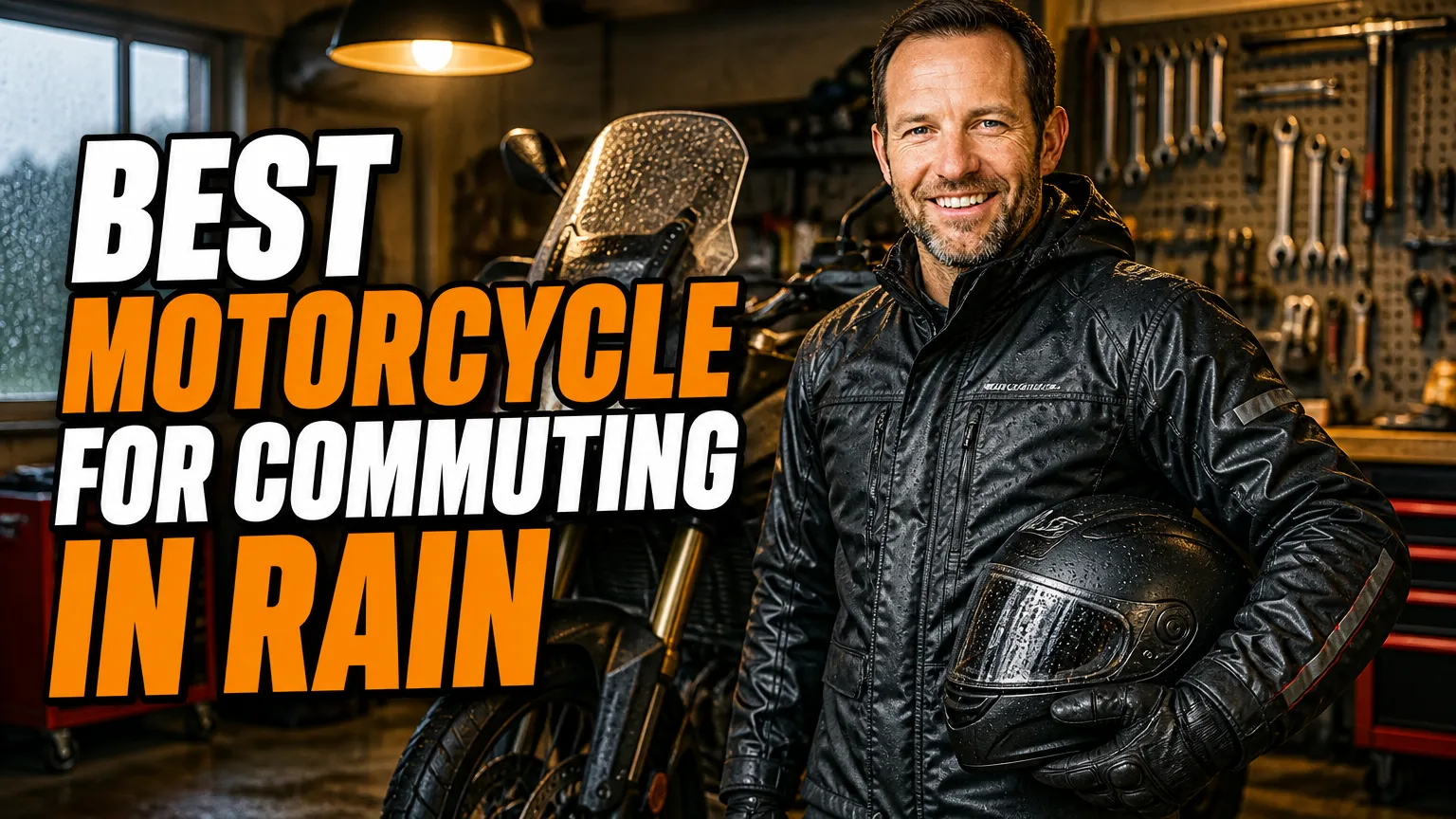
Finding the best motorcycle for commuting in rain is less about chasing the biggest engine or the most dramatic styling and more about choosing a bike that helps me stay comfortable, visible, and composed when the pavement turns slick. I look for predictable handling, effective brakes, wind protection, and practical features I’ll appreciate on an ordinary workday.
There isn’t one perfect answer for every commute. I’d choose differently for a crowded downtown route than for a long stretch of highway, so I’ve included nimble scooters, middleweight standards, and touring-oriented motorcycles below.
- I’d put the Honda NC750X DCT at the top of my list for practical, all-around commuting.
- The Yamaha XMAX and Honda ADV160 make a lot of sense for city-focused trips.
- I prioritize ABS, good tires, wind protection, and smooth controls over engine size.
- I still ride gently in the wet: no motorcycle feature can replace sensible speed and following distance.
1. Honda NC750X DCT: My pick for low-stress everyday riding
The Honda NC750X DCT is the bike I’d shortlist first if I wanted one motorcycle to handle a practical mix of city streets and faster roads. Its 745cc parallel-twin is tuned for accessible, everyday power rather than a frantic rush to high revs, which suits my preference for smooth throttle inputs on wet commutes.
Why I like it when the weather turns
The standout feature is Honda’s optional Dual Clutch Transmission. I can let the DCT handle gear changes, or use its manual mode, and avoid coordinating a clutch lever and shifter when traffic is stop-and-go. That doesn’t make a slick road harmless, but it does simplify one part of a busy ride.
I also value the NC750X’s upright riding position and its lockable, tank-shaped storage compartment, which holds approximately 23 litres. I can fit a small amount of daily gear without immediately adding luggage, and the relatively modest engine character feels easier to manage than a high-strung sportbike.
What I’d check before buying
The NC750X is a heavier, larger motorcycle than a small commuter scooter, and DCT versions cost more than a basic manual bike. Depending on model year and market, I’d expect pricing to land around the low-to-mid five figures before taxes and dealer charges. I’d also budget for quality rain gear and tires rather than treating electronic features as a substitute for grip.
For my broader shortlist of all-weather options, I’d compare it with the best motorcycle for riding in the rain. The NC750X is my all-rounder, but that wider comparison can help if I care more about bad-weather protection than everyday versatility.
2. Kawasaki Versys 650: My choice for a longer, upright commute
I’d consider the Kawasaki Versys 650 when a commute includes sustained highway speeds or rougher pavement. Its 649cc parallel-twin, upright ergonomics, and touring-friendly setup make it more comfortable for covering distance than many compact city bikes, without jumping to a large adventure-tourer.
Useful protection and control
The Versys 650 gives me a windscreen that can be adjusted to suit my height and riding position, plus a relaxed, upright stance that helps me scan traffic. ABS is available, and recent versions include Kawasaki Traction Control. I find those aids reassuring, but I still rely on gradual braking and gentle acceleration when painted lines, metal covers, or oily intersections are wet.
Its roughly four-gallon fuel tank is useful for regular commuting, and the engine has enough flexibility for highway merges. That extra capability comes with more weight and bulk than I need for a short, slow city route, so I’d take a test ride in the kind of traffic I actually face.
Who I think it suits
I’d pick the Versys 650 if comfort and weather protection matter more to me than squeezing through the tightest gaps. Pricing varies by year and equipment, but I’d generally plan for a mid-four-figure to low-five-figure purchase before taxes and accessories. A touring screen or hand guards may improve comfort, though I’d check fit and wind buffeting before spending extra.
3. Honda NX500: My sensible middleweight for mixed routes
The Honda NX500 is my approachable choice for a commuter who wants a manageable motorcycle that can still handle faster roads. It uses Honda’s 471cc parallel-twin, a familiar engine size in the brand’s middleweight lineup, and gives me an upright position that feels natural for daily traffic.
Why it works for wet-weather routines
For me, the NX500’s appeal is its balance: standard ABS, Honda Selectable Torque Control, a relatively compact feel, and a small adjustable windscreen. The traction-control system can help manage rear-wheel slip under acceleration, while ABS can help limit wheel lock during braking. Neither system overrides the need to ride smoothly, but both are useful features to have.
The NX500 is more approachable than a large adventure bike, yet it has enough engine for commuting beyond residential streets. Its fuel tank holds about 17 litres, and its modest overall size makes it easier for me to imagine parking and maneuvering it in a busy urban area.
My buying notes
I’d expect the NX500 to sit around the upper-$7,000 to $8,000 range in the United States, depending on year, destination charges, and local pricing. I’d check that the seat and windscreen suit my height, because a poorly fitting screen can direct rain or turbulent air toward my helmet rather than away from it.
If I were still learning, I’d compare the NX500 with advice on the best motorcycle engine size for beginners. I like the NX500’s balance, but the right engine size depends on my confidence, route, and experience.
4. Yamaha Tracer 9 GT+: My premium pick for long-distance wet commutes
The Yamaha Tracer 9 GT+ is the high-spec option I’d look at if my commute involved a lot of highway time and I had a generous budget. Its 890cc three-cylinder engine provides strong passing power, while the sport-touring layout gives me more wind protection and long-distance comfort than a naked bike.
Technology that supports a calmer ride
The GT+ includes advanced rider aids, such as an IMU-based electronics package, multiple ride modes, and a radar-assisted adaptive cruise-control system on equipped model years. A Rain mode softens engine response, which is the sort of adjustment I appreciate when my gloves are wet and my grip needs to stay deliberate. The bike also has cornering-aware braking and traction-control features, with exact equipment depending on model year and market.
I see its adjustable windscreen and touring ergonomics as major advantages during a long ride through steady rain. The trade-off is that it’s a tall, powerful, and expensive motorcycle. I wouldn’t choose it just for a short urban commute, and I’d take time to get comfortable with its weight before riding it in poor conditions.
What I’d budget for
Depending on market and model year, I’d expect the Tracer 9 GT+ to cost well into five figures, often around the mid-to-high teens in US dollars before fees. For me, it makes sense when I’ll genuinely use the comfort and technology on frequent longer rides, not as a way to avoid learning wet-weather technique.
5. Triumph Tiger Sport 660: My flexible middleweight tourer
I like the Triumph Tiger Sport 660 as a bridge between a commuter and a lightweight sport-tourer. Its 660cc three-cylinder engine gives it more highway headroom than a small scooter, while its upright riding position and practical windscreen make it easier to live with than a committed sportbike.
Rain mode and everyday usability
The Tiger Sport 660 offers a Rain riding mode, ABS, and switchable traction control. I’d use Rain mode when conditions call for a gentler response, then keep my own inputs measured rather than assuming the setting can compensate for standing water or worn tires. Its broad, usable power delivery is another reason I’d consider it for a mixed-speed commute.
The bike’s 17.2-litre fuel tank is helpful for longer days, and the screen provides some protection from direct airflow. I’d still test the screen in person: wind protection varies with rider height, and a screen that works well for one person can send spray or buffeting straight toward another.
Where it fits in my shortlist
I’d put the Tiger Sport 660 near the top if I wanted one machine for commuting, weekend rides, and occasional touring. It generally sits around the $9,000 to $10,000 range in the US, though model-year pricing and accessories can shift the final cost. I’d compare the real out-the-door price with the Versys 650 before deciding which ergonomics suit me better.
6. BMW F 900 XR: My comfort-first option for fast roads
The BMW F 900 XR is the motorcycle I’d consider when my daily route is mostly open road and I want a more premium sport-touring setup. Its 895cc parallel-twin offers strong performance, and the XR’s taller stance and fairing provide more shelter than a conventional naked commuter.
Features I’d value in poor weather
Depending on trim and model year, BMW’s equipment can include Rain and Road riding modes, ABS Pro, and traction-control features. I like the idea of a calmer throttle map and braking support, particularly when the road is wet, but I’d confirm exactly which electronic package comes on the bike I’m buying. BMW options can change the price and feature list considerably.
The F 900 XR’s upright position helps me maintain a clear view in traffic, and its fairing and screen are better suited to regular highway use than a small naked bike’s minimal bodywork. It is still a sizable, powerful machine, so I’d make sure I can handle low-speed turns and parking confidently before committing.
My practical caveat
I’d expect a new F 900 XR to cost in the low-to-mid five figures, with optional packages pushing it higher. It’s a compelling choice for a long commute, but I wouldn’t buy it solely for rain protection. For mostly slow city streets, I’d rather spend less on a smaller, easier-to-maneuver motorcycle and put the savings toward good protective gear.
7. Yamaha XMAX: My favorite scooter for a city commute
The Yamaha XMAX is the scooter I’d choose for a rain-prone urban route where storage and everyday convenience matter. Its 292cc engine is more substantial than a typical small-city scooter, and the automatic transmission means I don’t have to shift gears in stop-start traffic.
Practical features I appreciate
The XMAX comes with ABS and traction control, as well as a windscreen and under-seat storage. Those features make it an appealing daily package: I can carry small essentials, keep more airflow off my torso than I would on a bare motorcycle, and focus on smooth braking and throttle use rather than gear changes.
I wouldn’t mistake its screen and bodywork for complete weather protection. Rain can still reach my hands, legs, and boots, and the XMAX’s smaller scooter wheels call for special care around deep potholes and standing water. Its roughly 13-litre fuel tank is practical for regular urban use, while its performance is better suited to city streets and shorter faster-road stretches than sustained high-speed touring.
What I’d spend
Depending on year and market, I’d expect the XMAX to be priced around the mid-$6,000 range in the United States. I’d check the seat height and overall width before buying, especially if I need to park in a narrow space or regularly filter through dense traffic.
If electric power is on my mind instead, I’d also browse this guide to the best electric motorcycle for highway commuting. Electric range and charging access can matter just as much as rain equipment when I’m choosing a daily ride.
8. Honda ADV160: My compact pick for short urban trips
The Honda ADV160 is the small-displacement option I’d consider for a shorter, mostly urban commute. Its 157cc engine and automatic transmission make it easy to use in stop-start traffic, while the adventure-inspired styling comes with practical touches that suit rough city streets.
Small-bike advantages and limitations
I like that the ADV160 includes Honda Selectable Torque Control, a windscreen, and about 27 litres of under-seat storage. It also has ABS on the front wheel on common versions, but it is not the same as a full-sized motorcycle with dual-channel ABS. I’d check the exact specification in my market before buying and be especially careful with rear-wheel braking on slick pavement.
The ADV160’s light, compact character is an advantage when I’m maneuvering through tight streets or parking in a crowded area. Its 157cc engine, however, makes it a better fit for local commutes than long stretches of fast highway. I wouldn’t choose it if my route regularly requires high-speed passing or extended motorway travel.
My value check
I’d expect the ADV160 to cost around the mid-$4,000 range in the United States, depending on model year and dealer charges. For a new commuter, that lower purchase price and convenient storage can be compelling, but I’d still price a quality helmet, waterproof layers, gloves, and maintenance into my total budget.
How I choose a motorcycle for wet commuting
When I compare these bikes, I start with the route rather than the spec sheet. A small scooter can be ideal for a short city trip, while a middleweight with a proper screen makes more sense if I spend an hour on faster roads. I consider seat height, weight, parking, and how confidently I can make a slow U-turn as well as engine power.
Safety features I put near the top
I look for ABS first, then traction control and a Rain mode if they’re available and suit the bike. I treat these as extra support, not permission to brake late or accelerate hard. I also pay close attention to the tires: tread depth, age, pressure, and suitability for wet roads can have a bigger effect on confidence than a long list of electronic features.
Visibility and comfort matter, too. I want a windscreen that doesn’t create distracting turbulence, gloves that stay usable when damp, and lights that help other drivers see me. A motorcycle can have excellent equipment and still leave me soaked if I haven’t planned for waterproof clothing.
How I adjust my riding in the rain
I slow down, leave more space, and make my inputs smooth. I’m especially cautious on painted markings, metal plates, leaves, fuel spills, and the first minutes of rain, when road grime can make the surface unpredictable. I avoid sudden braking or steering changes and try to keep the bike upright when crossing slick patches.
For fuel-conscious daily riding, I’d also compare my options with the best gas mileage motorcycle for commuting. Running costs matter, but I wouldn’t trade away a comfortable, manageable fit just to chase a fuel-economy figure.
My final recommendation
If I wanted one versatile motorcycle for varied commuting, I’d start with the Honda NC750X DCT. For a more approachable middleweight, I’d consider the Honda NX500; for a long highway commute, I’d test the Kawasaki Versys 650 or Triumph Tiger Sport 660. In a city, the Yamaha XMAX and Honda ADV160 are practical alternatives with less shifting and useful storage.
Whichever one I choose, I’d make the same final checks: confirm the exact model-year equipment, sit on the bike in my riding gear, inspect its tires, and budget for proper waterproof clothing. The best motorcycle for my rainy commute is ultimately the one I can control comfortably and ride with patience when the road is slick.
Frequently Asked Questions
What features matter most on a motorcycle for rainy commuting?
I prioritize ABS, predictable throttle response, good tires, useful wind protection, and an upright riding position. Traction control and a rain mode are welcome extras.
Is a scooter a good choice for commuting in the rain?
Yes, especially for city trips. I like the Yamaha XMAX for its windscreen, storage, ABS, and traction control, though scooters still need suitable tires and careful riding on slick surfaces.
Does ABS make a motorcycle safe to ride in heavy rain?
ABS can help reduce wheel lock during hard braking, but it cannot create grip or prevent every crash. I slow down, leave more space, and use smooth inputs whenever the road is wet.
Which motorcycle is a sensible choice for a new rainy-weather commuter?
I would look closely at the Honda NX500. Its manageable 471cc engine, standard ABS, upright seating, and traction control make it approachable without being limited to short city trips.

Related Articles

7 Best Motorcycles for Short Highway Commutes: Comfortable, Capable Picks
I compare seven commuter-friendly motorcycles for brief highway rides, covering power, comfort, seat height, wind protection, and how I’d choose…
 Jake Miller
12 min read
Jake Miller
12 min read

8 Best Motorcycles for Comfortable, Confident Freeway Commuting
Compare eight freeway-ready motorcycles, from practical middleweights to luxury tourers, with real-world comfort, power, features, and buying advice for daily…
Jake Miller
13 min read

8 Best Motorcycles for Los Angeles Commuting: City Scooters to Freeway Bikes
Compare eight commuter-friendly motorcycles and scooters for Los Angeles traffic, from nimble city picks to freeway-ready bikes, with prices, specs,…
Jake Miller
11 min read