
7 Best Pit Bikes for Kids: Right-Sized Picks for 11-Year-Old Riders
 Jake Miller
11 min read
Jake Miller
11 min read
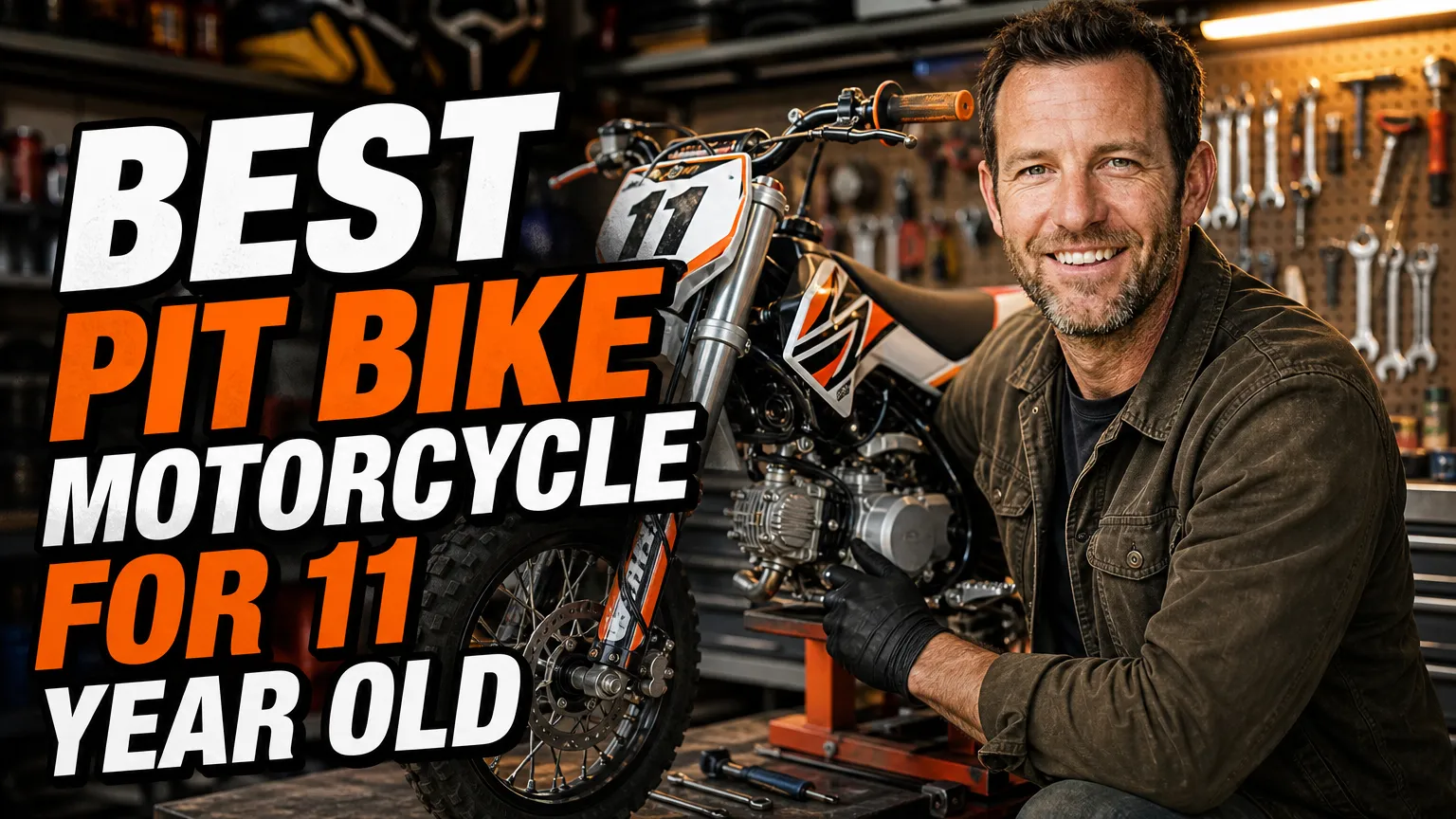
When I help choose a pit bike for an 11-year-old, I look beyond the engine size or the color of the plastics. A child needs to reach the controls comfortably, manage the bike’s weight, and have enough experience for its power and transmission. The right choice is the bike that fits the rider today, not the one that simply looks most like a full-size motocross machine.
My picks below range from approachable automatic-clutch 110s to larger manual-clutch models for taller, more experienced young riders. I’ve focused on established manufacturers and models with useful, checkable specifications; I also recommend confirming the latest details and pricing with a local dealer before buying.
- I’d start with the Honda CRF110F, Yamaha TT-R110E, or Kawasaki KLX110R for many new riders.
- I’d choose by inseam, confidence, and experience rather than age or displacement alone.
- The taller KLX110R L, CRF125F, TT-R125LE, and KLX140R suit riders who can manage their extra height or manual controls.
- I’d budget for a properly fitted helmet and protective gear, adult supervision, and a legal off-road riding area.
How I choose a bike for an 11-year-old
I start with fit. With the rider seated, I want them to reach the handlebars naturally, operate the brakes and throttle, and put their feet down with enough confidence to steady the bike. Seat height is a useful starting point, but the rider’s inseam, boots, suspension sag, and comfort all affect how a bike feels.
I also consider how the clutch works. Many 110cc trail bikes use an automatic clutch, so the rider can focus on throttle, shifting, braking, and balance without operating a hand clutch. A manual-clutch bike adds another skill to learn, which can be rewarding for a prepared rider but overwhelming for a beginner.
Finally, I check where the bike will be ridden. These are off-road machines, and local age, land-use, and supervision rules matter. I’d compare a pit bike with other off-road options in this dirt bike vs motorcycle guide, then confirm that the riding area allows the specific bike.
1. Honda CRF110F — My approachable all-around choice
I’d put the Honda CRF110F near the top of my list for a young rider who wants a manageable trail bike from a well-established manufacturer. Its 109cc air-cooled, fuel-injected four-stroke engine and four-speed transmission with an automatic clutch make it a practical option for learning without adding hand-clutch work right away.
Honda lists a seat height of about 26.3 inches, which can work for some younger riders, though I’d still check the actual fit in person. The CRF110F also has electric starting, a useful convenience when a rider is still building confidence. Its modest engine size doesn’t eliminate the need for careful throttle control or close supervision.
Why I’d consider it
I like the CRF110F as a first-bike candidate because its controls are relatively simple and its compact size is easier for many children to manage than a larger trail bike. I’d look at it for a new or developing rider who can comfortably handle its weight and reach the ground well enough to feel secure.
New-bike pricing varies by model year, dealer, and region, but I’d expect to compare it in roughly the mid-$2,000s to low-$3,000s before destination fees and taxes. I’d ask the dealer about current pricing, maintenance intervals, and any available throttle-limiting options for the specific model year.
2. Yamaha TT-R110E — A simple 110 for building skills
The Yamaha TT-R110E is another model I’d consider for a child who needs a compact, straightforward off-road bike. It has a 110cc air-cooled four-stroke engine, a four-speed transmission, and an automatic clutch, so the rider shifts gears without having to coordinate a hand clutch.
Its seat height is about 26.4 inches, close to the CRF110F’s, and it includes electric starting as well as a kick-start backup. That combination can make everyday use more convenient, especially when a young rider is learning how to start and operate a motorcycle.
Where I think it fits best
I’d shortlist the TT-R110E for a beginner who fits a small trail bike and wants to progress through the gears while keeping clutch operation simple. As with the Honda, I’d arrange a sit-on test rather than assuming that a published seat-height number guarantees a good fit.
In the U.S., I’d generally compare new TT-R110E listings around the mid-$2,000s to low-$3,000s, depending on model year and dealer costs. For a new rider, I’d put more emphasis on correct fit and instruction than on small differences between competing 110cc bikes.
3. Kawasaki KLX110R — My compact pick for learning off-road
I’d consider the Kawasaki KLX110R for a rider who wants a small bike with a friendly learning curve. Its 112cc air-cooled four-stroke engine pairs with a four-speed transmission and automatic clutch, giving the rider gears to learn without requiring manual clutch control.
Kawasaki lists the standard KLX110R with a seat height of about 26.8 inches. Its size and control layout make it a natural comparison with the CRF110F and TT-R110E, so I’d invite the rider to sit on all three if local dealers have them available.
My fit and value notes
I’d consider the KLX110R for a child who is ready to ride off-road but still benefits from a compact chassis and a simpler clutch setup. I’d also check the bike’s weight against the rider’s ability to pick it up or steady it, because a child may find even a modest motorcycle difficult to manage if it tips over.
Pricing changes with model year and location, but I’d budget roughly in the upper-$2,000s to low-$3,000s for a new example before fees. I’d confirm the exact specification with a Kawasaki dealer, particularly if I’m comparing it with the taller KLX110R L.
4. Kawasaki KLX110R L — A taller step up with a manual clutch
The KLX110R L is not just a taller version to buy automatically when a child grows. I’d look at it for a taller, more experienced rider who is ready for more involved controls: compared with the standard KLX110R, the L version has a higher seat, larger wheels, and a manual clutch.
Kawasaki lists the KLX110R L at about 28.7 inches of seat height, roughly two inches higher than the standard model. Its manual clutch can help a rider develop skills that transfer to larger motorcycles, but I wouldn’t make it a first choice for a child who hasn’t yet mastered braking, throttle control, and shifting.
When I’d choose the L
I’d choose this model only after checking that the young rider can reach and use the controls comfortably and understands the extra work of a hand clutch. If the rider is still learning basic balance and braking, I’d lean toward the standard KLX110R or another automatic-clutch 110 instead.
I’d expect the KLX110R L to cost more than the standard version, with new-bike prices often in the upper-$2,000s to mid-$3,000s before dealer fees. I’d verify the current year’s specifications and price, since equipment and retail pricing can change.
5. Honda CRF125F — A sensible move for a taller, capable rider
The Honda CRF125F is a step up in displacement and riding demands from a typical 110. It uses a 124.9cc air-cooled, fuel-injected four-stroke engine and a four-speed manual transmission, so I’d consider it for a taller 11-year-old who already has the coordination and experience to use a clutch.
The standard CRF125F has a seat height of about 29.1 inches. Honda also sells a Big Wheel version with larger wheels and a higher seat, so I’d make sure I’m comparing the exact model that fits the rider. The Big Wheel’s added height can be useful for a larger rider, but it is not automatically a better choice for every child.
My advice on moving up
I’d treat the CRF125F as a progression bike, not a default birthday purchase. Before choosing it, I’d ask whether the rider can operate a manual clutch smoothly, stop without panic, and handle the motorcycle’s height and weight when stationary.
New CRF125F pricing commonly sits around the mid-$3,000s to low-$4,000s, depending on standard versus Big Wheel trim, model year, and dealer fees. If I’m weighing engine size against experience, I’d also read about the best motorcycle engine size for beginners rather than assuming that more displacement is better.
6. Yamaha TT-R125LE — A manual-clutch option for growing riders
I’d look at the Yamaha TT-R125LE for a taller young rider who is ready to manage a manual clutch and a larger trail-bike layout. It has a 124cc air-cooled four-stroke engine, a five-speed transmission, and electric starting, which makes it a more involved option than the 110cc automatic-clutch bikes above.
Its seat height is about 31.7 inches, so I’d check fit particularly carefully for an 11-year-old. A child who can sit on the bike and touch the ground may still struggle to stop, turn, or recover from a loss of balance. I’d want to see confident control during a supervised fit check, not just a successful reach to the ground.
Who I’d put on this Yamaha
I’d reserve the TT-R125LE for a confident rider with prior experience and a suitable inseam. Its five-speed manual transmission can support skill development, but I’d prefer the smaller automatic-clutch models for a beginner who is still learning the basics.
I’d compare new-bike listings in approximately the mid-$3,000s to low-$4,000s before fees, checking current local dealer prices. Displacement alone doesn’t predict a safe pace: terrain, gearing, rider skill, and supervision all matter. I’d use top-speed articles such as how fast can a 150cc motorcycle go unleashing top speeds as context, not as a target for a child.
7. Kawasaki KLX140R — My larger option for an experienced, tall rider
The Kawasaki KLX140R is the largest and most demanding bike on my list for an 11-year-old. It has a 144cc air-cooled four-stroke engine, a five-speed transmission, and a manual clutch, so I’d consider it only for a taller, experienced young rider who has already developed good off-road control.
The standard KLX140R’s seat height is about 30.7 inches, and Kawasaki also offers larger-wheel variants with different dimensions. I’d check the exact version and fit in person. A bigger chassis can feel more natural for a growing rider, but its weight, height, and manual controls can make it a poor match for a smaller beginner.
Why I’d be cautious
I wouldn’t buy the KLX140R just because an 11-year-old is enthusiastic or wants a bike that will last longer. I’d choose it only if the rider can operate the clutch, shift smoothly, brake consistently, and handle the motorcycle in the type of terrain where they’ll ride.
Depending on trim and model year, I’d expect new pricing to fall around the mid-$3,000s to mid-$4,000s before fees. I’d treat higher-displacement speed comparisons, including how fast can a 300cc motorcycle go and how fast can a 500cc motorcycle go, as general motorcycle reading rather than useful benchmarks for a young pit-bike rider.
My final checklist before buying
I’d start with a supervised sit-on test and check that the rider can reach the controls and steady the bike. I’d match the motorcycle to the child’s actual experience, not their age alone, and I’d choose an automatic-clutch model if adding clutch operation would distract from the basics.
I’d budget for a certified, correctly fitted helmet, goggles, gloves, boots, and protective clothing before spending extra on upgrades. I’d also confirm local riding rules, use an approved off-road area, and provide close adult supervision. For me, those steps are just as important as choosing between a 110cc and a 125cc bike.
For many first-time riders, I’d begin by comparing the Honda CRF110F, Yamaha TT-R110E, and Kawasaki KLX110R. I’d move to a KLX110R L, CRF125F, TT-R125LE, or KLX140R only when the rider’s size, experience, and control skills make that step appropriate.
Frequently Asked Questions
What size pit bike is best for an 11-year-old?
I’d start by checking the rider’s inseam, confidence, and experience, not age alone. A 110cc model may suit a smaller beginner, while a taller or more experienced rider may fit a 125cc model.
Is a 110cc pit bike suitable for a beginner?
It can be, if the rider fits the bike and has adult supervision. I’d also look for manageable controls, a throttle limiter where available, and a safe place to practice.
Should I choose an automatic-clutch or manual-clutch pit bike?
I’d favor an automatic-clutch model for a beginner who is still learning throttle, braking, and balance. A manual-clutch bike can make sense once the rider is ready to learn shifting and clutch control.
Can an 11-year-old ride a pit bike on public roads?
These bikes are generally intended for off-road use, not public-road riding. I’d check local laws and ride only in an authorized area with suitable protective gear and adult supervision.

Related Articles

8 Comfortable, Confidence-Inspiring Motorcycles for Riders in Their 70s
Explore eight manageable motorcycles for riders in their 70s, with seat heights, weights, features, and practical advice for choosing a…
Jake Miller
12 min read

7 Approachable Motorcycles for Comfortable, Confident Riding at 65
Compare seven approachable motorcycles for comfort, weight, seat height, power and value, plus my practical test-ride checklist for choosing confidently…
Jake Miller
13 min read

7 Best Motorcycles for a 55-Year-Old Who Wants Comfort and Confidence
I compare seven approachable motorcycles for riders in their 50s, with real specs, comfort notes, price ranges, and practical advice…
Jake Miller
12 min read