
8 Best Motorcycle Chains for Long-Distance Touring: Picks I’d Trust With 5,000 Miles
 Jake Miller
8 min read
Jake Miller
8 min read
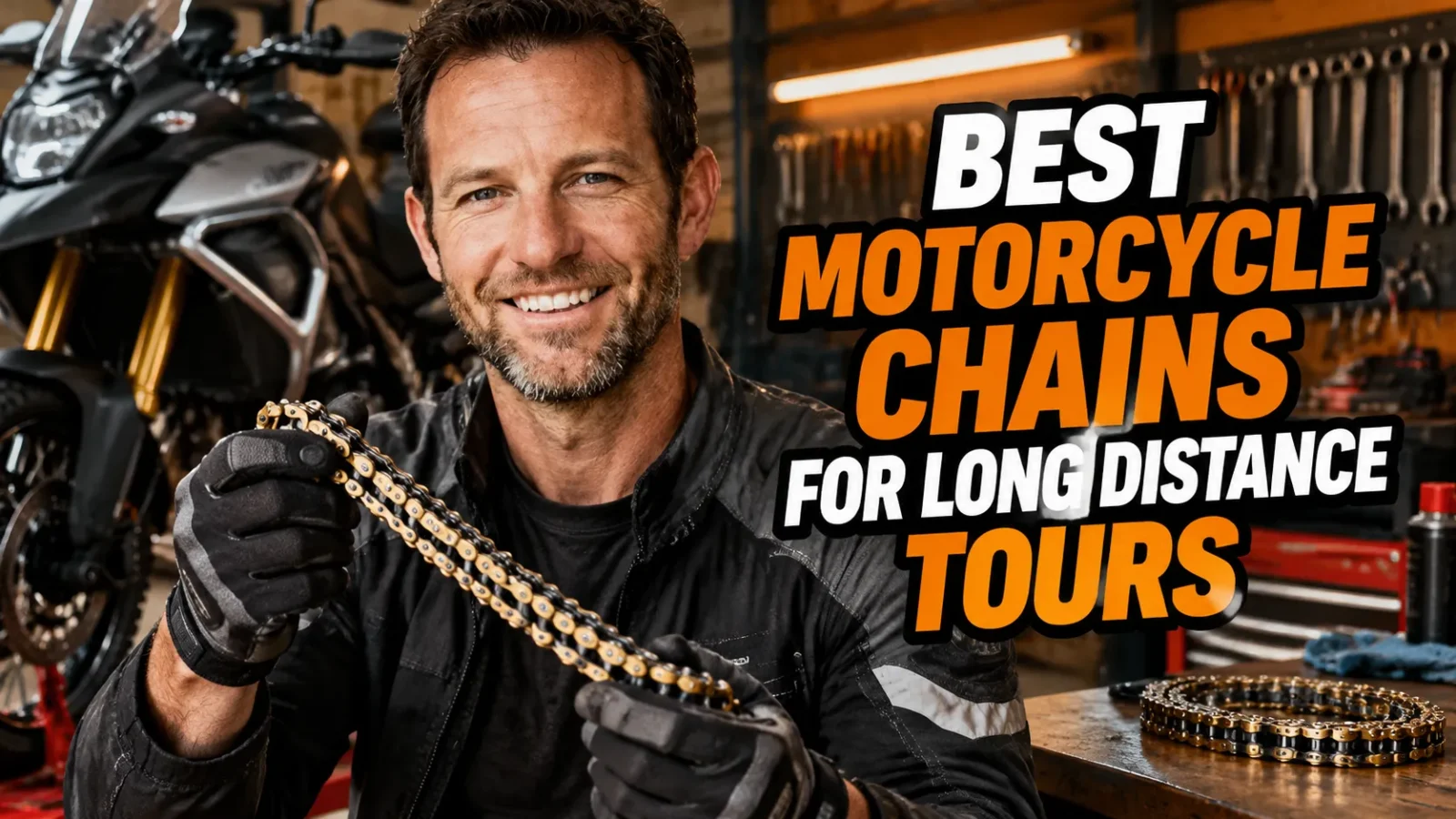
I’ve burned through more chains than I care to admit. Some died at 8,000 miles because I was lazy with lube. Others are still going strong past 25,000. The difference was almost never the bike — it was the chain I bolted on and how I treated it.
Long-distance touring is brutal on a final drive. You’re running loaded, at sustained highway speed, often in rain or dust, sometimes with a pillion and luggage pushing the bike well past its design weight. A cheap chain that feels fine on weekend rides will stretch and kink its way through your trip.
Below are the chains I’d actually trust on a multi-thousand-mile run, ranked by how they’ve performed for me and by the reputation they’ve earned in touring circles. I’ll be honest about price, wear life, and where each one makes sense.
- My overall pick is the D.I.D 530 ZVM-X2 — the strongest, longest-lasting chain I’ve run on a loaded tourer.
- For sealing and wet-weather touring, the RK 530 XSOZ1 and EK 530 SRX2 are the two I’d shortlist next.
- On a budget, the D.I.D 530 VX3 and JT 530 X1R punch well above their price.
- Match the pitch to your bike: 530 for big tourers and cruisers, 525 for mid-size adventure bikes.
- Always replace chain and sprockets together, and carry a spare rivet master link on tour.
What Separates a Great Touring Chain From a Decent One
Three things matter most: tensile strength, seal design, and how well the chain holds lubricant over thousands of miles. Tensile strength tells you how much load the plates and pins can take before they start stretching. On a fully loaded tourer, that margin matters.
Seal design is the quieter hero. O-rings keep factory grease in and grit out. X-rings do the same job with less friction because the seal deforms in two contact patches instead of one. XW-rings and Quadra-X rings take that idea further with wider or four-point sealing.
Finally, there’s serviceability. A touring chain needs a rivet-style master link, not a clip link. Clip links are fine for a paddock bike, but I’ve seen them shed at highway speed, and that’s a trip-ending event.
1. D.I.D 530 ZVM-X2 — Best Overall for Big Mileage
If I could only recommend one chain for long-distance touring, it would be the D.I.D 530 ZVM-X2. D.I.D rates it north of 10,000 pounds of tensile strength, which is enormous headroom for even a fully loaded sport-tourer or big V-twin.
In my experience, the ZVM-X2’s X-ring seals are what make it special. The chain runs cooler and quieter than cheaper alternatives, and I’ve had one go past 22,000 miles with nothing more than regular cleaning and lube. That’s genuinely rare.
It comes in gold or natural steel finishes, typically in 120 and 130 link lengths. Expect to pay roughly $140 to $170 depending on length and where you buy. Yes, that’s expensive. But spread over 20,000-plus miles, it’s cheaper per mile than three budget chains.
Who it’s for
Riders doing serious mileage on liter-class tourers, big adventure bikes, or torque-heavy cruisers. If your bike eats chains every 10,000 miles, this is the fix.
2. RK 530 XSOZ1 — Best XW-Ring Sealing
The RK 530 XSOZ1 uses RK’s XW-ring seal, which is essentially a wider X-ring with more sealing surface. For wet-weather touring — and let’s be honest, that’s most touring — that extra sealing makes a real difference.
Tensile strength sits just under 10,000 pounds, so it’s right in the same league as the D.I.D. I’ve run this chain through days of steady rain in the Pacific Northwest and found far less grit migration into the pins than with a basic O-ring chain.
RK Takasago has been making chains for decades, and the XSOZ1 is their flagship 530 touring option. Pricing usually lands around $130 to $160. It’s a brilliant choice if your trips tend to involve weather.
3. EK 530 SRX2 — Best for Torque-Heavy Tourers
EK’s 530 SRX2 uses their Quadra-X Ring seal, which has four points of contact instead of two. The theory is better sealing and better grease retention, and in practice it holds up well on high-torque bikes.
Tensile strength is around 10,000 pounds. I ran this on a big-bore V-twin tourer and it never showed the classic early-stretch symptoms you get from weaker chains under heavy throttle in top gear.
Expect to pay roughly $120 to $150. It’s available in natural steel and gold, and I’d happily run it coast to coast.
4. D.I.D 530 VX3 — Best Value X-Ring
Not everyone wants to spend $170 on a chain. The D.I.D 530 VX3 is the smart compromise: a genuine D.I.D X-ring chain with roughly 9,200 pounds of tensile strength, usually for $85 to $110.
I’ve used the VX3 on a mid-weight sport-tourer and got around 15,000 miles out of it. That’s not ZVM-X2 territory, but it’s outstanding for the money.
If you tour a few thousand miles a year rather than living on the road, this is the chain I’d tell you to buy without hesitation.
5. Regina 530 ZRP — Best for Heavyweight Cruisers
Regina is an Italian chain maker with a long history in OEM fitment on European tourers. Their Z-Ring line, including the 530 ZRP, is built for heavy bikes that put constant load through the drivetrain.
The Z-ring design uses a Z-shaped seal that Regina claims reduces friction while improving grease retention. On heavyweight cruisers and big sport-tourers, I’ve found the wear rate impressively linear — no sudden stretch spikes mid-life.
Pricing runs higher, often $150 to $190. It’s a premium buy, but for a bike that weighs 700 pounds before you add luggage, the extra sealing is worth it.
6. Tsubaki 530 Omega — Best O-Ring Workhorse
Not every touring chain needs to be an X-ring. The Tsubaki 530 Omega is a Japanese-made O-ring chain that does the boring thing extremely well: it lasts, and it doesn’t cost a fortune.
Tsubaki’s manufacturing quality is genuinely excellent, and the Omega’s quad-riveted pins resist the fatigue cracking that kills cheap chains. I’ve seen these run well past 18,000 miles with disciplined maintenance.
Expect around $100 to $125. If you want the X-ring version, Tsubaki’s Sigma line is the sibling to look at, but the Omega remains my pick for riders who’d rather spend the savings on fuel.
7. JT 530 X1R — Best Budget Pick
JT Sprockets is best known for sprockets, but their X1R chain is a legitimate budget touring option. It’s an X-ring chain at roughly $60 to $80, which is remarkable value.
It won’t match a D.I.D or RK for total life — I’d expect 10,000 to 14,000 miles with good care — but it’s a solid, dependable chain that gets you home. For a second bike or a bike you ride seasonally, it’s ideal.
Pair it with JT sprockets and you’ve got a complete drivetrain refresh for the price of one premium chain.
8. EK 525 ZVX3 — Best for Mid-Size Adventure Tourers
Plenty of touring bikes don’t use a 530 at all. Mid-size adventure tourers like the Suzuki V-Strom 650 and BMW F750GS run a 525, and the EK 525 ZVX3 is my go-to for that pitch.
It uses EK’s X-ring sealing with roughly 8,800 pounds of tensile strength — plenty for a 650 to 850cc twin carrying luggage. Typical pricing is $110 to $130, usually in 118 or 120 link lengths.
I’ve run this on a V-Strom through a 4,000-mile trip with zero adjustment needed beyond the initial break-in stretch. That’s exactly what you want from a touring chain.
Don’t Forget the Rest of the Drivetrain
A chain is only one part of a system. Worn sprockets, a tired countershaft bearing, or a misadjusted clutch can all make a brand new chain feel terrible within a few hundred miles.
On belt-driven and shaft-driven tourers — including most Harley-Davidson touring models — you won’t be buying a chain at all, but the maintenance mindset still applies. If you’re chasing down harley davidson transmission problems on a long ride, you’ll quickly learn that drivetrain noise is rarely just one component.
Clutch condition matters too. Knowing when to do a clutch adjustment on harley davidson models can be the difference between smooth shifts and a slipping, juddering mess halfway through a tour.
And it’s genuinely useful to understand how does a wet clutch work, because a dragging clutch puts shock loads through your final drive that no chain — however strong — was designed to absorb.
My Buying Checklist Before You Order
Match the pitch exactly
Check your owner’s manual. A 530 chain will not fit a 525 sprocket. Getting this wrong is the single most common ordering mistake I see.
Buy longer than you need
Chains come in fixed lengths. If your bike needs 110 links, buy 120 and cut it down with a chain breaker. That way you’ve always got spare links for emergencies.
Insist on a rivet master link
For touring, rivet every time. Carry a spare master link and a small chain tool in your kit — it weighs almost nothing and can save an entire trip.
Replace sprockets at the same time
A hooked front sprocket will destroy a new chain in a few thousand miles. Do the whole set. Your wallet will thank you later.
Final Thoughts
If you want the short answer: the D.I.D 530 ZVM-X2 is the chain I’d put on any big touring bike tomorrow. If weather is your nemesis, go RK 530 XSOZ1. If budget rules, the D.I.D 530 VX3 is the smart money.
Whatever you choose, the maintenance matters more than the badge. Clean it, lube it every 500 miles, check your slack, and even a mid-priced chain will carry you a very long way. Ignore it, and the most expensive chain in the world will let you down in the middle of nowhere.
Frequently Asked Questions
How long should a motorcycle chain last on a long tour?
A quality X-ring or XW-ring chain typically lasts 15,000 to 25,000 miles if you clean and lube it every 500 miles. On a long tour, carry a spare rivet master link and check slack daily.
Are O-ring or X-ring chains better for touring?
X-ring chains generally seal better and run with less friction, so they last longer. That said, a well-made O-ring chain like the Tsubaki 530 Omega is still a solid, affordable choice for touring.
Do I need to replace my sprockets with a new chain?
Yes, ideally. A hooked or worn sprocket will chew through a brand new chain in a few thousand miles, so I always replace chain and sprockets as a matched set.
What chain size do most touring bikes use?
Most big touring bikes and cruisers run a 530 chain, mid-size adventure tourers often use a 525, and many sport-tourers and smaller ADV bikes use a 520.

Related Articles

Motorcycle Chain Keeps Getting Loose? Why It Happens and How I Finally Fixed It
Motorcycle chain keeps getting loose no matter how often you adjust it? I break down the causes, from worn sprockets…
Jake Miller
10 min read

Loose Motorcycle Chain Symptoms: 9 Warning Signs I Learned the Hard Way
Loose motorcycle chain? I walk through the symptoms I've felt and heard, how to measure slack in 5 minutes, and…
Jake Miller
11 min read

Motorcycle Clutch Problems Symptoms: 9 Warning Signs I Wish I’d Caught Sooner
Slipping, dragging, or a mushy lever? I break down the real motorcycle clutch problems symptoms I've found on my own…
Jake Miller
10 min read