
6 Best 1000cc-Class Motorcycles for Beginners: Tame, Friendly Big Bikes
 Jake Miller
8 min read
Jake Miller
8 min read
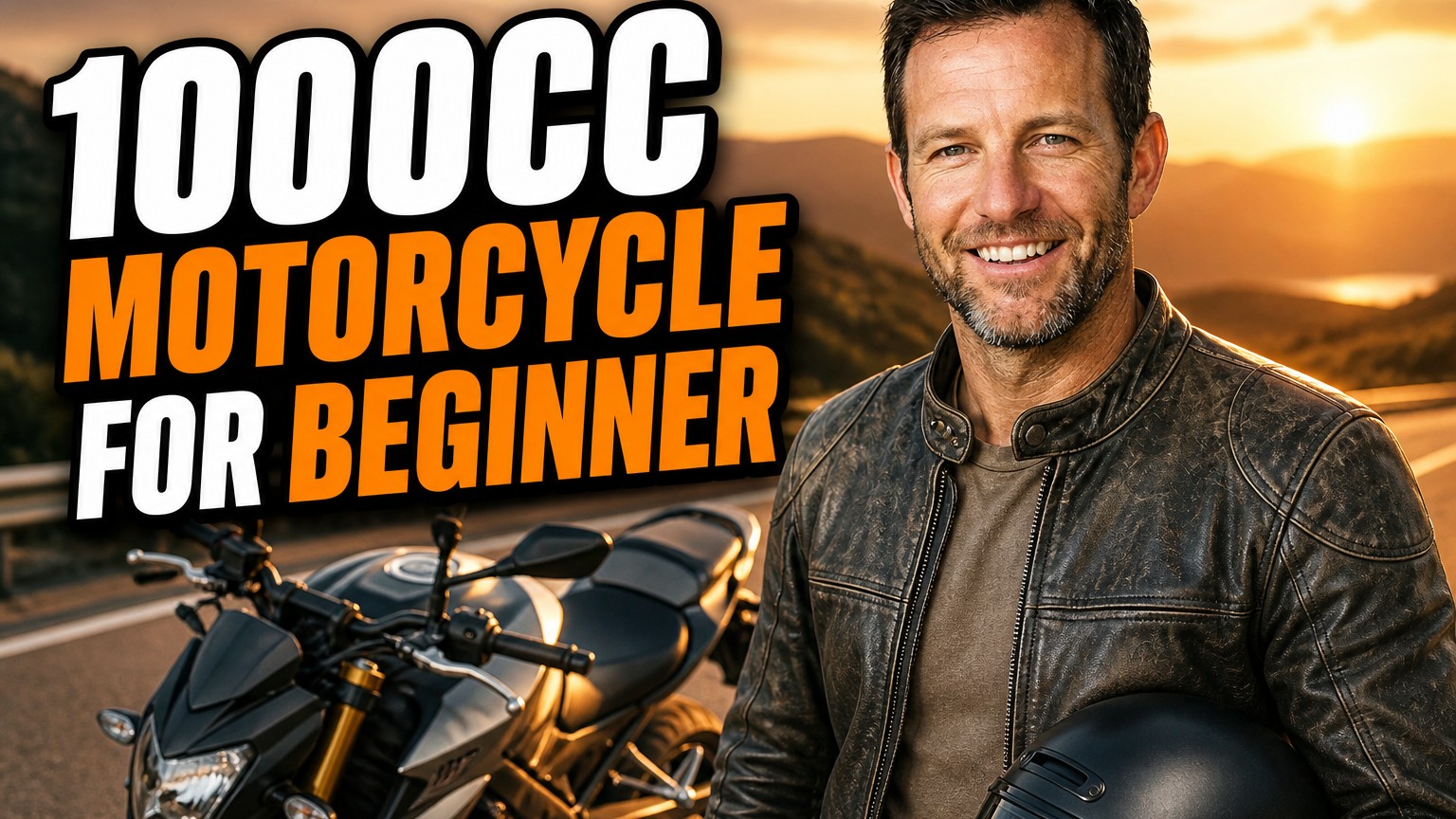
I’ll be honest up front: a 1000cc motorcycle is not the classic recommendation for a first bike. Most experienced riders, me included, will tell you to start smaller. But I also know that plenty of people walk into a dealership with real budget, real maturity, and a strong desire to buy once.
If that’s you, the good news is that “1000cc” doesn’t automatically mean “dangerous.” Some big-displacement bikes are smooth, heavy-but-balanced, and loaded with rider aids. Others are track weapons that will bite a newcomer fast.
I’ve put together the six big-bore bikes I’d actually feel comfortable recommending to a new rider. I’m including a few that sit slightly above 1000cc, because that’s where the friendliest options live.
- My top pick for most new riders is the Honda Rebel 1100 (DCT): low seat, mellow power, easy to ride.
- Look for traction control, ride modes, ABS, and a smooth torque curve, not just a big number on the spec sheet.
- Avoid superbikes and aggressive naked bikes (CBR1000RR, R1, MT-10) as a first machine.
- Budget for gear, training, and maintenance on top of the sticker price.
How I Chose These Beginner-Friendly Big Bikes
I judged each bike on how it behaves at low speed, in traffic, and when I’m tired or distracted. Peak horsepower barely factored in. A bike that is easy to ride slowly will teach you more than one that is thrilling at 120 mph.
My Selection Criteria
- Throttle and power delivery: smooth, linear, and predictable.
- Seat height and weight: can a newer rider flat-foot it and push it around a parking lot?
- Electronics: traction control, cornering ABS, selectable ride modes.
- Comfort: upright ergonomics so you can focus on learning.
- Real-world availability: every bike here is a current, widely sold model.
1. Honda Rebel 1100 DCT — Best Overall for New Riders
If you made me pick one big-bore bike for a beginner, it would be the Honda Rebel 1100. It uses the 1,084cc parallel twin from the Africa Twin, but it’s tuned for low-end grunt rather than top-end fireworks. Power is strong yet very easy to manage.
The seat height is about 27.5 inches, which is a huge confidence boost at stoplights. The cruiser-style ergonomics put you in a relaxed, upright position that feels natural from day one.
Why I Love the DCT Version
The optional Dual Clutch Transmission is the star here. There’s no clutch lever to stall, so you can concentrate on steering, braking, and traffic. I’ve seen nervous new riders relax within minutes on this setup.
You also get ride modes, torque control, and cruise control on the Rebel 1100. Expect to pay roughly $9,500 to $10,500 depending on year and transmission.
Things to Consider
It’s heavy at around 500 pounds, so practice parking-lot maneuvers early. Once it’s moving, though, the weight sits low and feels stable.
2. Honda NT1100 — Best for Commuting and Touring
The Honda NT1100 is the sensible adult in this lineup. It shares that same 1,084cc twin, but it’s wrapped in a comfortable sport-touring package with a windscreen, hand guards, and a relaxed riding position.
I like this bike for riders who plan to commute and take the occasional weekend trip. The power is tractable and the electronics are excellent. Honda’s throttle-by-wire system with multiple riding modes lets you soften the response while you learn.
Specs and Price
- Engine: 1,084cc parallel twin
- Seat height: around 32 inches, with adjustability
- Transmission: 6-speed manual or DCT
- Typical price: about $12,000 to $13,500
At that seat height, shorter riders may find it tall at first. The DCT version again makes the learning curve gentler, and the wind protection means less fatigue on longer rides.
3. Suzuki V-Strom 1050 — Best Adventure-Style Pick
The Suzuki V-Strom 1050 has a 1,037cc V-twin with a famously friendly, torque-rich character. It pulls cleanly from low revs and doesn’t snap at you when you twist the throttle.
What really sells it for newer riders is the electronics package. You get traction control, cornering-aware ABS, a low-RPM assist function, and selectable ride modes. That low-RPM assist helps prevent stalls when you’re pulling away.
The Trade-Offs
Seat height is roughly 33 inches, so it’s tall for shorter riders. It’s also a big, upright machine that takes practice at walking pace.
That said, the geometry is predictable and the riding position is comfortable. Expect pricing around $14,000 to $15,500 for the standard model, depending on trim.
4. Kawasaki Ninja 1000SX — Best Sport-Touring Option With Safety Tech
I know, “Ninja” and “beginner” in the same sentence makes people nervous. But the Kawasaki Ninja 1000SX is more refined sport-tourer than raw superbike. Its 1,043cc inline-four makes strong, linear power with a very smooth throttle.
The riding position is more upright than a true sportbike, and the windscreen is adjustable. Think of it as a fast but civilized grand tourer.
Electronics That Help
Kawasaki fits an IMU-based electronics suite with cornering management, traction control, multiple power modes, and a quickshifter. A TFT display and cruise control are standard too.
Choose the lowest power mode and keep it there for your first few months. Pricing sits around $13,500 to $15,000. I’d recommend this one to riders with some confidence, or those who commit to training and restraint.
5. Suzuki GSX-S1000GT — Best for Comfort-First Riders
The Suzuki GSX-S1000GT is built around a 999cc inline-four derived from a legendary Suzuki sportbike engine. Despite that pedigree, it’s tuned for touring comfort, with a roomy seat, upright bars, and a large windscreen.
The motor is smooth and revvy. It has serious power, but traction control and selectable ride modes help tame it. I’d run it in the softest setting while learning.
Who It Suits
This is a good match for taller riders who want a comfortable all-day machine. The seat height is around 32 inches, with a comfortable reach to the bars.
Expect to pay in the range of $13,000 to $14,500. It’s heavier and more powerful than the Honda picks, so I’d put it a step above them in difficulty.
6. Honda Africa Twin CRF1100L — Best for Tall, Adventure-Minded Beginners
The Honda Africa Twin CRF1100L uses the 1,084cc twin that powers the Rebel and NT, but here it’s tuned for adventure riding. It’s smooth, tractable, and has legendary reliability.
Honda’s electronics suite is excellent. You get multiple ride modes, adjustable traction control, wheelie control, and cornering ABS. The optional DCT works beautifully off-road and in traffic.
The Big Catch
Seat height is the issue. At roughly 33.9 to 34.8 inches, it’s genuinely tall, and the bike is heavy. A lower seat option exists, but I’d only recommend this bike if you have the inseam for it.
Pricing starts around $15,000 and climbs with options. For the right rider, it’s a bike you can grow into and keep for a decade.
What I’d Avoid as a First 1000cc Bike
I’d steer clear of full-on superbikes like the Honda CBR1000RR, Yamaha YZF-R1, or aggressive nakeds like the Yamaha MT-10. They’re astonishing machines, but their power, crouched ergonomics, and sharp throttle response leave very little margin for beginner mistakes.
Even with traction control, physics still wins. Electronics help, but they don’t replace skill.
Buying Advice I Wish Someone Had Given Me
Set Aside Money for Gear and Training
Budget at least $1,000 to $1,500 for a quality helmet, jacket, gloves, pants, and boots. Then take a rider-training course. It’s the best money you’ll spend, and some insurers offer discounts for it.
Consider Buying Used
Many of these models hold their value, but a lightly used example can save thousands. Just inspect it carefully and check for crash damage. Dropping a bike while learning is common, so a cosmetic scratch on a used one hurts less.
Test Ride Before You Commit
Sit on every bike. Check whether you can flat-foot it, and see how the clutch and throttle feel. If a dealer lets you do a slow-speed U-turn in a parking lot, that tells you more than any spec sheet.
Keeping Your Big Bike Healthy: Oil Basics
Large engines reward good maintenance. Fresh oil is the cheapest insurance you can buy, and it affects clutch feel, shifting, and engine life.
If you’re researching your options, I found this guide to the best motor oil for 4 stroke motorcycle a helpful starting point. You can also compare viewpoints in this rundown of the top engine oil for 4 stroke motorcycle options.
Choosing the Right Oil
Always follow your owner’s manual for viscosity and specification. Most bikes with a wet clutch need JASO MA or MA2-rated oil, not automotive oil with friction modifiers.
For another angle, this article on what is the best engine oil for 4 stroke motorcycle breaks down the basics well. And if you want a broader overview, see this piece on the best engine oil for motorcycle use.
Riders outside the US may also like this resource on the best engine oil for 4 stroke motorcycle in india, which covers locally available options.
My Final Thoughts
A 1000cc-class bike can work as a first motorcycle, but only if you pick the right one and ride with humility. For me, the Honda Rebel 1100 DCT is the clear winner for approachability. The NT1100 and V-Strom 1050 follow close behind.
Start in the gentlest power mode, take a training course, and build your skills gradually. The bike will still be fast a year from now, and you’ll be a much better rider when you finally want to use all of it.
Ride safe, and enjoy the journey.
Frequently Asked Questions
Is a 1000cc motorcycle too powerful for a beginner?
It can be, but engine size alone doesn’t decide it. Power delivery, weight, electronics, and seat height matter more. A bike like the Honda Rebel 1100 has a big engine but a gentle, torquey character and a low seat, so it’s far more forgiving than a 1000cc superbike.
Which 1000cc bike is easiest for a new rider?
In my experience, the Honda Rebel 1100 DCT is the easiest. It has a low seat, an optional automatic-style transmission, and smooth power. The Honda NT1100 is a close second if you want a touring-friendly option.
Should I take a safety course before riding a 1000cc bike?
Yes. Take a recognized rider-training course first, wear full protective gear, and spend your first few months in low-traffic areas. Skills matter more than displacement.
Do bigger bikes need special engine oil?
Most modern 1000cc four-stroke bikes use a JASO MA-rated motorcycle-specific oil in the viscosity listed in the owner’s manual, commonly 10W-30 or 10W-40. Always check your manual and change oil on schedule.

Related Articles
7 Best Batteries for Motorcycles I’ve Tested and Trust in 2026
I've tested dozens of motorcycle batteries to find the best performers. From AGM to lithium, here are my top picks…
Jake Miller
15 min read

The Perfect Battery for Your Harley Davidson Softail: A Rider’s Complete Guide
Discover the perfect battery for your Harley Davidson Softail. I've tested multiple options and share real-world performance data, maintenance tips,…
Jake Miller
14 min read

The Best Battery for Your Harley Davidson: My Complete Guide After Years of Testing
Discover which battery truly performs best for Harley Davidson motorcycles. Real rider experience with AGM, lithium, and OEM options to…
Jake Miller
12 min read