
7 Best Battery Maintainers for Motorcycles: Trickle Chargers That Actually Keep Your Bike Alive
 Jake Miller
14 min read
Jake Miller
14 min read
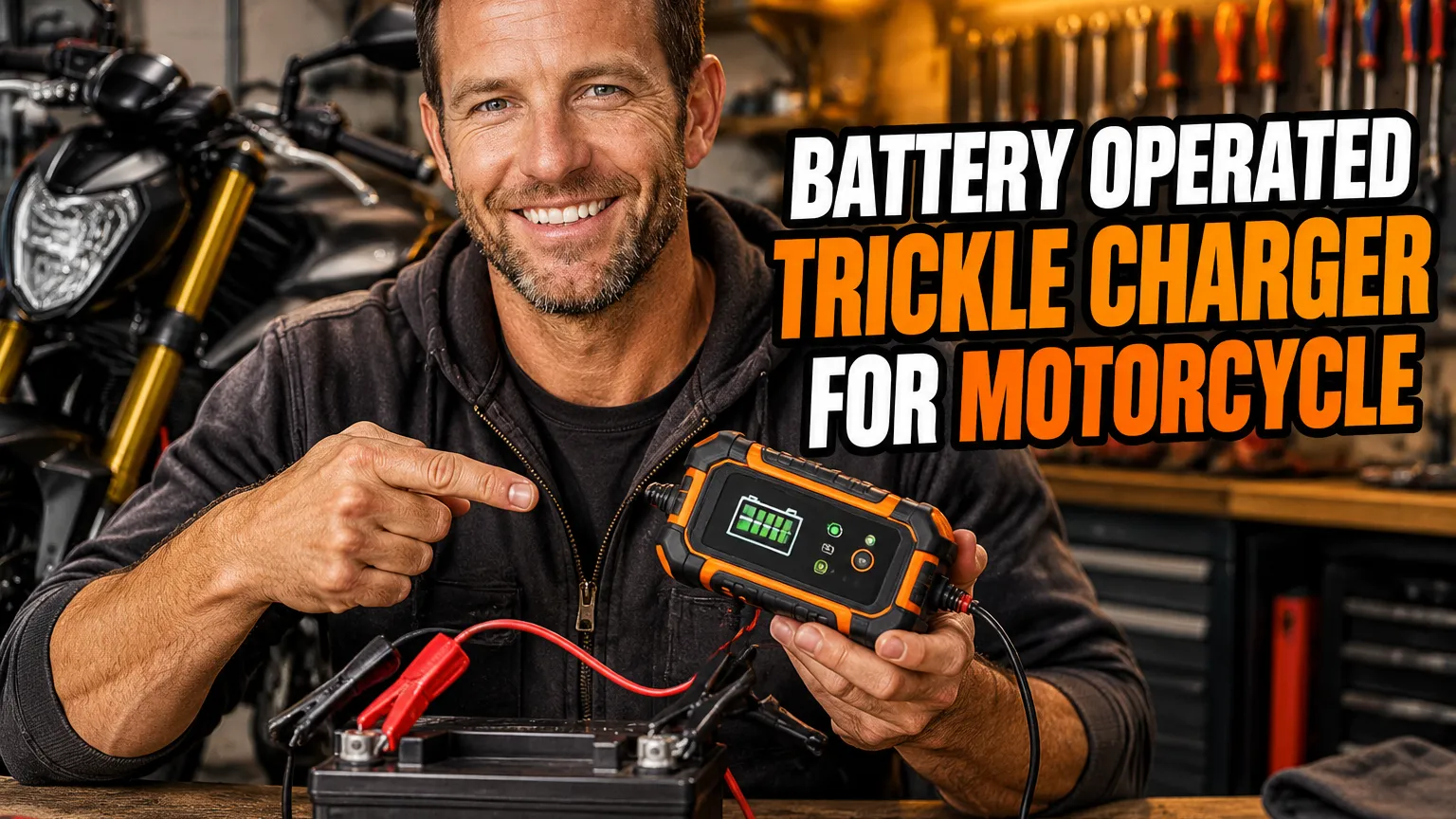
I’ve killed more motorcycle batteries than I care to admit. Not by riding too much — by letting bikes sit. A month of cold garage time, a few parasitic draws from the clock and the ECU, and that beautiful Sunday morning turns into a click-click-click and a push to the nearest hill.
After burning through three batteries in two seasons, I finally did what I should have done years ago: I bought a maintainer and left it plugged in. Then I bought a few more, because I wanted to know which ones were actually worth the money and which were just a plastic box with a light on it.
What follows is my honest rundown of the battery-operated trickle chargers and maintainers I’ve run on my own bikes — a carb’d twin that sits all winter, a fuel-injected sportbike, and a big cruiser with a notoriously thirsty electrical system. These aren’t spec-sheet guesses. I’ve lived with every one of these.
One quick note before we start: a maintainer is only as good as the battery it’s attached to. If yours is already sulfated and reading 9 volts, no charger on this list will save it. I’ve written separately about picking the best battery brand for motorcycle use, and if you’re not sure what chemistry you’re working with, start with what is the best battery for a motorcycle before you spend money on charging gear.
- Best overall: Battery Tender Junior 800 — dead simple, rock solid, under $40, and mine has survived six years of garage abuse.
- Best for multiple bikes: Battery Tender 4-Bank — charge four bikes from one wall outlet without buying four separate units.
- Best tech-forward pick: NOCO GENIUS1 — force-mode recovery, temperature compensation, and it’ll charge lithium.
- Best cheap insurance: Battery Tender 021-0123 (1.25A) or the Schumacher SP1297 if you want Bluetooth voltage monitoring.
- Key rule: 0.75A–1.5A is the sweet spot for motorcycle batteries. Bigger isn’t better unless you’re reviving a dead one.
1. Battery Tender Junior 800 — My Default Answer for Almost Everyone
If you asked me to recommend one charger and then walked away before I could finish, this is what I’d shout after you. The Battery Tender Junior 800 is a 12V, 800mA smart maintainer, and it’s the unit that I’ve had bolted to the most bikes over the years.
The 800mA output is the reason it works so well. It’s slow enough to be gentle on a small 12Ah motorcycle battery, but it’s not so slow that it takes a week to bring a partially discharged battery back up. I’ve put one on a battery at 11.8 volts and had it back to full float in about a day and a half.
What I Actually Like About It
The Junior 800 is four-stage: it does a bulk charge, then absorption, then float, then a maintenance pulse if voltage drops. That last stage is the whole point. It’s not constantly pushing current at your battery — it wakes up, checks, tops off, and goes back to sleep.
It also has reverse polarity protection and a spark-proof connection, which matters more than people admit. I’ve connected mine in the dark, in a cold garage, with gloves on, more than once. It has never complained.
The unit ships with both ring terminals and alligator clips, so you can permanently install the ring leads on your battery and just plug in the SAE connector whenever you park. That’s how mine is set up on the cruiser, and it takes me four seconds to hook up.
Where It Falls Short
No temperature compensation, and it won’t do a desulfation or repair cycle. If you’ve got a deeply neglected battery, this isn’t the tool — it’ll just tell you the battery is bad and refuse to charge it, which is honestly the correct behavior but frustrating when you’re trying to rescue something.
It also won’t charge lithium. If you’ve gone to a lithium battery, look elsewhere on this list. For everything else — flooded lead-acid, AGM, gel — it’s the benchmark.
2. NOCO GENIUS1 — The One I Reach For When a Battery Is Questionable
The NOCO GENIUS1 is the charger I grab when I don’t know what I’m dealing with. It’s a 1-amp unit with a genuinely impressive feature set for the price, and it’s the one I’ve used most successfully on batteries that other chargers refused to touch.
What sets it apart is Force Mode. If a battery has dropped below the threshold where the charger’s safety logic will engage — usually around 1 to 2 volts on a 12V battery — the GENIUS1 lets you deliberately override that and push a small charge in to wake it up. I’ve rescued two batteries this way that the Battery Tender walked away from.
The Tech That Justifies the Price
It’s a nine-step charging profile with built-in desulfation, and it does temperature compensation — the charger adjusts voltage based on ambient temperature, which is genuinely important in an unheated garage in February.
It handles 6V and 12V, and it’ll do lead-acid, AGM, gel, and lithium (both LiFePO4 and standard lithium-ion). That’s a lot of chemistry coverage in a unit that’s smaller than a paperback.
The integrated thermal sensor and the IP65 water resistance rating mean I don’t panic if I leave it in a damp shed. Mine lives on a shelf next to a leaky window and has been fine for three years.
The Honest Downsides
The GENIUS1 is more expensive than the Basic Battery Tender, sometimes by double, and for a straightforward battery that just needs topping off, that money is wasted. You’re paying for the recovery features and the chemistry flexibility.
I also find the LED indicator system slightly cryptic. There’s a lot of flashing and color-coding to interpret, and I still pull up the manual occasionally. The Battery Tender’s simple red-light/green-light system is easier to read at a glance.
3. Battery Tender 4-Bank Charger — Because I Own More Bikes Than Sense
At some point I crossed the line from “a few bikes” into “a storage problem,” and the 4-bank charger became non-negotiable. This is the 022-0148-DL-WH, a four-channel unit that charges and maintains four 12V batteries simultaneously, each on its own independent 1.25A circuit.
Independent channels are the critical detail. I’ve got a lead-acid battery on bank one, an AGM on bank two, and a lithium on bank three, and each one gets its own charge profile and its own status light. The unit doesn’t average them or share current between banks.
Why It Made My Life Easier
Before this, I had four separate chargers plugged into a power strip with four wall warts hanging off it like a bad Christmas tree. The 4-bank consolidated all of that into a single box with a single cord.
Each channel has its own reverse-polarity and short-circuit protection, and if one channel faults out, the others keep going. I’ve had one bank throw an error on a dead battery while the other three hummed along happily.
It comes with four sets of ring terminals and four sets of alligator clips — enough to permanently wire all four bikes.
Who Should Skip It
If you own one or two bikes, don’t buy this. It’s roughly four times the price of a single Junior 800, and you’ll be paying for capacity you don’t use. It also takes up real bench space — it’s a substantial box, not a pocket-sized dongle.
And there’s no lithium-specific mode on the standard version, so if your whole fleet is lithium, look at the lithium-compatible variant instead.
4. Schumacher SP1297 — The One With the App
I’m skeptical of app-connected gear as a rule, but the Schumacher SP1297 won me over because the app does exactly one useful thing: it tells me the battery voltage remotely, on demand.
This is a 1.5A fully automatic maintainer with a Bluetooth module built in. The companion app shows you real-time voltage, charge status, and fault codes. I can be in the house and confirm that the bike in the detached garage is actually sitting at 13.2 volts on float, which is genuinely reassuring when it’s -10°C outside.
The Charging Side of the Equation
It’s a multi-stage automatic charger with a 12V-only output, and it does have a desulfation mode for neglected batteries. It’ll handle standard, AGM, gel, and there’s a lithium-compatible version available if that’s your setup.
The clamps are solid and the leads are longer than most, which matters when your battery is buried under a seat and a side panel. I’ve hooked it up to a V-twin cruiser without having to remove anything.
What Annoys Me
Schumacher’s app needs to be open and connected to give you live data, and pairing has occasionally made me re-pair for no obvious reason. It’s not a dealbreaker, but it’s not seamless either.
More importantly, the app is a nice-to-have, not a necessity. If you just want to know your battery is charged, the LED on a Battery Tender tells you that for half the money.
5. Battery Tender 021-0123 (1.25 Amp) — The Bigger Sibling Worth Knowing About
This is the unit I recommend when someone tells me they’ve got a big-bore cruiser or a bike with a substantial parasitic drain. The 021-0123 pushes 1.25 amps instead of 800mA, and that extra half-amp makes a measurable difference on a larger battery.
I ran mine on a 20Ah AGM in a big touring bike for a full winter, and it never once went into an error state. The 800mA Junior would have worked too, but it would have taken noticeably longer to bring the battery back from a partial discharge.
The Practical Case for the Extra Amps
Battery capacity scales roughly with displacement and electrical load. A tiny 250cc thumper has an 8Ah battery. A big touring bike might have 18–20Ah. Pushing 800mA into a 20Ah battery isn’t dangerous, but it’s slow, and slow means the charger stays in bulk mode longer, which generates more heat.
The four-stage profile is the same as the Junior: bulk, absorption, float, maintenance. Same reverse polarity protection, same spark-proof design, same ring-and-clip kit.
Who It’s For
Big cruisers, touring bikes, and anything with an alarm or a factory immobilizer that draws current while parked. If your bike has a modern CAN bus that never fully sleeps, this is the more appropriate tool.
For a small sportbike or a dirt bike, it’s overkill and you’re paying a premium for amps you don’t need.
Speaking of cruisers — if you’re running a Harley, the battery you’re maintaining matters as much as the charger. I’ve covered that separately in my pieces on the best motorcycle battery for harley davidson and the best motorcycle battery for harley sportster, and the charger recommendations here pair well with all of them.
6. CTEK MXS 5.0 — The Premium Pick I Bought for One Specific Reason
The CTEK MXS 5.0 is more charger than most motorcycle owners need, and I bought it anyway because of the Recond mode. I had a battery that had been sitting for eighteen months in a parts bike, and I wanted to see if the CTEK could bring it back.
It did. Not perfectly — the battery was never quite what it was — but it went from refusing to accept a charge to holding 12.6 volts and starting the bike reliably for another season.
What You’re Paying For
The MXS 5.0 is a 5-amp, eight-step charger with a proper desulfation/recondition program, temperature sensing, and the ability to handle 12V lead-acid, AGM, gel, and there’s a lithium variant available. The build quality is a step above the plastic-bodied budget units — it feels like a tool rather than a toy.
It’s also genuinely clever about diagnosing. It’ll tell you whether a battery is sulfated, whether it can be recovered, and whether it’s simply beyond saving. That’s useful information when you’re deciding whether to spend $120 on a new battery.
Why Most People Shouldn’t Buy It
Five amps is a lot for a motorcycle battery. The MXS 5.0 is really a car charger that happens to work brilliantly on motorcycles, and for routine maintenance it’s more current than you want to push into a small battery on a regular basis. It’s smart enough not to cook anything, but it’s still overkill.
It’s also expensive — often two to three times the price of a Junior 800. Buy it if you want one charger that handles the car, the bike, and the boat. Buy something smaller if you only need the bike looked after.
7. Battery Tender Plus 021-0128 — The Classic That Still Works
The Battery Tender Plus was the original smart maintainer as far as most riders are concerned, and I still keep one on the shelf. It’s a 1.25A, four-stage charger with the same philosophy as the Junior, just with more current and a slightly more robust housing.
It has one feature the Junior lacks: temperature compensation. The Plus adjusts its output voltage based on ambient temperature, which means it charges more accurately in a freezing garage or a hot one. That’s a real advantage if your bike lives somewhere with actual seasons.
The Case for the Original
Battery Tender’s whole selling point is that the charger won’t overcharge and won’t damage your battery if you leave it connected indefinitely. I’ve had a Plus connected to a stored bike for eight consecutive months without issue. Float voltage stayed steady, water loss on a flooded battery was minimal.
It ships with the standard ring-terminal and clip kit, and it’s compatible with Battery Tender’s whole ecosystem of extension leads and quick-disconnects, which is handy if you’re maintaining multiple bikes with one charger — you just install the ring leads on every bike and move the charger between them.
What’s Changed
Honestly, not much, and that’s the point. The Plus is a mature product that does one job reliably. It won’t do desulfation, it won’t do lithium, and it won’t talk to your phone. If you want any of that, look at the NOCO or the Schumacher above.
If you want a charger that will still be working in ten years and that you’ll never have to think about, this is a strong bet. It’s the most “set it and forget it” unit on this list.
How I Actually Choose Between Them
After running all seven of these on my own bikes, my decision tree is pretty simple, and it might save you some deliberation.
Match the Charger to the Battery, Not the Bike
Before you buy anything, know your battery. A 12V, 10Ah AGM battery wants a 0.75–1.25A maintainer. A 20Ah AGM in a big cruiser wants 1.25A and up. Lithium wants a lithium-specific profile, full stop — a lead-acid maintainer will not charge a lithium battery correctly.
If you’re still working out what’s in your bike, this applies to older Japanese bikes too. I’ve written about the best battery for honda magna, and the same logic applies across that whole era of bikes: figure out the chemistry and the capacity first, then pick the charger.
Buy for the Worst Case, Not the Best
If your battery is always healthy and always topped up, any of these will do the job. The reason I lean toward the NOCO GENIUS1 and the CTEK MXS 5.0 is that they handle the bad days — the deeply discharged battery, the one that sat too long, the one you’re not sure about.
Paying an extra $40 for a charger that can rescue a $120 battery once is money well spent. I’ve done it twice and I’m ahead on the deal.
Permanently Install the Leads
This is the single biggest quality-of-life upgrade and it costs nothing. Every charger on this list comes with ring terminals. Bolt them to your battery posts, route the SAE connector somewhere accessible — under the seat, behind a side panel, zip-tied to the frame — and cap it when not in use.
Once that’s done, maintaining your battery takes five seconds instead of fifteen minutes of removing panels. It’s the difference between actually doing it every time and “meaning to” do it until the bike won’t start.
Final Thoughts From Someone Who Learned the Hard Way
The best battery-operated trickle charger for a motorcycle is the one you’ll actually use. That sounds like a cop-out, but it’s the honest answer after years of watching people buy fancy chargers and never plug them in because the process is annoying.
If you want my short list: the Battery Tender Junior 800 for almost everyone, the NOCO GENIUS1 if you want recovery features and lithium support, the 4-bank if you’ve got a garage full of bikes, and the CTEK MXS 5.0 if you want one charger that does everything including the car.
Buy one before you need it. A maintainer costs less than a battery, and it turns a two-year battery into a five-year battery. That’s the whole pitch, and it’s the reason there’s one plugged into my cruiser right now as I write this.
Frequently Asked Questions
Can I leave a trickle charger on my motorcycle battery all winter?
Yes, if it’s a smart maintainer rather than a dumb trickle charger. Units like the Battery Tender Junior and NOCO GENIUS1 automatically drop to a float or maintenance voltage once the battery is full, so they can stay connected for months. Check that your unit explicitly says ‘float mode’ or ‘maintenance mode’ before leaving it unattended.
Do I need to remove the battery from my motorcycle to charge it?
No. All the maintainers on this list ship with ring-terminal or alligator-clip leads that let you charge the battery in the bike. I permanently bolt the ring terminals to my battery posts and just plug in the SAE connector when the bike is parked. Just make sure you connect the charger to the battery before plugging it into the wall.
What size charger do I need for a motorcycle battery?
Motorcycle batteries are small, usually 12V and somewhere between 8 and 20Ah. A 0.75A to 1.5A maintainer is plenty. Anything above 2A is overkill for routine topping off and can cook a small battery if the charger isn’t smart. Save the 5A+ units for cars or for reviving a deeply sulfated battery.
How long does a motorcycle battery last if I keep it on a maintainer?
In my experience, three to five years instead of one to two. Most motorcycle batteries don’t die from use, they die from sitting discharged. Keeping it on a maintainer whenever the bike is parked is the single cheapest thing you can do to extend battery life.

Related Articles

Scooters vs Motorcycles: My Honest, First-Hand Comparison After Riding Both for Years
After thousands of miles on both scooters and motorcycles, I break down cost, comfort, maintenance, and safety to help you…
Jake Miller
10 min read

7 Scooters That Look Like Motorcycles for Riders Who Want Style and Storage
Explore my top 7 scooters that look like motorcycles, from adventure crossovers like the Honda X-ADV to sporty maxis like…
Jake Miller
9 min read

How Long Do Honda Motorcycles Last? My 20-Year Owner’s Reality Check
Discover how long Honda motorcycles really last from an owner with 100k+ miles of experience. Learn maintenance secrets, high-mileage examples,…
Jake Miller
10 min read