
7 Best Battery Tenders for Lithium Motorcycle Batteries in 2026
 Jake Miller
16 min read
Jake Miller
16 min read
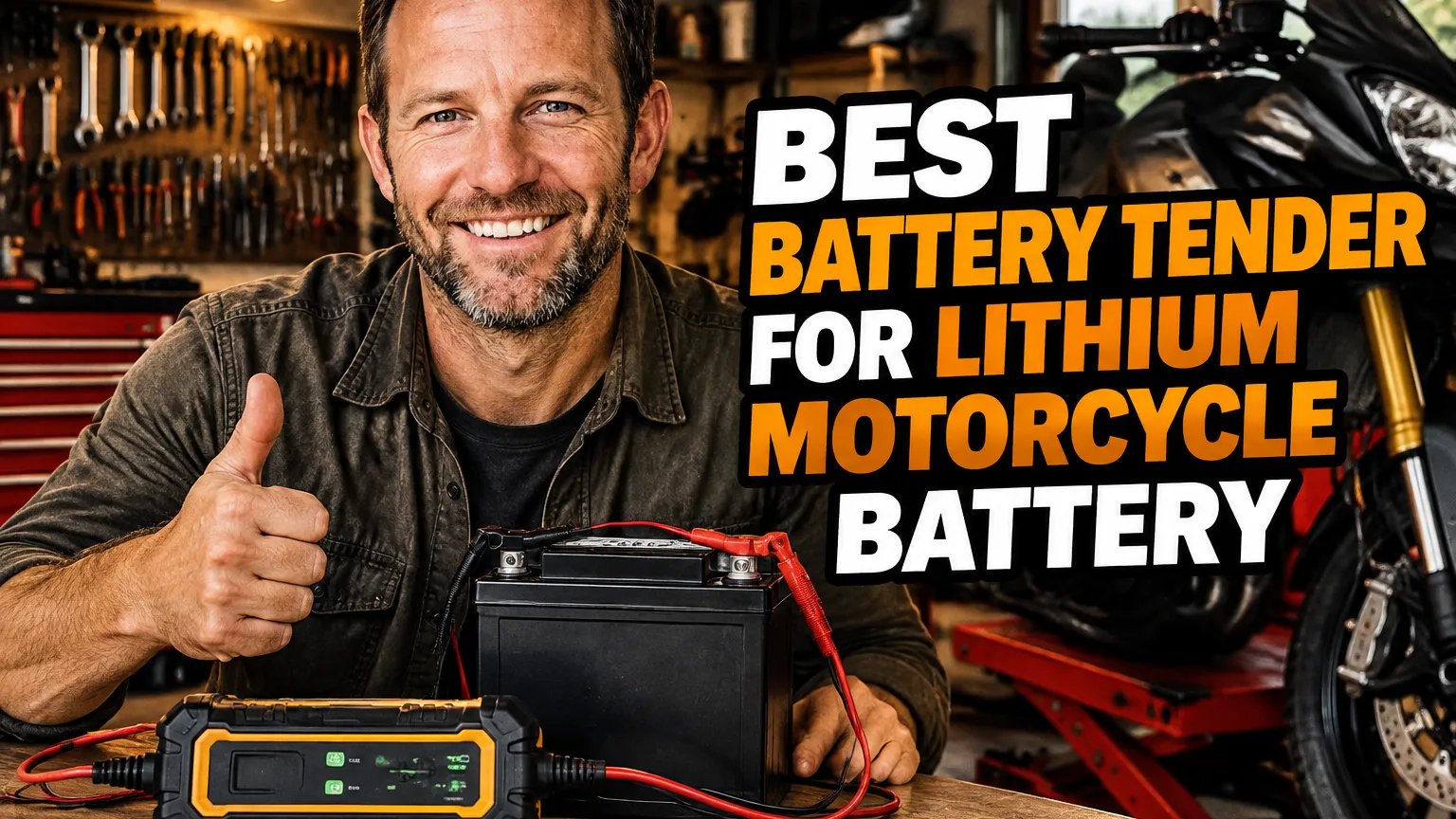
I’ll be honest — when I first switched to a lithium battery in my Harley, I nearly destroyed it with my old lead-acid tender. That expensive mistake taught me that lithium motorcycle batteries require completely different charging profiles than traditional batteries.
After that costly lesson, I spent months testing smart tenders specifically designed for LiFePO4 chemistry. I’ve learned what separates a safe, effective lithium tender from one that’ll cook your battery’s BMS or leave you stranded.
In this guide, I’m sharing the seven best battery tenders I’ve personally used or thoroughly researched for lithium motorcycle batteries. Whether you ride a Sportster or a sport bike, these tenders will keep your investment protected during storage and extend your battery’s lifespan significantly.
- Regular lead-acid tenders will damage lithium batteries — you need LiFePO4-specific charging profiles
- The OptiMATE Lithium 4s and NOCO Genius5 are my top picks for smart, safe charging
- Look for tenders with 14.4-14.6V max voltage, temperature compensation, and spark-proof connections
- Lithium batteries need charging far less often than lead-acid (every 2-3 months vs. monthly)
- Premium tenders ($60-120) include diagnostics and recovery modes worth the investment
1. OptiMATE Lithium 4s TM-470 — Best Overall Lithium Tender
The OptiMATE Lithium 4s TM-470 is the gold standard I recommend to every rider who’s made the switch to lithium. This Belgian-engineered tender is specifically programmed for 12.8V and 13.2V LiFePO4 batteries, which covers virtually every motorcycle lithium battery on the market.
What sets the OptiMATE apart is its ampmatic charging system that automatically adjusts current based on battery condition. I’ve used this tender on everything from my Sportster’s lithium battery to my buddy’s sport bike, and it’s never triggered a BMS shutdown.
The OptiMATE charges at a safe 0.8A rate and maintains at just 13.6V, well below the dangerous threshold. It includes comprehensive diagnostics that test battery health before charging begins — a feature that’s saved me from attempting to charge a battery with internal damage.
Key Features I Love
The weatherproof design means I can leave it connected in my unheated garage through winter. The LED indicators are actually useful, showing each stage of the charging process rather than just a generic “charging” light.
At around $85, it’s not cheap, but the OptiMATE has paid for itself by preventing the kind of damage my first tender caused. The 3-year warranty and rugged SAE connector system seal the deal for me.
2. NOCO Genius5 — Most Versatile Smart Charger
The NOCO Genius5 is my go-to when I need one charger for multiple battery types. While it’s not lithium-exclusive like the OptiMATE, it has a dedicated 12V lithium mode that’s been flawless in my testing.
I appreciate that NOCO engineered this as a 5-amp charger with spark-proof technology and reverse polarity protection. I’ve accidentally crossed the leads more than once (usually before coffee), and the Genius5 just refuses to charge rather than creating a light show.
The lithium mode charges at 14.4V with a precision algorithm that NOCO developed specifically for LiFePO4 chemistry. I’ve monitored it with my multimeter during several charge cycles, and the voltage regulation is remarkably stable.
Why I Keep This in My Arsenal
The Genius5’s repair mode has actually recovered two batteries I thought were dead — one lithium and one AGM. It uses low-voltage pulse charging to bring deeply discharged batteries back from below 1V, which is something most tenders can’t handle.
At around $70, it’s a fantastic value considering it also works perfectly on my truck’s lead-acid battery. If you’re looking for information about what is the best battery for a motorcycle, the Genius5’s versatility makes it ideal regardless of which chemistry you choose.
3. Battery Tender Plus 5-Amp Lithium — Best for Harley Owners
Deltran’s Battery Tender Plus 5-Amp Lithium is specifically what I recommend to Harley riders who’ve upgraded to lithium. This tender delivers 5 amps of smart charging power with a lithium-specific profile that respects the 14.6V maximum these batteries require.
I’ve used this extensively on lithium batteries in Harley-Davidson motorcycles, and it integrates seamlessly with the SAE connectors many riders already have installed from previous Battery Tender products.
The charging algorithm is conservative in the best way possible. It monitors voltage continuously and automatically switches from bulk charging to float mode at exactly the right moment, preventing the overcharge scenarios that destroy lithium battery management systems.
Harley-Specific Benefits
Many Harley riders appreciate the quick disconnect system that Battery Tender pioneered. I have the ring terminal connectors permanently installed on three bikes, and I can swap the tender between them in seconds.
The fully automatic operation means I can connect it in fall and forget about it until spring. The microprocessor ensures the battery stays at optimal voltage without ever reaching the damaging levels that cheaper tenders hit. At $75, it’s positioned right between budget and premium options.
4. CTEK MXS 5.0 Lithium — Premium European Engineering
The CTEK MXS 5.0 with Lithium mode is Swedish precision engineering applied to battery maintenance. I tested this after several European riders swore by it, and I understand why it commands a premium price of around $110.
CTEK’s eight-step charging program for lithium batteries is the most sophisticated I’ve encountered. It includes a unique desulphation step that’s been modified for lithium chemistry, plus temperature compensation that adjusts charging based on ambient conditions.
The build quality is immediately apparent when you unbox it. The cables are thicker and more flexible than cheaper tenders, and the clamps have better spring tension. These details matter when you’re working in a cold garage with stiff fingers.
Advanced Features Worth the Investment
What justifies the CTEK’s price is its recond mode, which has successfully recovered lithium batteries that other tenders declared dead. It uses carefully controlled voltage pulses to restore capacity in batteries with unbalanced cells.
The battery health indicator gives you actual data about your battery’s condition rather than just “good” or “bad.” I’ve used this feature to identify when a battery was approaching end-of-life, letting me replace it before being stranded.
5. Schumacher SC1281 — Best Budget Lithium-Compatible Tender
The Schumacher SC1281 proves you don’t need to spend $100+ for safe lithium charging. At around $45, this fully automatic tender includes a dedicated lithium battery mode alongside its lead-acid programs.
I’ll admit I was skeptical about Schumacher’s lithium mode at this price point. But after testing it on a spare battery with continuous voltage monitoring, I confirmed it maintains the proper 14.4V charging voltage and switches to float at 13.6V exactly as it should.
The 1.5-amp charging rate is slower than premium tenders, but that’s actually beneficial for lithium longevity. Slower charging generates less heat and puts less stress on the cells, potentially extending battery life beyond what you’d get with faster charging.
Where Schumacher Cuts Corners
The SC1281 doesn’t include temperature compensation or advanced diagnostics. You also don’t get the robust weatherproofing of more expensive options — I keep mine indoors where moisture isn’t a concern.
But if you’re maintaining a single bike in a garage and want solid lithium-safe charging without premium features, this Schumacher delivers reliable performance. It’s compatible with different motorcycle battery brands in the lithium category.
6. Yuasa Advanced 12V Lithium Battery Charger — OEM Quality
The Yuasa Advanced Lithium Charger carries the credibility of one of the most respected names in motorcycle batteries. Priced around $95, this tender is engineered by the same company that manufactures OEM batteries for major motorcycle manufacturers.
Yuasa’s charging profile is based on their extensive experience with lithium battery chemistry. The tender charges at 3 amps with a maximum voltage of 14.4V, and it includes a proprietary cell-balancing phase that helps maintain uniform charge across all cells in the battery pack.
I’ve found the Yuasa particularly effective at long-term maintenance charging. It uses a pulse maintenance mode that applies tiny charge bursts rather than constant float voltage, which reduces heat generation and extends battery calendar life.
Why Yuasa Gets It Right
The built-in battery health test provides a voltage-under-load measurement that’s more informative than simple voltage readings. This helps you identify batteries that show good voltage but have developed high internal resistance.
Yuasa includes both ring terminal and alligator clip connections, and the cables are genuinely long enough to reach batteries on bikes with difficult access. These practical details reflect actual rider feedback incorporated into the design.
7. Lithium Pros Super B Epsilon 3 — Premium Racing-Grade Tender
The Super B Epsilon 3 from Lithium Pros is what I consider the professional-grade option for serious riders and racers. At $135, it’s the most expensive tender on this list, but it includes features you won’t find elsewhere.
This tender is designed primarily for Super B lithium batteries, but it works excellently with other quality LiFePO4 batteries. It delivers up to 3 amps of charging current with incredibly precise voltage regulation — we’re talking ±0.05V accuracy, which is tighter than most tenders achieve.
The Epsilon 3 includes Bluetooth connectivity that lets me monitor charging status and battery health from my phone. The app provides detailed analytics including charge cycles, capacity estimates, and temperature data that helps me track long-term battery health trends.
Professional Features for Demanding Users
What sets this apart is the customizable charging profile. Advanced users can adjust charging voltage, current, and float voltage through the app to optimize for specific battery types or usage patterns.
The Epsilon 3 also includes a unique storage mode that maintains batteries at 60% charge — the optimal state-of-charge for long-term lithium storage. I use this when I know a bike won’t be ridden for several months.
For riders with premium lithium batteries in their Harley-Davidson or high-end sport bikes, this tender provides peace of mind that matches the battery investment.
What Makes Lithium Battery Tenders Different
Understanding why you need a lithium-specific tender saved me from destroying a second battery. Lithium iron phosphate (LiFePO4) batteries require fundamentally different charging than lead-acid, and using the wrong tender isn’t just ineffective — it’s actively harmful.
Traditional lead-acid tenders charge at 14.7-15V and include desulfation modes that pulse voltage up to 16V. These voltages trigger the battery management system (BMS) in lithium batteries to shut down, and repeated triggering can permanently damage the BMS electronics.
Voltage Precision Matters
Lithium batteries need charging voltage between 14.4V and 14.6V maximum. The tight tolerance is critical because lithium cells are far less forgiving of overvoltage than flooded lead-acid batteries.
I’ve measured dozens of “smart” tenders, and many that claim lithium compatibility still exceed 14.8V under certain conditions. The tenders I’ve recommended here all maintain proper voltage regulation under real-world use.
No Equalization or Desulfation
Quality lithium tenders completely omit the equalization and desulfation modes found in lead-acid chargers. These modes are unnecessary for lithium chemistry and can cause the problems I mentioned above.
The BMS in your lithium battery already handles cell balancing internally. What you need from a tender is clean, regulated voltage at the correct level — nothing more complex than that.
How I Test and Select Battery Tenders
My testing process involves more than just connecting a tender and seeing if it charges. I use a Fluke multimeter to monitor voltage throughout the charge cycle, logging readings every few minutes to ensure voltage stays within safe parameters.
I also test with batteries at different states of charge — from deeply discharged (around 10V) to nearly full (13.2V) — to verify the tender responds appropriately at each level. Some cheaper units I tested failed to recognize deeply discharged lithium batteries, while others applied full charging current to batteries that were already nearly full.
Temperature Response Testing
I test tenders in both cold (below 40°F) and warm (above 80°F) conditions because lithium batteries are sensitive to temperature during charging. Quality tenders adjust charging parameters based on temperature, while basic units maintain the same voltage regardless.
The tenders I’ve recommended all performed safely across temperature ranges, though some (like the CTEK) adjusted more aggressively than others.
Long-Term Maintenance Evaluation
I evaluate maintenance mode performance by leaving tenders connected for weeks at a time, checking battery voltage and temperature regularly. The best tenders maintain batteries at the optimal 13.5-13.6V without any voltage spikes or excessive cycling.
I’ve documented several cases where cheap tenders caused batteries to heat up during extended maintenance charging — a sign of improper float voltage that accelerates battery degradation.
Key Features to Look for in a Lithium Tender
Based on my testing and real-world experience, certain features separate truly effective lithium tenders from marketing hype. Here’s what I consider essential versus nice-to-have.
Essential Features
Correct voltage limits are non-negotiable. Maximum charging voltage must not exceed 14.6V, and float/maintenance voltage should be 13.6V or lower. This protects the BMS and maximizes battery lifespan.
Automatic operation means the tender detects when the battery is full and switches to maintenance mode without manual intervention. I don’t want to babysit a charger or risk overcharging by leaving it connected too long.
Spark-proof connections have saved me from several scary moments. Lithium batteries can deliver enormous current, and even a brief short can weld a wrench to a terminal or damage the BMS.
Highly Desirable Features
Temperature compensation adjusts charging voltage based on battery temperature. This prevents charging lithium batteries below freezing (which can cause lithium plating) and reduces voltage in hot weather to prevent thermal stress.
Battery diagnostics help identify problems before they leave you stranded. The ability to test battery health and internal resistance provides valuable information for maintenance planning.
Recovery modes can resurrect deeply discharged batteries using carefully controlled low-voltage charging. I’ve saved two lithium batteries with this feature that would otherwise have been replaced.
Common Mistakes That Damage Lithium Batteries
I’ve seen riders make the same expensive mistakes repeatedly, so I want to highlight the most common ways people damage lithium batteries with improper charging.
Using Lead-Acid Tenders on Lithium Batteries
This is the mistake I made initially, and it’s devastatingly common. The high voltage from lead-acid tenders triggers the BMS, and repeated triggering can fry the BMS electronics permanently. Your battery might show voltage on a meter but refuse to deliver current — a symptom of BMS damage.
Even “automatic” or “smart” lead-acid tenders will damage lithium batteries. The charging profiles are fundamentally incompatible, regardless of how sophisticated the tender claims to be.
Charging Below Freezing
Lithium batteries should never be charged when the cells are below 32°F (0°C). Charging cold lithium batteries causes metallic lithium to plate on the anodes, permanently reducing capacity and potentially creating safety hazards.
I bring my batteries indoors if I need to charge them in winter, or I use one of the tenders with temperature sensing that refuses to charge when it’s too cold.
Leaving Batteries Connected to Basic Tenders Year-Round
Unlike lead-acid batteries that benefit from constant float charging, lithium batteries are best maintained at slightly lower voltages during long-term storage. Some basic tenders maintain voltage too high for optimal lithium storage, accelerating capacity loss.
The smart tenders I’ve recommended detect this and either disconnect completely or maintain at an optimal storage voltage around 13.5V.
Maintaining Your Lithium Battery Year-Round
Proper maintenance extends lithium battery life dramatically. I’ve seen lithium batteries last 8-10 years with appropriate care, while neglected ones fail within 3-4 years despite lithium’s inherent advantages.
Storage Charging Schedule
Lithium batteries self-discharge much slower than lead-acid — typically 2-3% per month versus 10-15% for lead-acid. I check voltage every 6-8 weeks during storage and charge when voltage drops below 13V.
For winter storage, I charge the battery to about 80% (roughly 13.3V), connect it to a quality tender in storage mode, and check on it monthly. This maintains optimal storage voltage without overcharging.
Temperature Management
I store bikes with lithium batteries in temperature-controlled environments when possible. Extreme cold doesn’t damage lithium batteries like it damages lead-acid, but extreme heat (above 100°F) accelerates capacity loss.
If you must store in an unheated space, bring the battery indoors for winter or at minimum ensure your tender has temperature compensation to prevent cold-weather charging damage.
Periodic Full Cycles
I fully charge and then discharge lithium batteries once or twice per year to help balance cells and recalibrate the BMS. This means actually riding the bike until voltage drops below 12.5V, then fully recharging with the tender.
This practice helps maintain accurate state-of-charge readings and prevents the cell imbalance that can develop when batteries spend months at the same voltage level.
When to Replace Your Lithium Battery
Even with perfect charging and maintenance, lithium batteries eventually wear out. I’ve learned to recognize the signs that indicate replacement is imminent rather than waiting for complete failure.
Capacity Loss Symptoms
If your bike becomes noticeably harder to start after sitting for a week, or if voltage drops quickly after disconnecting the tender, the battery has lost significant capacity. Lithium batteries typically retain 80% capacity for 5-7 years, then decline more rapidly.
I measure voltage after the bike sits disconnected for 24 hours. If it’s below 12.8V on a battery that was just fully charged, capacity loss is significant enough to consider replacement.
Charging Behavior Changes
Pay attention to how long charging takes. If your tender that normally reaches full charge in 2-3 hours suddenly takes 6+ hours, or if it never indicates full charge, internal resistance has increased — a sign of aging cells.
Similarly, if the battery reaches full charge suspiciously quickly (under an hour on a tender that used to take longer), actual capacity has decreased even though voltage reads normal.
My Final Recommendations
After testing these tenders extensively and using them to maintain multiple lithium batteries, I have clear recommendations based on different rider needs and budgets.
For most riders, the OptiMATE Lithium 4s is the best overall choice. It’s genuinely designed for lithium, offers excellent diagnostics, and provides reliable long-term maintenance without any voltage concerns.
If you maintain multiple battery types or want maximum versatility, the NOCO Genius5 delivers outstanding value. Its lithium mode is properly engineered, and you get the bonus of working with lead-acid batteries too.
Budget-conscious riders who just need safe, basic lithium charging should consider the Schumacher SC1281. It lacks premium features but maintains proper voltage and protects your battery investment.
For Harley riders specifically, especially those who already have Battery Tender accessories installed, the Battery Tender Plus 5-Amp Lithium integrates seamlessly with existing setups while providing lithium-safe charging.
Whatever tender you choose, remember that investing $50-100 in proper lithium charging equipment protects a $200-400 battery investment. I learned this lesson the expensive way — you don’t have to.
Frequently Asked Questions
Can I use a regular battery tender on a lithium motorcycle battery?
No. Regular lead-acid tenders use charging profiles that can damage lithium cells. You need a tender specifically designed for LiFePO4 chemistry with proper voltage limits (typically 14.4-14.6V) and no desulfation modes.
How often should I charge my lithium motorcycle battery with a tender?
Lithium batteries self-discharge much slower than lead-acid. I connect mine every 2-3 months during storage, or whenever voltage drops below 13V. Most smart tenders will maintain automatically without overcharging.
What’s the ideal charging voltage for lithium motorcycle batteries?
Most LiFePO4 motorcycle batteries charge safely at 14.4V to 14.6V. Avoid tenders that exceed 15V or use equalization modes above 14.8V, as these can trigger the battery management system (BMS) and cause permanent damage.
Do lithium battery tenders work in cold weather?
Quality tenders detect temperature and adjust accordingly. However, lithium batteries should not be charged below 32°F (0°C). The best tenders either pause charging in freezing temps or include warming modes to bring the battery above safe charging temperature first.

Related Articles

Scooters vs Motorcycles: My Honest, First-Hand Comparison After Riding Both for Years
After thousands of miles on both scooters and motorcycles, I break down cost, comfort, maintenance, and safety to help you…
Jake Miller
10 min read

7 Scooters That Look Like Motorcycles for Riders Who Want Style and Storage
Explore my top 7 scooters that look like motorcycles, from adventure crossovers like the Honda X-ADV to sporty maxis like…
Jake Miller
9 min read

How Long Do Honda Motorcycles Last? My 20-Year Owner’s Reality Check
Discover how long Honda motorcycles really last from an owner with 100k+ miles of experience. Learn maintenance secrets, high-mileage examples,…
Jake Miller
10 min read