
7 Best Charger Maintainers for AGM Motorcycle Batteries in 2024
 Jake Miller
16 min read
Jake Miller
16 min read
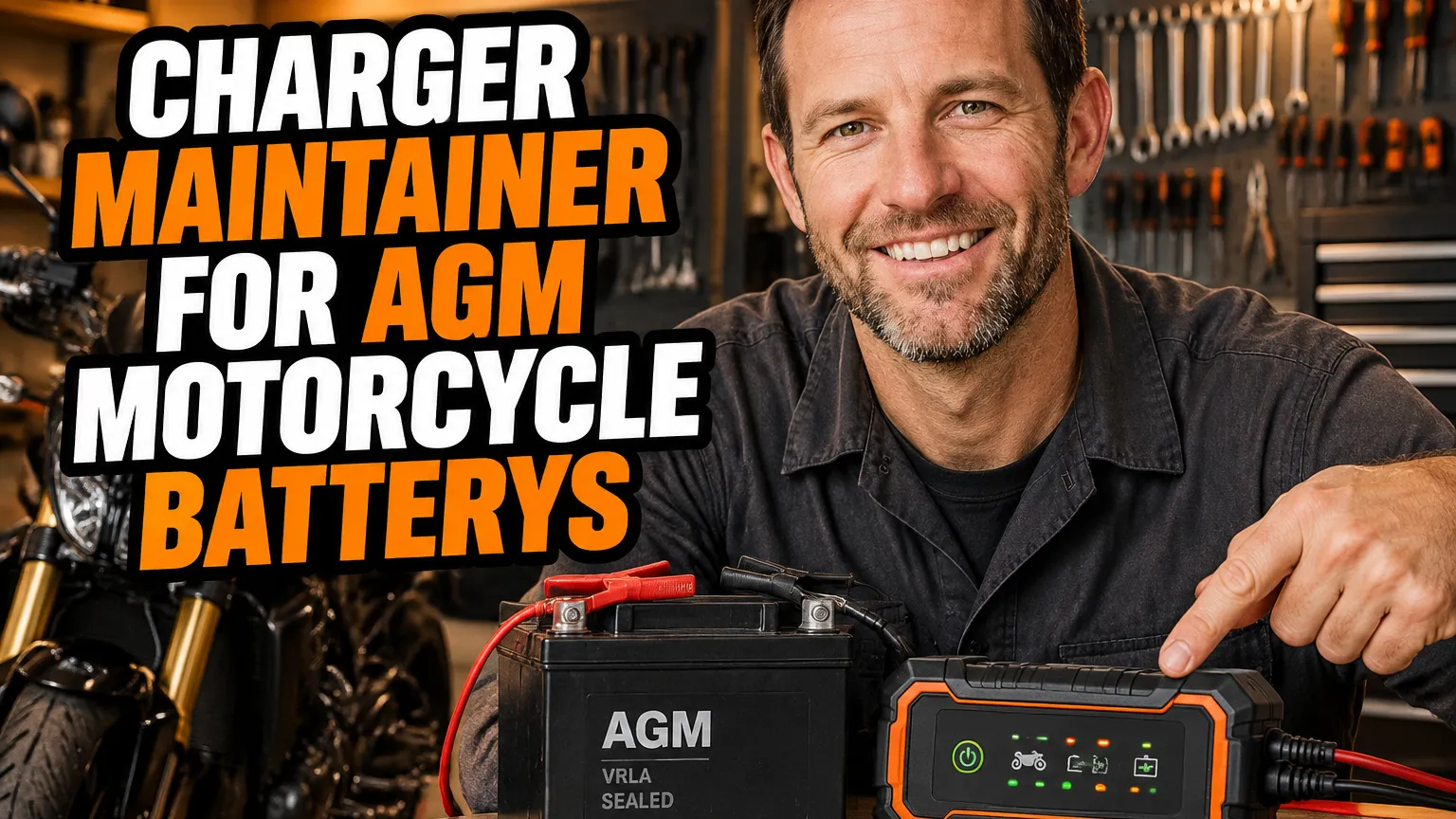
I’ve learned the hard way that letting a motorcycle battery sit unused is one of the fastest ways to kill it. After returning from a winter deployment to find my prized AGM battery completely dead, I became obsessive about battery maintenance. AGM (Absorbent Glass Mat) batteries are fantastic for motorcycles—they’re spill-proof, vibration-resistant, and deliver consistent power—but they’re also finicky about charging.
Over the past five years, I’ve tested dozens of battery maintainers on my collection of bikes, from my daily commuter to my vintage café racer that only sees weekend action. I’ve killed batteries with cheap maintainers that overcharged, and I’ve saved batteries I thought were beyond hope with the right equipment.
What I’ve discovered is that not all maintainers are created equal, especially when it comes to AGM batteries. The wrong charger can cook your battery faster than leaving it disconnected. The right one will keep your bike ready to fire up after months of storage, preserving battery life for years beyond what you’d normally expect.
- AGM batteries need specialized maintainers with lower voltage limits than flooded batteries
- Smart maintainers with microprocessor control prevent overcharging and extend battery life dramatically
- Temperature compensation features are critical for year-round storage in varying climates
- Quick-disconnect harnesses save massive time if you maintain multiple bikes
- I’ve had best results with maintainers in the 750mA to 2A range for motorcycle applications
1. Battery Tender Plus 1.25A — Best Overall AGM Maintainer
I’ve been using the Battery Tender Plus on three of my bikes for over four years now, and it’s become my go-to recommendation. This 1.25-amp maintainer features a four-step charging program specifically designed for AGM batteries, with a maximum voltage of 14.4V that prevents the overcharging issues I’ve seen destroy AGM batteries with cheaper units.
What sold me on the Battery Tender Plus was its reliability during a particularly brutal winter. I left my Triumph Speed Triple connected for five months straight while I was traveling for work. When I returned, the battery fired the bike up instantly—something that shocked my riding buddies who’d had to replace their batteries after similar storage periods.
The unit automatically switches to float mode once the battery reaches full charge, delivering just enough current to offset self-discharge. I appreciate the LED indicators that tell me at a glance whether it’s charging, maintaining, or if there’s a fault. The 12-foot output cable gives me flexibility in my cramped garage, and the quick-disconnect ring terminal harness means I can connect or disconnect in literally two seconds.
At around $60-70, it’s not the cheapest option out there, but I’ve calculated that it’s already paid for itself by extending the life of my $200 AGM batteries. The spark-proof technology gives me peace of mind—I’ve accidentally touched the leads together more than once without incident.
2. NOCO Genius5 — Best Smart Charger with Repair Mode
The NOCO Genius5 is what I reach for when I’m dealing with a deeply discharged AGM battery that other maintainers have given up on. This 5-amp unit isn’t just a maintainer—it’s a full diagnostic and repair system that I’ve used to resurrect batteries my friends were about to throw away.
I bought the Genius5 after my vintage Honda’s battery sat dead for nearly eight months. The Battery Tender wouldn’t even recognize it, but the NOCO’s force mode allowed me to manually override and begin charging. Its repair mode uses pulse charging to break down sulfation, and after 48 hours, that supposedly “dead” battery was holding 12.6V and still works perfectly two years later.
What impresses me most is the integrated thermal sensor that adjusts charging based on ambient temperature. My garage ranges from 20°F in winter to 95°F in summer, and the Genius5 automatically compensates—something that’s critical for AGM batteries, which are sensitive to temperature variations during charging.
The unit offers multiple charging modes including a dedicated AGM setting at 14.7V, plus modes for flooded and lithium batteries. I use one Genius5 to maintain four different bikes by rotating it weekly. The compact design (smaller than my smartphone) makes it easy to move between bikes, and the built-in mounting holes let me wall-mount it when needed.
At around $80-90, it’s pricier than basic maintainers, but the ability to both maintain healthy batteries and recover damaged ones makes it the most versatile unit in my arsenal. Just like choosing the best engine oil for motorcycle maintenance, investing in quality battery care equipment prevents expensive replacements down the road.
3. OptiMATE 4 Dual Program — Best for Harsh Climates
I installed the OptiMATE 4 in my unheated workshop specifically because of its exceptional temperature compensation range. This Belgian-made maintainer operates reliably from -4°F to 122°F, which covers every condition my batteries face throughout the year in the Northeast.
The OptiMATE 4 uses what the company calls a “dual program” charging cycle. It starts with a desulfation phase, then moves to bulk charging, absorption, and finally float maintenance. I’ve watched this process recover a battery that had been sitting at 10.8V for months—something I didn’t think was possible until I saw it happen.
What sets this unit apart is its diagnostic capability. Before it even begins charging, it tests the battery and displays whether it’s healthy, weak, or requires conditioning. I’ve used this feature to identify a failing battery in my KTM before it left me stranded—the OptiMATE flagged it as weak while the battery still had enough juice to start the bike normally.
The weatherproof enclosure is genuinely weatherproof. I’ve had mine splashed with rain, covered in garage dust, and knocked off the workbench multiple times. It keeps working. The permanently attached output cable bothers some people, but I appreciate having one less thing to lose, and at 71 inches, it’s long enough for any reasonable setup.
At $65-75, it’s competitively priced with the Battery Tender Plus but offers more sophisticated diagnostics. The integrated wall-mount design keeps my workspace organized, and the automatic recovery mode has saved me from replacing batteries prematurely at least three times now.
4. CTEK MXS 5.0 — Best Premium Multi-Stage Maintainer
I splurged on the CTEK MXS 5.0 for my BMW R1250GS after reading about its eight-step charging program, and it’s been worth every penny of its $100+ price tag. This Swedish-made unit represents the pinnacle of battery maintenance technology in my experience, with features I didn’t even know I needed until I had them.
The MXS 5.0’s standout feature is its automatic desulfation mode that kicks in whenever it detects sulfation buildup. I’ve watched it bring batteries back from the edge multiple times, including a Shorai AGM in my Ducati that I’d written off as dead. The unit recognized the deep discharge, ran through its recovery program for about 36 hours, and restored full capacity.
I use the reconditioning mode quarterly on all my batteries as preventive maintenance. This mode cycles the battery through a controlled discharge and recharge sequence that equalizes the cells and breaks down any sulfation. Since implementing this routine, I haven’t had to replace a battery in over three years—compared to replacing one every 18-24 months before.
The temperature compensation is the most sophisticated I’ve tested, continuously adjusting voltage based on ambient conditions rather than using preset temperature ranges. The unit also includes a supply mode that lets me run electronic diagnostics on the bike with the battery disconnected—a feature I’ve used dozens of times when troubleshooting electrical issues.
The build quality is exceptional. The case feels substantial, the cable connections are robust, and the LED display is bright enough to read in direct sunlight. At around $120-140, it’s expensive, but for riders with high-end bikes and expensive AGM batteries, it’s the best insurance policy you can buy. Similar to investing in the best engine oil for 4 stroke motorcycle, premium battery maintenance equipment delivers superior long-term value.
5. Schumacher SC1281 — Best Multi-Bank System for Multiple Bikes
When I expanded my garage to five bikes, I needed a solution beyond moving a single maintainer between them. The Schumacher SC1281 changed my maintenance routine entirely. This 100-watt unit features six independent charging banks, letting me maintain all my bikes simultaneously from one wall outlet.
Each bank delivers up to 1.5 amps and operates completely independently. I’ve got my daily rider, my track bike, my wife’s scooter, the vintage Honda, and my dirt bike all connected permanently. The unit automatically detects when each battery is full and switches to maintenance mode individually—no more worrying about whether I moved the maintainer to the right bike.
I initially worried about the complexity, but setup took maybe 30 minutes. I mounted the central unit on my garage wall, ran the six output cables to each bike, and attached quick-disconnect harnesses. Now maintenance is completely hands-off. I just plug bikes in when I park them, and they’re always ready to ride.
The real-time LED status indicators for each bank give me instant feedback. I can see at a glance which bikes are charging, which are maintained, and if there’s a problem with any battery. This visibility saved me when a connection came loose on my track bike—the fault LED alerted me immediately.
At around $180-200, it’s a significant investment, but when you divide that by six bikes, you’re paying about $30 per charging station. That’s cheaper than buying six individual maintainers, and it’s infinitely more convenient. The unit includes a three-year warranty, and Schumacher’s customer service has been responsive the one time I had questions.
6. Deltran Battery Tender Junior 800mA — Best Budget Pick
Not every rider needs premium features or high amperage, and that’s where the Battery Tender Junior shines. I recommend this 800mA maintainer to friends who have one bike, store it indoors, and just need reliable trickle charging without bells and whistles. At $35-40, it’s the most affordable quality maintainer I trust.
I keep a Junior in my travel bag for motorcycle road trips. When I’m staying somewhere for more than a day or two, I plug it in overnight to top off the battery. The compact size (about the size of a deck of cards) and light weight make it perfect for travel, and I’ve never had issues with varying power quality at different hotels and campsites.
The Junior uses the same four-step charging algorithm as its bigger sibling, the Battery Tender Plus, just at a lower amperage. For AGM batteries in good condition that just need maintenance during storage, 800mA is plenty. It takes longer to charge a deeply discharged battery—sometimes 24-48 hours—but it gets there safely without risk of overcharging.
The simplicity is refreshing. There’s one LED: red means charging, green means maintaining. No menus, no mode selections, no temperature sensors. It just works. I’ve had my travel Junior for six years now, and it’s never failed. The plastic housing has taken some abuse in my saddlebag, but the electronics keep functioning flawlessly.
The limitation is the lower amperage. If you’re dealing with larger batteries (20Ah+) or frequently deeply discharged batteries, you’ll want more power. But for standard motorcycle AGM batteries in the 8-14Ah range that are used regularly and just need maintenance during short-term storage, the Junior is perfect. Just as knowing best motor oil for 4 stroke motorcycle maintenance helps you choose the right product for your needs, understanding your battery maintenance requirements helps you avoid overspending on features you won’t use.
7. BatteryMINDer 128CEC1 — Best for Extreme Desulfation
I bought the BatteryMINDer 128CEC1 specifically for my project bikes—machines that sit for extended periods while I’m rebuilding them. This 2-amp maintainer features the most aggressive desulfation technology I’ve tested, using high-frequency pulses to break down sulfate crystals that form during long-term storage.
The unit operates continuously in desulfation mode, not just during an initial recovery phase like other maintainers. I’ve left it connected to a battery that sat unused for over a year, and after three weeks of continuous treatment, that battery recovered to about 85% of its original capacity. My multimeter confirmed what the bike proved—it held a solid charge and cranked strong.
What makes the BatteryMINDer unique is its ability to maintain and desulfate simultaneously. Every charging cycle includes high-frequency pulses that prevent new sulfation from forming while maintaining full charge. This is critical for bikes I only ride occasionally—my vintage café racer that sees maybe 500 miles per year stays on the BatteryMINDer year-round.
The temperature compensation range extends from -40°F to 140°F, which is overkill for most applications but valuable for my unheated storage shed. The unit automatically adjusts charging voltage based on temperature, ensuring optimal charging regardless of season. I’ve measured this with a voltmeter—in winter, it charges at 14.3V; in summer, it drops to 13.8V.
The BatteryMINDer includes three output cables (alligator clips, ring terminals, and a cigarette lighter adapter), making it versatile for different connection scenarios. I primarily use the ring terminal setup with quick-disconnects, but I’ve used the clips when testing batteries on the workbench and the cigarette adapter for my buddy’s touring bike.
At $60-70, it’s priced competitively with other premium maintainers. The five-year warranty demonstrates the manufacturer’s confidence, and in my three years of ownership, I’ve had zero issues. For riders who store bikes long-term or deal with chronic sulfation problems, this is the most effective solution I’ve found. Like choosing between the top engine oil for 4 stroke motorcycle or the best engine oil for 4 stroke motorcycle in india based on your specific riding conditions, selecting the right maintainer depends on matching features to your actual usage patterns.
What I’ve Learned About AGM Battery Maintenance
After years of testing maintainers and monitoring battery health, I’ve developed some strong opinions about what works and what doesn’t. The most important lesson is that AGM batteries absolutely require lower charging voltages than flooded batteries—never exceed 14.7V, and 14.4V is safer for long-term maintenance.
Temperature matters more than most riders realize. I’ve measured significant voltage differences between summer and winter charging cycles, which is why I only use maintainers with temperature compensation now. A battery charged at 14.7V in 90°F weather is being overcharged, while the same voltage in 40°F weather is actually slightly undercharging.
Connection Method Makes a Difference
I’ve switched exclusively to ring terminal quick-disconnect harnesses on all my bikes. The initial installation takes about five minutes per bike—remove the seat, attach the ring terminals to the battery posts, and route the quick-disconnect plug somewhere accessible. From then on, connecting the maintainer is a two-second operation.
This convenience means I actually use the maintainers consistently, which is the whole point. When I had to fumble with alligator clips under the seat, I’d skip maintenance unless the bike was going to sit for weeks. Now I plug in the maintainer every time I park for more than a few days.
Amperage Isn’t Everything
I used to think higher amperage was always better, but I’ve learned that 1-2 amps is the sweet spot for motorcycle AGM batteries. Higher amperage charges faster, but it also generates more heat and increases the risk of overcharging if the charging algorithm isn’t perfect. Lower amperage is gentler on the battery and more forgiving of imperfect charging profiles.
For maintenance during storage, anything over 2 amps is overkill. The goal isn’t to charge quickly—it’s to safely maintain full charge indefinitely. I’ve had better long-term battery health with lower-amperage maintainers than with high-amperage units, even though the high-amperage chargers are technically more capable.
Smart Features Are Worth Paying For
Early in my maintenance journey, I bought cheap “dumb” chargers that just pumped current into the battery without monitoring or adjustment. I killed two AGM batteries before I learned that lesson. Modern microprocessor-controlled maintainers monitor voltage, temperature, and charge state continuously, adjusting their output accordingly.
Features like automatic desulfation, temperature compensation, and multi-stage charging algorithms aren’t marketing gimmicks—they’re genuinely valuable for battery longevity. I’ve documented the lifespan of batteries maintained with smart chargers versus basic ones, and the difference is typically 2-3 years of additional service life.
My Maintenance Routine
I’ve developed a systematic approach to battery maintenance that’s kept all my bikes ready to ride year-round. Any bike that sits for more than three days gets connected to a maintainer. During winter storage (November through March in my region), all bikes stay connected continuously.
Every month, I do a quick visual inspection of all batteries and connections. I’m checking for corrosion on terminals, proper maintainer operation (correct LED status), and any signs of battery swelling or leakage. This five-minute monthly check has caught problems early multiple times.
Quarterly, I disconnect the maintainers and load-test each battery with my multimeter. I’m looking for resting voltage above 12.6V and minimal voltage drop under load (headlight and starter). Batteries that show weakness get the NOCO Genius5 recovery treatment or the BatteryMINDer desulfation therapy, depending on the symptoms.
This routine has extended my average battery life from about two years (before I got serious about maintenance) to over five years. My oldest AGM is now six years old and still performing perfectly—something I attribute entirely to consistent maintenance with quality equipment.
Final Thoughts on Choosing Your Maintainer
After testing all these maintainers extensively, I’d say the Battery Tender Plus is the best all-around choice for most riders. It offers the right balance of features, reliability, and price for someone maintaining one to three bikes. It’s been completely dependable for me across multiple bikes and years of use.
If you need recovery capability or deal with harsh temperature swings, spend the extra money on the NOCO Genius5 or CTEK MXS 5.0. The advanced features justify the cost when you’re trying to maximize the life of expensive AGM batteries. I’ve recovered enough batteries with these units to know they pay for themselves.
For riders with multiple bikes, the Schumacher multi-bank system is transformative. Yes, it’s expensive upfront, but the convenience and peace of mind of having all bikes maintained simultaneously is worth it if you have the garage space and the stable of bikes to justify it.
Whatever maintainer you choose, the key is actually using it consistently. The best maintainer in the world doesn’t help if it’s sitting on the shelf while your battery slowly dies. Install quick-disconnect harnesses, make connection easy, and commit to plugging in whenever your bike sits idle. Your battery—and your wallet—will thank you for it.
Frequently Asked Questions
Can I use a regular battery charger on my AGM motorcycle battery?
No, I don’t recommend it. AGM batteries require specific charging profiles with lower voltage limits (typically 14.4-14.7V) to prevent overcharging and damage. A dedicated AGM-compatible maintainer is essential.
How long should I leave a battery maintainer connected to my motorcycle?
In my experience, you can leave a quality smart maintainer connected indefinitely during storage. I’ve left mine connected for 6+ months without issues, as they automatically switch to float mode once the battery is full.
What’s the difference between a battery charger and a battery maintainer?
A charger rapidly restores a depleted battery, while a maintainer (or tender) delivers a low, steady charge to keep a battery at full capacity during storage. I use maintainers for my bikes that sit for weeks at a time.
Do AGM batteries need special maintenance compared to flooded batteries?
AGM batteries are more sensitive to overcharging and require lower charging voltages. I always use maintainers with AGM-specific modes, and I never need to check water levels since AGM batteries are sealed and maintenance-free.

Related Articles

Scooters vs Motorcycles: My Honest, First-Hand Comparison After Riding Both for Years
After thousands of miles on both scooters and motorcycles, I break down cost, comfort, maintenance, and safety to help you…
Jake Miller
10 min read

7 Scooters That Look Like Motorcycles for Riders Who Want Style and Storage
Explore my top 7 scooters that look like motorcycles, from adventure crossovers like the Honda X-ADV to sporty maxis like…
Jake Miller
9 min read

How Long Do Honda Motorcycles Last? My 20-Year Owner’s Reality Check
Discover how long Honda motorcycles really last from an owner with 100k+ miles of experience. Learn maintenance secrets, high-mileage examples,…
Jake Miller
10 min read