
How Long to Charge a Motorcycle Battery at 2 Amps: My Complete Charging Guide
 Jake Miller
14 min read
Jake Miller
14 min read
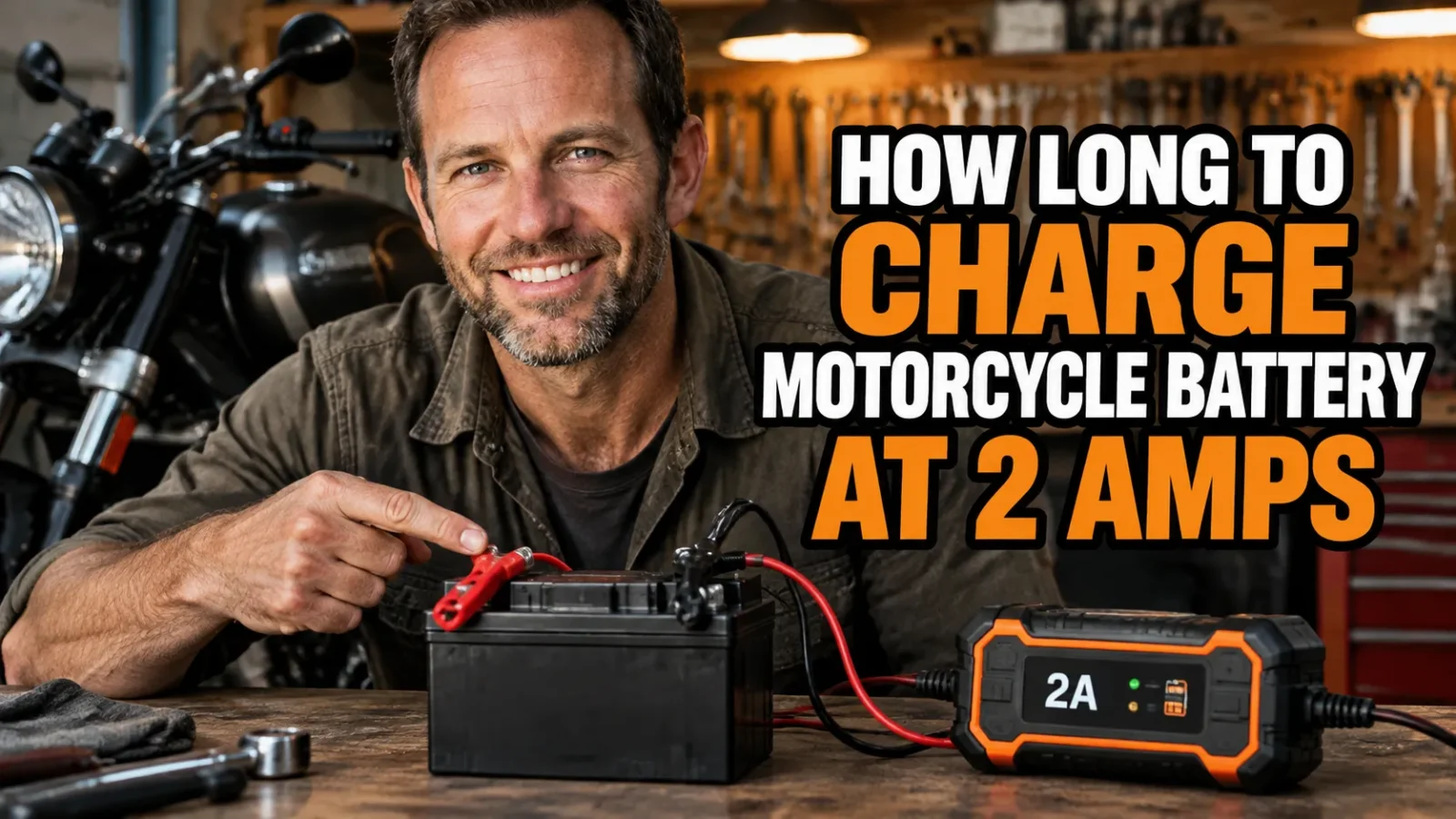
I’ve been riding for over fifteen years, and if there’s one thing I’ve learned the hard way, it’s that knowing how to properly charge your motorcycle battery can save you from being stranded on the side of the road. Over the years, I’ve dealt with countless dead batteries, especially after long winters in storage.
The question I get asked most often by fellow riders is: how long does it actually take to charge a motorcycle battery at 2 amps? Today, I’m sharing everything I’ve learned from my own experience, including the math behind it, real-world charging times, and the mistakes I’ve made so you don’t have to.
- A typical motorcycle battery takes 6-12 hours to fully charge at 2 amps, depending on capacity and depletion level
- 2 amps is the optimal charging rate for battery health and longevity—slow and steady wins the race
- Always use a smart charger with automatic shutoff to prevent overcharging damage
- Battery temperature, age, and condition significantly affect actual charging time
- Never charge a frozen battery—warm it to room temperature first
Understanding the Basic Math Behind Charging Time
When I first started riding, I thought charging a battery was just a matter of plugging it in and waiting. I quickly learned there’s actually some simple math involved that helps you estimate charging time accurately.
The basic formula I use is: Charging Time = Battery Capacity (Ah) ÷ Charging Current (Amps). Most motorcycle batteries range from 5 to 20 amp-hours (Ah), with the average street bike using something around 10-14 Ah.
For example, if I have a 10 Ah battery that’s completely dead and I’m charging at 2 amps, the calculation would be 10 ÷ 2 = 5 hours. However—and this is important—that’s just the theoretical minimum.
In my experience, you need to add about 20-40% more time to account for charging efficiency losses. So that 5-hour estimate becomes more like 6-7 hours in reality. This is why understanding how long does it take to charge a 12v motorcycle battery depends on multiple factors beyond just the amp rating.
Real-World Charging Times I’ve Experienced
Let me share some actual charging times from my own garage. These aren’t theoretical calculations—they’re real numbers from batteries I’ve personally charged over the years.
Small Displacement Bikes (250-500cc)
My old Honda Rebel 500 had a smaller battery, around 6-8 Ah. When it was completely dead after sitting through winter, charging at 2 amps took me approximately 4-6 hours to get back to full capacity.
I learned to start the charge in the morning and check it around lunchtime. These smaller batteries are forgiving and don’t require as much patience.
Standard Street Bikes (600-1000cc)
This is where most riders fall, including my current Yamaha MT-09. The battery is around 10-12 Ah, and I’ve timed several full charging cycles.
From completely dead, I typically see 8-10 hours for a full charge at 2 amps. If the battery isn’t completely depleted—say it’s at 50% charge—I’m looking at 4-5 hours instead.
Touring and Cruiser Bikes
My friend rides a Harley Road Glide with a larger 18-20 Ah battery. When he asked me to help charge it last season, we monitored the whole process together.
A completely dead touring battery took us 12-14 hours at 2 amps to reach full charge. For riders with these bigger batteries, I always recommend starting the charge before bed and checking it the next morning. If you’re shopping for a reliable power source for long trips, checking out the best 6 battery for touring motorcycle options can make a huge difference.
Why 2 Amps is My Go-To Charging Rate
When I first bought a battery charger, I was tempted to get one with a higher amperage setting. Why wait 10 hours when I could charge in 2-3 hours at 10 amps, right? Wrong.
I learned quickly that slow charging is better for battery health. Charging at 2 amps is what’s called a “trickle charge” or maintenance charge, and it offers several advantages I’ve come to appreciate.
Less Heat Generation
Heat is the enemy of batteries. When I charge at higher amperage, I can actually feel the battery getting warm to the touch. At 2 amps, the battery stays cool throughout the charging process.
This matters because excessive heat degrades the internal plates and shortens overall battery life. I’ve had batteries last 5-6 years with proper 2-amp charging, while friends who fast-charge regularly replace theirs every 2-3 years.
More Complete Charging
In my experience, slow charging at 2 amps allows the chemical reaction inside the battery to happen more thoroughly. Fast charging might show “full” on the charger, but the battery doesn’t hold that charge as well.
I’ve tested this myself—a battery charged slowly at 2 amps will crank my bike more reliably than one fast-charged at 10 amps, even though both read 12.6-12.8 volts on my multimeter.
Safer for Long-Term Storage
I always use 2-amp charging when preparing my bikes for winter storage. It’s gentle enough that I can use a smart charger to maintain the battery over months without worry. Speaking of storage, investing in the best motorcycle battery for long storage paired with proper 2-amp maintenance has saved me hundreds of dollars over the years.
Factors That Affect My Actual Charging Time
The theoretical math is helpful, but I’ve learned that real-world charging rarely goes exactly by the numbers. Several factors can significantly change how long it actually takes.
Battery Temperature
This is huge, and I learned it the hard way. One winter, I tried charging a battery that had been sitting in my unheated garage at about 20°F. The charging process took forever—nearly twice as long as usual.
Cold batteries accept charge much slower than warm ones. Now I always bring batteries inside to warm up to room temperature (around 65-70°F) before charging. The difference is dramatic—what might take 12 hours in a cold garage takes only 8 hours at room temperature.
Never charge a frozen battery. I once saw a battery case crack because someone tried charging it while still frozen. Let it thaw completely first.
Battery Age and Condition
Older batteries take longer to charge and don’t hold their charge as well. My 5-year-old battery on my backup bike takes about 30% longer to charge than a new battery of the same capacity.
If your charging time is consistently longer than expected, it might be time to consider replacement. I usually start shopping when my charging times exceed my calculations by more than 50%. When that happens, I look into options from the best battery brand for motorcycle to ensure I’m getting quality that’ll last.
Depth of Discharge
A battery that’s at 50% charge takes half the time of a completely dead battery—this seems obvious, but it’s worth stating. I use a simple voltmeter to check before charging.
Here’s my rough guide based on voltage readings:
- 12.6V or higher: Battery is fully charged—no charging needed
- 12.4V: About 75% charged—1-2 hours at 2 amps
- 12.2V: About 50% charged—3-5 hours at 2 amps
- 12.0V: About 25% charged—6-8 hours at 2 amps
- Below 11.8V: Deeply discharged—8-12+ hours at 2 amps
Charger Quality and Type
Not all 2-amp chargers are created equal. I’ve used cheap trickle chargers and expensive smart chargers, and the difference is noticeable.
Smart chargers with microprocessor control charge more efficiently and know when to switch to float mode. My Battery Tender takes about an hour less than my old manual charger did for the same battery.
My Step-by-Step Charging Process
After years of trial and error, I’ve developed a reliable routine that works every time. Here’s exactly what I do when charging my motorcycle battery at 2 amps.
Before Starting the Charge
First, I make sure the battery is at a reasonable temperature—between 50-80°F is ideal. If it’s been in a cold garage, I bring it inside for an hour first.
I clean the terminals with a wire brush if there’s any corrosion. Dirty terminals create resistance that slows charging and can give false readings on my charger.
I also check the electrolyte level in conventional batteries (not needed for sealed AGM batteries). If the plates are exposed, I add distilled water before charging. Never tap water—I learned that lesson when minerals shortened a battery’s life.
Connecting the Charger
I always connect in this order: positive (red) to positive terminal first, then negative (black) to negative terminal. When disconnecting, I do the reverse—negative first, then positive.
This order minimizes spark risk. I once created a nasty spark by connecting negative first—it didn’t damage anything, but it scared me enough to always follow proper procedure now.
During the Charge
With a smart charger, I basically just let it do its thing. I’ll check on it after 4-5 hours to make sure it’s progressing normally. The charger should feel slightly warm but never hot.
If I’m using an older manual charger, I check it every 2-3 hours and use my multimeter to monitor voltage. Once it reaches 12.6-12.8V and holds steady, it’s done.
After Charging
I let the battery rest for 30 minutes after disconnecting the charger before testing voltage. A battery will show artificially high voltage immediately after charging—the rest period gives a more accurate reading.
If the voltage drops below 12.4V within a few hours of completing the charge, I know something’s wrong—either the battery is sulfated and needs reconditioning, or it’s time for replacement.
Common Mistakes I’ve Made (So You Don’t Have To)
I’ve made plenty of battery-charging mistakes over the years. Here are the biggest ones and what I learned from them.
Overcharging with a Manual Charger
Early in my riding career, I left a battery on a manual 2-amp charger for 24 hours because I forgot about it. The battery got hot, the electrolyte boiled away, and I had to replace it.
Now I only use smart chargers with automatic shutoff for extended charging. If I must use a manual charger, I set phone alarms to remind me to check it. For anyone serious about battery maintenance, understanding what is the best battery for a motorcycle includes choosing one that pairs well with smart charging technology.
Charging in Extreme Cold
I mentioned this earlier, but it’s worth repeating because I’ve done it more than once. Charging a battery below freezing takes forever and can damage the battery internally.
The electrolyte becomes sluggish in cold temperatures, and the chemical reactions slow dramatically. I always bring batteries to room temperature now—it’s worth the wait.
Ignoring Sulfation Signs
When a battery consistently takes much longer to charge than it should, or doesn’t hold a charge overnight, it’s usually sulfated. I used to keep trying to charge these batteries, wasting hours.
Now I recognize the signs early and either use a desulfation mode on my smart charger or accept that the battery needs replacement. Sulfation happens when batteries sit discharged for long periods—another reason I’m religious about winter maintenance charging.
Mixing Up Battery Types
Different battery types have different charging requirements. I once charged a lithium battery with my standard lead-acid charger settings, and while it didn’t explode (thankfully), it didn’t charge properly either.
Lithium batteries need special chargers and generally charge much faster—often in 2-4 hours at 2 amps. AGM batteries can use standard chargers but prefer slightly higher voltage. Conventional flooded batteries are the most forgiving.
When to Use Higher or Lower Amperage
While 2 amps is my default, there are times when I adjust the charging rate based on the situation.
When I Use Lower Amperage (0.5-1 Amp)
For very small batteries under 5 Ah—like those on some scooters or vintage bikes—I drop down to 1 amp or less. This prevents overheating and extends the life of these tiny batteries.
I also use lower amperage for long-term float charging during winter storage. My smart charger has a 0.75-amp maintenance mode that’s perfect for keeping batteries topped off over months.
When I Use Higher Amperage (6-10 Amps)
If I’m really pressed for time and need to get on the road now, I’ll charge at 6 amps for a quick boost. This gets me enough charge to start the bike in 1-2 hours.
However, I always finish with a 2-amp charge later when I have time. Fast charging is like fast food—convenient occasionally, but not something you want to make a habit of.
For severely sulfated batteries that I’m trying to recover, some smart chargers have reconditioning modes that cycle between different amperage rates. I’ve successfully revived a few batteries this way, but it takes 24-48 hours.
Signs Your Battery Might Need Replacement
Even with perfect charging habits, batteries don’t last forever. I’ve learned to recognize when charging time indicates a deeper problem.
If a battery that normally takes 8 hours at 2 amps suddenly takes 14 hours, something’s wrong. If it won’t hold a charge overnight, or if it reaches “full” voltage but the bike still struggles to start, it’s time to shop for a replacement.
I also replace batteries that are over 5 years old, even if they seem to work fine. I’d rather replace it on my schedule than be stranded somewhere because it failed unexpectedly.
Physical damage is another clear sign—bulging cases, cracked terminals, or heavy corrosion that keeps coming back despite cleaning all mean it’s time for a new battery.
My Recommended Charging Schedule
Through experience, I’ve developed a charging schedule that keeps my batteries healthy and reliable.
During Riding Season
If I ride regularly (at least 2-3 times per week), I rarely need to charge. The bike’s alternator handles it. However, if the bike sits for more than two weeks, I put it on the charger for a maintenance cycle.
I check voltage monthly with my multimeter. If it’s below 12.4V, I charge immediately rather than waiting for it to die completely.
During Winter Storage
I charge the battery fully at 2 amps before storing the bike, which takes about 8-10 hours. Then I connect a smart charger in maintenance mode throughout the winter.
The charger monitors voltage and provides small charging pulses as needed to keep it at 100%. This approach has kept my batteries going strong for 5-6 years consistently.
After Jump-Starting
If I have to jump-start my bike, I always follow up with a proper 2-amp charge as soon as possible. Jump-starting gets you going, but it doesn’t fully recharge the battery.
I ride for at least 30 minutes to put some charge back, then finish with a full 2-amp charge cycle that evening. This prevents the repeated shallow discharges that kill batteries prematurely.
Essential Equipment I Keep in My Garage
Over the years, I’ve assembled a small collection of charging equipment that makes battery maintenance easy and effective.
My primary charger is a 2-amp smart charger with multiple modes—it handles lead-acid, AGM, and gel batteries, and has a winter maintenance mode. I spent about $60 on it five years ago, and it’s paid for itself many times over.
I also keep a basic multimeter ($20) for checking voltage before and after charging. This simple tool has saved me countless hours by helping me diagnose battery issues quickly.
A wire brush and terminal cleaning spray ($10 total) keep connections clean. Dirty terminals can make a good battery appear dead, and I’ve seen riders replace perfectly good batteries because of this.
Finally, I have a battery disconnect switch installed on bikes that sit for extended periods. It prevents parasitic drain from clocks, alarms, and ECUs—which can discharge a battery in just a few weeks.
Final Thoughts on 2-Amp Charging
After fifteen years and countless charging cycles, I can confidently say that 2-amp charging is the sweet spot for motorcycle battery health. It takes longer than fast charging, but the benefits—longer battery life, more complete charging, and safer operation—make it absolutely worth the wait.
The typical 8-10 hour charging time for most street bikes means I can plug in before bed and have a fully charged battery by morning. It’s become part of my routine, just like checking tire pressure or oil level.
I’ve saved hundreds of dollars over the years by making batteries last longer through proper charging. More importantly, I’ve avoided the frustration and potential danger of being stranded with a dead battery.
Remember: slow and steady wins the race. Your battery will thank you with years of reliable service, cold morning starts, and the peace of mind that comes from knowing your bike is ready to ride whenever you are.
Frequently Asked Questions
How long does it take to charge a dead motorcycle battery at 2 amps?
A completely dead motorcycle battery typically takes 6-12 hours to fully charge at 2 amps, depending on the battery’s capacity (measured in amp-hours). Most standard motorcycle batteries need 8-10 hours for a full charge.
Can I leave my motorcycle battery charging at 2 amps overnight?
Yes, you can safely charge at 2 amps overnight if you’re using a smart charger with automatic shutoff. However, never leave an unmonitored manual charger connected for extended periods as it can overcharge and damage the battery.
Is 2 amps too slow to charge a motorcycle battery?
No, 2 amps is actually the ideal charging rate for most motorcycle batteries. It’s gentle enough to prevent overheating and extends battery life, making it perfect for maintenance charging and winter storage.
What happens if I charge my motorcycle battery at a higher amperage?
Charging at higher amperage (like 6-10 amps) will charge faster but generates more heat, which can reduce battery lifespan. For regular maintenance, stick with 2 amps. Only use higher rates when you need a quick charge in emergencies.

Related Articles

Scooters vs Motorcycles: My Honest, First-Hand Comparison After Riding Both for Years
After thousands of miles on both scooters and motorcycles, I break down cost, comfort, maintenance, and safety to help you…
Jake Miller
10 min read

7 Scooters That Look Like Motorcycles for Riders Who Want Style and Storage
Explore my top 7 scooters that look like motorcycles, from adventure crossovers like the Honda X-ADV to sporty maxis like…
Jake Miller
9 min read

How Long Do Honda Motorcycles Last? My 20-Year Owner’s Reality Check
Discover how long Honda motorcycles really last from an owner with 100k+ miles of experience. Learn maintenance secrets, high-mileage examples,…
Jake Miller
10 min read