
Why Your Motorcycle Battery Dies After 3 Days (And How I Fixed Mine for Good)
 Jake Miller
10 min read
Jake Miller
10 min read
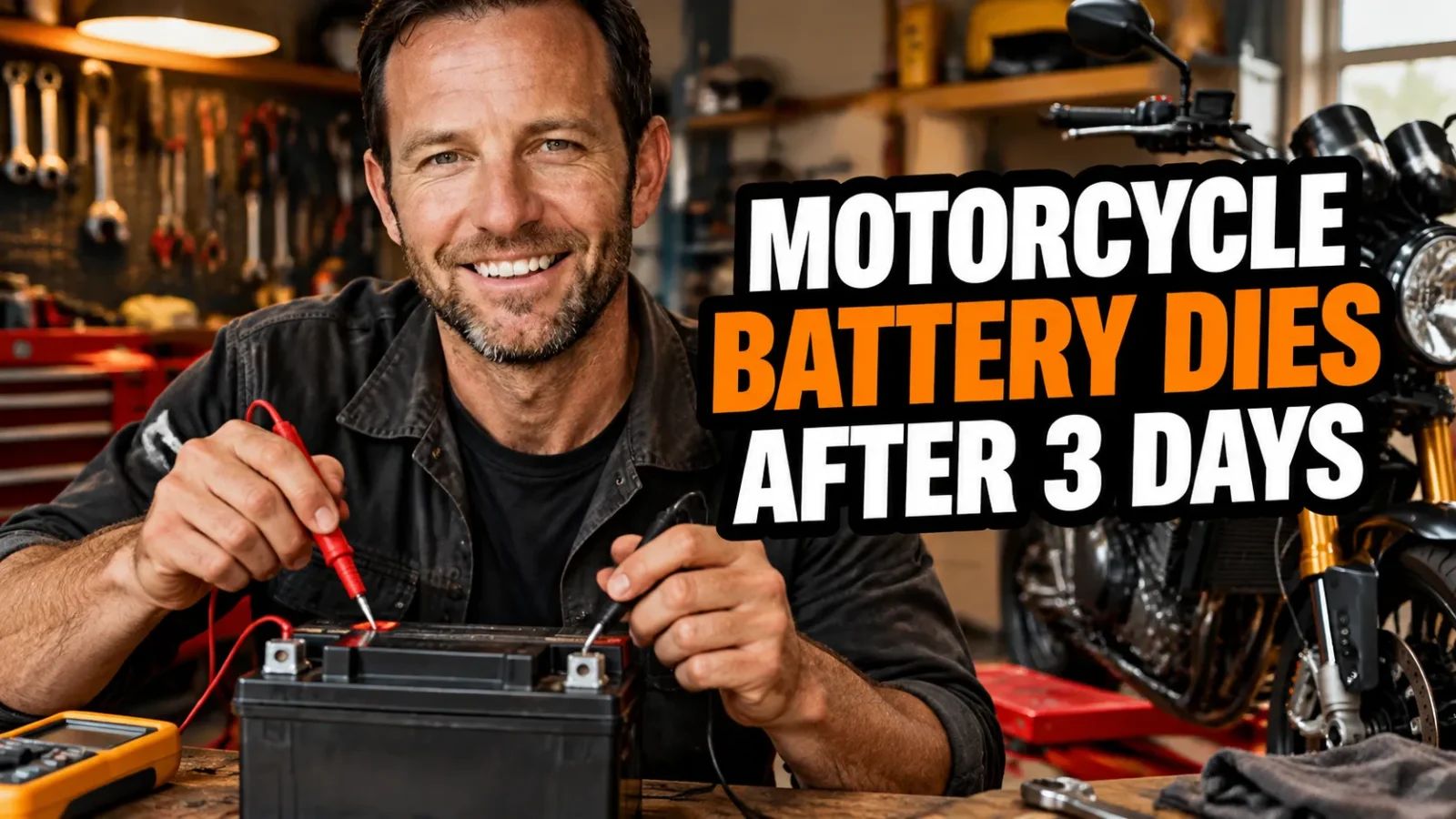
I’ve been riding for over fifteen years, and nothing frustrates me more than walking into my garage, ready for a ride, only to find my motorcycle completely dead. If your motorcycle battery dies after 3 days of sitting, you’re not alone—I’ve dealt with this exact problem multiple times across different bikes.
The good news? I’ve learned exactly what causes this issue and how to fix it permanently. In this guide, I’ll walk you through everything I discovered during my battle with rapid battery drain, including the hidden culprits most riders miss.
- Parasitic drain from accessories, alarms, or faulty wiring is the #1 cause of batteries dying within days
- A failing voltage regulator or stator prevents proper charging, leading to progressive battery death
- Old batteries (3+ years) naturally lose capacity and can’t hold a charge like they used to
- Testing for parasitic draw with a multimeter is the fastest way to diagnose the problem
- Using a battery tender during storage prevents most rapid-drain issues completely
My First Experience with Rapid Battery Death
Let me start with my own story. I had a 2016 cruiser that ran perfectly fine—until it didn’t. I’d ride on Sunday, park it in the garage, and by Wednesday evening the battery would be completely dead. Not weak, not struggling—completely dead.
I initially blamed the battery itself. After all, it was about four years old, so I figured it had simply reached the end of its life. I grabbed what I thought was the best battery brand for motorcycle applications and installed it, confident I’d solved the problem.
Three days later? Dead again. That’s when I realized the battery wasn’t the real problem—something was killing it.
Understanding Normal vs. Abnormal Battery Drain
Here’s what I learned through this frustrating process: every motorcycle battery experiences some level of self-discharge. It’s completely normal for a battery to lose charge over time, even when the bike isn’t running.
A healthy motorcycle battery should maintain enough charge to start your bike for 2-4 weeks of sitting idle, sometimes longer depending on conditions. If your battery dies after just 3 days, you’re dealing with something beyond normal self-discharge.
What’s Draining Power When Your Bike Is Off?
Modern motorcycles aren’t truly “off” when you turn the key. Many components continue drawing small amounts of power, including:
- Electronic control units (ECUs) that maintain memory
- Clock displays and digital instrument clusters
- Security systems and alarm modules
- Fuel injection computers that store adaptive data
- Aftermarket accessories like GPS trackers or USB ports
These systems typically draw between 20-50 milliamps combined. At that rate, a good battery should last weeks. But when something malfunctions or an accessory doesn’t shut off properly, that draw can spike to 200-500 milliamps or more—enough to kill your battery in days.
The Real Culprits Behind 3-Day Battery Death
Through troubleshooting multiple bikes (mine and friends’), I’ve identified the most common causes. Here’s what I’ve found, in order of frequency.
Parasitic Drain: The Silent Battery Killer
This was my problem. A parasitic drain occurs when something continues pulling power after you’ve shut down the bike. In my case, it was an aftermarket alarm system that never fully went to sleep.
I discovered this by performing a parasitic draw test—something every rider should know how to do. With the bike completely off and the key removed, I disconnected the negative battery cable and connected my multimeter in series between the cable and the battery terminal.
A healthy reading should be under 50 milliamps. Mine showed 380 milliamps. That’s massive. At that rate, my 14Ah battery was being drained at roughly 9 amp-hours per day, completely depleting it in less than two days of sitting.
Failing Voltage Regulator or Rectifier
Here’s something that surprised me: a bad voltage regulator doesn’t just prevent charging—it can actually drain your battery. I’ve seen this on two different bikes in my riding group.
The voltage regulator converts AC power from the stator into DC power and regulates it to the correct voltage (around 14-14.5V). When it fails, it can backfeed power from the battery into the stator windings, creating a constant drain.
You can test this by checking the voltage at your battery terminals with the engine running. It should read 13.5-14.5V at cruising RPM. If it’s below 13V or above 15V, your charging system has issues.
Sulfated or Damaged Battery Plates
Even when I thought I was buying what is the best battery for a motorcycle, I learned that batteries can arrive with manufacturing defects or become damaged through deep discharge cycles.
Sulfation occurs when lead sulfate crystals build up on the battery plates, reducing capacity. A heavily sulfated battery might show 12.6V when fully charged but can’t deliver the cold cranking amps needed to start the bike—and it loses that charge rapidly.
I’ve found that batteries subjected to repeated deep discharges (below 12V) develop permanent sulfation damage. This creates a vicious cycle: the weak battery dies quickly, you charge it, it dies again, and each cycle makes it worse.
How I Diagnosed My Battery Drain Problem
Let me walk you through the exact process I used to identify my parasitic drain. You can do this yourself with basic tools.
Step 1: Measure the Parasitic Draw
First, I made sure everything was off—key out, no lights, no accessories. Then I disconnected the negative battery cable and set my multimeter to measure DC current (amps).
I connected the multimeter in series: negative cable to one probe, negative battery terminal to the other. This forces all current to flow through the meter, showing me exactly how much power the bike was drawing while “off.”
My reading: 380mA. Way too high. For reference, most bikes should be under 50mA, and many are under 25mA.
Step 2: The Fuse-Pulling Test
With the multimeter still connected and showing that high draw, I started pulling fuses one at a time from the fuse box. The goal was to find which circuit was causing the excessive drain.
When I pulled the fuse for the accessory circuit (where my alarm was connected), the reading dropped from 380mA to 35mA. Bingo. I’d found the culprit.
Step 3: Checking the Charging System
Even after fixing the parasitic drain, I wanted to ensure my charging system was working properly. I started the bike and measured voltage at the battery terminals at idle, then at 3,000 RPM.
Idle: 13.2V. At 3,000 RPM: 14.1V. Perfect. This told me my stator and voltage regulator were functioning correctly, and the bike was properly recharging the battery during rides.
Solutions That Actually Worked for Me
Once I identified the problem, fixing it was straightforward—though it required some trial and error.
Removing the Problematic Alarm System
In my case, the aftermarket alarm was the villain. I had two options: try to fix the alarm’s sleep mode issue or remove it entirely. I chose removal because the alarm had other quirks I didn’t like.
After removing it and reconnecting everything properly, my parasitic draw dropped to 32mA—perfectly normal. The battery now holds its charge for weeks.
Investing in a Quality Battery Tender
For bikes that sit for extended periods, I now use a best battery charger for a motorcycle—specifically, a smart tender that maintains optimal charge without overcharging.
I keep my touring bike (which sits more during winter) on a tender whenever it’s in the garage for more than a week. This has completely eliminated the 3-day death problem and extended my battery life significantly.
The tender I use has a desulfation mode, which actually helps reverse minor sulfation damage. After keeping a weak battery on it for about a month, I noticed improved performance.
Replacing the Battery (When Necessary)
Sometimes the battery really is the problem. After four years and multiple deep discharge cycles, my original battery had lost too much capacity to recover. Even after fixing the parasitic drain, it struggled to hold a charge beyond a week.
I replaced it with a quality AGM battery appropriate for my riding style. For those doing long tours, I’d recommend checking out options for a best 6 battery for touring motorcycle, though most modern bikes use 12V systems.
Preventing Future Battery Death Issues
Once I solved my immediate problem, I implemented several habits to prevent it from happening again. Here’s what I do now.
Regular Voltage Checks
I keep a small multimeter in my garage and check battery voltage before and after rides. A healthy, fully charged battery should read 12.6-12.8V when the bike is off and hasn’t been ridden for a few hours.
If I see the resting voltage below 12.4V, I know something’s wrong—either the battery didn’t charge fully during my last ride, or something is draining it.
Proper Storage Practices
When I know my bike will sit for more than two weeks, I either disconnect the negative battery cable or connect it to a tender. This is especially important during winter months.
For my Indian, I make sure to use a battery specifically designed for the bike’s needs—you can find good options for a best battery for indian motorcycle that match the OEM specifications perfectly.
Being Cautious with Accessories
After my alarm system debacle, I’m much more selective about aftermarket electrical accessories. Before installing anything, I research whether it has known parasitic drain issues.
I also make sure any accessory installation includes proper fusing and, ideally, a dedicated kill switch so I can completely isolate it when needed.
When to Call a Professional
I’m comfortable with basic electrical troubleshooting, but some issues require professional diagnosis. If you’ve tested for parasitic drain and checked your charging system but still experience rapid battery death, you might have:
- Internal stator problems that require specialized testing equipment
- ECU or wiring harness issues that are difficult to trace
- Corroded or damaged connectors creating intermittent problems
- Frame grounding issues that cause erratic electrical behavior
I’ve learned that spending $100-150 on professional diagnosis can save hundreds in parts thrown at a problem through guesswork. A good motorcycle electrician has tools and experience that make short work of mysterious electrical gremlins.
My Current Battery Maintenance Routine
These days, I rarely deal with dead batteries. Here’s my maintenance routine that keeps everything running smoothly:
Weekly: I check battery voltage if the bike has been sitting. Takes 30 seconds with a multimeter.
Monthly: I clean battery terminals with a wire brush and apply terminal protector spray to prevent corrosion.
Before storage: I connect the tender and check that it’s cycling properly (most tenders have indicator lights showing charge status).
Annually: I perform a full charging system test, checking voltage regulator output at various RPMs and confirming the stator is producing proper AC voltage.
Final Thoughts from My Experience
Dealing with a motorcycle battery that dies after 3 days was incredibly frustrating, but it taught me valuable lessons about motorcycle electrical systems. The most important takeaway? Don’t assume it’s just a bad battery.
In my experience, the battery itself is rarely the sole culprit when you’re dealing with rapid drain. More often, it’s a symptom of an underlying electrical problem—parasitic drain, charging system failure, or accumulated damage from repeated deep discharges.
By learning to test for parasitic draw and checking your charging system output, you can diagnose most of these issues yourself. And by implementing good maintenance habits—using a tender during storage, checking voltage regularly, being careful with accessories—you can prevent the problem from recurring.
If I had to give one piece of advice, it would be this: invest in a quality multimeter and learn basic electrical testing. That $30 tool and 30 minutes of learning saved me hundreds in unnecessary parts and dealership diagnostics. Your future self will thank you when you’re riding instead of troubleshooting.
Frequently Asked Questions
Why does my motorcycle battery die after 3 days?
The most common causes are parasitic drain from accessories, a failing voltage regulator, sulfated battery plates, or a battery that’s simply reached the end of its lifespan (typically 3-5 years).
How do I test for parasitic drain on my motorcycle?
Disconnect the negative battery cable and connect a multimeter in series between the cable and terminal. A healthy bike should draw less than 50 milliamps when off. Anything higher indicates a parasitic drain.
Can a bad stator cause my battery to die quickly?
Yes, absolutely. A failing stator won’t charge your battery properly while riding, meaning it never fully recharges. Over time, this leads to a battery that can’t hold a charge for more than a few days.
Should I use a battery tender when storing my motorcycle?
Yes, I highly recommend it. A quality battery maintainer keeps your battery at optimal charge levels during storage, preventing sulfation and extending battery life significantly.

Related Articles

Scooters vs Motorcycles: My Honest, First-Hand Comparison After Riding Both for Years
After thousands of miles on both scooters and motorcycles, I break down cost, comfort, maintenance, and safety to help you…
Jake Miller
10 min read

7 Scooters That Look Like Motorcycles for Riders Who Want Style and Storage
Explore my top 7 scooters that look like motorcycles, from adventure crossovers like the Honda X-ADV to sporty maxis like…
Jake Miller
9 min read

How Long Do Honda Motorcycles Last? My 20-Year Owner’s Reality Check
Discover how long Honda motorcycles really last from an owner with 100k+ miles of experience. Learn maintenance secrets, high-mileage examples,…
Jake Miller
10 min read