
Why Motorcycles Are So Loud: The Real Reasons Behind That Roar
 Jake Miller
11 min read
Jake Miller
11 min read
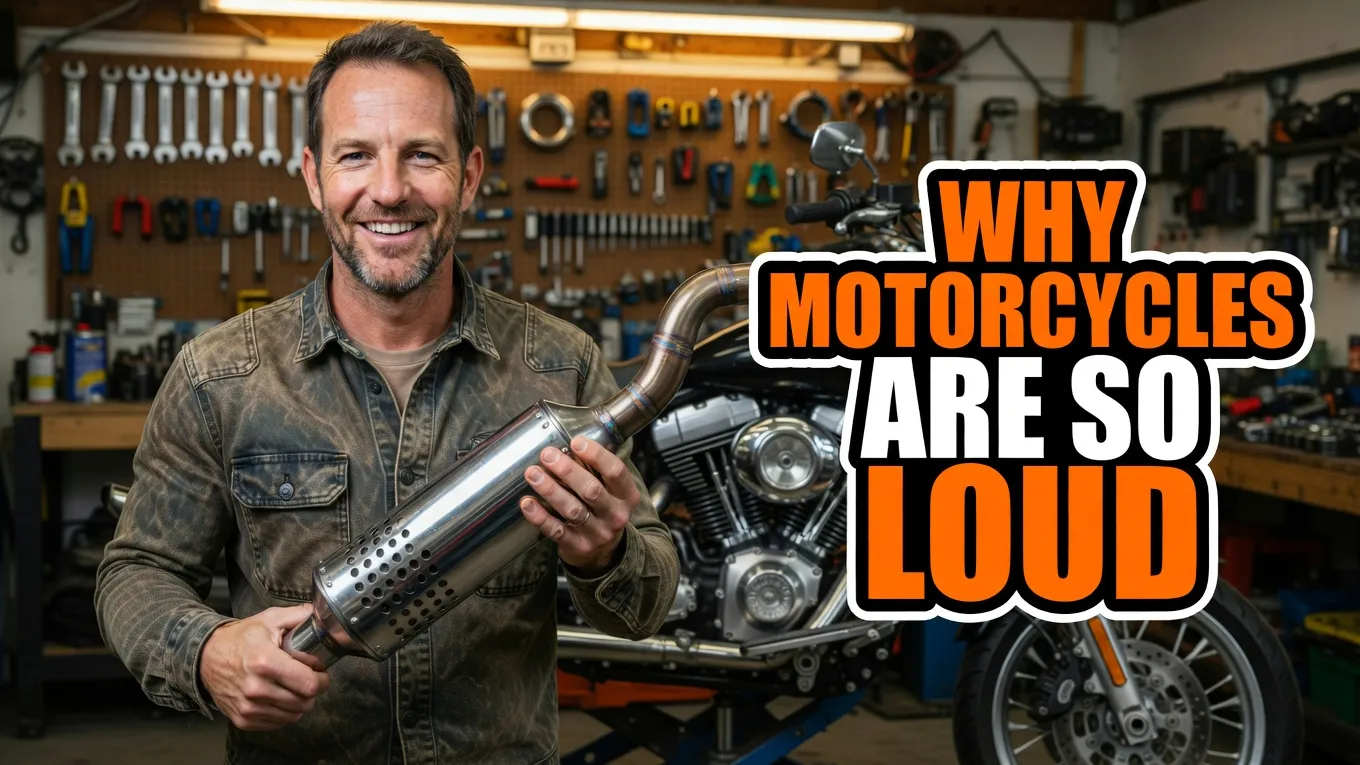
I’ve been riding motorcycles for years, and one question I hear constantly from non-riders is: “Why are motorcycles so damn loud?” It’s a fair question, especially when you’re trying to enjoy a quiet Sunday morning and a pack of bikes rumbles past your window.
The truth is more nuanced than you might think. Some motorcycles are loud by design, others are loud by choice, and a few are loud because of physics that riders can’t entirely control. Let me walk you through everything I’ve learned about motorcycle noise, from engine mechanics to exhaust systems to the cultural factors that keep those decibel levels climbing.
- Motorcycles are loud primarily due to exhaust design and the lack of sound insulation that cars have
- Stock bikes meet noise regulations; most excessive noise comes from aftermarket modifications
- Engine configuration, cylinder count, and firing order all influence sound characteristics
- The “loud pipes save lives” debate continues, but studies show mixed results on actual safety benefits
- Legal limits exist, and modified exhausts can result in fines or failed inspections
The Fundamental Physics of Motorcycle Noise
Let’s start with the basics. When your engine fires, it creates controlled explosions inside the cylinders. These explosions produce exhaust gases that exit through the exhaust system at high pressure and velocity.
In a car, those gases travel through a long, complex exhaust system with multiple mufflers and resonators, all tucked safely underneath where you can’t hear them clearly. The entire passenger compartment is also insulated with sound-deadening materials.
On a motorcycle, you’re sitting right on top of the engine with nothing between you and the mechanical symphony below. There’s no roof, no doors, no trunk full of insulation. Just you, the bike, and the open air.
Why Size Actually Matters
Motorcycles can’t hide big, heavy mufflers like cars can. Weight is the enemy of performance and handling on two wheels. Every pound you add affects acceleration, braking, and cornering.
That means exhaust systems need to be compact and efficient. Smaller mufflers mean less sound absorption. It’s a fundamental trade-off that every motorcycle manufacturer faces.
Engine Configuration and Sound Signatures
Not all motorcycle engines sound the same, and that’s largely due to their configuration. I’ve ridden everything from singles to inline-fours, and each has its own personality.
A single-cylinder thumper produces a distinctive “thump-thump-thump” because there’s only one cylinder firing. V-twins, especially the 45-degree V-twins that Harley-Davidson uses, create that iconic rumble because of their uneven firing intervals.
The Science of Firing Order
When cylinders fire at irregular intervals, you get a loping, syncopated rhythm. When they fire evenly (like in most inline-four sport bikes), you get a smoother, higher-pitched scream.
I remember the first time I twisted the throttle on a friend’s supersport. The engine screamed up to 14,000 RPM with a sound like a Formula 1 car. Compare that to my cruiser’s low, burbling idle, and you’d think they were different species of machine.
The Exhaust System: Where Sound Is Born
The exhaust system isn’t just a pipe that carries gases away. It’s an acoustic instrument that shapes how your bike sounds. Every bend, baffle, and chamber affects the final note.
Stock exhaust systems are engineered to meet strict noise regulations while maintaining performance. They use sophisticated baffles, resonators, and catalytic converters to quiet things down.
Aftermarket Exhausts: The Volume Knob
Here’s where things get controversial. Many riders replace their stock exhausts with aftermarket systems specifically designed to be louder. Some do it for performance gains (less restriction can mean more power), others purely for the sound.
I’ll admit, I’ve run aftermarket pipes on several of my bikes. The difference is night and day. A bike that was whisper-quiet from the factory suddenly announces itself blocks away. It’s intoxicating for the rider, but I understand why neighbors aren’t thrilled.
The performance argument has merit, though. Removing restrictions can free up horsepower, especially on bikes that are heavily restricted from the factory to meet emissions standards. But let’s be honest—most riders do it for the sound.
Two-Stroke vs. Four-Stroke Engines
If you’ve ever heard an old two-stroke dirt bike, you know that distinctive high-pitched buzz. Two-strokes fire every revolution, while four-strokes fire every other revolution. That means twice as many combustion events per minute.
Two-strokes are also simpler mechanically, with fewer parts to absorb sound. They’re less common on modern street bikes due to emissions regulations, but you’ll still find them on dirt bikes and some older models.
Four-stroke engines dominate the current market. They’re quieter, cleaner, and more fuel-efficient. But they still produce plenty of noise, especially when pushed to high RPMs.
The Role of Engine Maintenance
A poorly maintained bike is often a louder bike. I’ve noticed that when my motorcycle’s throttle is sticking or the engine isn’t running smoothly, the sound changes—usually getting raspier and more uneven.
Exhaust leaks, worn gaskets, and loose heat shields all contribute to increased noise. Sometimes what sounds like an intentionally loud bike is actually just a neglected one.
The Throttle Connection
Your throttle system plays a surprisingly important role in noise management. When throttle cables aren’t properly adjusted, you might experience erratic engine behavior that changes how loud the bike sounds at different speeds.
I’ve also seen riders struggle with issues where their motorcycle stopped running while riding, often due to fuel or ignition problems that first manifest as unusual sounds or vibrations.
The “Loud Pipes Save Lives” Debate
This is the rallying cry of riders who defend their loud exhausts. The argument goes: if drivers can hear you coming, they’re less likely to merge into you or pull out in front of you.
I’ve had mixed experiences with this theory. On one hand, I’ve definitely seen drivers react to the sound of my bike before they saw me. On the other hand, studies show that motorcycle sound travels primarily behind the bike at highway speeds due to the Doppler effect.
What the Research Actually Shows
Most accident studies conclude that visibility matters far more than audibility. Bright gear, proper lighting, and defensive riding techniques prevent more crashes than loud pipes ever will.
That said, in urban environments at lower speeds, some sound can help. I’m more inclined to believe it matters in parking lots and city streets than on the highway.
Legal Limits and Enforcement
Every jurisdiction has noise regulations, though enforcement varies wildly. In my area, the limit is 80 decibels at idle for motorcycles manufactured after certain years. Many aftermarket exhausts blow past that threshold easily.
I’ve seen riders get ticketed at motorcycle rallies where cops set up noise checkpoints. They’ll pull you over, measure your exhaust with a decibel meter, and hand you a citation if you’re over the limit.
The EPA Stamp Requirement
In the United States, aftermarket exhausts are supposed to have EPA stamps certifying they meet federal emissions and noise standards. Many “off-road only” pipes explicitly state they’re not street legal.
Installing one of these systems on a street bike is technically illegal, though millions of riders do it anyway. Some states are cracking down harder than others.
Cultural and Community Factors
Let’s not ignore the elephant in the room: some segments of motorcycle culture actively celebrate loud bikes. It’s part of the identity, the rebellion, the “we’re here and we’re not apologizing” attitude.
I get it. There’s something primal about that sound. It makes you feel alive, powerful, connected to the machine. When I’m carving through mountain roads with the exhaust echoing off the cliffs, it’s genuinely euphoric.
But I also live in a neighborhood, and I’ve learned to be more considerate. I keep the RPMs low in residential areas, especially early morning or late at night. The joy I get from my loud exhaust doesn’t justify waking up someone’s baby or ruining a peaceful evening.
Modern Technology and Quieter Options
The industry is actually moving toward quieter bikes, believe it or not. Electric motorcycles are obviously the extreme example—they’re nearly silent except for a faint electric whine.
But even gas-powered bikes are getting better sound insulation technology. Manufacturers are using advanced materials and computer modeling to create exhausts that perform well while staying quiet.
Active Noise Cancellation
Some high-end bikes now feature active exhaust valves that open and close based on RPM and throttle position. At low speeds and light throttle, the valves route exhaust through additional baffles for quiet operation. Under hard acceleration, they open up for better flow and sound.
It’s a compromise that lets riders have the best of both worlds. I’ve tested bikes with these systems, and they’re impressively effective.
The Rider’s Perspective on Modifications
When considering whether to install an aftermarket exhaust, I always weigh several factors. Performance gains are real but often modest—usually 5-10% more horsepower at most. The weight savings can be significant, especially if you’re replacing heavy stock pipes.
But the sound is what really drives the decision for most people. Before you judge, understand that for many riders, the auditory feedback is part of the riding experience. It helps you sense what the engine is doing, when to shift, how hard you’re working the motor.
Responsible Modification
If you’re going to modify your exhaust, I’d suggest choosing a system that’s not obnoxiously loud. There’s a sweet spot between boring stock silence and “wake the whole county” volume.
Companies like Akrapovič, Yoshimura, and Two Brothers make quality exhausts that sound great without being antisocial. You can also install baffle inserts that let you dial back the volume when needed.
And please, for the love of everything, don’t be that person who revs their bike for no reason in parking lots. Nobody thinks you’re cool. We all think you’re compensating for something.
The Impact of Riding Style
How you ride dramatically affects how loud your bike is. Short-shifting and keeping RPMs low produces minimal noise. Wringing out every gear to redline creates maximum volume.
I notice this especially when riding in groups. Some riders are constantly on and off the throttle, engine braking hard, downshifting aggressively. Others ride smoothly with minimal throttle input. The noise difference is dramatic, even on identical bikes.
Throttle Control and Sound Management
Learning smooth throttle control isn’t just about being quiet—it’s fundamental riding technique. Issues like throttle sticking can make this harder, which is why I always ensure my throttle tube is compatible with my bike and properly lubricated.
Some riders also use throttle locks for highway cruising, though you need to be careful with those to avoid unexpected situations.
My Take on the Future of Motorcycle Sound
I think we’re heading toward a fork in the road. Electric motorcycles will continue to gain market share, bringing near-silent performance to those who want it. Traditional gas bikes will likely face stricter regulations, pushing manufacturers to innovate on sound control.
But I don’t think loud motorcycles will disappear entirely. There’s too much cultural attachment, too much rider demand. What I hope happens is that we collectively become more thoughtful about when and where we unleash that volume.
The track is the perfect place for maximum noise. Residential neighborhoods at 6 AM are not. It’s really that simple.
Finding the Balance
After years of riding and testing different setups, I’ve landed on a middle ground. I run a slip-on exhaust that’s noticeably louder than stock but not excessive. It gives me the performance and sound I want without making enemies everywhere I go.
I also practice throttle discipline in sensitive areas. I can enjoy the full sound on empty roads while being respectful in populated areas. It’s not complicated—it’s just basic consideration for others.
The reality is that motorcycles will always be louder than cars, and that’s okay. The exposure to the elements, the mechanical intimacy, the visceral feedback—it’s all part of what makes riding special. But there’s a difference between inherently loud and intentionally obnoxious.
Understanding why motorcycles are loud helps us make better choices about our own bikes and riding style. Whether you’re a rider defending your exhaust choice or a neighbor wondering why that Harley just woke your kids, I hope this perspective helps you see the full picture.
At the end of the day, we all share the road and the neighborhoods we ride through. A little understanding and consideration goes a long way on both sides.
Frequently Asked Questions
Are stock motorcycles actually loud, or is it just aftermarket exhausts?
Stock motorcycles are designed to meet noise regulations and are typically much quieter than aftermarket setups. Most excessive noise comes from modified exhaust systems that riders install to change performance or sound characteristics.
Why do Harley-Davidson motorcycles sound different from sport bikes?
Harley engines use a unique V-twin configuration with uneven firing intervals, creating their distinctive potato-potato rumble. Sport bikes typically have inline or parallel engines with even firing, producing a higher-pitched scream at high RPMs.
Is a loud motorcycle actually safer on the road?
The ‘loud pipes save lives’ argument is debatable. While some noise can alert distracted drivers, sound travels backward more than forward at speed, and studies show visibility and defensive riding matter far more for safety than exhaust volume.
Can I get a ticket for having a loud motorcycle?
Yes, absolutely. Most jurisdictions have specific noise ordinances and decibel limits for motorcycles. Modified exhausts that exceed these limits or lack proper EPA stamps can result in fines, failed inspections, or even impoundment in some areas.

Related Articles
7 Best Batteries for Motorcycles I’ve Tested and Trust in 2026
I've tested dozens of motorcycle batteries to find the best performers. From AGM to lithium, here are my top picks…
Jake Miller
15 min read

The Perfect Battery for Your Harley Davidson Softail: A Rider’s Complete Guide
Discover the perfect battery for your Harley Davidson Softail. I've tested multiple options and share real-world performance data, maintenance tips,…
Jake Miller
14 min read

The Best Battery for Your Harley Davidson: My Complete Guide After Years of Testing
Discover which battery truly performs best for Harley Davidson motorcycles. Real rider experience with AGM, lithium, and OEM options to…
Jake Miller
12 min read