
How a Hubless Motorcycle Wheel Works: Design, Pros, Cons and Real-World Limits
 Jake Miller
12 min read
Jake Miller
12 min read
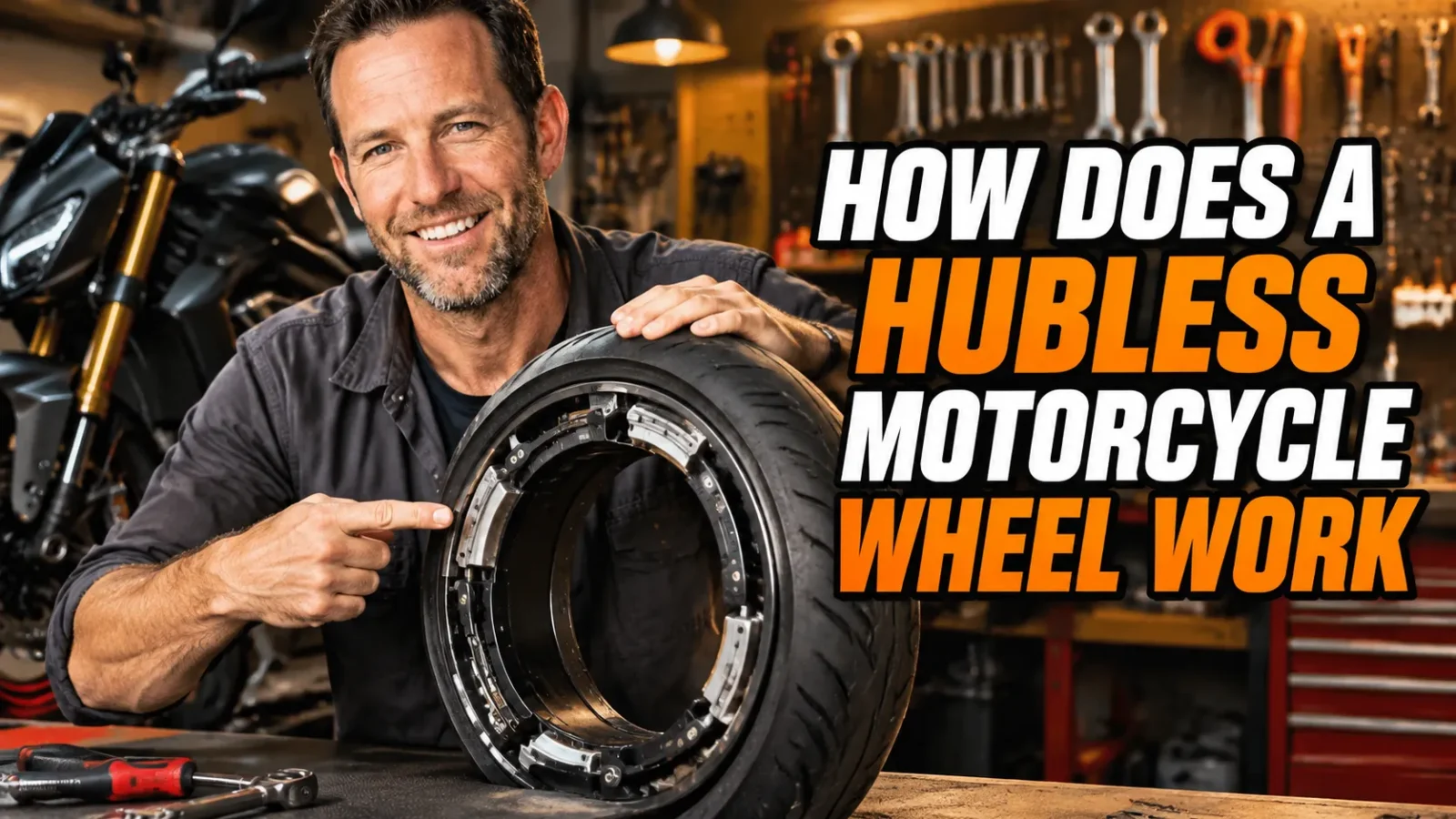
The first time I saw a motorcycle with an empty, open space where the wheel center should be, I did a double take. No hub, no spokes, no axle running through the middle. Just a tire and a big ring that somehow kept spinning and carrying the bike down the road.
As a rider who likes to understand what is holding me up at speed, I had to know how it works. I dug into the design, the engineering logic, and the compromises. Here is everything I learned, explained the way I wish someone had explained it to me.
- A hubless wheel spins around a fixed inner structure using rollers, bearings, or magnets placed around the rim instead of an axle at the center.
- Power can come from a toothed ring, an internal gear, or an electric motor built into the rim itself.
- The look is striking and the packaging is flexible, but weight, cost, and serviceability are real drawbacks.
- For daily riding, conventional wheels are still the safer and more practical choice.
The Basic Idea: Moving the Pivot to the Edge
On a normal motorcycle wheel, everything revolves around a central axle. The hub sits on bearings, spokes or a cast web connect the hub to the rim, and the rim holds the tire. All the load flows from the rim, through the spokes, to the hub and into the axle.
A hubless wheel flips that logic. The rotating part is essentially just the rim and tire, and the thing it rotates around is a stationary ring or carrier that sits inside or beside it. The pivot point moves from the center to the circumference.
That is the whole trick. Once you accept that the “bearing” can be spread around the edge rather than concentrated in the middle, the rest of the design starts to make sense.
The Key Components I Look For
Different builders solve this in different ways, but most hubless designs share a handful of parts. Understanding them makes any hubless wheel much easier to read at a glance.
The Outer Rotating Ring
This is the part that carries the tire. It is usually thicker and stiffer than a normal rim because it has to do the job that spokes would normally do. It also often includes a track, groove, or flange on its inner face for the rollers to ride on.
Because the ring is the structural heart of the wheel, its stiffness matters a lot. A flexy ring would deform under cornering loads, and that would be felt straight through the bars.
The Stationary Inner Carrier
Inside or beside the ring sits a fixed hoop, plate, or arm. This is what connects to the fork or swingarm. Think of it as the “axle,” except it is shaped like a partial ring instead of a rod.
It has to be rigid and accurately machined. Any misalignment here shows up as vibration, uneven roller wear, or drag.
Rollers, Bearings, or Magnets
These are the contact points that let the ring spin against the carrier. Most designs I have seen use a series of guide rollers or bearing wheels spaced around the carrier. They hold the ring in place radially and, with the right profile, laterally too.
More exotic concepts use magnetic levitation or air-cushion approaches, but those are mostly confined to show bikes and engineering studies. Rollers remain the practical solution.
How Load Travels Through a Hubless Wheel
Here is where it gets interesting. In a spoked wheel, the bike’s weight hangs from the top spokes in tension. In a cast wheel, the load goes through the web. In a hubless wheel, the load goes through the rollers.
When I sit on the bike, my weight pushes down through the carrier onto the rollers at the bottom of the ring. The ring rolls over those rollers while the tire contacts the road. Every roller sees changing loads as the ring rotates.
Why Roller Spacing Matters
Too few rollers, and each one carries a punishing load. Too many, and you add weight, friction, and complexity. Designers have to balance it carefully.
Cornering adds another layer. When I lean into a turn, the load shifts sideways. The roller profile and the ring’s track must resist those lateral forces without binding or slipping.
Stiffness Versus Weight
A conventional wheel gets its stiffness from geometry: tensioned spokes or a ribbed casting. A hubless wheel gets it from a heavy-duty ring. That usually means more material, and more material means more unsprung weight, something I always try to minimize.
Unsprung weight affects how quickly the suspension can react. Heavier wheels feel less nimble over bumps. I will come back to that in the downsides section.
Getting Power to the Road
Without a central hub, you cannot just bolt a sprocket to the axle. Builders have come up with a few clever alternatives.
Toothed Ring and Chain or Belt
One option is to cut teeth or a grooved profile into the ring itself. A chain or belt wraps around it, much like around a giant sprocket. It is mechanically simple, but it puts a lot of demand on the ring’s material and tolerances.
Internal Ring Gear
Another approach uses an internal gear on the inside face of the ring, driven by a small pinion. This is a bit like how some large industrial rotating drums are turned. It keeps the drive hidden and neat, and it can offer a useful reduction ratio.
Rim-Mounted Electric Motors
For electric bikes, this is where hubless wheels get really appealing to me. Magnets can be embedded in the rotating ring, with stator coils on the fixed carrier. The ring becomes the rotor of the motor.
The result is a drive system that is integrated into the wheel itself, with no chain, no belt, and no gearbox. Because the motor diameter is large, it can produce solid torque at modest speeds.
Braking Without a Hub
Braking is another area where the design needs creativity. A standard disc bolts to the hub. Here, there is no hub to bolt to.
The usual answer is to attach a disc or braking flange directly to the rotating ring. The caliper then mounts to the stationary carrier and clamps the disc as normal. In some designs, the ring itself has a machined braking surface.
I like this idea in theory because the braking surface can be large in diameter, which improves leverage. In practice, heat management is the challenge. The brake heat has to go somewhere, and it can end up near the rollers or ring track if it is not carefully managed.
Steering and Suspension Considerations
A hubless front wheel still needs to steer. That means the carrier has to attach to a fork, a hub-center steering arm, or some other linkage. It is usually mounted from one side only, like a single-sided swingarm.
Because the inner space is open, designers can try unusual front-end layouts. Some concepts use that open center to run steering geometry through the wheel, which is the same spirit as hub-center steering systems used on a few boutique machines.
The catch is that a single-sided mounting puts big bending loads on the carrier. Braking and cornering both try to twist it. It needs to be very stiff, and again that adds weight.
The Upsides That Excite Me
I will be honest: the appeal is not purely practical. A lot of it is visual and conceptual. Still, there are some genuine advantages worth noting.
- Unique styling: An open-center wheel looks futuristic, and you can see right through it.
- Packaging freedom: The empty middle can house brakes, motors, or even storage in concept designs.
- Integrated electric drive: A rim motor eliminates drivetrain parts.
- Large brake diameter: A disc at the outer edge offers strong leverage.
- Distributed load: Bearings spread across a big circumference rather than concentrated at one point.
The Downsides I Cannot Ignore
Now for the reality check. Every time I weigh up a hubless wheel against a conventional one, I find a long list of compromises. Some are manageable, but others are serious.
Weight and Rotating Mass
A heavy ring placed at the outer edge adds rotational inertia, which is the hardest kind of weight to deal with. It makes the bike slower to turn in and slower to change direction. Gyroscopic effects get stronger, too.
Cost and Complexity
Precision-machined rings, custom rollers, and bespoke carriers do not come cheap. There is no mass-market supply chain, so almost everything is custom-made. Replacement parts can be hard or impossible to source.
Dirt, Water, and Wear
Rollers and tracks around the outside of the wheel are exposed to road grit, water, and salt. Sealing them properly is a serious challenge. In a standard wheel, the bearings are tucked away in a protected hub.
On that note, if you are used to maintaining a standard wheel, it is worth knowing how long do wheel bearings last on a motorcycle in normal use. A hubless design replaces those few bearings with many rollers, and each one is a wear item.
Serviceability
Changing a tire on a hubless wheel can be tricky. Depending on the design, you might need to split the ring or remove the carrier entirely. Compare that to the simple process I am used to with a regular wheel.
Spoked, Cast, or Hubless: How Do They Compare?
Traditional wheels have decades of refinement behind them. Spoked wheels flex a little and absorb impacts well. Cast wheels are stiff, light, and affordable. If you are curious about how spoked designs are laid out, I have also looked at how many spokes on a motorcycle wheel and why builders choose particular counts.
Hubless wheels have no spokes at all, so they lose that built-in compliance. Everything depends on the ring’s stiffness and the roller system’s precision. That is a bold engineering bet, and it does not always pay off.
A Quick Mental Summary
- Spoked: flexible, repairable, great for off-road.
- Cast: stiff, light, low-maintenance, ideal for street.
- Hubless: distinctive, experimental, expensive, and niche.
Alignment, Balance, and Handling Quirks
A wheel that rotates on a ring and rollers needs to run true. If the ring is slightly out of round, or the rollers are unevenly worn, you will feel it as vibration or a rhythmic wobble. That is not so different from the problems riders face with conventional wheels.
If you ever notice shaking at the bars, I would start by reading about why does my front wheel wobble on my motorcycle. Many of the causes, such as imbalance, tire wear, or loose components, apply regardless of wheel type.
Rear Wheel Setup
Aligning a hubless rear wheel is just as important as with any other. The carrier must be square to the frame, and the drive element, whether a belt, chain, or motor, must track straight. A small error can create drag and accelerate wear.
The fundamentals are the same ones I follow on any bike. If you want a refresher, my notes on how to adjust rear wheel alignment on a motorcycle and how to align rear motorcycle wheel side to side cover the principles that carry over to unconventional setups.
Is It Safe? My Honest Take
Safety comes down to engineering quality and testing. A well-built hubless wheel with properly rated components can be safe. But because the design is unconventional, there is far less real-world data than for standard wheels.
I would not trust an untested, amateur-built hubless wheel at highway speeds. The failure modes, such as a roller seizing or a ring cracking, are not forgiving. Any production use should come with certification and rigorous testing.
Legal Considerations
Regulations vary by region. Many places do not ban the design outright, but they do require that wheels meet strength and safety standards. A custom hubless wheel may need an engineering inspection before it is road legal.
Where I Think Hubless Wheels Are Headed
I do not expect hubless wheels to replace conventional ones anytime soon. The weight, cost, and sealing issues are too significant for mainstream use. But I do think they have a future in a few niches.
Electric bikes and scooters are the most promising. A rim-integrated motor makes a lot of sense when there is no gearbox or chain to worry about. Concept and show bikes will keep using the look, too, because it genuinely turns heads.
What I Would Want to See
For me to consider one on my own bike, I would need proven sealing, replaceable roller modules, and independent testing data. I would also want weight parity with a good cast wheel. Until then, I admire the engineering from a distance.
Final Thoughts
A hubless motorcycle wheel works by moving the pivot from the center to the edge. A rotating ring carries the tire, a fixed carrier connects to the bike, and rollers or magnets let the two move against each other. Drive and braking are adapted to suit the ring.
It is an elegant, eye-catching idea, and I love that engineers keep pushing the boundaries. But for everyday riding, I will stick with a wheel that is light, serviceable, and proven. If a hubless design ever matches those qualities, I will be first in line to try it.
Frequently Asked Questions
Are hubless motorcycle wheels street legal?
It depends on where you live. Most regions regulate wheels through general safety and type-approval rules rather than banning the design outright, but a hubless wheel usually needs certification or an inspection. Check with your local vehicle authority before fitting one.
Do hubless wheels have bearings?
Yes. Instead of a small bearing set around an axle, they use rollers, bearing carriages, or magnetic levitation around the large outer ring. The load is spread over a much bigger circumference.
Are hubless motorcycle wheels better than spoked or cast wheels?
Not for most riders today. They offer unique styling, an open center, and packaging freedom, but cost, weight, serviceability, and limited parts support keep conventional wheels ahead for daily riding.
How is a hubless wheel driven and braked?
Power can come from a chain or belt acting on a toothed ring, an internal gear, or an electric motor built into the rim. Brakes typically clamp a disc or flange fixed to the rotating ring.

Related Articles

8 Best Cruiser Motorcycle Tires for Street Riding: My Real-World Picks
I rank the 8 best cruiser motorcycle tires for street riding, from Michelin to Pirelli, with real notes on grip,…
Jake Miller
9 min read

8 Best Michelin Motorcycle Tires for Every Riding Style (Tested Picks)
Looking for the best Michelin motorcycle tires? I break down my 8 favorite models for sport, touring, adventure, cruiser, and…
Jake Miller
9 min read

Yamaha Tire Pressure Guide: The Right PSI for Safer, Smoother Rides
Learn the right tire pressure for your Yamaha, from sportbikes to cruisers and dirt bikes. Check, adjust and maintain PSI…
Jake Miller
9 min read