
Two-Up Tire Pressure: How I Set My PSI for Riding With a Passenger
 Jake Miller
10 min read
Jake Miller
10 min read
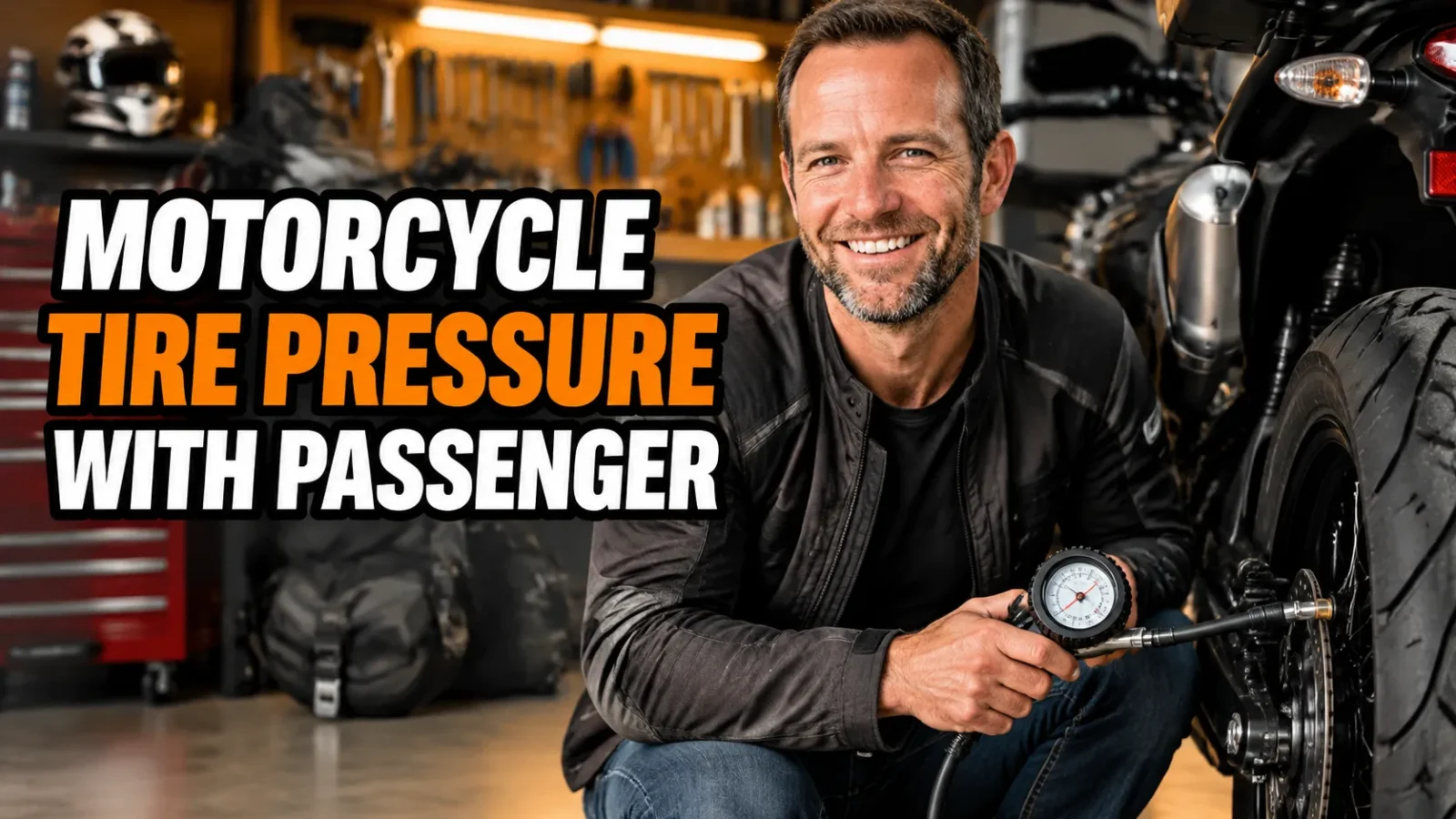
The first time I took a passenger on a long ride, I did everything right except one thing. I checked the oil, tightened the chain, and loaded the luggage, but I left my tires at solo pressure. About an hour in, the rear felt squirmy in corners and the bike wallowed on the highway.
That ride taught me that tire pressure is the cheapest, fastest, and most overlooked safety adjustment you can make when riding two-up. In this guide, I’ll share what I’ve learned about setting pressures for a passenger, how I verify them, and the mistakes I see riders make again and again.
- Start with your owner’s manual or swingarm sticker, which often lists a separate two-up pressure.
- In my experience, adding 2 to 4 PSI to the rear (and 0 to 2 PSI to the front) is a sensible adjustment when the manual is silent.
- Always measure and adjust when the tires are cold, and never exceed the sidewall maximum.
- A good gauge and a tire pressure monitoring system make two-up riding safer and less stressful.
- Return to your solo pressure when the passenger gets off.
Why a Passenger Changes Everything for Your Tires
A passenger isn’t just extra weight. They change how that weight sits on the bike, how the suspension behaves, and how hard your tires work on every mile of road.
The Load Shifts Toward the Rear
When your passenger climbs on, most of their weight lands over or behind the rear axle. On my bikes, the rear tire can easily take on an extra 120 to 200 pounds, depending on who’s riding with me and how much gear we carry.
The front tire gets lighter in relative terms, which is why steering can feel a bit floaty. That shift is exactly why the rear needs more support than the front.
Heat Is the Silent Enemy
An underinflated tire flexes more as it rolls. That flexing generates heat, and heat is what breaks down tire construction over time.
I’ve seen the telltale signs on friends’ bikes: shoulders worn unevenly, a rear tire that feels mushy by the end of a long day, and in one scary case, a tire that failed on an interstate. Heat plus load plus low pressure is a bad combination, and two-up riding stacks all three.
Handling and Braking Feel
Correct pressure keeps the contact patch the right shape. Too low, and the tire squirms and turns in slowly. Too high, and the contact patch shrinks, grip drops, and the ride gets harsh.
With a passenger, braking distances also grow because there’s more mass to stop. I want every bit of grip I can get, which means getting the pressure right before I roll out.
Start With the Manufacturer’s Numbers
Before I touch a gauge, I look up what the people who built the bike recommend. This is the single most reliable starting point, and it’s often overlooked.
Where to Find the Right Specs
- The owner’s manual, usually in the specifications or tire section
- A sticker on the swingarm, frame, or under the seat
- The tire manufacturer’s website, for load and inflation guidance
- The sidewall, which shows the maximum pressure (not the recommended one)
Many touring and cruiser manuals list a “solo” and “rider plus passenger” figure. If yours does, use it and skip the guesswork. If you ride a bagger or tourer, my notes on cruiser motorcycle tire pressure go deeper on how those heavier machines like to be set up.
Understanding “Cold” Pressure
Every number you’ll find assumes cold tires. That means the bike has been parked for at least three hours, or it’s been ridden less than a mile at low speed.
Once you ride, the air inside warms up and the pressure climbs, often by 4 to 6 PSI. I never let air out of a hot tire to hit the “right” number, because it will end up underinflated once it cools.
My Real-World Two-Up Adjustments
When the manual doesn’t give a two-up figure, I use a conservative rule of thumb. It has served me well across several bikes and thousands of miles, but treat it as a starting point rather than gospel.
The Rule of Thumb I Use
I add roughly 2 to 4 PSI to the rear tire and 0 to 2 PSI to the front. The heavier the passenger and luggage, the closer I get to the top of that range.
I never exceed the maximum pressure printed on the tire sidewall. That number is a ceiling, not a target.
Example Pressure Ranges by Bike Type
The table below shows the kind of ranges I’ve used. Your bike, tires, and manual always take priority over these examples.
| Bike Type | Front (Solo) | Rear (Solo) | Front (Two-Up) | Rear (Two-Up) |
|---|---|---|---|---|
| Sport-touring | 36 PSI | 38 PSI | 36 to 38 PSI | 40 to 42 PSI |
| Cruiser / bagger | 36 PSI | 36 PSI | 36 to 38 PSI | 38 to 40 PSI |
| Adventure | 32 PSI | 36 PSI | 32 to 34 PSI | 38 to 40 PSI |
| Standard / naked | 32 PSI | 36 PSI | 34 PSI | 38 to 40 PSI |
A Note on Sport Bikes
On sportier machines, I’m more cautious about going high. Performance tires are designed to work within a narrow pressure window, and extra PSI can make them feel skittish.
If you ride a sport bike with a passenger, check the tire maker’s guidance first. My write-up on the best micheline sport tire for motorcycle covers how those tires behave and why pressure matters so much with them.
A Note on Adventure and Dual-Sport Bikes
Adventure bikes complicate things because they’re often loaded with luggage as well as a passenger. I treat the total weight as the real variable, not just the person on the back seat.
If you’re heading off pavement, you may drop pressures, but with a passenger I stay on the road-oriented side of the range. Low pressure plus heavy load is a recipe for pinch flats and rim damage.
My Step-by-Step Process Before Every Two-Up Ride
I keep this routine simple so I actually do it. It takes about five minutes, and I’ve never regretted the time.
- Check the tires cold. I do this in the morning or after the bike has rested in the garage.
- Use a quality gauge. Cheap gauges can be off by several PSI, which defeats the whole purpose.
- Record the solo pressure. I jot it in my phone so I can return to it later.
- Adjust the rear first. Then I make a small front adjustment if needed.
- Inspect the tread and sidewalls. I look for cuts, bulges, embedded nails, and cracking.
- Recheck after the first fuel stop. A quick warm check tells me whether anything is leaking.
Don’t Forget the Suspension
Tire pressure works hand in hand with your suspension settings. If your bike has adjustable preload, increase it for the passenger so the rear doesn’t sag.
A bike that squats too much changes steering geometry and puts even more strain on the rear tire. I always adjust preload and pressure together.
Why I Rely on Monitoring Instead of Guessing
Gauges are great, but they only tell you the pressure at one moment. On a long two-up trip, I want to know what’s happening while I ride.
Real-Time Peace of Mind
A tire pressure monitoring system lets me glance at a display or phone and see live pressure and temperature. A slow leak that I’d never notice by feel becomes obvious within minutes.
If you’re curious about options, I’ve tested and compared the best tire pressure monitoring system for motorcycle setups, and I can’t overstate how useful they are when you’re responsible for someone else’s safety.
What I Look for in a Monitor
- Accurate readings with alerts for rapid pressure loss
- Temperature display, since heat tells the other half of the story
- Easy installation and replaceable batteries
- A display I can read at a glance while riding
Tire Condition Matters as Much as Pressure
You can nail the PSI and still have a problem if the tire itself is worn out, unbalanced, or damaged. I treat pressure as one piece of a bigger tire-care puzzle.
Balance and Vibration
An unbalanced tire causes vibration that gets amplified when you add weight and speed. Your passenger will feel it too, and they’ll let you know about it.
If you mount your own tires or swap wheels often, a good balancer is worth the investment. I’ve shared my favorites in my guide to the best tire balancer for motorcycle owners.
Be Ready for a Puncture
Two-up riding often means longer trips, and longer trips mean more chances to pick up a nail. I never leave home without a plug kit and a compact inflator.
A roadside fix is a temporary measure, but it can get you and your passenger to safety. If you haven’t built a kit yet, take a look at my picks for the best tire repair kit for motorcycle riders.
Know When to Replace
Worn tires are far less forgiving under load. I replace mine well before they reach the wear indicators if I regularly ride two-up, especially on the rear.
Tires also age. Even with plenty of tread, rubber that’s more than five or six years old can harden and lose grip.
Common Mistakes I See (and Have Made)
Over the years, I’ve watched riders, including me, fall into the same traps. Here are the big ones.
Mistake 1: Trusting the Sidewall Number
The maximum pressure on the sidewall is not the recommended pressure for your bike. Inflating to that number can make the ride harsh and reduce grip.
Mistake 2: Checking Hot Tires
I did this early on and ended up thinking my pressures were fine when they were low. Always check cold, or account for the expected rise if you must check warm.
Mistake 3: Forgetting to Reset
Riding solo on two-up pressures makes the bike feel stiff and can reduce traction, especially in the wet. I make it a habit to return to the solo setting when the passenger isn’t with me.
Mistake 4: Ignoring Luggage Weight
Saddlebags, a top case, and a tank bag all add to the load. When I pack heavily, I treat the bike as if it’s carrying an extra passenger and adjust accordingly.
Mistake 5: Relying on Looks
You cannot judge pressure by eye, particularly on radial tires with stiff sidewalls. A tire can lose 10 PSI and still look fine. Always use a gauge.
Weather and Temperature Considerations
Air pressure changes with temperature, roughly 1 PSI for every 10 degrees Fahrenheit. That means a tire set perfectly on a warm afternoon can be several PSI low on a chilly morning.
On multi-day trips, I recheck pressures each morning. If I’m riding through big temperature swings, such as crossing mountains, I check more often and adjust to stay close to my target.
Talking to Your Passenger
This part isn’t about tires, but it matters just as much. A good passenger makes the bike easier to control, and a nervous one makes it harder.
I brief my passengers on leaning with me, holding on, and staying relaxed. Then I tell them what I did to the bike, including the tire pressure check. It builds trust, and it shows them that safety matters to me.
Final Thoughts From the Saddle
Setting the right pressure for a passenger isn’t complicated, but it does require attention. Start with the manual, adjust the rear a few PSI, check cold, and verify often. Pair that with healthy tires, proper suspension settings, and a way to monitor pressure on the road.
In my experience, the riders who treat tire pressure as a ritual are the ones who enjoy two-up riding the most. Their bikes handle better, their tires last longer, and their passengers feel safer.
So before your next ride together, grab your gauge, take five minutes, and give your tires the attention they deserve. You’ll feel the difference in the first corner, and so will the person on the back.
Frequently Asked Questions
How much should I increase my motorcycle tire pressure when carrying a passenger?
Always start with your owner’s manual, since many list separate two-up pressures. As a general rule, I add about 2 to 4 PSI to the rear tire and 0 to 2 PSI to the front, never exceeding the maximum pressure on the tire sidewall.
Should I check tire pressure hot or cold?
Check it cold, meaning the bike has sat for at least three hours or been ridden less than a mile. Riding heats the air and gives you a falsely high reading, so adjusting a hot tire usually leaves you underinflated.
What happens if I ride two-up with the solo tire pressure?
The tires flex more under the extra weight, which builds heat, wears the shoulders faster, and makes steering feel vague or heavy. In extreme cases, underinflation can lead to tire failure, especially at highway speeds or in hot weather.
Do I need to lower the pressure after the passenger gets off?
Yes, I recommend returning to your solo pressure when you ride alone. Running two-up pressures solo can shrink the contact patch, reduce grip, and make the ride harsher.

Related Articles

8 Best Cruiser Motorcycle Tires for Street Riding: My Real-World Picks
I rank the 8 best cruiser motorcycle tires for street riding, from Michelin to Pirelli, with real notes on grip,…
Jake Miller
9 min read

8 Best Michelin Motorcycle Tires for Every Riding Style (Tested Picks)
Looking for the best Michelin motorcycle tires? I break down my 8 favorite models for sport, touring, adventure, cruiser, and…
Jake Miller
9 min read

Yamaha Tire Pressure Guide: The Right PSI for Safer, Smoother Rides
Learn the right tire pressure for your Yamaha, from sportbikes to cruisers and dirt bikes. Check, adjust and maintain PSI…
Jake Miller
9 min read