
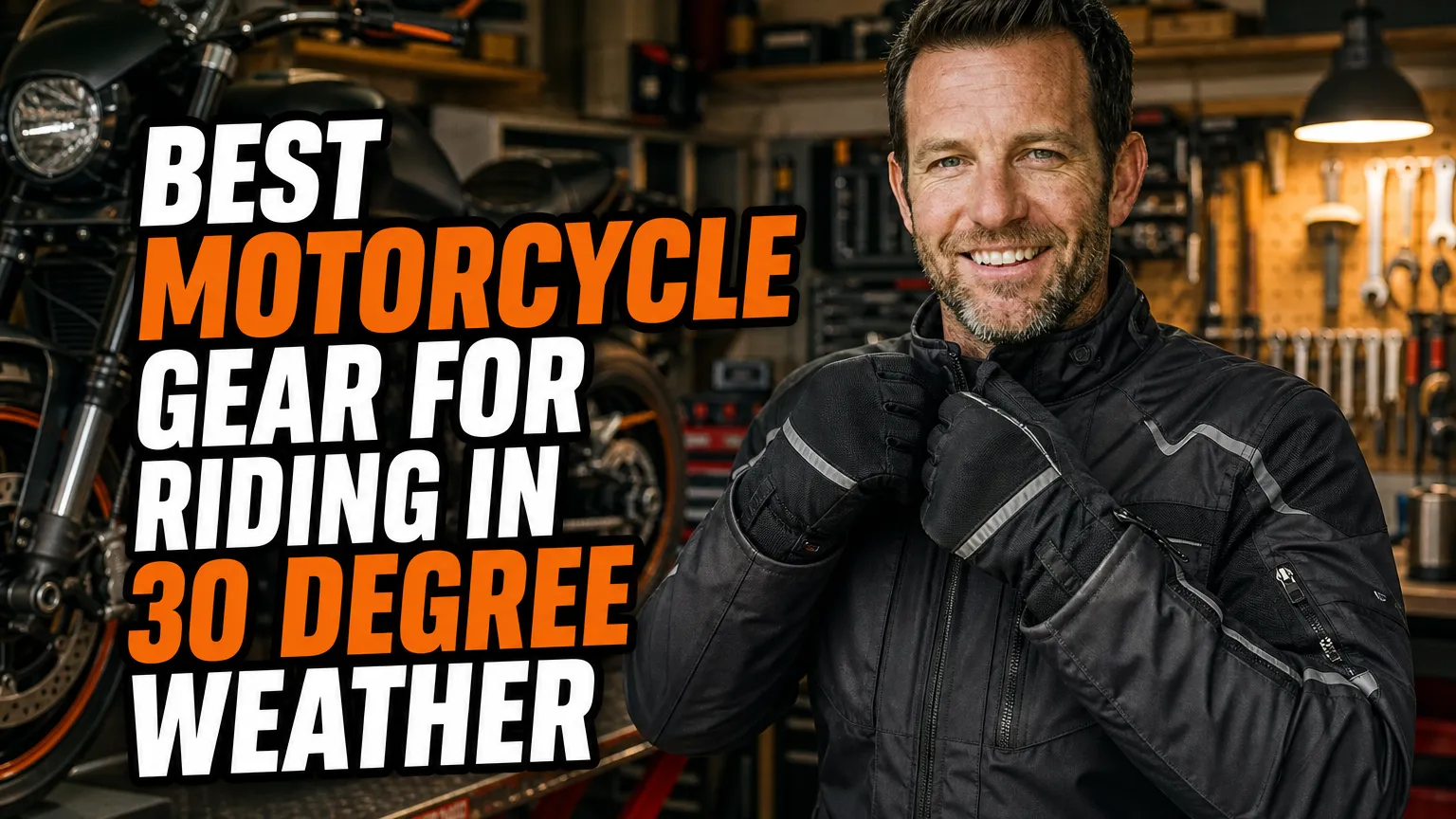
Thirty-degree motorcycle rides demand more than a thick jacket. I need windproof layers, warm hands and feet, enough freedom of movement to control the bike, and a careful eye on road conditions. In my experience, the right combination matters more than piling on bulky clothing.
Here are the products I’d consider when putting together the best motorcycle gear for riding in 30 degree weather. I’ve included protective outerwear as well as the layers that help make a cold ride more manageable. Gear models and prices can change, so I always check the current specifications and sizing before buying.
- I use a moisture-wicking base layer, insulating layer, and protective outer shell rather than relying on one thick garment.
- Heated gear can help at 30°F, but I check my bike’s electrical capacity and keep the wiring secure.
- I prioritize well-fitting gloves, boots, and a warm neck covering because exposed extremities get uncomfortable quickly.
- I skip the ride if frost, ice, or poor visibility makes traction or control uncertain.
1. Gerbing 12V Heated Jacket Liner — My Core Heated Layer
When I expect a long ride near freezing, I look at the Gerbing 12V Heated Jacket Liner as a way to add warmth beneath a motorcycle jacket. It’s designed to draw power from a 12-volt motorcycle electrical system, so I don’t have to depend only on layers of passive insulation. Gerbing’s heated garments use its Microwire heating technology, and the liner is intended to be worn under an outer jacket.
I like the idea of warming my torso without adding a bulky layer that restricts my arms. I’d still wear a protective riding jacket over it: a heated liner is not a crash-protection shell. Before buying, I check the exact version’s included connectors, available sizes, and whether a temperature controller is included or needs to be purchased separately.
What I check before connecting it
I confirm that my bike’s charging system has enough spare capacity for the heated liner and any other accessories I plan to run. I also route the cable so it can’t snag on the bike or interfere with steering, and I disconnect it carefully when I get off. For me, a properly fitted heated liner is a useful supplement, not a substitute for a dry, wind-resistant jacket.
2. Gerbing 12V Heated Gloves — My Pick for Keeping Fingers Warm
My hands are one of the first places I notice the cold, and cold fingers can make controls harder to operate. Gerbing 12V Heated Gloves are built to connect to a 12-volt power source and add heat at the hands. I consider them when ordinary insulated gloves aren’t enough for the temperature or length of my ride.
I pay close attention to fit. Gloves that are too tight can feel uncomfortable and may leave less room for a thin liner, while gloves that are too loose can compromise my feel for the controls. I also check the cuff length and make sure I can comfortably position it with my jacket sleeve to reduce wind and water getting inside.
My fit and safety check
Before I head out, I test the gloves on the bike and confirm I can operate the throttle, brake, clutch, and switches without struggling. I check the current product specification for protective features and certification rather than assuming every heated glove has the same protection. If I use a wired setup, I make sure the connection releases safely and the cable doesn’t limit my movement.
3. KLIM Badlands Pro A3 Jacket — A Protective Outer Shell for Serious Miles
For a premium outer layer, I’d consider the KLIM Badlands Pro A3 Jacket. It’s an adventure-touring jacket built around a waterproof, breathable GORE-TEX shell, with protective components and coverage intended for demanding riding. The shell helps block wind and weather, while I can build warmth underneath it with a base layer, an insulating layer, or a heated liner.
I wouldn’t treat a waterproof shell as insulation by itself. At 30°F, I’d plan my underneath layers carefully and make sure the jacket fits over them without pulling across my shoulders or restricting my reach. The Badlands Pro A3 is a high-priced option, so I’d try it on with the layers I actually intend to wear and check the manufacturer’s current armor and certification details.
Why I favor a shell-and-layer approach
With a shell-based system, I can adjust the insulation as conditions change. I can add warmth for a cold morning, then remove a mid-layer if the ride warms up. I also appreciate having a motorcycle-specific jacket that combines weather protection with riding-focused coverage, instead of relying on a casual winter coat that isn’t designed for the bike.
4. KLIM Badlands Pro A3 Pants — Matching Protection for My Lower Half
I don’t want a warm torso and freezing legs, so I’d pair the KLIM Badlands Pro A3 Pants with suitable upper-body gear. These are adventure-touring motorcycle pants from the same Badlands Pro A3 range as the jacket. Their GORE-TEX construction is designed to provide waterproof, breathable weather protection, and they’re made to work as protective riding pants rather than ordinary winter trousers.
For a 30°F ride, I’d check whether my chosen base layer fits comfortably beneath them and whether the pants sit correctly when I’m in my normal riding position. I pay attention to the knee and hip armor placement, the waist connection with my jacket, and the leg openings over my boots. I also verify the current model’s construction and armor specifications before purchasing.
My lower-body layering plan
I use a close-fitting base layer under motorcycle pants instead of trying to stuff thick everyday trousers underneath. That keeps the fit more manageable and reduces bunching around my knees. If I’m considering heated pants or another powered layer, I check the combined electrical load and make sure the wiring won’t interfere with getting on or off the motorcycle.
5. Dainese D-Core Thermo LS — A Close-Fitting Base Layer
The Dainese D-Core Thermo LS is a long-sleeved thermal base layer I’d consider for cold-weather riding. A close-fitting layer like this sits next to my skin and helps form the foundation of a layering system. I prefer a base layer that moves comfortably under my jacket without bulky seams or fabric folds getting in the way.
I don’t expect a base layer alone to make 30°F comfortable. Its job is to work with my insulating mid-layer and protective outerwear, not replace them. I choose a fit that feels snug but doesn’t restrict my shoulders, and I check the garment’s care instructions so it continues to work well after regular use.
When I wear it
I’d reach for a thermal top like the D-Core Thermo LS on a cold morning, especially when I’ll be riding for more than a short trip. I combine it with a wind-blocking jacket and add insulation according to the forecast, ride length, and my personal comfort. If I’m comparing everyday starter layers, I’d also point new riders toward my guide to the best motorcycle clothing for beginners.
6. KLIM Arctic Balaclava — A Practical Barrier Around My Neck and Head
A balaclava can help cover exposed skin around the neck and lower face where cold air may sneak past a jacket collar. The KLIM Arctic Balaclava is a purpose-made cold-weather covering I’d consider for use beneath a helmet. I look for a fit that stays comfortable and doesn’t create pressure points or bunch up when I turn my head.
I’m careful not to let a face covering interfere with my helmet fit, vision, or breathing. Before riding, I put my helmet on with the balaclava and check that the visor closes properly and my head can move freely. If my visor fogs or my visibility becomes compromised, I stop and address it rather than trying to ride through the problem.
Small details that matter to me
I make sure the balaclava doesn’t cover or distort helmet padding and that it works with my jacket collar. A neck covering can improve comfort, but it won’t compensate for a poor-fitting helmet or an outer layer that lets wind funnel inside. I also avoid pulling fabric over my mouth in a way that makes breathing difficult or directs moisture onto the visor.
7. Sidi Adventure 2 Gore-Tex Boots — Waterproof Coverage for Cold, Wet Roads
For my feet, I’d consider the Sidi Adventure 2 Gore-Tex Boots. They’re motorcycle adventure boots with a waterproof Gore-Tex membrane, a useful feature when cold weather comes with rain or road spray. A proper riding boot also gives me more coverage and structure than ordinary winter footwear, which is why I wouldn’t substitute casual insulated boots for motorcycle-specific protection.
At 30°F, I check that the boots fit comfortably with the socks I plan to wear. Too much thickness can make the fit tight, and I still need to move my feet naturally on the pegs and controls. I also look at how the boot closes over my pants and whether the current model’s protective details meet my needs before I buy.
Keeping my feet comfortable
I start with a suitable riding sock and a dry boot, then adjust from there. I avoid assuming that a waterproof boot automatically feels warm: protection from water and insulation are different things. When I’m planning a long ride, I think about breaks and the forecast as well as the boot itself, since cold feet can become distracting over time.
8. Gerbing 12V Heated Socks — Extra Help for Cold Feet
If insulated socks and suitable boots aren’t enough for the ride I have planned, I’d look at Gerbing 12V Heated Socks. They’re designed to provide powered warmth through a 12-volt system, which can be helpful when I’m riding in sustained cold rather than popping out for a brief trip. I confirm the exact product version, available sizing, and connection requirements before ordering.
Heated socks need to fit comfortably inside boots. I wouldn’t squeeze them into footwear that already feels tight, because that can make the overall setup uncomfortable and interfere with normal foot movement. I also check the power draw alongside my other heated gear so I don’t assume my motorcycle can safely support every accessory at once.
My practical approach to heated foot gear
I test the complete setup at home: socks, boots, wiring, and riding position. I verify that cables are routed safely and that I can get off the bike without catching a connection. If I’m already warm enough with dry socks and a good boot fit, I may skip powered socks and keep my electrical system load lower.
How I Put My Cold-Weather Setup Together
My basic system starts with a comfortable base layer, followed by insulation and then protective motorcycle outerwear. I add heated gear when the ride length and temperature call for it, but I don’t use heat as a reason to wear non-protective clothing. I want every layer to work together without limiting my movement or putting pressure on joints.
I also think about the motorcycle, not just my wardrobe. Cold tires may take time to reach their normal operating temperature, and near-freezing weather can bring frost or ice, especially on bridges, shaded corners, and untreated roads. I leave extra following distance, ride smoothly, and turn around or postpone the trip if traction looks uncertain.
My quick pre-ride checklist
- Fit: I check that gloves, boots, and layers let me operate the controls and move naturally.
- Power: I confirm my motorcycle can support the electrical demand of the heated gear I’m using.
- Weather: I check for frost, precipitation, and changing road conditions, not just the air temperature.
- Visibility: I test my visor and ventilation before setting off and stop if fogging affects my view.
- Flexibility: I bring or wear layers I can adjust if the temperature changes during the ride.
For warmer months, I use a different approach focused on airflow and heat management; my guide to the best motorcycle gear for summer covers that side of the gear decision. For a 30°F ride, though, my priorities are simple: stay dry, block the wind, protect my hands and feet, and never let the desire to ride override safe road conditions.
Frequently Asked Questions
What should I wear on a motorcycle ride at 30°F?
I layer a moisture-wicking base layer, a warm mid-layer, protective windproof outerwear, insulated gloves, and warm boots. I add heated gear when my bike’s electrical system can support it.
Are heated motorcycle gloves worth it at 30°F?
In my experience, heated gloves can make a major difference because cold hands can lose comfort and dexterity quickly. I still wear protective motorcycle gloves and check that the heated pair fits without restricting movement.
Can I ride a motorcycle safely in 30-degree weather?
I ride only when roads are dry and conditions are predictable. At 30°F, I watch for frost, ice, reduced tire grip, and cold-related distraction, and I postpone the ride if traction is uncertain.
How do I keep my motorcycle helmet from fogging in cold weather?
I use a compatible Pinlock anti-fog insert, keep the visor and ventilation system in good condition, and avoid blocking airflow with a face covering. I never ride with visibility compromised.

Related Articles

5 Motorcycle Wrist Braces and Guards I’d Choose for Confident Riding
Compare five wrist braces and guards I’d consider for street and dirt riding, with fit, support, glove compatibility, and buying…
 Jake Miller
11 min read
Jake Miller
11 min read

7 Under Armour Base Layers I’d Choose for Comfortable Motorcycle Rides
Discover seven Under Armour base layers for hot and cold rides, plus my fit tips and safety advice for wearing…
Jake Miller
10 min read

8 Best Motorcycle Base Layers for Staying Warm on Cold Rides
Compare eight rider-ready thermal base layers, from merino to synthetic options, with fit, warmth, layering advice, and picks for cold-weather…
Jake Miller
11 min read