
10 Best Motorcycle Riding Glasses for the Money: Picks I Ride With Every Week
 Jake Miller
10 min read
Jake Miller
10 min read
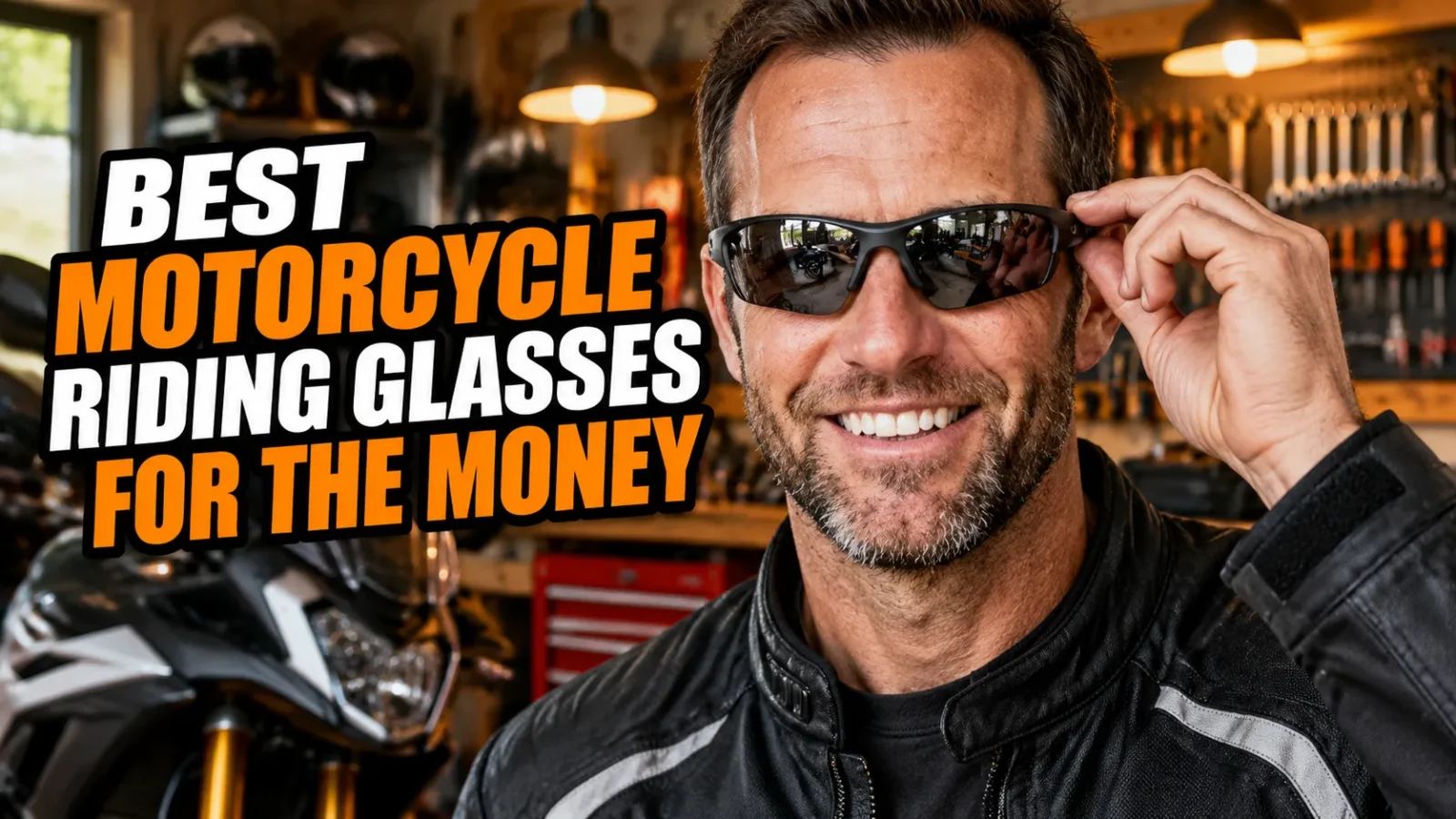
I’ve burned through more pairs of riding glasses than I care to admit. Gas station shades, $200 boutique sunglasses, hardware-store safety glasses, snow goggles stuffed under a half helmet — I’ve tried all of it behind a windscreen at 70 mph.
Here’s the thing I learned the hard way: price and performance barely correlate in this category. A $30 pair of ANSI-rated safety glasses will often beat a $180 fashion sunglass that fogs up the second you stop at a traffic light.
What actually matters is wind sealing, lens impact rating, and whether the temples fit under your helmet without drilling into your skull. Everything else is marketing.
So this list is what I personally ride with and what I keep recommending to friends who ask me the same question every spring. If you’ve ever chased down harley davidson transmission problems, you already know that a rough-running bike makes cheap, flimsy eyewear feel ten times worse — every vibration travels straight into your face.
- My overall value pick is the Wiley X AirRage — ANSI-rated, foam gasket, usually under $100.
- For wind and dry eyes, nothing here beats the 7Eye by Panoptx Chubasco.
- The Bobster Night Hawk is the cheapest photochromic pair I’d trust on the highway.
- If you want the absolute floor on price, the Pyramex Ztek costs less than a tank of gas.
- Skip fashion sunglasses. Look for ANSI Z87.1, polycarbonate lenses, and a foam gasket.
What I Actually Look For in Budget Riding Glasses
Before I get into the picks, let me explain my filter. I don’t care how a pair looks on a shelf. I care how it performs at 65 mph with a crosswind and a bug hatch in progress.
Impact rating is non-negotiable
Anything I put on my face needs an ANSI Z87.1 rating at minimum. Road debris, gravel, and the occasional rock off a truck tire will find your eye eventually. A fashion lens with no rating is a gamble I stopped taking years ago.
Foam gaskets change everything
A closed-cell foam gasket around the frame is the single biggest comfort upgrade you can buy. It blocks wind, blocks dust, and keeps your eyes from drying out on long days. If you ride without a windshield, this matters more than lens tint.
Fit under a helmet
I wear a full-face helmet 90% of the time. Thin, flat temples slide in without pressure points. Thick frames turn into a headache after an hour. I test every pair on a two-hour loop before I recommend it.
1. Wiley X AirRage — Best Overall Value
If someone asked me to name one pair and shut up, it would be the Wiley X AirRage. It’s a wraparound frame with a removable closed-cell foam gasket, ANSI Z87.1-2015 impact rating, and shatterproof Selenite polycarbonate lenses.
That removable gasket is why I love it. On a naked bike in January, the foam goes in and my eyes stay wet and comfortable. On a hot August commute, I pull the foam out and get full airflow without swapping glasses.
The AirRage usually runs between $80 and $110 depending on the lens kit. Some bundles include interchangeable lenses, which turns one frame into three. For the money, that’s the best flexibility on this list.
The downside? It’s not photochromic. You’re swapping lenses or picking a tint. I run the clear/gray combo and it covers 90% of my riding.
2. 7Eye by Panoptx Chubasco — Best for Dry Eyes and Wind
If you suffer from dry eye, wind burn, or that awful watery-eye squint on cold mornings, the 7Eye by Panoptx Chubasco is the answer. The AirShield foam gasket seals completely around the eye socket, which makes it feel closer to a goggle than a sunglass.
I wore a pair through a full day of 45-degree highway miles and my eyes never once watered. That’s not something I can say about any other open-frame design I’ve tried.
You’ll pay $90 to $130, and 7Eye offers a pile of lens options including photochromic and polarized versions. The Chubasco isn’t the lightest frame here, but the seal is genuinely in a different league.
3. Bobster Night Hawk — Best Photochromic Value
Photochromic lenses that darken in sun and lighten in shade usually cost a fortune. The Bobster Night Hawk delivers that trick for around $40 to $55, which is why I keep a pair in my tank bag as a backup.
The lens goes from a light smoke to a dark tint as light changes, and it includes a removable foam gasket plus a strap kit. That means it works as glasses for the commute and as a goggle-style shield when you’re doing highway miles.
Optical clarity isn’t quite Oakley-level, and the photochromic range isn’t the widest I’ve used. But at this price, nothing else comes close. This is the pair I hand to friends who want to try photochromic without committing real money.
4. Global Vision Highway 77 — Best Convertible Design
The Global Vision Highway 77 is the swiss army knife of this list. It’s a wraparound safety frame that converts into a goggle with a removable foam insert and an included strap, and it costs somewhere around $20 to $30.
I keep a pair in my saddlebag for guests, passengers, and anyone who forgot their glasses. The polycarbonate lens meets ANSI Z87.1 impact standards, so I don’t feel bad handing them to a new rider.
Build quality is clearly budget — the frame flexes more than I’d like, and the foam isn’t as dense as the Wiley X stuff. But as a $25 emergency pair that actually protects your eyes, it’s a ridiculous value.
5. Edge Kazbek — Best ANSI-Rated Budget Pick
The Edge Kazbek is a safety glass, not a fashion sunglass, and that’s exactly why it’s on this list. It carries an ANSI Z87.1+ rating with a military-grade impact standard, a lightweight TR90 frame, and Edge’s Vapor Shield anti-fog coating.
That anti-fog treatment is the real story. I’ve worn these in humid summer rain and had far less fogging than pairs costing four times as much. The Kazbek runs about $35 to $45 with polarized lens options.
No foam gasket, so it’s not my first choice for a naked bike on the interstate. But under a windshield or a fairing, it’s a fantastic daily pair. I also keep one in my truck.
6. Oakley Fuel Cell — Best Optics If You’ll Stretch
Okay, the Oakley Fuel Cell isn’t a budget pick at $120 to $160. But I’m including it because the money actually goes somewhere real: Plutonite lens material and Oakley’s HDO optics, which give noticeably sharper, less distorted vision than cheap polycarbonate.
I notice it most when I’m scanning a twisty road for gravel. Cheap lenses slightly warp the edges of your vision. The Fuel Cell doesn’t. The O-Matter frame is also tough enough that I’ve dropped mine on asphalt twice without a scratch on the lens.
No foam gasket, so wind gets in. If dry eyes are your problem, buy the Chubasco instead. If clarity is your priority and you can stretch the budget, this is the pair.
7. Tifosi Dolomite 2.0 — Best Lightweight Photochromic
The Tifosi Dolomite 2.0 is what I grab for long summer days when I don’t want to think about lighting. It uses Fototec photochromic lenses that adjust automatically, and the whole thing weighs so little I forget I’m wearing it.
It’s a sporty, cycling-adjacent frame with hydrophilic rubber nose and temple pads, which means it grips better when you sweat. That’s a genuinely useful trait on a hot ride.
At roughly $80 to $100, it sits in the middle of this list on price. The Dolomite 2.0 doesn’t have a foam gasket, so it’s a windshield-and-fairing kind of pair, but the weight and the photochromic lens make it my favorite for 90-degree afternoons.
8. Locs Dragon — Best Oversized Coverage for Touring
If you ride a bagger, a touring bike, or anything with a tall windshield, the Locs Dragon gives you a huge amount of coverage for very little money. I usually see them between $25 and $40.
The oversized wrap shape blocks peripheral glare in a way that smaller frames just don’t. On a long interstate day, that means less squinting, less fatigue, and less of that late-afternoon eye ache I used to get constantly.
They’re not ANSI-rated, which is my one real complaint. So I treat them as a fair-weather touring pair rather than a gravel-road pair. For the price, the coverage per dollar is excellent.
9. Spy Optic Discord — Best Style-Forward Option
Some riders want to look good at the bike night, and that’s fine. The Spy Optic Discord is the pair I wear when I’m not worried about a rock strike — it’s a modern, slightly angular frame with HD+ polarized lenses and a comfortable fit.
Expect $90 to $130. The lens quality is genuinely good, with solid glare reduction on wet roads, and the frame is sturdy without being heavy.
It has no impact rating and no gasket, so it’s a lifestyle-and-commute pair, not a touring workhorse. But it’s the one pair on this list my non-riding friends compliment, so take that for what it’s worth.
10. Pyramex Ztek — Best Under $15
I almost didn’t include the Pyramex Ztek, but then I remembered I own four pairs. They cost somewhere around $5 to $15 depending on the lens, and they carry an ANSI Z87.1 rating with a polycarbonate lens.
That’s cheaper than lunch. If you lose or scratch them, you shrug and grab another pair. I keep one in the garage, one in the truck, and two in the saddlebag for passengers.
Obviously there are compromises: the frame is stiff, the optics aren’t premium, and there’s no foam. But as a bare-minimum, genuinely protective pair, nothing on this list beats the price-to-safety ratio.
A Quick Note on Bike Maintenance and Eye Fatigue
Here’s something nobody tells you: your glasses can only do so much if your bike is vibrating like a paint shaker. I’ve learned to keep the mechanical side of my bikes dialed in, because a smooth bike is a comfortable bike.
On my cruisers, a proper clutch adjustment on harley davidson models makes launches noticeably smoother, which means less head bob at low speed. That translates directly into less pressure from my temples against the helmet liner.
I also spent an afternoon reading up on how does a wet clutch work, and it completely changed how I think about clutch feel and engagement. Once I understood the fluid dynamics, I stopped dumping the clutch and started riding smoother.
And if your top end is rattling, don’t ignore it. One of the classic symptoms of bad timing chain tensioner motorcycle failures is a buzzing vibration that gets worse with rpm — and that buzz goes straight through the bars, the frame, and into your face. No pair of glasses fixes a bike that needs maintenance.
My Final Take on Buying Cheap Riding Glasses
You don’t need to spend $200 to protect your eyes on a motorcycle. You need an impact rating, polycarbonate lenses, and — if you ride without a windshield — a foam gasket.
My personal rotation is the Wiley X AirRage for touring, the Bobster Night Hawk in the tank bag as a backup, and a Pyramex Ztek in every vehicle I own. That whole setup costs less than one premium sunglass.
Start with the rating, then worry about the tint. Your eyes will thank you at mile 300.
Frequently Asked Questions
Are expensive motorcycle riding glasses actually worth it?
Not always. A $35 pair of ANSI Z87.1 safety glasses like the Edge Kazbek blocks wind and road debris about as well as a $150 fashion sunglass. I only spend more when I want photochromic lenses or genuinely better optical clarity.
What should I look for in cheap riding glasses?
Three things: an ANSI Z87.1 impact rating, polycarbonate lenses, and a foam gasket if you ride behind a short windshield. A wrap-around frame matters too, because it keeps wind from drying your eyes out at highway speed.
Can I wear motorcycle riding glasses under a full-face helmet?
Yes, as long as the temples are thin and flat. I avoid thick acetate frames and chunky arms, because they press into my temples after an hour or two. Every pair on this list fits under my Shoei.
Do I really need photochromic lenses for riding?
They aren’t mandatory, but they are the single biggest quality-of-life upgrade in this category. A photochromic pair like the Bobster Night Hawk means I never have to swap lenses when the sun drops behind the ridge.

Related Articles

10 Best Sunglasses for Motorcycle Riding, Ranked by a Rider Who’s Worn Them All
I've ridden thousands of miles in wind, glare and bugs. Here are the 10 best sunglasses for motorcycle riding, from…
Jake Miller
9 min read

10 Best Safety Glasses for Riding Motorcycle at Night (Rider Tested)
I tested 10 pairs of night riding glasses to find the clearest, most fog-free options for motorcycle riding after dark,…
Jake Miller
12 min read

8 Best Ray-Bans for Motorcycle Riding: What Actually Works Under a Helmet
After years of riding in Ray-Bans, I ranked the 8 best pairs for motorcycling, from helmet-friendly Aviators to wind-blocking wraps,…
Jake Miller
10 min read