
8 Best Ray-Bans for Motorcycle Riding: What Actually Works Under a Helmet
 Jake Miller
10 min read
Jake Miller
10 min read
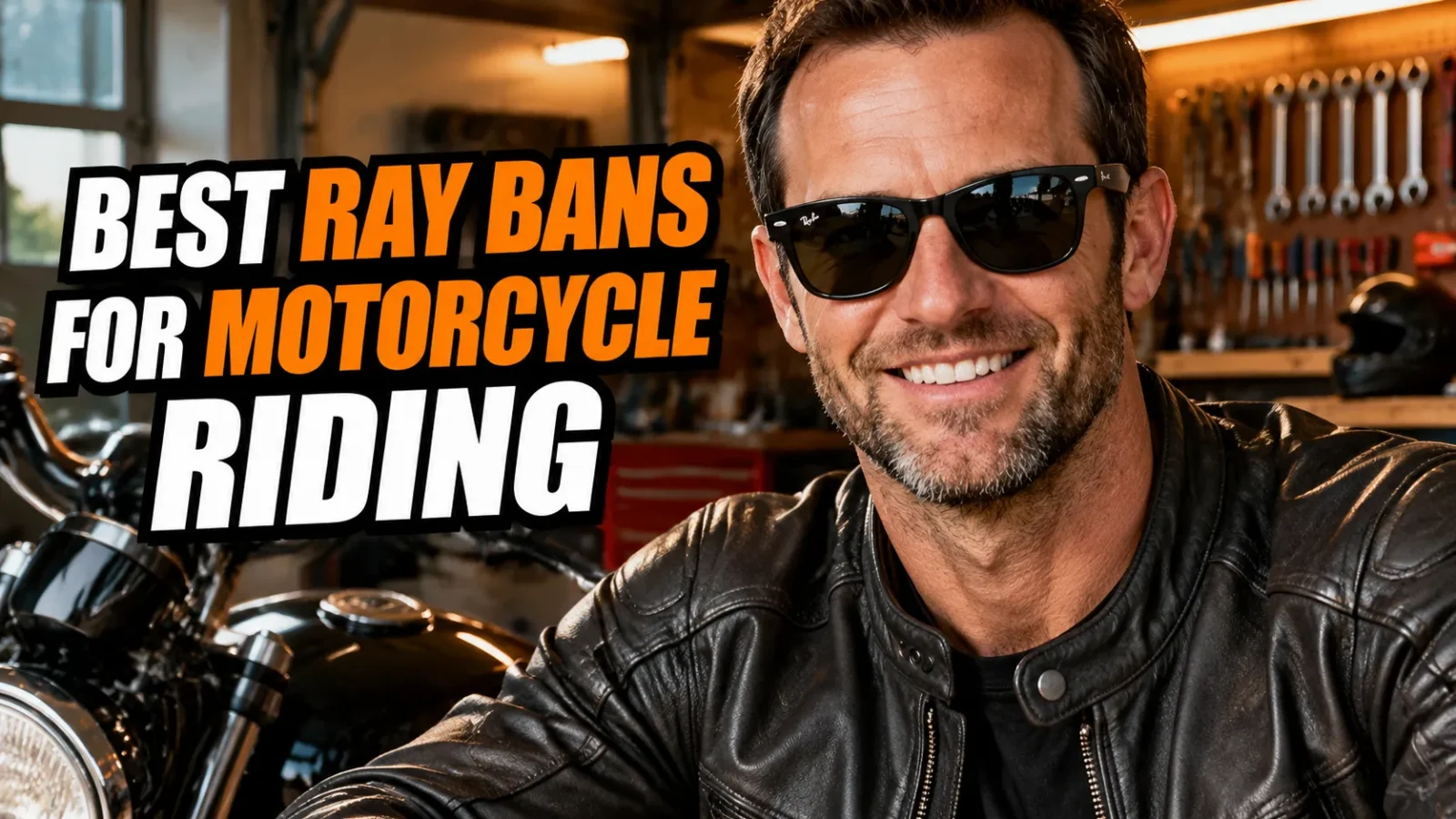
I have been wearing Ray-Bans on motorcycles for the better part of fifteen years, and I will be the first to admit I did it for the wrong reasons at the start. I wanted the look. Then I did a 900 km day across the Alps in a pair of beat-up Aviators and realized something useful: a thin metal arm, a glass lens with a proper tint, and a frame that sits close to your face can genuinely make a ride better.
What follows is not a fashion list. It is the eight Ray-Ban models I have actually ridden in, ranked by how well they behave at speed, under a helmet, and in real weather. I have worn some of these for years, wrecked a couple, and quietly retired others to the car. I will tell you which is which.
One thing before we start. Eyewear is only one piece of the comfort puzzle, and the biggest single upgrade I ever made to long-distance riding had nothing to do with my face. It was a proper Best Motorcycle Seat. Sort your contact points first, then worry about your sunglasses.
- My overall pick is the Ray-Ban Aviator Classic RB3025 because the thin metal temples slide under a full-face helmet without pressure points.
- For open-face and half helmets, the rubberized Ray-Ban Justin RB4165 grips better and stays put in wind.
- If you want maximum wind blocking, go wrap: the Predator 2 RB2027 is the closest Ray-Ban gets to riding eyewear.
- Honest caveat: standard Ray-Ban lenses are not ANSI Z87.1 rated, so treat them as glare and debris protection, not crash-rated eye armor.
1. Ray-Ban Aviator Classic RB3025 — Best Overall for Helmet Wear
If you only buy one pair off this list, buy this one. The RB3025 Aviator Classic is the model I reach for nine times out of ten, and it is entirely down to the temples. They are thin, straight, and barely tapered, which means they slide into a full-face helmet’s cheek pads without that horrible levering sensation you get from chunky plastic arms.
Why It Works Under a Helmet
The frame is monel metal, so it flexes instead of snapping when you shove it into a helmet in a hurry. The G-15 lens is a crystal glass unit that Ray-Ban has been making forever, and it handles bright, flat midday light better than almost anything else I have tried. It also darkens the world evenly without the weird colour shifts you get from cheap tinted lenses.
Price sits roughly between $165 and $230 depending on lens and size at the time of writing. You can get it in 55 mm, 58 mm and 62 mm widths. I wear the 58 mm. The 62 mm looks great in photos and fights every helmet I own.
What I’d Change
Glass lenses are heavy, and after about four hours the nose pads start to leave marks. If you ride long days, order the polycarbonate or Chromance version instead. It is lighter and I honestly cannot tell the optical difference at speed.
2. Ray-Ban Justin RB4165 — Best Grip for Windy, Open-Face Rides
The Justin is the pair I wear with an open-face helmet or a half helmet, because the frame is nylon with a rubberized matte finish. That rubberized texture is the whole point. When I turn my head at 100 km/h, the Justins stay planted. My metal frames slide.
The frame is also lighter and more forgiving than a wire frame, and the slightly rectangular shape gives a bit more coverage at the bottom edge than a classic Wayfarer. Sizes run 54 mm and 55 mm, and the price is friendly: roughly $120 to $180, with polarized versions creeping toward $200.
It is not a wrap, so wind still curls in from the sides. But for city riding, cruisers and short blasts, the Justin is my most-worn pair after the Aviator. It also survives being stuffed in a jacket pocket better than anything metal.
3. Ray-Ban Caravan RB3136 — Best for Long-Haul Touring
The Caravan is the Aviator’s squarer, slightly more serious sibling, and I prefer it on long touring days. The lens shape drops lower at the outer corner, which cuts a noticeable amount of low-angle glare that sneaks under an Aviator when the sun is sitting just above the horizon.
It is still a metal frame with G-15 glass, still thin-templed, still helmet friendly. The 58 mm size is the sweet spot. Expect to pay somewhere between $165 and $215.
Here is the thing though: after eight hours in the saddle, sunglasses are not what is making you miserable. I have written before about how much difference the right perch makes on a big tour, and honestly a best motorcycle seat for harley touring setup changed my long days more than any lens ever did. If you are tall and folding yourself onto a stock seat, that is your real problem, not your eyewear. The Best Motorcycle Seat for Tall Riders guide covers that properly.
4. Ray-Ban Predator 2 RB2027 — Best Wrap-Around Wind Protection
The Predator 2 is the closest Ray-Ban has ever come to building actual riding eyewear. It is a full wrap with a metal top bar, a 61 mm lens, and a shape that curves back toward your temples so wind has far less opportunity to get behind the lens.
I wore a pair of these for two seasons of dual-sport riding and they were excellent. Peripheral glare disappears. Bugs bounce off instead of embedding in your cheek. At highway speed, the difference between a wrap and a flat lens is genuinely enormous.
Downsides: the wrap shape does not love every face, and the thicker temples are a tighter squeeze under a snug helmet. Price runs about $160 to $200. If you ride a dual-sport or adventure bike, this is the one I would pick, and if you are spending your money on comfort, the same logic applies to your bike. There is a good piece on best motorcycle seats for kawasaki klx250 that follows the same philosophy: fix the contact points and everything else gets easier.
5. Ray-Ban Tech Carbon Fibre RB8313 — Best Lightweight Pair
This is the pair I forget I am wearing. The RB8313 uses a genuine carbon fibre frame, which drops the weight dramatically compared to metal, and the 61 mm lens gives decent coverage without a full wrap shape.
It is the most expensive option on this list, generally $280 to $330, and it is aimed at people who care about weight. On a bike, weight matters more than you would think. Heavy glasses plus a helmet plus vibration equals a headache by hour three, and the carbon fibre frame removes almost all of that.
Spring hinges are another quiet win here. They let the arms flex outward slightly when you pull the glasses on over a helmet liner, instead of levering against your skull. Mine have taken a beating and the frame still looks new.
6. Ray-Ban Clubmaster RB3016 — Best for Open-Face Cruiser Style
I will be honest: the Clubmaster is not the most practical riding frame on this list. The acetate browline is thick, the metal lower rim is thin, and the 49 mm or 51 mm lens leaves a fair bit of peripheral exposure. Wind gets around the edges.
But on a cruiser with an open-face helmet, at sensible speeds, nothing looks better, and the browline genuinely does block overhead sun in a way that a flat-top frame does not. If I am pootling along a coastal road on a Sunday, this is what I am wearing.
Price is roughly $155 to $210. Expect the acetate arms to press on your temples after an hour under a tight helmet, so this is a short-ride frame for me. Cruiser riders who spend real hours in the saddle should sort their seating first, and I would point Sportster owners at this guide to the Best Seat for Harley Sportster before they spend another dollar on sunglasses.
7. Ray-Ban Folding Wayfarer RB4105 — Best Packable Pair
The Folding Wayfarer is the pair that lives permanently in my tank bag. It folds at the bridge and both hinges into a case roughly the size of a deck of cards, which means it goes in a jacket pocket without leaving a lump.
Optically it is a standard Wayfarer: acetate frame, G-15 or polarized lens, 50 mm and 54 mm sizes, roughly $170 to $240. Under a helmet the acetate arms are chunkier than an Aviator’s, so it is a second-tier choice for full-face riding, but a first-tier choice for touring luggage.
If you are on the shorter side and already fighting to get a foot down at stops, you probably want a slim frame that does not add bulk inside a helmet. There is a whole write-up on the Best Motorcycle Seat for Short Riders that tackles the same fit-versus-comfort trade-off, and it is worth a read if you are dialling in a bike around your own dimensions.
8. Ray-Ban Meta Wayfarer — Best Smart Glasses for Navigation and Calls
I was sceptical, then I used a pair for a month of commuting. The Ray-Ban Meta Wayfarer packs open-ear speakers and a camera into a normal-looking Wayfarer frame, and for a rider it solves two annoying problems: hearing navigation prompts and taking calls without pulling over.
The speakers sit above your ear and do not block traffic noise, which is safer than earbuds and, in most places, legal where earbuds are not. Voice control handles calls and music without you touching your phone. Battery life is around four hours of mixed use, so it is a commute tool rather than a touring tool.
Pricing starts around $299 and climbs with lens options. The camera is a novelty on a bike, but the audio is genuinely useful. Two caveats: it needs a charged phone, and loud pipes will drown out the speakers above about 90 km/h.
A Quick Word on Lenses and Safety
I need to be straight with you, because a lot of listicles are not. Ray-Ban’s standard lenses are not certified to ANSI Z87.1, and they are not rated to ECE impact standards either. Their polycarbonate lenses do pass basic drop-ball testing, and glass is surprisingly tough, but neither is proper riding eye protection.
If you ride fast, ride in traffic with debris, or ride off-road, the right answer is a dedicated safety-rated pair. I wear Ray-Bans because I like them and I accept the trade-off. That is a personal call, not a recommendation.
Which Tint I Actually Use
Non-polarized G-15 for almost everything. It is neutral grey-green, it does not distort colour, and it handles bright sun without over-darkening shadows. Polarized is brilliant for glare off wet asphalt and chrome, but it can make some LCD dashboards go dark or rainbow at certain angles. Try it before you commit.
Chromance lenses are worth the upgrade if you ride a lot of high-contrast mountain roads. They boost contrast noticeably and I like them in dappled tree cover.
Final Thoughts: Which Pair I’d Actually Buy
If I had to own one pair for the rest of my riding life, it is the Ray-Ban Aviator Classic RB3025 in 58 mm with G-15 lenses. Thin temples, neutral tint, helmet friendly, and it looks right on everything from a naked bike to a bagger.
For open-face riding, add the Justin RB4165. For dual-sport and adventure, the Predator 2 RB2027 is the one that actually behaves like riding gear. And if you want to fold them into a tank bag, the Folding Wayfarer RB4105 earns its place.
Whatever you choose, buy the frame that fits your face first and your aesthetic second. Sunglasses that slide down your nose at speed are worse than no sunglasses at all, and no amount of classic styling fixes a bad fit.
Frequently Asked Questions
Are Ray-Bans actually good for motorcycle riding?
They can be, especially thin-temple metal frames like the Aviator Classic RB3025 and rubberized nylon frames like the Justin RB4165. Just know that standard Ray-Ban lenses are not certified to ANSI Z87.1, so they are style and glare protection first, impact protection second.
Which Ray-Bans fit best under a full-face helmet?
I get the cleanest fit from thin-temple models: the Aviator Classic RB3025, the Caravan RB3136 and the Folding Wayfarer RB4105. Thick acetate arms like the Clubmaster RB3016 tend to press on my temples after about an hour.
Are polarized Ray-Bans bad for riding?
Polarized lenses kill glare off chrome and wet asphalt, but they can make some LCD dash displays go dark or rainbow at certain angles. I run non-polarized G-15 most of the time and save polarized for sunny touring days.
Can I get prescription Ray-Bans for riding?
Yes. Most Ray-Ban frames are Rx-ready through Ray-Ban’s own prescription service or any optical shop. Ask for polycarbonate lenses, which are lighter and more impact resistant than glass.

Related Articles

10 Best Sunglasses for Motorcycle Riding, Ranked by a Rider Who’s Worn Them All
I've ridden thousands of miles in wind, glare and bugs. Here are the 10 best sunglasses for motorcycle riding, from…
Jake Miller
9 min read

10 Best Safety Glasses for Riding Motorcycle at Night (Rider Tested)
I tested 10 pairs of night riding glasses to find the clearest, most fog-free options for motorcycle riding after dark,…
Jake Miller
12 min read

10 Best Riding Glasses for Motorcycle Riders — Real Picks I’d Buy Again
After years of squinting through cheap shades, I ranked the best riding glasses for motorcycle use - from Wiley X…
Jake Miller
10 min read