
9 Best Motorcycle Goggles for Touring — Tested Picks for Long-Haul Riders
 Jake Miller
16 min read
Jake Miller
16 min read
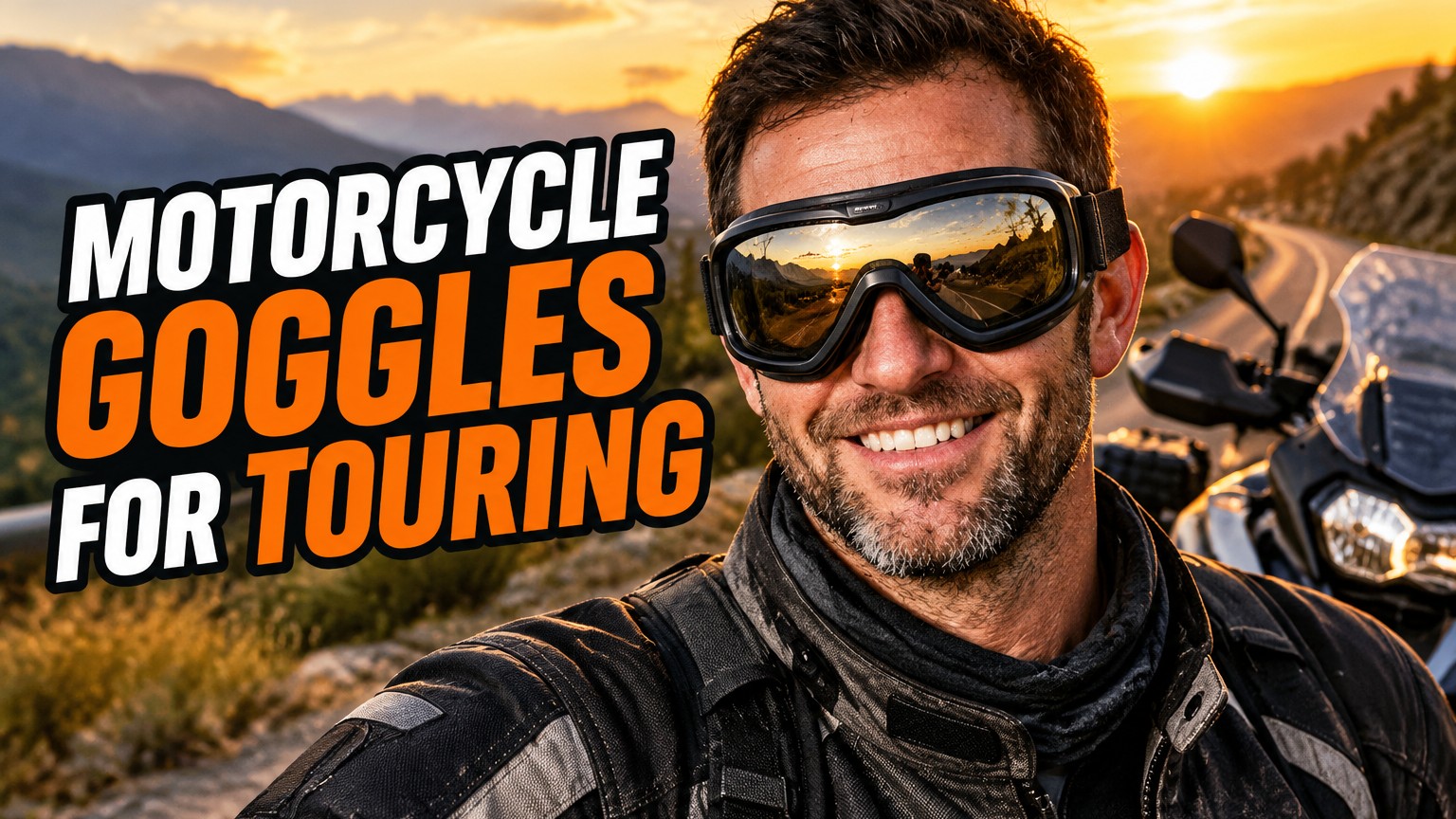
I’ve spent more late nights in a cheap motel room with a towel stuffed under the bathroom door, trying to dry out foggy goggle foam, than I care to admit. That’s the thing nobody tells you about touring goggles — they’re not a fashion accessory you strap on for a photo at the overlook. They’re the piece of gear that decides whether hour nine of a 600-mile day is tolerable or miserable. I’ve ridden touring miles through the Appalachians, the high desert, and one memorably awful stretch of I-40 in a cold front that came out of nowhere. I’ve worn goggles under open-face helmets, modulars, and ADV lids with the visor removed. Some of them I loved. A couple I threw in a dumpster outside Amarillo. So this isn’t a spec sheet roundup. This is what I’ve actually learned about which goggles survive a long day, and which ones only look good in the product photos.
- My overall pick for touring is the 100% Barstow — classic looks, genuinely comfortable for 8+ hour days.
- If you wear prescription glasses, the Scott OTG or Oakley O-Frame 2.0 MX OTG are the two that actually fit over frames without pinching.
- For rainy or cold-weather touring, dual-pane anti-fog lenses are non-negotiable — single-pane goggles will betray you.
- Budget matters less than you think: the Bobster Night Hawk punches well above its price.
- Match the goggle to your helmet. Half-helmet and cruiser riders have different needs than ADV riders.
Why Touring Goggles Are a Different Animal
Before I get into the list, let me explain my reasoning, because I think most goggle reviews get this backward. They treat goggles as a styling choice. For touring, they’re a fatigue-management tool. Here’s what I mean. At 70 mph with an open-face or modular helmet, your eyes are exposed to wind, dust, UV, and road debris for hours at a time. A cheap lens with poor optics forces your eyes to constantly micro-adjust. That doesn’t sound like much until hour six, when your eyes are watering and your concentration is shot. So when I evaluate a touring goggle, I weight four things heavily:
Optical clarity.Distortion at the edges of the lens is a dealbreaker for me. It messes with your depth perception in traffic.
Anti-fog performance.Temperature swings between valleys and ridgelines will fog anything. A dual-pane lens is the single biggest factor here.
All-day comfort.Wide silicon-backed straps, thick but breathable foam, and a frame that spreads pressure across your cheekbones rather than digging into your nose.
Field of view.Peripheral vision matters when you’re checking mirrors and blind spots a hundred times a day. Everything below is judged on those four axes, plus how it actually held up after a few thousand miles.
1. 100% Barstow — Best Overall for Long-Distance Touring
If I had to hand someone one goggle and say “ride across the country in this,” it would be the
100% Barstow. I’ve put serious mileage on mine and it’s the one I keep reaching for. The Barstow is 100%’s retro-styled model, and yes, it looks great. But what sold me is the fit. The frame sits wide across the face, which means the foam doesn’t concentrate pressure on the bridge of your nose the way narrower goggles do. After eight hours, that difference is enormous.
Lens and Optics
The standard Barstow ships with a scratch-resistant, anti-fog coated lens, and the optical clarity is genuinely good — no edge distortion that I can detect. I ride with the clear lens for night and early-morning starts, and swap to the smoke or mirror lens for bright days. They’re easily swappable, which matters more than people realize. On a multi-day tour you’ll want to carry two lenses, and a goggle that fights you on the swap is a goggle you’ll stop using.
Comfort and Fit
The strap is wide with a silicone backing strip, so it doesn’t slip on a bare helmet shell or a fabric-covered one. The foam is triple-layer and dense enough to seal well without feeling like a vise. My one gripe: the Barstow runs a touch large, so if you have a narrow face, try before you buy.
Who It’s For
Open-face and modular helmet riders who want one goggle that does everything reasonably well. It’s priced in that comfortable middle range — not budget, not boutique — and it’s built to last. For me, this is the default answer to “which touring goggle should I buy?”
2. Scott OTG — Best for Glasses Wearers
If you wear prescription glasses, this is probably the section you’re here for. I’ve got a riding buddy who’s worn glasses his whole life, and goggle shopping has been a nightmare for him — most models press his frames into his temples until he’s got a headache by noon. The
Scott OTGsolves that with a frame cavity specifically designed to clear eyeglass temples. The foam is cut back in the right places so your glasses sit naturally rather than getting shoved against your face.
The Fog Problem
Here’s the catch with any OTG goggle: two lenses close together means double the fog risk. The Scott OTG handles it better than most thanks to a decent airflow path, but I’ll be honest — in cold, wet conditions you’re still fighting it. My buddy’s fix was a prescription insert, and honestly that’s the better long-term path if you tour a lot. But if you want an off-the-shelf answer, the Scott OTG works, and it works without pinching. For anyone who’s decided to skip goggles entirely, take a look at the
Best Glasses Frames for Motorcycle Helmets— some of those options are genuinely helmet-friendly in ways regular frames aren’t.
Practical Notes
The Scott OTG is affordable and widely available. It’s not a premium goggle, and the lens isn’t going to blow you away optically, but for the glasses-wearing tourist it’s a solid, proven choice. I’ve seen it on ADV forums for years for exactly this reason.
3. Oakley O-Frame 2.0 MX OTG — Best Premium OTG Option
If you wear glasses and want to spend more for a real step up in optics, the
Oakley O-Frame 2.0 MX OTGis my pick. It’s an MX goggle at heart, but the OTG fit makes it a legitimate touring option. Oakley’s lens technology is the headline here. Their
Plutonitelens material filters 100% of UVA, UVB, and UVC, and it meets ANSI impact standards. For long days in bright sun, that UV protection genuinely matters — I’ve had my eyes get fatigued on multi-day trips in cheap goggles, and it’s not fun.
Impact Protection
The O-Frame 2.0 series is designed around impact resistance. If you ride anywhere with gravel trucks or debris kick-up, that’s real peace of mind. The frame is flexible and the triple-layer face foam seals well. The strap has silicone beading that holds securely.
The Trade-Off
It’s more expensive than the Scott, and the MX-oriented shape means it fits best under a full-face or ADV helmet rather than a classic open-face. If you want the retro open-face look, this isn’t the one. But if you’re touring on an ADV bike with a peak visor and you wear glasses, the O-Frame 2.0 MX OTG is about as good as it gets.
4. Bobster Night Hawk — Best Budget Touring Goggle
I’ll be honest, I didn’t expect much from the
Bobster Night Hawkthe first time I picked one up. It’s inexpensive. It’s not a name that gets a lot of hype. But I’ve recommended it to more riders than almost anything else on this list. Bobster is a real, established brand in the cruiser and open-face world, and the Night Hawk is their workhorse. The frame is foam-lined and comfortable, and it converts — you can run it with the included strap, or swap to the temple arms for a glasses-style fit.
Why It Works for Touring
The convertibility is genuinely useful. On a long tour I sometimes want goggles at speed and glasses at a fuel stop, and the Night Hawk does both without me carrying two pairs. The lens options include clear, smoke, and a few tints. Optical quality is good for the price — not Oakley-good, but perfectly serviceable for highway riding.
The Honest Caveat
This is a budget goggle, and it shows in the foam density and the strap hardware. Expect a couple of seasons of hard use, not a decade. But at this price, replacing it every few years is fine. For cruiser riders, this pairs beautifully with an open-face helmet. If that’s your setup, my companion piece on the
best motorcycle goggles for cruiserriders covers a few more options in this vein.
5. Bobster Raptor — Best Photochromic Pick for Variable Light
Sunrise departures and sunset arrivals are the touring reality nobody plans for. You roll out at 6 a.m. in the dark and pull in at 8 p.m. with the sun in your eyes. Carrying two lenses is one answer. A photochromic lens is the other. The
Bobster Raptoris a foam-lined goggle with a photochromic lens that darkens in UV light and clears in low light. That single lens handles dawn, midday, and dusk.
How It Actually Performs
Photochromic lenses don’t change instantly — there’s a lag of a minute or two. So if you ride from bright sun into a dark tunnel, you’ll have a moment of reduced clarity. On interstate touring, that’s rarely a problem. On twisty mountain roads with heavy tree cover, it can be. I still carry a clear lens as backup. But the Raptor’s photochromic lens means I’m not swapping constantly, and on a long day that’s a real quality-of-life improvement.
Fit and Finish
Foam-lined frame, adjustable strap, decent field of view. It’s a comfortable, uncomplicated goggle. Bobster’s build quality here is a step above their entry-level stuff.
6. 100% Strata 2 — Best Value for Trail and Mixed-Surface Touring
The
100% Strata 2is one of the most popular goggles in the world, and for good reason — it delivers a lot for the money. It’s an MX/MTB goggle by design, but I’ve ridden it on mixed-surface tours where I’m bouncing between pavement and gravel, and it holds up. The 9-point lens retention system keeps the lens seated even when you’re getting rattled around.
Lens Options
100% offers the Strata 2 with a huge range of lenses — clear, smoke, mirrored, and various VLT ratings. The dual-layer face foam is comfortable, and the 40mm silicone-coated strap stays put.
Why It Made the List
Value. Plain and simple. The Strata 2 gives you 100%’s lens quality and a genuinely comfortable fit for a fraction of what flagship goggles cost. For a rider building out a touring kit on a budget, this is a smart buy. The main limitation is that it’s shaped for full-face and ADV helmets. Under an open-face lid the coverage isn’t ideal.
7. Oakley Airbrake MTB — Best Premium Lens System
Okay, this is the splurge. The
Oakley Airbrake MTBuses Oakley’s
Prizmlens technology and their Switchlock system, which lets you swap lenses in seconds with a lever instead of wrestling the frame.
Prizm Lens Technology
Prizm is Oakley’s contrast-enhancing lens tech. It tunes the light transmission to emphasize specific colors, which means terrain features — potholes, gravel, road edges — pop out more clearly. I noticed it most in flat, overcast light where everything normally looks the same shade of gray. For touring, that translates to less eye strain and better hazard detection. It sounds like marketing until you ride with it.
The Switchlock Advantage
The Switchlock system is the real draw for a tourist. If conditions change — sun comes out, clouds roll in — you swap the lens in under a minute without tools. On a long tour that’s genuinely valuable.
Is It Worth It?
It’s expensive. There’s no way around that. But the Airbrake is built for riders who tour a lot and want the best optics available. If you ride 10,000+ miles a year, the cost per mile is easy to justify.
8. Scott Split OTG — Best Ventilated OTG for Hot Climates
Back to the OTG world, because I know a lot of touring riders wear glasses. The
Scott Split OTGis a wider, more ventilated take on their OTG formula. Scott builds in specific venting channels and uses a dual-pane lens on several versions, which is a meaningful upgrade over the basic OTG. In heat, that venting makes a real difference — I’ve ridden in triple-digit temperatures and ventilation is the difference between tolerable and unbearable.
Coverage and Fit
The Split OTG has a larger frame than the standard Scott OTG, giving more room for glasses and better peripheral coverage. The foam seals well without over-pressuring.
Where It Shines
Hot-weather touring. If you ride the Southwest in summer, or anywhere humid and warm, the ventilation on the Split OTG earns its keep. It’s also a good choice if you’ve had fogging issues with other OTG goggles, since the dual-pane lens and venting work together.
9. Bobster Bandit — Best for Half-Helmet Riders
Last entry, and it’s a specific one. If you tour on a half helmet with no face protection at all, you need a goggle that seals tightly against your face, and the
Bobster Banditis built for exactly that. It’s a low-profile, foam-backed goggle with a snug fit. The frame sits close to the face, which minimizes wind infiltration at speed — important when you’ve got nothing else between you and a 70 mph headwind.
Why Half-Helmet Riders Need Different Goggles
With a half helmet, the goggle has to do all the work. There’s no visor, no chin bar, nothing to break the wind. That means a snug seal, a strap that doesn’t lift, and foam that stays put. The Bandit delivers that. It’s not the most optically advanced goggle on this list, but for its purpose it’s effective and affordable. If this is your setup, I’d strongly suggest reading the
best motorcycle goggles for half helmetguide too — there are fit nuances specific to half-helmet touring that are worth understanding before you buy.
How I’d Choose Between These
Let me make this easy, because nine options is a lot. If you wear glasses:
Scott OTGfor value,
Oakley O-Frame 2.0 MX OTGfor premium. That’s the short version. If you don’t wear glasses and want one goggle:
100% Barstow. It’s my answer almost every time. If you’re on a tight budget:
Bobster Night Hawkor
100% Strata 2. Both are genuinely good, not just cheap. If you ride in rain or cold: prioritize anything with a dual-pane lens. Single-pane goggles fog, and once they fog at speed you’re effectively blind. The
best motorcycle goggles for riding in the rainroundup covers the wet-weather specialists in more depth. If you want the best optics money can buy:
Oakley Airbrake MTB.
Anti-Fog: The Thing That Will Make or Break Your Tour
I want to spend a moment here because it’s the single biggest complaint I hear from touring riders, and it’s the easiest thing to get right.
Dual-Pane Is the Answer
A dual-pane lens has two layers of lens material with an air gap between them. That gap acts as an insulator, keeping the inner surface warmer so moisture in your breath doesn’t condense on it. Every serious touring goggle should have one. Single-pane lenses can be treated with anti-fog coatings, but coatings wear off, and when they do you’re stuck.
Ventilation Matters Too
Foam blocks airflow, which is good for wind protection and bad for fogging. Goggles with vented frames or strategic foam gaps let moisture escape. This is why the Scott Split OTG does well in heat.
Technique Helps
A few habits that genuinely work:
Don’t seal the goggle against your nose.Leave a slight gap so you exhale downward rather than up into the lens. This alone fixes a lot of fogging.
Keep the goggle on your face, not on your forehead.Putting it up on your helmet collects sweat in the foam, which then fogs the lens when you put it back on.
Dry the foam overnight.Don’t leave a damp goggle in a sealed helmet bag. Air it out.
When Nothing Works
If you’ve tried dual-pane lenses, ventilation, and technique and you’re still fogging, the problem might be your helmet’s airflow. A modular or open-face helmet with poor venting traps your exhaled breath. Sometimes the fix isn’t the goggle — it’s the lid.
Lens Tints: What I Actually Carry
Here’s my real-world touring lens strategy, and I think it’ll save you some money.
Clear
Non-negotiable. You need a clear lens for dawn, dusk, night, and heavy rain. Every tour, every time.
Smoke or Dark Tint
For bright days. I run a smoke lens from about 10 a.m. to 4 p.m. in summer. In winter, low sun can be brutal, so I keep a dark lens handy even on short days.
Mirrored or Contrast Tint
These are nice-to-haves. A mirrored lens looks great and handles glare well. A contrast-enhancing tint — like Oakley’s Prizm — genuinely helps in flat light and mixed terrain. I don’t carry a yellow or amber lens anymore. I used to, thinking it’d help in overcast conditions, and honestly it just made everything look odd without improving my vision. Your mileage may vary.
A Few Fit Notes That Saved Me Money
Measure your face width, not your head circumference.Goggle fit is about face width and nose bridge height. A goggle that fits your helmet size can still be wrong for your face.
Try the goggle with your actual helmet on.In-store, put the helmet on, then the goggle over it. The strap routing and frame position change completely.
Check Strap length.Some goggle straps won’t reach around a large modular helmet with a communicator unit mounted on the side. I’ve been burned by this.
Silicone backing is worth paying for.A plain elastic strap will slide, especially on smooth helmet shells.
Foam density matters in the cold.Cheap foam gets stiff and stops sealing when temperatures drop.
Final Thoughts From Someone Who’s Owned Too Many of These
Nine goggles is more than any one rider needs. I know that. But touring riders are a varied bunch — some of us are on Gold Wings with full-face helmets, some are on baggers with half helmets, some are on ADV bikes eating gravel roads. The goggle that’s perfect for one is wrong for another. My hope is that this list helps you find the one that’s right for your setup rather than the one with the best marketing. If you take nothing else away: get a dual-pane lens, get a silicone-backed strap, and get a goggle that spreads pressure across your face instead of grinding into your nose. Do those three things and your next long tour will be a whole lot more comfortable. And pack a clear lens. Always pack a clear lens.
Frequently Asked Questions
What makes motorcycle goggles good for touring specifically?
Touring goggles need three things above all: all-day comfort from a wide, pressure-spreading frame and strap, anti-fog performance so a dual-pane or vented lens holds up through temperature swings and rain, and optical clarity with enough peripheral vision to check mirrors and blind spots. Fashion-first goggles rarely tick all three.
Can I wear prescription glasses under touring goggles?
Yes, but you need an OTG (over-the-glasses) design with a deep enough frame cavity. Models like the Scott OTG and Oakley O-Frame 2.0 MX OTG are built exactly for this. If goggles keep fogging over your glasses, I’d point you toward glasses frames designed for helmets instead.
Are goggles or a full-face visor better for long-distance touring?
It depends on your helmet. An open-face or modular helmet with a flipped-up visor lets air in but exposes your eyes, so goggles win on those. Research the best motorcycle goggles for riding in the rain if you tour in wet climates, and match the goggle to the helmet shell.
How much should I spend on touring goggles?
A reliable touring goggle runs $40 to $120. Below $30 you’re gambling on lens optics and foam durability. Above $120 you’re paying for specialty tints, photochromic lenses, or premium frame materials that only matter in specific conditions.

Related Articles
7 Best Eyewear from Oakley SI for Motorcycle Riding
I've tested Oakley SI's tactical eyewear for riding. Here are the 7 best models that combine ballistic protection, clarity, and…
Jake Miller
15 min read
7 Best Women’s Sunglasses for Motorcycle Riding in 2026
Discover the best women's sunglasses for motorcycle riding with our expert guide. From wind protection to UV coverage, find the…
Jake Miller
14 min read
7 Best Sunglasses for Motorcycle Riding I’ve Tested on the Road
I've tested dozens of motorcycle sunglasses in real riding conditions. Here are the 7 best pairs that stay put at…
Jake Miller
14 min read