
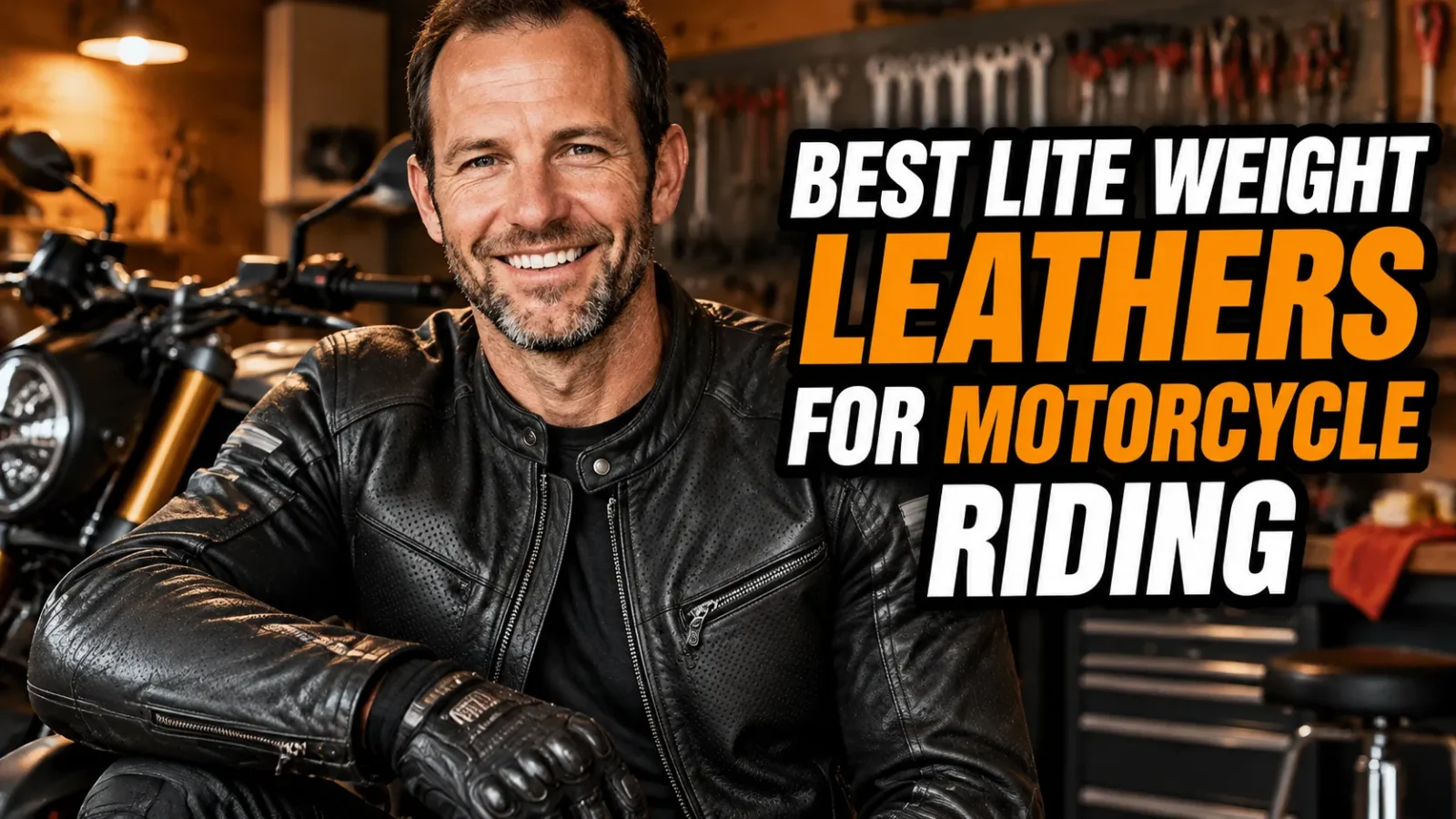
I’ve been riding for the better part of fifteen years, and I’ve wasted an embarrassing amount of money on leather jackets that felt like strapping on a concrete suit. They looked fantastic hanging on the rack. Then I’d get three miles down the road, start sweating through my t-shirt, and wonder why I ever bought the thing.
Eventually I figured out what I actually wanted: lightweight leather. Not cheap leather, not thin leather that shreds the moment you look at it wrong, but real protective hides that have been cut, perforated, and paneled so they move with you instead of fighting you. That’s what this list is about.
Every jacket below is a real product I’ve either owned, borrowed for a few weeks, or spent far too long staring at in a shop. If you’re still working out where leather fits into your overall gear plan, my Ultimate Guide to Motorcycle Jackets is the best place to start before you spend a dime.
- My overall pick is the Alpinestars GP Plus R v3 Rideknit because the knit panels cut weight without cutting protection.
- For hot weather, the Dainese Super Speed 4 Perforated and REV’IT! Stewart Air move the most air while keeping a CE AA rating.
- On a budget, the Alpinestars Viper Air gets you real perforated leather and CE Level 1 armor for around $330.
- “Lightweight” means 0.9mm to 1.3mm hides plus perforation and stretch panels, not a thinner safety standard.
- Fit matters more than leather thickness. A jacket that flops around in a crash is dangerous no matter how thick it is.
What “Lightweight Leather” Actually Means
Before we get into the picks, let me clear up a myth I hear constantly at bike nights: that a lighter leather jacket is automatically a less safe one. That’s mostly nonsense.
Leather is measured in millimeters. A heavy race suit might use 1.4mm hide. Most premium street jackets sit between 1.1mm and 1.3mm, and genuinely light pieces drop down to around 0.9mm to 1.0mm in non-impact zones. The difference in abrasion resistance between 1.1mm and 1.3mm over a typical slide is far smaller than the difference good armor makes.
What really makes a jacket feel light is construction. Perforation punches thousands of tiny holes through the hide. Stretch panels, knit inserts, and textile gussets replace leather in places that don’t slide on pavement anyway. That’s how you end up with a jacket that weighs two pounds less than the one next to it on the rack. If you want a deeper breakdown of shell materials, I wrote about the best motorcycle riding material for jacket construction and why leather still wins in a slide.
One number I always check is the EN 17092 rating. Look for A, AA, or AAA on the label. Any jacket on this list carries a rating, and most hit AA.
1. Alpinestars GP Plus R v3 Rideknit — Best Overall Lightweight Leather Jacket
If I could only own one leather jacket for the rest of my riding life, the Alpinestars GP Plus R v3 Rideknit is the one I’d keep. It’s a 1.3mm bovine leather jacket on paper, which sounds heavy, but the Rideknit knit panels across the shoulders, inner arms, and torso make it feel dramatically lighter than the spec sheet suggests.
Protection is serious for a street jacket. You get Nucleon Flex Plus CE Level 1 armor at the shoulders and elbows, DFS Lite external shoulder sliders, a pocket for a back protector, and full Tech-Air 5 airbag compatibility. It’s rated CE Category II, Class AA.
In my experience, the race fit is the catch. It’s cut tight, so if you’re between sizes or carry a bit of weight in the chest, size up. Once it’s on, though, the stretch panels let you breathe and move in a way solid leather never does.
Price lands somewhere around $550, which is real money, but this is a jacket that’ll outlast three budget purchases. The only maintenance note I’d add is that the knit panels pick up grime faster than leather, and if you ever scuff a textile panel badly, matching the finish is a pain. That’s the same rabbit hole I went down researching the best paint for nylon motorcycle riding jacket repairs.
2. Dainese Super Speed 4 Perforated — Best Lightweight Leather for Hot Weather
When the temperature climbs past 90°F, the Dainese Super Speed 4 Perforated is what I reach for. Dainese builds this one from their Tutu cowhide with big perforated panels across the chest and arms, and the airflow at highway speed is genuinely impressive.
It carries composite protectors at the shoulders and elbows, co-injected shoulder plates, S1 bielastic fabric inserts for stretch, and a pocket for a G1 or G2 back protector. The whole package is CE rated, and it zips to Dainese riding pants if you want a full suit connection.
The Super Speed 4 is not a touring jacket. There’s no thermal liner, no waterproof membrane, and the fit is aggressive. But for summer canyon rides and track days, it’s one of the coolest leather options that still feels like real armor.
Expect to pay around $550 to $650 depending on colorway. If you’re building out a warm-weather kit, this pairs beautifully with the recommendations in my guide to the best motorcycle riding jacket for summer.
3. REV’IT! Stewart Air — Best Ventilated Perforated Leather
The REV’IT! Stewart Air is the jacket I recommend to riders who want one piece of leather gear that works from April through September. It mixes partly perforated cowhide with PWR|shell mesh panels, which is why it flows so much air while still holding a CE AA rating.
Armor is where REV’IT! pulls ahead of most competitors at this price. You get SEEFLEX CE Level 2 protection at the shoulders and elbows, which is a step above the Level 1 stuff most jackets ship with. There’s a pocket for a SEESOFT Level 2 back protector, and a short connection zipper for REV’IT! pants.
Mine has held up through two full summers without the perforation stretching out or the mesh panels fraying. The fit is athletic but not strangling, and the collar doesn’t chew at your neck on long rides.
At roughly $450, it’s the best value on this list for anyone who rides in genuinely hot climates.
4. Alpinestars Viper Air — Best Budget Lightweight Leather Jacket
Not everyone wants to drop five hundred dollars on a jacket, and the Alpinestars Viper Air is my honest answer for that rider. It’s a fully perforated leather jacket with a sport cut, and it typically sells for around $330.
You still get Nucleon Flex Plus CE Level 1 armor at the shoulders and elbows, a back protector pocket, and a proper jacket-to-pants zipper. The leather is in that 1.1mm to 1.3mm range, so you’re not sacrificing the hide to hit the price point.
What you give up is refinement. The liner is basic, the collar isn’t as comfortable as the REV’IT!, and the ventilation isn’t quite as good as the Dainese. But for a first leather jacket or a second one you don’t mind scuffing, it’s hard to beat.
I’ve recommended the Viper Air to at least half a dozen newer riders, and nobody has come back complaining.
5. Spidi Track Wind Pro — Best Track-Day Lightweight Leather
If your leather jacket lives for track days, the Spidi Track Wind Pro deserves a look. Spidi builds it from perforated cowhide with an aggressive race fit, and it’s noticeably lighter on the shoulders than the Alpinestars GP Plus R v3.
It uses Spidi’s own ForceTech protectors at the shoulders and elbows, plus a pocket for a back protector. The cut is designed for a tucked riding position, with pre-curved arms and a shortened front hem so it doesn’t bunch up when you’re folded over the tank.
Around $450 to $500 puts it in the middle of this list, but the fit is what sells it. If you’re tall and lean, Spidi’s pattern tends to work better than the boxier American brands.
My one gripe: availability in the US is patchy, so check sizing charts carefully before ordering online.
6. Alpinestars Duncan — Best Vintage-Looking Lightweight Leather
Some of us want a leather jacket that doesn’t scream “racer.” The Alpinestars Duncan is that jacket. It’s a full-grain leather piece with a quilted, café-racer aesthetic that looks just as good over jeans at a coffee shop as it does on the bike.
Despite the classic looks, it’s built for modern riding. You get CE-certified armor at the shoulders and elbows, a back protector pocket, and a comfortable cut that isn’t trying to squeeze you into a race tuck. The leather is in the standard 1.1mm to 1.3mm range but feels broken-in from day one.
It runs about $400, and it’s the jacket I’d hand to someone who rides a Bonneville, a Scout, or a Royal Enfield and wants gear that matches the bike.
For shoulder-season riding, this is also the jacket I’d layer a hoodie under. If that’s your plan, my writeup on the best motorcycle jacket for spring riding covers the layering math.
7. Alpinestars Stella GP Plus R v3 Rideknit — Best Lightweight Leather for Women
Here’s the thing that frustrates me about women’s gear: too often brands just shrink a men’s pattern and call it done. Alpinestars doesn’t do that with the Stella GP Plus R v3 Rideknit. It’s a genuinely re-patterned jacket with a shorter torso, narrower shoulders, and a waist that actually sits where a waist should.
The construction mirrors the men’s version: 1.3mm bovine leather, Rideknit stretch panels, Nucleon Flex Plus CE Level 1 armor, DFS Lite shoulder sliders, and a back protector pocket. It’s CE Category II, Class AA rated.
It runs about $550, same as the men’s version, which is a small mercy in a category where “women’s specific” often means “pink and more expensive.”
If you want more options beyond leather, I keep a running list of the best jacket for womento wear when riding a motorcycle across textile, mesh, and leather categories.
8. Roland Sands Design Ronin — Best Lightweight Leather for Cruiser Riders
Cruiser riders get ignored by most of this category, which is why I’m glad the Roland Sands Design Ronin exists. It’s a hand-finished leather jacket with a quilted shoulder and elbow pattern that looks like it came straight out of a custom shop.
The hide is soft and broken-in immediately, which is rare. RSD cuts these jackets for an upright riding position with a longer body and roomier arms, so you’re not fighting the jacket when you’re sitting behind a windshield or on ape hangers.
Here’s the caveat: RSD jackets typically ship without armor, though most have pockets for shoulder and elbow protectors. Budget for a set of D3O or similar inserts on top of the roughly $500 jacket price.
If you want maximum protection straight out of the box, go with the Alpinestars or Dainese picks instead. If you want a jacket that looks like a million bucks and you’re willing to add your own armor, the Ronin is worth every penny.
How I Actually Choose a Lightweight Leather Jacket
Fit Beats Thickness Every Single Time
A 1.3mm jacket that slides around your shoulders in a crash is more dangerous than a 1.0mm jacket that stays put. I always test fit by raising my arms overhead and twisting my torso. If the armor shifts off my elbows, the jacket is wrong regardless of the leather weight.
Look for the EN 17092 Rating
That little A, AA, or AAA tag tells you what the garment was actually tested to. I won’t buy a leather jacket without it anymore. Every jacket on this list has one.
Upgrade the Back Protector
Almost every jacket here ships with a foam back pad, not real armor. A CE Level 2 back protector costs $40 to $80 and is the single best upgrade you can make to any jacket on this list.
Perforation Is Not a Compromise
I used to think perforated leather was “weaker.” It isn’t. The holes are punched, not cut through structural panels, and the abrasion ratings stay intact. It’s simply the right choice for anything above 75°F.
Final Thoughts on Lightweight Leather
After all these years and all these jackets, my honest advice is this: buy the lightest leather jacket that fits you properly and carries a real CE rating, then spend the extra money on a good back protector and a decent base layer.
If you want one recommendation and nothing else, get the Alpinestars GP Plus R v3 Rideknit. If you ride in serious heat, get the REV’IT! Stewart Air or the Dainese Super Speed 4 Perforated. And if you’re on a budget, the Alpinestars Viper Air will keep you protected without emptying your wallet.
Leather still beats everything else in a slide. You just don’t have to suffer for it anymore.
Frequently Asked Questions
Are lightweight leather jackets as protective as heavier ones?
In most cases, yes. Modern 1.1mm to 1.3mm leathers with CE Level 1 or Level 2 armor and an EN 17092 AA rating offer excellent abrasion resistance. What you give up with lighter leather is usually longevity and some tear strength, not everyday crash protection.
Is perforated leather actually cooler in summer?
Perforated leather moves a surprising amount of air once you’re above about 30 mph, and it still holds its abrasion rating. It is not as cool as a full mesh textile jacket, but it is far cooler than solid leather and much safer than mesh in a slide.
How much should I spend on a lightweight leather riding jacket?
Budget perforated leather starts around $300, mid-range jackets with better armor and liners sit between $400 and $600, and premium track-focused pieces run $600 to $900. Buy the best armor and fit you can afford, then upgrade the back protector separately.
Can I wear a lightweight leather jacket in spring and fall?
Absolutely. A lightweight leather shell with a windproof liner is one of the most versatile pieces of gear you can own for shoulder seasons. I wear mine from about 50°F up to 90°F, swapping base layers as the temperature changes.

Related Articles

7 Best Hoodies for Motorcycle Riding: Real Gear I Actually Wear on Two Wheels
I tested the best hoodies for motorcycle riding, from Kevlar-lined stealth options to armored commuter picks. Here's what actually protects…
 Jake Miller
8 min read
Jake Miller
8 min read
9 Best Vests for Motorcycle Riding: Real-World Picks I Actually Wear
I've ridden thousands of miles in motorcycle vests. Here are 9 real, tested picks — from armored leather to hi-vis…
Jake Miller
11 min read
8 Best Heated Vests for Motorcycle Riding: Wired and Battery Picks for Cold Commutes
I've ridden through freezing winter commutes with eight heated vests. Here's which 12V wired and battery powered heated vests actually…
Jake Miller
11 min read