
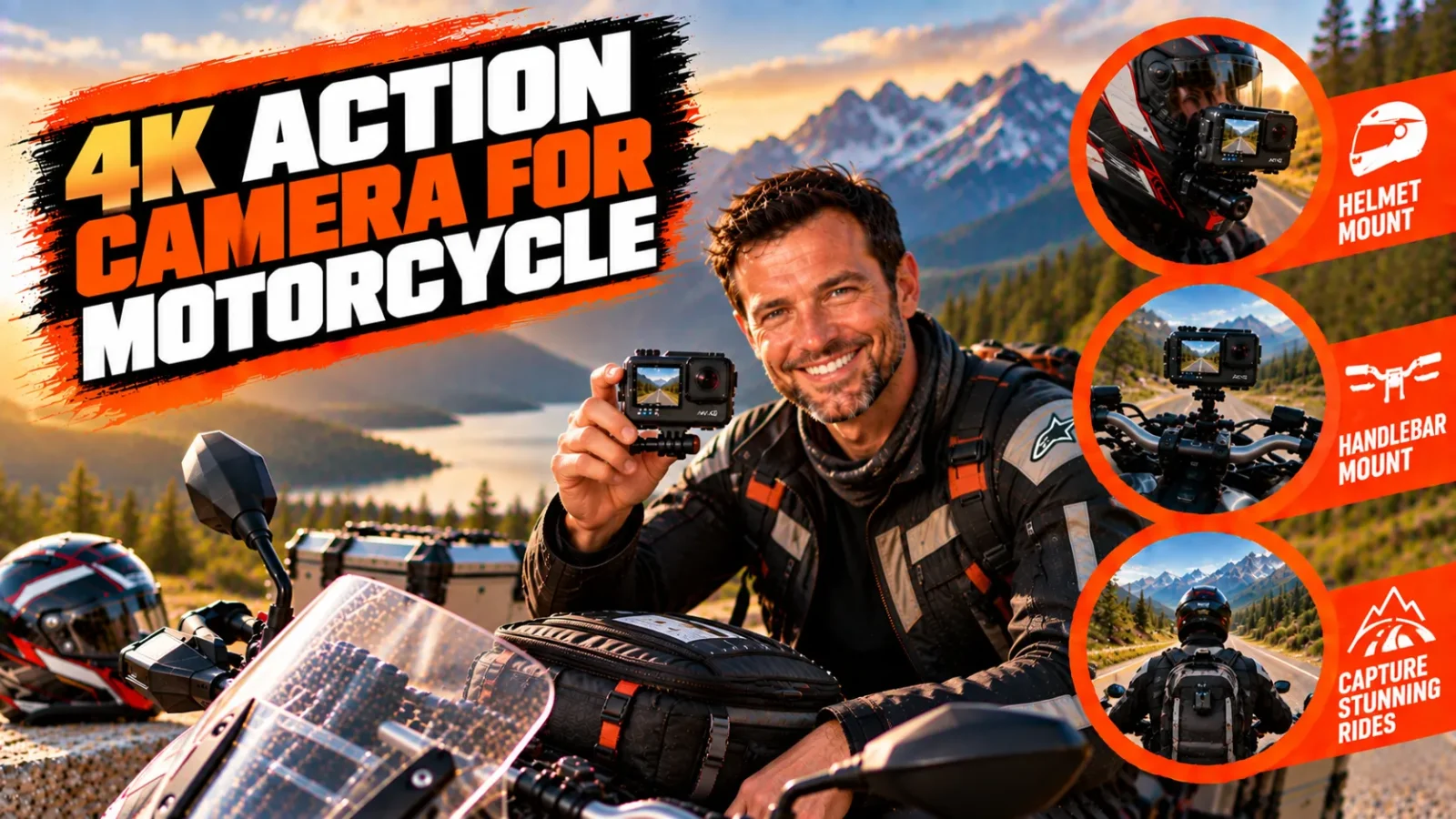
I’ve been strapping cameras to my helmet and handlebars for years, mostly because I got tired of telling people about that near-miss with a distracted driver and having nobody believe me. A good 4K action camera doesn’t just make your rides look cinematic — it’s basically a black box for your bike.
But not every action camera is built for the abuse motorcycling throws at it. Vibration, wind noise, rain, and the occasional tip-over in a parking lot all separate the good cameras from the ones that die after one season. I’ve tested a stack of them, and I’m sharing my honest picks below.
- The GoPro Hero 13 Black is my top overall pick for stabilization, durability, and 4K quality on two wheels.
- If you want 360° footage so you never miss an angle, the Insta360 X4 is genuinely impressive.
- Budget riders should look at the Akaso Brave 8 — surprisingly capable for under $150.
- Mount quality matters as much as the camera itself; I’ve linked my favorite mounting setups throughout.
- Low-light riders (dawn commutes, night rides) should prioritize the DJI Osmo Action 5 Pro.
1. GoPro Hero 13 Black — Best Overall 4K Action Camera for Motorcycle Riding
I keep coming back to GoPro, and the Hero 13 Black is the reason why. It shoots 5.3K60 and 4K120 video, which means silky-smooth slow-motion footage of canyon carving that actually looks good when you slow it down.
The HyperSmooth 6.0 stabilization is the real headline feature for me. Motorcycles vibrate constantly, especially at highway speed, and GoPro’s stabilization irons out almost all of it without that weird “floaty” digital look some competitors have.
GoPro also introduced new magnetic lens mods with the Hero 13, including a wide-angle and an anamorphic lens, which is a fun option if you want a different look for cruiser rides versus track days. Battery life sits around 70 minutes of continuous 4K recording, which is decent but not class-leading.
Why it works so well for riders
It’s rated for waterproofing down to 33 feet without a case, handles temperature swings well, and the touchscreen is responsive even with thin gloves on. If you’re deciding between a helmet or chest setup, I go into more detail in my breakdown of the best action camera for motorcycle helmets.
Price range: Around $399-$450 depending on bundle. Best for: Riders who want the most reliable, well-rounded option and don’t mind paying flagship prices.
2. Insta360 X4 — Best 360° Camera for Never Missing a Shot
I was skeptical of 360° cameras until I actually rode with the Insta360 X4 mounted on a stalk above my helmet. The trick is you capture everything around you in 360°, then “reframe” the shot afterward in the app — meaning you don’t have to aim the camera at all while riding.
It shoots 8K30 in 360 mode or reframes down to a stabilized 4K output, and the invisible selfie-stick effect makes for some genuinely cool third-person riding shots that look like a drone followed you.
The FlowState stabilization is arguably better than GoPro’s for this use case since it’s working with a full 360° sphere of data, not just a fixed frame. Battery life is roughly 135 minutes, notably longer than most GoPro competitors.
The catch with 360 cameras
Editing takes more effort. You have to reframe every clip in the Insta360 app before you get a “normal” video, which adds time compared to a straight-out-of-camera GoPro clip. If you’re patient, though, the creative payoff is worth it.
Price range: Around $500 for the standard bundle. Best for: Riders who want dramatic, creative footage and don’t mind extra editing time.
3. DJI Osmo Action 5 Pro — Best for Low-Light and Night Riding
If you commute before sunrise or ride home after dark, the DJI Osmo Action 5 Pro deserves a serious look. DJI significantly upgraded the sensor size here, and it genuinely shows — night footage is noticeably cleaner and less grainy than what I get out of most competitors.
It records 4K at up to 120fps, has dual touchscreens (front and back), and DJI’s RockSteady 3.0 stabilization is nearly on par with GoPro’s HyperSmooth. Battery life is excellent too, rated around 240 minutes in some conditions, which matters a lot on longer group rides.
DJI also nailed the magnetic quick-release mounting system. I found it faster to swap between my helmet mount and handlebar mount mid-ride compared to GoPro’s twist-lock buckles.
Weatherproofing and durability
It’s waterproof to 20 meters without a case and rated to work in temperatures as low as -4°F, which is genuinely useful if you ride through cold mornings or wet climates.
Price range: Around $349-$400. Best for: Night riders, commuters, and anyone prioritizing low-light image quality.
4. Insta360 Ace Pro 2 — Best Sensor Quality (Co-Engineered with Leica)
The Insta360 Ace Pro 2 surprised me. It uses a 1/1.3″ sensor co-tuned with Leica, and the color science is noticeably richer and more accurate than most action cameras I’ve tested, especially in tricky lighting like dusk or dappled forest roads.
It shoots 4K120 and even 8K24, with a flip-up screen that’s genuinely handy for checking your framing before a ride. AI-powered stabilization (called “FlowState AI”) does a great job smoothing out engine vibration at highway speeds.
Dual native ISO gives it an edge in mixed lighting — think riding in and out of tunnels or shaded canyon roads where exposure normally struggles to keep up.
Battery and heat management
Insta360 added a removable battery here, which is a small thing that matters a lot on all-day rides — you can just swap in a charged spare instead of waiting around. It also handles heat better than the original Ace, avoiding the thermal shutdowns some early action cameras suffered.
Price range: Around $450. Best for: Riders who care most about image and color quality over brand loyalty.
5. GoPro Hero 12 Black — Best Value Flagship Pick
Since the Hero 13 launched, the GoPro Hero 12 Black has dropped in price while still packing nearly identical core specs — 5.3K60 and 4K120 video, HyperSmooth 6.0 stabilization, and the same rugged waterproof build GoPro is known for.
Honestly, unless you specifically want the new lens mod ecosystem from the Hero 13, the Hero 12 Black gives you 90% of the experience for noticeably less money. I still run one as a backup camera on my adventure bike.
It also added HDR video recording, which genuinely helps balance bright sky and shaded pavement — a common exposure headache on sunny rides with lots of shadows from trees or overpasses.
A great entry point into the GoPro ecosystem
Because it shares mounts and accessories with newer GoPro models, it’s an easy way in if you’re building out a whole camera setup. I’d pair it with a solid adhesive mount — I walk through my favorite setups in this guide to the best GoPro adhesive mount setup for motorcycle helmet use.
Price range: Around $299-$350. Best for: Riders who want flagship performance without paying flagship prices.
6. Insta360 Go 3S — Best Ultra-Compact Camera for Minimalist Setups
Sometimes I don’t want a bulky camera on my helmet at all, and that’s where the Insta360 Go 3S comes in. It’s tiny — about the size of your thumb — and clips onto gear, a chest mount, or even the brim of a helmet using its magnetic pendant.
Don’t let the size fool you: it shoots proper 4K30 video (2.7K at higher frame rates) with solid stabilization, and the low profile means way less wind noise and drag compared to a standard action camera housing.
The included charging case doubles as a viewfinder and extra battery, which is a clever solution to the Go series’ historically short battery life. On its own, the camera runs about 45 minutes, but the case extends total shooting time significantly.
Who should actually consider this one
If a bulky helmet cam bothers you, or you want a camera that basically disappears visually, this is worth the tradeoff in battery life and manual controls. It’s less about specs and more about how unobtrusive it feels while riding.
Price range: Around $399 for the 64GB version. Best for: Riders who want minimal bulk and don’t need long continuous recording sessions.
7. Akaso Brave 8 — Best Budget 4K Action Camera
Not everyone wants to spend $400+ just to document their weekend rides, and I get it. The Akaso Brave 8 is the budget option I actually recommend, rather than just tolerate.
It shoots true 4K30 video, has a built-in removable lens filter for glare reduction, and comes with a surprisingly good electronic image stabilization system for the price point. It won’t match GoPro or DJI in tricky lighting, but in daylight riding conditions, footage looks genuinely solid.
It’s also waterproof to 33 feet without a housing and includes dual screens (front and back), a feature you’d normally expect only on cameras twice the price.
Where it falls short
Low-light and night footage gets noisy fast, and the stabilization can’t fully keep up with sustained highway vibration the way GoPro’s HyperSmooth does. For casual weekend riders on a budget, though, it’s hard to beat the value here.
Price range: Around $130-$160. Best for: Riders who want 4K footage without spending flagship money.
8. SJCAM SJ11 Pro — Best Alternative Budget Pick with Interchangeable Lenses
The SJCAM SJ11 Pro doesn’t get talked about as much in the U.S., but I’ve found it to be a genuinely competent alternative in the sub-$200 category. It uses a Sony sensor, shoots 4K30, and — unusually for this price range — supports interchangeable lenses, including a wide-angle option.
Build quality feels sturdier than most budget cameras, and the touchscreen interface is more responsive than I expected. Gyroscope-based stabilization does a reasonable job smoothing out road vibration, though it’s a step below the Akaso Brave 8 in daylight sharpness, in my experience.
A solid pick for tinkerers
If you like customizing your setup — swapping lenses, trying different mounts, adjusting manual exposure — the SJ11 Pro gives you more control than most budget cameras bother offering.
Price range: Around $150-$180. Best for: Budget-conscious riders who want more manual control and lens flexibility.
How I Actually Pick a Camera for Motorcycle Riding
Specs sheets only tell part of the story. Here’s what I actually weigh when deciding which camera goes on my helmet for a given ride.
Stabilization matters more than resolution
A shaky 4K video is still a shaky video. I’d rather have rock-solid stabilization at 1080p than jittery 4K footage. Thankfully, most cameras on this list nail both.
Battery life and heat management
Long rides expose weaknesses fast. Some action cameras — especially compact ones — will overheat and shut down mid-ride in hot weather. I always test a new camera on a 90-minute ride before trusting it for a longer trip.
Mounting setup is half the battle
Even the best camera looks terrible with a wobbly, poorly placed mount. I’ve gone down the rabbit hole comparing options, and if you’re still deciding between chin mounts, side mounts, or adhesive setups, my guide on the best GoPro mounts for motorcycle helmets covers this in depth.
Audio quality is easy to overlook
Wind noise ruins more motorcycle footage than bad video ever does. Cameras with dedicated wind-reduction settings, like the GoPro Hero 13 and DJI Osmo Action 5 Pro, make a noticeable difference when you’re reviewing footage later.
GoPro vs. Everything Else: A Quick Reality Check
People ask me constantly whether GoPro is still worth it in 2024 given the competition. Honestly? Yes, mostly because of the sheer ecosystem — mounts, accessories, and third-party support are still unmatched.
If you’re specifically comparing GoPro models for your helmet setup, I’ve written a deeper dive on the best GoPro camera for motorcycle helmet use that goes model-by-model.
That said, DJI and Insta360 have both closed the gap significantly, and in some categories — like low-light performance or 360° flexibility — they’ve genuinely surpassed GoPro. Don’t assume brand loyalty should override your actual use case.
My Final Take
If I had to grab just one camera for a season of riding, I’d still reach for the GoPro Hero 13 Black. It’s the safest all-around choice, and the accessory ecosystem makes it easy to adapt for helmet, chest, or handlebar mounting depending on the ride.
But honestly, there’s no universally “correct” answer here. Night owls should lean toward the DJI Osmo Action 5 Pro, creative riders should try the Insta360 X4, and anyone watching their budget should feel completely fine with the Akaso Brave 8.
Whichever camera you choose, spend just as much thought on your mounting setup as the camera itself — a great camera with a bad mount will always disappoint you on playback. Ride safe, and keep that lens clean.
Frequently Asked Questions
What is the best 4K action camera for motorcycle riding overall?
In my experience, the GoPro Hero 13 Black is the best all-around choice thanks to its HyperSmooth stabilization, swappable lens mods, and reliable 4K60 footage that holds up even on rough roads.
Do I need a 4K camera, or is 1080p good enough for motorcycle rides?
4K is worth it if you ever plan to crop footage, zoom in on license plates for insurance claims, or want crisp freeze-frames. 1080p is fine for casual vlogging, but 4K gives you far more flexibility in editing.
Which action camera has the best image stabilization for bumpy roads?
The GoPro Hero 13 Black and DJI Osmo Action 5 Pro both offer exceptional electronic stabilization that handles vibration and potholes better than almost anything else I’ve tested.
Is a helmet mount or chest mount better for motorcycle riding?
I generally prefer helmet mounts for a first-person view and better stabilization, but chest mounts reduce helmet weight and can look more natural. Check out my guide on the best GoPro mounts for motorcycle helmets for more on this.

Related Articles

6 Best Rear View Cameras for Motorcycle: Riders Who Want Eyes in the Back of Their Head
I've tested the top rear view cameras for motorcycles so you don't have to. Here are my real-world picks for…
 Jake Miller
12 min read
Jake Miller
12 min read

8 Best Cameras for Riding Motorcycle in 2026 (Rider-Tested Picks)
I've mounted, crashed, and rain-soaked dozens of cameras on my helmet and bike. Here are the 8 best cameras for…
Jake Miller
9 min read

9 Best Cameras for Motorcycle Travel: My Tested Picks for Long-Haul Rides
I've tested action cams, 360 cameras, and mirrorless bodies on thousands of touring miles. Here are the 9 best cameras…
Jake Miller
12 min read