
6 Best Insta360 Cameras for Motorcycle Riding (Tested & Ranked)
 Jake Miller
12 min read
Jake Miller
12 min read
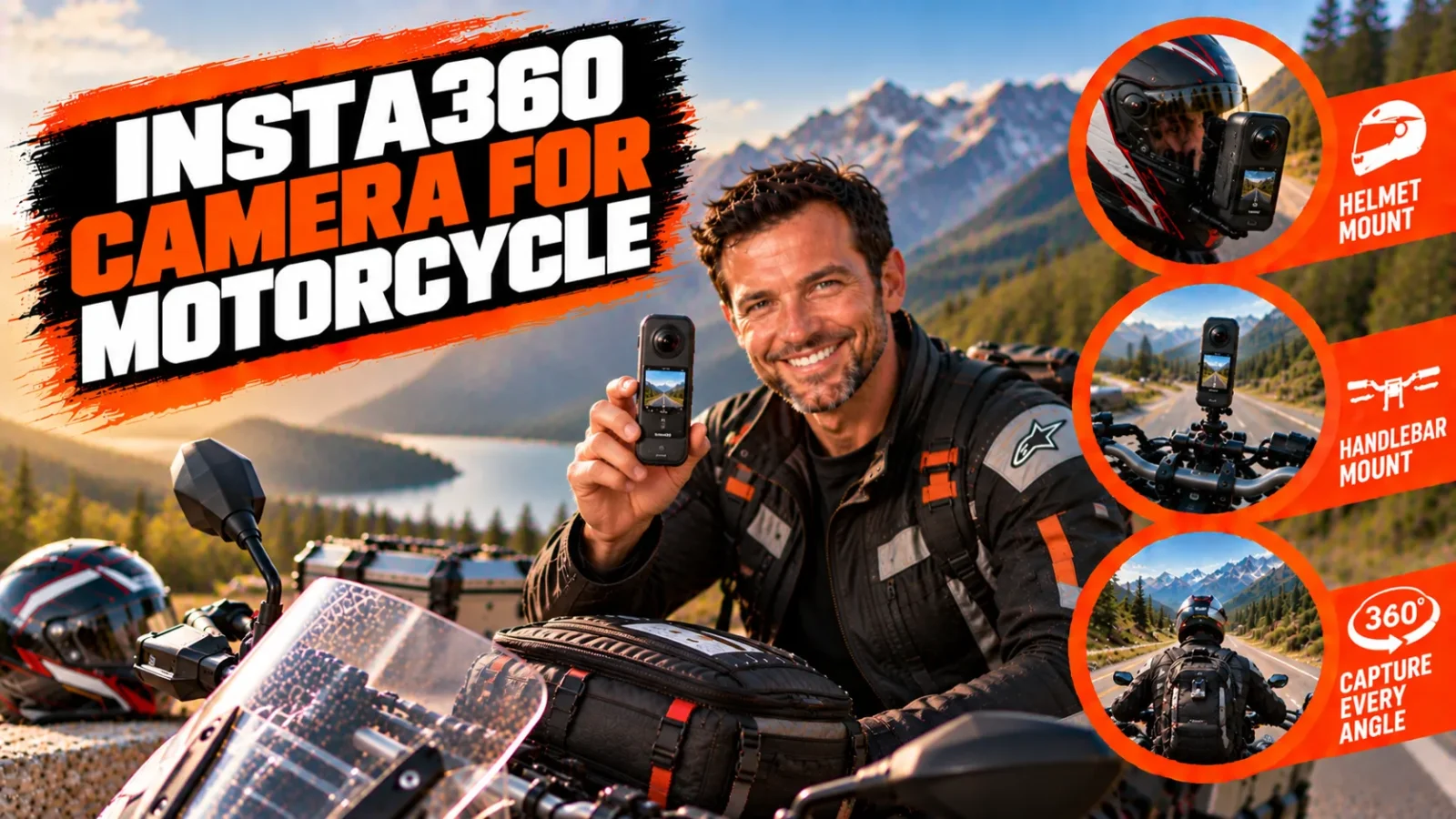
I’ve mounted a lot of cameras to my helmet and bike over the years, and Insta360 has quietly become my go-to brand for motorcycle footage. The 360-degree reframing alone has saved me from missing shots more times than I can count.
In this guide, I’m breaking down the best Insta360 camera for motorcycle riding based on real rides, real crashes into gravel (the camera survived, my pride didn’t), and hours of editing footage afterward. I’ll cover the flagship 360 cameras, the tiny magnetic ones, and the budget options that still deliver.
Every camera on this list is something I’ve either owned, borrowed from a riding buddy, or tested extensively on multi-day trips. No filler, no guessing — just what actually works when you’re doing 70mph on a backroad.
- My top overall pick is the Insta360 X4 — 8K 360 capture means I never have to guess where the “good” angle will be while riding.
- If you want a traditional action-cam shape that mounts like a GoPro, the Insta360 Ace Pro 2 is my pick.
- The Insta360 GO 3S is the most discreet option, magnetically clipping to your helmet or jacket with almost zero wind noise or drag.
- Budget-conscious riders should look at the Insta360 X3 or Insta360 GO 3 — both are still genuinely great for daily rides.
- All these cameras pair with mounts you likely already own if you’ve used a GoPro setup before.
Why I Switched to Insta360 for Motorcycle Rides
I used to run a traditional action camera on my helmet for years. It worked fine until I realized how often I’d aim it slightly wrong, or a car would pass on the side the lens wasn’t pointing at.
With a 360 camera, that problem disappears. I capture everything around me and decide the framing later, sitting at my desk instead of guessing mid-corner.
That said, Insta360 doesn’t just make 360 cameras — they’ve branched into traditional action cams and tiny magnetic cameras too. I’ll cover all three formats here because honestly, the “best” one depends heavily on your riding style.
If you’re still torn between brands entirely, I’ve also put together a full comparison of the best action camera for motorcycle helmets that’s worth a read before you commit.
1. Insta360 X4 — Best Overall Insta360 Camera for Motorcycle Riding
The Insta360 X4 is what I reach for on almost every ride now, and it’s my top recommendation for anyone asking about the best Insta360 camera for motorcycle use. It shoots true 8K 360-degree video, which sounds excessive until you realize you can crop into any angle later without losing quality.
I’ve used the X4 on canyon roads where a car passed dangerously close, and I was able to pull a clean angle showing exactly what happened — something a fixed-lens camera simply can’t do after the fact.
What Stands Out
Battery life is genuinely strong at around 135 minutes of continuous 4K equivalent 360 footage, which gets me through most day rides without a swap. The touchscreen on the back makes framing and reviewing clips easy even with gloves on, once you get used to the resistive touch response.
It’s also rated for dust and water resistance without a housing, though I still run mine with the optional lens guards since bugs and gravel chips add up fast on the highway.
Price and Who It’s For
Expect to pay around $500 for the X4. It’s not cheap, but if you’re serious about capturing full-loop footage of group rides or want the flexibility to reframe shots in post, this is the one I’d tell a friend to buy first.
2. Insta360 Ace Pro 2 — Best Traditional Action Camera Shape
Not everyone wants to deal with 360 footage and the stitching/editing process that comes with it. If you just want familiar POV footage straight out of the camera, the Insta360 Ace Pro 2 is my pick.
It’s built with Leica co-engineered optics and a flip-up screen, and it mounts exactly like a standard action camera — meaning it works with the same hardware most riders already own.
Real-World Performance
I found the low-light footage from the Ace Pro 2 noticeably better than older Insta360 action cams, which matters a lot for early morning or dusk rides when visor glare and shadow gets tricky. The 1/1.3-inch sensor pulls in more light than you’d expect from a camera this size.
FlowState stabilization is baked in here too, so even rough pavement or gravel sections come out smooth without needing a separate gimbal. It also shoots 8K at 4K/120fps for slow-motion overtakes or corner entries.
Price and Fit
The Ace Pro 2 runs around $450. If you already own a chin mount or top mount from a GoPro setup, this camera slots right in — check my guide on best GoPro mounts for motorcycle helmets for compatible hardware.
3. Insta360 GO 3S — Best Tiny, Discreet Camera for Helmets
The Insta360 GO 3S is genuinely one of my favorite pieces of gear, and not just for motorcycling. It’s a thumb-sized magnetic camera that clips onto your helmet, jacket collar, or chest strap with almost no wind resistance.
I’ve worn it on the chin bar of my full-face helmet for entire multi-day trips and honestly forgot it was there half the time. That’s a big deal compared to bulkier action cameras that catch wind noise and create drag at speed.
Specs Worth Knowing
The GO 3S shoots up to 4K at 30fps and 2.7K at 60fps, with a small but usable “Action Pod” that adds a screen, extra battery, and physical buttons when you want more control. On its own, it’s controlled mostly through voice commands or the phone app.
Battery life on the tiny camera body alone is short — around 45 minutes at 4K — but the Action Pod extends that considerably. I treat it like a two-part system: tiny camera for capture, pod for charging and reviewing between stops.
Who Should Buy This
If discretion and weight matter more to you than raw resolution, the GO 3S at around $400 (with Action Pod bundle) is worth every penny. It’s my pick for riders who found bulkier cameras annoying on long stretches.
4. Insta360 X3 — Best Budget 360 Camera for Motorcycle Trips
Before the X4 came out, I rode with the Insta360 X3 for well over a year, and honestly, it still holds up extremely well. Since the X4 launched, the X3 has dropped in price and become a genuinely smart budget pick.
It shoots 5.7K 360 video instead of 8K, which is still plenty sharp for reframing highlight clips or sharing to social media. The difference between X3 and X4 footage is noticeable mainly when you crop in tight or view on a large screen.
Why I’d Still Recommend It
The X3 has the same FlowState stabilization and the same intuitive touchscreen interface as its successor. For riders who mostly post to Instagram or YouTube at 1080p-4K, you genuinely won’t miss the extra resolution of the X4.
Battery life sits around 81 minutes per charge, noticeably shorter than the X4, so I’d budget for a spare battery if you’re doing longer rides.
Pricing
You can typically find the X3 for $300-$350 now, sometimes less during sales. For anyone testing whether 360 camera footage fits their riding style before committing to the flagship, this is where I’d start.
5. Insta360 GO 3 — Best Budget Tiny Camera
The original Insta360 GO 3 (before the “S” update) is still sold and still a fantastic budget option if you want that magnetic, ultra-light form factor without paying flagship prices.
I lent mine to a buddy who was nervous about mounting anything bulky to his new helmet, and it became his go-to camera almost immediately. The size just doesn’t intimidate people the way a full action cam does.
Trade-offs Compared to the GO 3S
The GO 3 has a smaller sensor and slightly less impressive low-light performance than the 3S. Daytime highway and canyon footage still looks great, but shaded forest roads or dusk rides show more noise.
It uses the same Action Pod accessory system, so if you upgrade later, some accessories may carry over depending on the generation compatibility — worth double-checking before buying add-ons separately.
Price Point
Sitting around $300 with the pod bundle, the GO 3 is an easy recommendation for riders who want the tiny-camera experience without spending flagship money.
6. Insta360 RS 1-Inch 360 Edition — Best Image Quality for Serious Riders
If image quality is your top priority and budget isn’t a huge concern, the Insta360 RS 1-Inch 360 Edition is the sharpest, cleanest footage I’ve gotten out of any 360 camera on a bike.
It uses dual 1-inch sensors co-engineered with Leica, and the difference shows up immediately in dynamic range — sunset rides with harsh backlighting look dramatically better than on the X3 or X4.
The Modular System
What makes the RS unique is its swappable lens system. You can switch between the 1-inch 360 mod, a standard 4K wide-angle mod, and other lens options depending on what kind of ride you’re documenting.
I’ve swapped mine to the wide-angle mod for tank-mounted shots and back to 360 for helmet duty on the same trip, which is genuinely convenient if you like variety in your footage.
Price and Considerations
This is the priciest option here, often running $800+ depending on which mods you buy. It’s bulkier than the X4 too, so it’s better suited to tank or handlebar mounts than helmet use for most riders. I’d only recommend it if you’re producing content professionally or just really care about maximum image quality.
How I Actually Mount These on My Bike
Every camera on this list uses Insta360’s standard mounting tab, which is compatible with most GoPro-style mounts already on the market. That’s a huge advantage if you’ve already invested in mounting hardware.
For helmet mounts specifically, I’ve had the best results with chin mounts for 360 cameras since they’re already positioned to capture the full sphere without your helmet blocking the shot. Check my full breakdown of the best GoPro mounts for motorcycle helmets if you need hardware recommendations.
For a more permanent, vibration-resistant setup, I’ve also switched some of my cameras over to adhesive mounts rather than clip mounts. My guide on the best GoPro adhesive mount setup for motorcycle helmet use covers exactly how I set mine up to survive highway speeds without shifting.
A Quick Note on Chest and Tank Mounts
I personally prefer chest mounts for the GO 3S since it’s light enough not to bounce around much. For the bulkier X4 or RS, I lean toward tank mounts or handlebar mounts to keep weight off my helmet entirely.
Your neck will thank you after a long day if you distribute camera weight smartly instead of stacking everything on your lid.
Insta360 vs GoPro: My Honest Take for Motorcycle Riders
I get asked constantly whether Insta360 or GoPro is the better choice for motorcycle footage. Honestly, it comes down to whether you value the reframing flexibility of 360 capture or the simplicity of traditional POV footage.
GoPro still wins on raw brand recognition, accessory ecosystem size, and simplicity — you point, you shoot, you’re done. If that sounds more your speed, my rundown of the best GoPro camera for motorcycle helmet use covers the current lineup in detail.
But for me personally, the ability to fix a bad angle after the ride has been worth the extra editing step every single time. I’ve salvaged footage with Insta360’s reframing tool that would’ve been a total loss with a fixed-lens camera.
What I Look for Before Buying Any Camera for My Bike
Mounting Compatibility
I never buy a camera without checking that it works with mounts I already own. All the Insta360 models above use the same tab-style mount, which saves money long-term.
Battery Life vs Ride Length
Be honest with yourself about how long your rides actually are. If you’re doing all-day trips, the X4’s longer battery life matters more than squeezing out extra resolution from a shorter-lived camera.
Wind Noise and Drag
Bulkier cameras create more wind noise in audio and slightly more drag at highway speeds. The GO 3S wins here by a wide margin simply due to its size.
Editing Time You’re Willing to Spend
360 footage requires reframing in the app or desktop software before it’s shareable. If you want grab-and-go footage with zero editing, the Ace Pro 2’s traditional format saves time.
After years of testing these cameras across different bikes and riding styles, my honest recommendation is this: start with the Insta360 X4 if budget allows, or the Insta360 X3 if you want to try 360 footage without the flagship price tag. Either way, you’ll capture rides in a way a traditional action camera simply can’t match.
Frequently Asked Questions
Is Insta360 better than GoPro for motorcycles?
It depends on your goals. Insta360’s 360-degree cameras like the Insta360 X4 let you reframe shots after the ride, which is huge for motorcycle footage where you can’t always predict the best angle. For straightforward POV, check out my breakdown of the best GoPro camera for motorcycle helmet use to compare.
Where should I mount an Insta360 camera on my motorcycle helmet?
I’ve had the best luck with chin mounts and top-of-helmet mounts for 360 cameras since they capture the full sphere anyway. My guide to the best GoPro mounts for motorcycle helmets covers hardware that also works with Insta360’s mounting system.
Do I need a stabilizer or gimbal accessory for Insta360 cameras on a motorcycle?
No. Insta360’s FlowState stabilization is built into the software, so cameras like the Insta360 X4 and Insta360 Ace Pro 2 smooth out vibration and bumps automatically without any extra gimbal hardware.
Which Insta360 camera lasts longest on a full day ride?
The Insta360 X4 gives me roughly 135 minutes of continuous 4K footage per battery, which is the best runtime in this lineup. I always carry a spare battery or a power bank for anything longer than a half-day ride.

Related Articles

6 Best Rear View Cameras for Motorcycle: Riders Who Want Eyes in the Back of Their Head
I've tested the top rear view cameras for motorcycles so you don't have to. Here are my real-world picks for…
Jake Miller
12 min read

8 Best Cameras for Riding Motorcycle in 2026 (Rider-Tested Picks)
I've mounted, crashed, and rain-soaked dozens of cameras on my helmet and bike. Here are the 8 best cameras for…
Jake Miller
9 min read

9 Best Cameras for Motorcycle Travel: My Tested Picks for Long-Haul Rides
I've tested action cams, 360 cameras, and mirrorless bodies on thousands of touring miles. Here are the 9 best cameras…
Jake Miller
12 min read