
10 Best Camera Backpacks for Motorcycle Riders Who Refuse to Compromise on Gear
 Jake Miller
12 min read
Jake Miller
12 min read
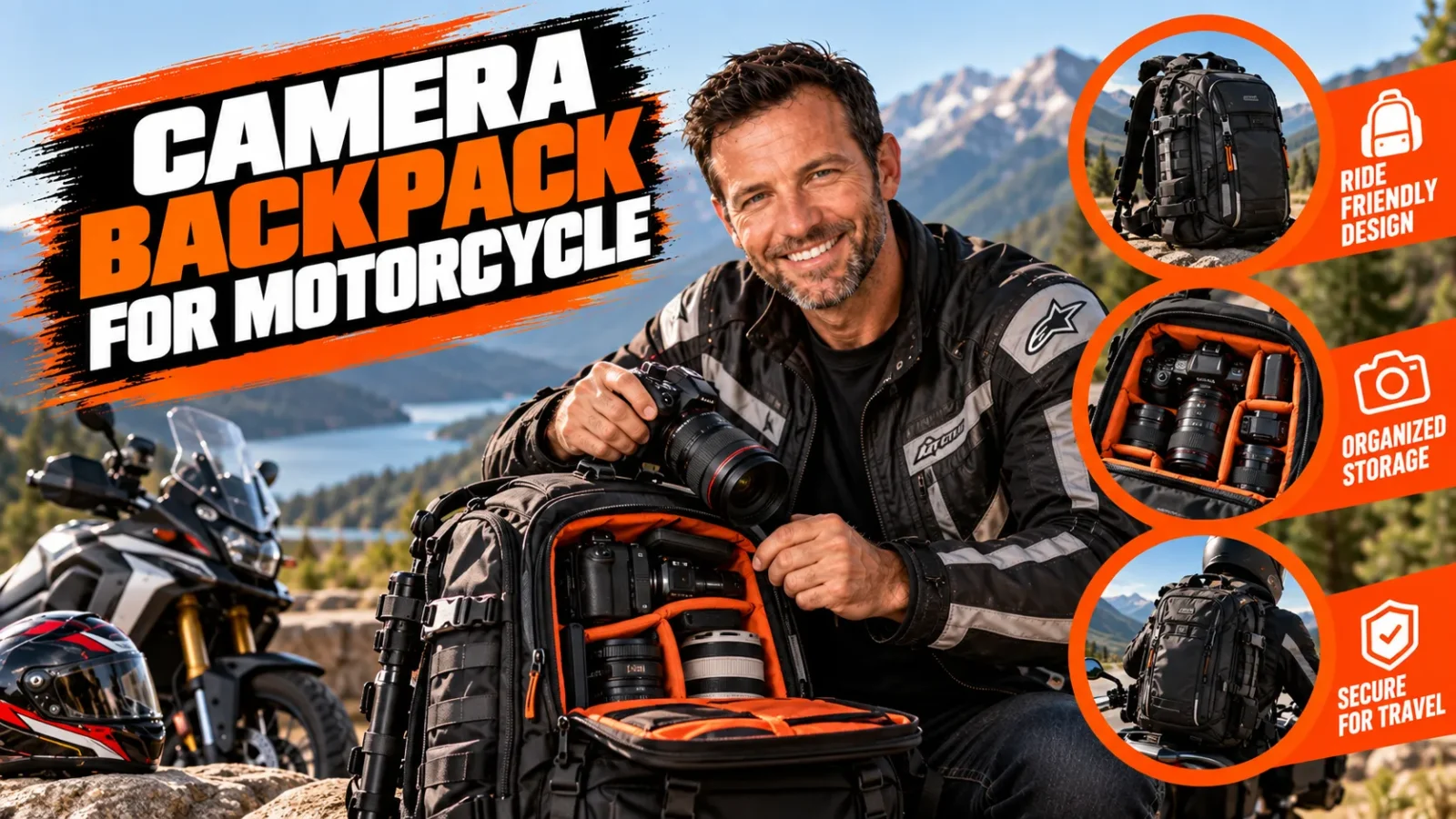
I’ve strapped a lot of expensive glass to my back over the years, and I learned the hard way that a regular camera bag and a motorcycle don’t mix. Wind buffets it, straps dig into your collarbone at highway speed, and one hard pothole can turn your lens collection into a very costly rattle.
After swapping through more packs than I care to admit, I’ve narrowed it down to the ones I’d actually trust with my own gear on a five-hour ride. These aren’t generic “camera bag” recommendations — every one of these has features that specifically matter when you’re riding, not just walking around a city.
- My overall favorite is the Lowepro Flipside Trek BP 250 AW — it wears low, has a real sternum strap, and shrugs off rain.
- For minimalist commuting rides, the Peak Design Everyday Backpack 20L V2 hides its “camera bag” look best.
- Adventure touring riders doing multi-day trips should look at the f-stop Tilopa or Shimoda Action X30.
- On a budget? The Lowepro Photo Hatchback BP 150 AW II gets you 90% of the protection for a fraction of the price.
- Whatever pack you choose, prioritize a chest strap and low back profile — comfort at 70 mph matters more than looks.
1. Lowepro Flipside Trek BP 250 AW — Best Overall Camera Backpack for Motorcycle Riding
This is the pack I reach for most often, and it’s not close. The Flipside Trek BP 250 AW has a rear-access opening, which means thieves and road grime can’t get into your camera compartment while it’s on your back — a big deal when you’re stopped at a gas station in riding gear.
The included All Weather AW Cover is what sold me. I’ve ridden through a genuine downpour with it deployed and my mirrorless body plus two lenses stayed bone dry underneath.
It also has a padded, adjustable sternum strap and a hip belt, both of which keep the bag from swinging around when you’re leaned over in a corner. That stability alone makes it worth the roughly $170-190 price tag for me.
Why I trust it on two wheels
The back panel sits close and low, so it doesn’t catch wind or pull on your shoulders at speed. There’s also a top pocket that’s perfect for stashing your phone or a spare action camera before you get rolling.
2. Peak Design Everyday Backpack 20L V2 — Best Low-Profile Everyday Carry
If you commute on a motorcycle and don’t want your bag screaming “expensive camera gear inside,” the Peak Design Everyday Backpack 20L V2 is my pick. It looks like a sleek city backpack, but the FlexFold dividers inside convert it into a fully padded camera cube in seconds.
I like that it uses weatherproof 400D nylon canvas — it’s not fully submersible, but it laughed off a light drizzle on my ride home without a rain cover. At around $260, it’s not cheap, but the build quality (magnetic buckles, YKK zippers) has held up for me over three years of near-daily use.
The external carry straps let me lash a tripod or a jacket to the outside, which I appreciate on days when I’m packing light gear but bulky layers.
A small caveat
It doesn’t come with a dedicated sternum strap out of the box on all configurations, so I added a third-party chest strap for anything beyond a short commute. Worth checking before you buy if highway riding is your main use case.
3. Shimoda Designs Action X30 v2 — Best for Adventure Touring
When I’m loading up for a multi-day adventure ride, the Shimoda Action X30 v2 comes with me. It’s built like actual motorcycle luggage — roll-top closure, tarpaulin-style waterproof base, and a suspended harness system that transfers weight to your hips instead of your shoulders.
At 30 liters, it swallows a full mirrorless kit, a drone, and still has room for a rain jacket or tent poles strapped externally. Prices run around $260-300 depending on the core unit you pair with it, since Shimoda sells the shell and the internal camera “core” separately.
I appreciate that the harness has a proper sternum strap with an emergency whistle buckle — a small touch, but it tells you this bag was designed by people who think about outdoor safety, not just photography.
Storage flexibility
Because the internal core is modular, I can swap between a full camera insert and a general gear insert depending on whether I’m shooting that day or just touring. That versatility is rare in this category.
4. f-stop Tilopa — Best for Multi-Day Expeditions
The f-stop Tilopa is the pack I’d grab for a week-long ride through mountain switchbacks with a full camera kit. It’s a 50-liter beast with an internal camera unit (ICU) system, meaning the padded camera insert lives inside a much larger, rugged expedition backpack shell.
That combo means I can carry my camera gear plus a sleeping bag, extra layers, and tools all in one pack, rather than juggling saddlebags and a separate camera bag. Expect to pay $300-350 for the bag plus ICU together.
The load-bearing hip belt is genuinely excellent — I’ve worn this thing for 10-hour riding days and my shoulders never felt it. It’s overkill for a quick coffee ride, but for real touring, nothing else I’ve used comes close.
5. Lowepro Photo Hatchback BP 150 AW II — Best Budget Pick
Not everyone wants to spend $250 on a bag, and I get that. The Lowepro Photo Hatchback BP 150 AW II runs around $110-130 and still delivers the essentials: rear-panel access, a built-in rain cover, and enough room for a mirrorless body with two lenses plus a 10-inch tablet.
It’s smaller and lighter than most on this list, which I actually like for shorter rides where I don’t want a bulky pack pulling at my shoulders in traffic. The tripod straps on the side are a nice inclusion at this price point.
It doesn’t have as robust a hip belt as the pricier options, so I wouldn’t take it on an all-day tour. But for weekend rides to shoot local scenery, it’s genuinely one of the best values in the category.
6. Kriega R30 Backpack — Best Motorcycle-Specific Build
The Kriega R30 isn’t marketed as a camera bag at all — it’s a motorcycle backpack first, built from the same waterproof, abrasion-resistant materials Kriega uses in its luggage systems. I add a padded camera cube insert (Lowepro and Peak Design both sell standalone ones) and it becomes a fantastic riding-specific camera pack.
What sold me is the Quadloc harness system, which is genuinely the most stable chest and shoulder strap setup I’ve used on any backpack, camera-focused or not. At around $185, it’s not the cheapest option, but the durability is built for actual motorcycle abuse, not just airport travel.
If you’re someone who values a bag that can survive being dropped on gravel more than one with dedicated lens dividers, this is my recommendation.
Mounting your action camera alongside it
Since the R30 doesn’t include internal dividers on its own, I usually keep my action camera clipped to my helmet instead of buried in the pack. If you haven’t sorted that setup yet, my guide to the best GoPro mounts for motorcycle helmets covers the sturdiest options I’ve tested.
7. Thule Covert DSLR Backpack — Best for Quick-Access Shooting
The Thule Covert DSLR Backpack has a side-access camera compartment that lets me pull my camera out without taking the whole bag off — genuinely useful when I’ve pulled over on the side of a scenic road and want to grab a shot fast before traffic builds up behind me.
It holds a DSLR or mirrorless body with up to three lenses, plus a 15-inch laptop sleeve for editing on the road. Pricing typically sits around $180-200.
The exterior fabric is a rugged, water-resistant canvas that’s handled light rain fine in my experience, though I’d still throw a rain cover over it in a real storm since it doesn’t ship with one built in.
8. Manfrotto Pro Light Bumblebee-130 PL — Best Compact Sling-Style Option
For riders who prefer something smaller and slung across the body rather than a full backpack, the Manfrotto Pro Light Bumblebee-130 PL is worth a look. It’s technically a backpack, but its compact 13-liter size makes it feel more like a sling bag when it’s on.
I like using this one for shorter rides where I’m carrying a single mirrorless body, a couple of small primes, and not much else. It’s priced around $130-150 and includes an integrated rain cover, which is a nice surprise at this size.
The trade-off is obvious: it’s not built for multi-day loads. But if you want the smallest, least cumbersome option that still protects gear properly, this is a strong pick.
9. Lowepro ProTactic 450 AW II — Best for Carrying a Full Gear Loadout
When I’m heading out to actually shoot a job rather than just capture ride footage, the Lowepro ProTactic 450 AW II comes along. It’s a 25-liter monster that fits two camera bodies, up to six lenses, a drone, and a 15-inch laptop, which is more than most riders will ever need — but if you’re a working photographer who also rides, it’s fantastic.
At roughly $230-250, it includes a fully sealed rain cover, MOLLE-compatible straps for adding pouches, and a customizable divider system that I’ve rearranged a dozen different ways depending on the shoot.
It’s heavier and bulkier than the others here, so I only bring it on rides where I know I’ll actually need the full kit. For everyday riding, one of the smaller packs above makes more sense.
10. WANDRD PRVKE 31 — Best Hybrid Travel and Camera Backpack
The WANDRD PRVKE 31 blends a travel backpack with a camera bag, and it’s become my go-to for multi-day motorcycle trips where I’m also carrying clothes and toiletries alongside gear. The included camera cube is removable, so the bag doubles as regular luggage once you’re off the bike.
It’s made from a water-resistant 900D exterior fabric that’s held up well through several wet rides, and the roll-top design adds extra protection against spray from the tire in front of you if you’re riding in a group. Expect to pay around $200-230 with the camera cube bundle included.
The exterior straps are sturdy enough that I’ve lashed a tripod and a rolled-up rain jacket to the outside without issue, which I appreciate on trips where saddlebag space is tight.
What I Actually Look for Before Buying a Motorcycle Camera Backpack
After going through this many packs, I’ve settled on a checklist. It’s saved me from buying bags that look great in photos but fall apart on the road.
A real sternum and waist strap
This is non-negotiable for me. Without a sternum strap, a loaded backpack pulls backward at speed and puts strain on your shoulders and lower back within an hour. Every pack I’ve recommended above has one.
Weather sealing you can actually trust
I don’t mean “water resistant” in the vague marketing sense — I mean a genuine included rain cover or a sealed roll-top design. Riding means you can’t always predict when weather turns, and your camera gear won’t forgive you for guessing wrong.
A low, close-fitting profile
Bags that stick far off your back catch wind and shift your center of gravity in corners. I always check how a pack sits when I’m leaned forward in a riding position, not just standing upright in a store.
Room to grow (but not too much)
I’ve learned to buy slightly smaller than I think I need. An oversized pack that’s half-empty bounces around more than a snug one that’s properly loaded.
Pairing Your Backpack With the Right Action Camera Setup
A great backpack solves storage and protection, but most of my footage these days actually comes from a helmet-mounted camera, not something I pull out of my bag mid-ride. If you’re building out your setup, I’d start with my rundown of the best action camera for motorcycle helmets to find a body that survives vibration and weather.
Once you’ve got the camera sorted, the mounting hardware matters just as much. I’ve tested a handful of adhesive setups, and my notes on the best GoPro adhesive mount setup for motorcycle helmets cover which ones actually survive a full season of riding without peeling off.
Your backpack, in that setup, becomes the safe home for spare batteries, memory cards, and your main camera body once you’ve stopped rolling and want to switch to stills.
My Final Take
If I had to pick just one, I’d still grab the Lowepro Flipside Trek BP 250 AW — it hits the sweet spot of weatherproofing, stability, and price that most riders actually need. But your riding style should really drive the decision here.
Commuters should lean toward the Peak Design Everyday Backpack 20L V2, adventure tourers should look hard at the Shimoda Action X30 or f-stop Tilopa, and anyone on a tighter budget will be happy with the Lowepro Photo Hatchback BP 150 AW II.
Whichever one you choose, the goal is the same: gear that survives the ride so you’re not the one who shows up to the shoot with a cracked lens. I’ve made that mistake once — I don’t plan on making it again.
Frequently Asked Questions
What makes a camera backpack safe for motorcycle riding?
A good motorcycle camera backpack needs a low, close-to-body profile, a sternum and waist strap to stop shifting at speed, weatherproof material or a rain cover, and internal dividers that keep lenses from clattering together over bumps.
Can I wear a regular camera backpack on my motorcycle?
You can in a pinch, but most standard camera bags sit too far off your back and lack a sternum strap, which becomes dangerous at highway speeds. I’d recommend a pack built with adjustable chest straps, like the Lowepro Flipside Trek BP 250 AW or Shimoda Action X30.
Should I mount an action camera on my helmet or my backpack?
Both work well together. Check out my breakdown of the best GoPro camera for motorcycle helmet setups if you want handlebar or head-mounted footage in addition to what you’re carrying in your pack.
How much should I spend on a motorcycle camera backpack?
I’ve found solid options from around $110 for something like the Lowepro Photo Hatchback BP 150 AW II up to $300+ for premium builds like the f-stop Tilopa, depending on how much gear you carry and how rugged you need it to be.

Related Articles

6 Best Rear View Cameras for Motorcycle: Riders Who Want Eyes in the Back of Their Head
I've tested the top rear view cameras for motorcycles so you don't have to. Here are my real-world picks for…
Jake Miller
12 min read

8 Best Cameras for Riding Motorcycle in 2026 (Rider-Tested Picks)
I've mounted, crashed, and rain-soaked dozens of cameras on my helmet and bike. Here are the 8 best cameras for…
Jake Miller
9 min read

9 Best Cameras for Motorcycle Travel: My Tested Picks for Long-Haul Rides
I've tested action cams, 360 cameras, and mirrorless bodies on thousands of touring miles. Here are the 9 best cameras…
Jake Miller
12 min read