
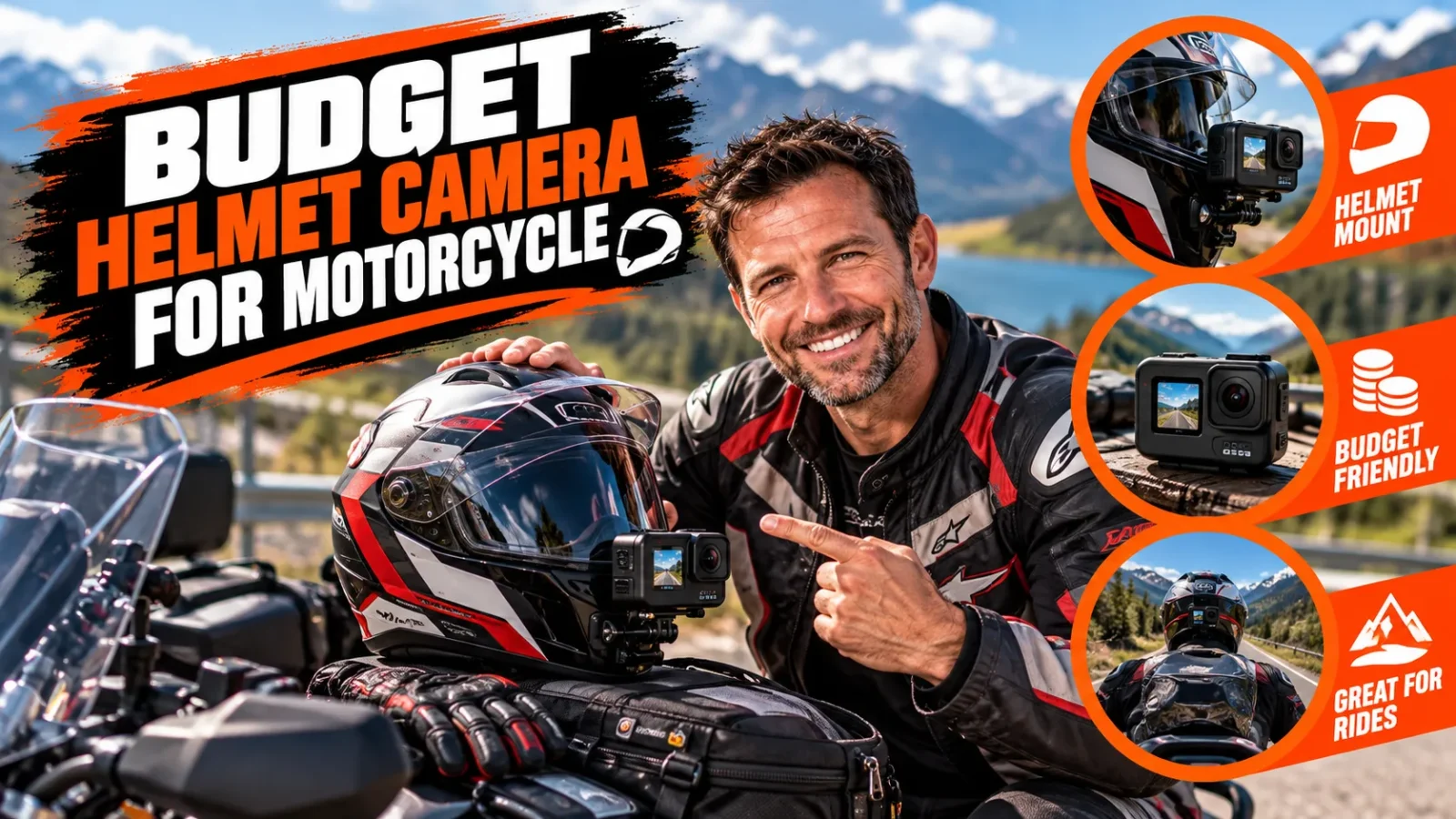
I’ve burned through more helmet cameras than I’d like to admit. Some died after two rain rides. Others produced footage so shaky it looked like I’d strapped a paint mixer to my head. So when I say I’ve found the real budget winners, I mean I’ve earned that opinion the hard way.
This list isn’t about the cheapest garbage I could find on a clearance rack. It’s about cameras that actually deliver usable footage, survive real riding conditions, and don’t demand a second mortgage. I ride in everything from Sunday canyon carves to commuting through traffic, and I’ve mounted every camera on this list to my own lid at some point.
If you’re also curious about premium options before committing to a budget pick, I’ve got a separate breakdown of the best GoPro camera for motorcycle helmet use that’s worth a look. But if your wallet is telling you to keep things reasonable, stick with me here.
- My overall top pick under budget is the GoPro Hero (2024) for its reliability and app support, but the Akaso Brave 7 LE gives you 90% of that experience for half the price.
- If smooth footage matters most, the DJI Osmo Action 3 punches way above its price point for stabilization.
- For riders who hate bulky gear, the Insta360 GO 3 is tiny, light, and barely noticeable on your helmet.
- Truly rock-bottom budgets should look at the Campark X30 or Akaso EK7000 Pro — both under $80 and still shoot 4K.
- Whatever camera you pick, invest a few extra dollars in a proper mount — I cover that separately below.
1. GoPro Hero (2024) — Best Overall Budget Pick
I know GoPro isn’t usually the “budget” brand, but the stripped-down GoPro Hero (2024) changed my mind. It ditches some of the flagship bells and whistles but keeps the core GoPro reliability I trust on long rides.
It shoots 1080p at up to 60fps, which sounds modest compared to 4K rivals, but honestly, for reviewing near-misses or sharing highlight clips, it’s plenty sharp. The waterproofing up to 5 meters means I never worry about sudden downpours mid-ride.
What sold me was the touchscreen and the GoPro Quik app integration. Pulling footage off my helmet and editing a quick clip at a gas stop takes minutes, not an hour of fiddling with file transfers.
At around $199, it’s pricier than most on this list, but you’re paying for GoPro’s ecosystem — mounts, accessories, and app support that just works. If you want something that feels like a “real” action camera without the $400 flagship tax, this is it.
Why I keep coming back to it
I’ve dropped this thing, rained on it, and left it baking on my tank bag in July heat. It’s still going. For riders who value dependability over spec-sheet bragging rights, that counts for a lot.
2. Akaso Brave 7 LE — Best Value for Money
If you want the most camera for your dollar, the Akaso Brave 7 LE is my pick. I paid under $100 for mine, and it shoots true 4K at 30fps with electronic image stabilization (EIS) that actually works reasonably well on a motorcycle.
It comes with a detachable external mic port, which is a rare feature at this price point. I’ve used it to pick up exhaust note and wind commentary that most budget cams simply can’t capture without an add-on.
The dual screens (front and rear) make framing shots easy before I even clip it onto my helmet mount. Battery life sits around 90 minutes of continuous 4K recording, which covers most of my weekend rides between charging stops.
Build quality feels a notch below GoPro, and the touchscreen can be laggy in cold weather with gloves on. But for the price, I haven’t found anything that beats the Brave 7 LE’s value proposition.
Where it falls short
Low-light footage gets grainy fast. If you do a lot of night riding, this isn’t your camera. For daytime rides and sunny weekend trips, though, it’s excellent.
3. DJI Osmo Action 3 — Best Stabilization on a Budget
DJI entered the action camera game aggressively, and the Osmo Action 3 is proof. I’ve mounted this on my chin bar and been genuinely shocked at how smooth the footage looks, even over rough pavement.
DJI’s RockSteady 3.0 stabilization is the star feature here. It handles engine vibration and helmet wobble better than cameras twice its price. If shaky footage has been your biggest complaint with past cameras, this fixes it.
It shoots 4K at 120fps for slow-motion highway shots, and the magnetic quick-release mounting system means I can pop it off my helmet in seconds at a gas station without unscrewing anything. That convenience alone makes it worth considering.
Pricing fluctuates, but I’ve regularly seen it drop to $200-$250 during sales, putting it firmly in budget territory compared to flagship GoPros. Battery life is solid too, rated for about 160 minutes in ideal conditions, though cold weather riding cuts that down noticeably.
A note on mounting
Because the Osmo Action 3 uses DJI’s proprietary magnetic mount, you’ll want an adapter if you’re using standard GoPro-style helmet mounts. I go into this more in my guide to GoPro mounts for motorcycle helmets, which covers compatible adapters too.
4. Insta360 GO 3 — Best Tiny and Lightweight Pick
The Insta360 GO 3 is barely bigger than a thumb, and that’s exactly why I love it for helmet mounting. There’s no bulky housing catching wind or throwing off your helmet’s balance at highway speeds.
It uses a magnetic pendant-style mount that sticks flush to your helmet shell. I genuinely forget it’s there sometimes until I check my footage later. For riders worried about aerodynamics or looking “extra” with a big camera rig, this solves that problem entirely.
Footage tops out at 2.7K, which is a step down from full 4K rivals, but the stabilization and color science from Insta360 are genuinely impressive for something this small. The companion app also makes editing ridiculously easy on your phone.
Pricing starts around $199 for the 32GB version, putting it in the mid-budget range. Battery life is the tradeoff — expect around 30-45 minutes of continuous recording, so it’s better suited to shorter rides or clip-based capturing rather than all-day touring footage.
Best use case
I use mine for quick canyon runs and social media clips rather than long-haul touring days. If your rides are typically under an hour, this little camera is hard to beat for convenience.
5. SJCAM SJ10 Pro — Best Budget 4K Alternative
SJCAM doesn’t get talked about as much as GoPro or DJI, but the SJ10 Pro deserves more attention. I picked one up specifically to test as a GoPro alternative, and it held up better than I expected.
It records 4K at 30fps with a Sony sensor that handles daylight riding conditions well. The built-in gyroscope stabilization isn’t quite DJI-level, but it’s leagues better than entry-level cameras in this price bracket, which typically sits around $150-$180.
One feature I genuinely appreciate is the removable, swappable battery system. I carry two spares in my tank bag, so I never worry about running dry mid-tour. That’s a real advantage over sealed-battery competitors.
The waterproof case rating goes down to 30 meters, which is honestly overkill for motorcycle riding but nice peace of mind during unexpected rainstorms.
Minor gripes
The companion app isn’t as polished as GoPro’s or DJI’s, and firmware updates can be a bit clunky to install. But if you’re comfortable being a little more hands-on, the SJ10 Pro delivers strong value.
6. Campark X30 — Best Ultra-Cheap Option
When my buddy asked me for a camera recommendation under $70, the Campark X30 was my answer without hesitation. It’s genuinely one of the cheapest cameras I’d actually trust on a helmet.
It records 4K at 24fps (with smoother 1080p at 60fps), and while the footage won’t win any awards, it’s crisp enough for reviewing incidents or sharing casual ride clips online. For the price, that’s more than fair.
The waterproof case included in the box is sturdy and rated for underwater use up to 30 meters, which translates to bombproof rain protection on the road. I’ve ridden through genuine downpours with this thing exposed and had zero issues.
Battery life is modest at around 90 minutes, and you’ll want to pick up a spare battery since replacements are cheap and readily available. Wi-Fi connectivity for app transfers works, though it’s noticeably slower than pricier competitors.
Who this is really for
If you just want basic accountability footage for insurance purposes or casual clips without spending real money, the Campark X30 does the job. Don’t expect cinematic quality, but do expect reliability for the price.
7. Akaso EK7000 Pro — Best for First-Time Camera Owners
Before you spend real money on a helmet camera, I always recommend trying the Akaso EK7000 Pro first. It’s one of the most beginner-friendly cameras I’ve tested, with dead-simple menus and a straightforward mounting kit included.
It shoots 4K at 25fps, and while the sensor isn’t going to blow you away, it’s genuinely solid for the roughly $60-$80 price tag I usually see it listed at. This is a great “test the waters” camera before committing to something pricier.
The kit comes with an absurd number of mounting accessories — more than I’ve seen bundled with any other budget camera. That’s handy if you’re also testing different rides or gear setups and want flexibility without buying separate mounts.
Where it struggles is stabilization. There’s minimal EIS, so footage at higher speeds or over bumpy roads can get noticeably shaky. It’s fine for casual city rides but less ideal for spirited backroad runs.
My honest take
I still keep one of these in my gear bag as a backup camera. It’s cheap enough that I don’t stress about damaging it, and that peace of mind is worth something on its own.
8. APEMAN Trawo A80 — Best Battery Life on a Budget
Long-distance touring riders, this one’s for you. The APEMAN Trawo A80 surprised me with battery performance that outlasts most of its competitors in this price range, which typically runs around $70-$90.
It records 4K at 30fps and includes built-in EIS that handles moderate vibration reasonably well. It’s not going to match DJI’s stabilization tech, but for a camera at this price, I was genuinely impressed with how usable the footage looked afterward.
The dual battery setup (two included batteries plus a charging dock) means I can swap batteries at a fuel stop and keep recording all day during longer tours. That’s a meaningful advantage if you’re documenting multi-day trips rather than short joyrides.
It also includes voice control, which sounds gimmicky until you’re riding gloved-up and need to start recording without fumbling with tiny buttons. I’ve used this more than I expected to, especially during cold months.
The tradeoff
Build quality feels a bit more plasticky than the Akaso or SJCAM options, so I wouldn’t recommend dropping it repeatedly on pavement. Treat it gently, and it’ll reward you with strong battery life and dependable footage.
How I actually chose these cameras
I didn’t just skim spec sheets for this list. Every camera here has spent real time strapped to my helmet, through rain, heat, vibration, and the occasional low-speed tip-over in a parking lot.
My criteria were simple: reasonable video quality, decent battery life, real waterproofing (not marketing fluff), and a price tag that wouldn’t make me wince if the camera got scratched or lost.
I also weighed how easy each camera was to actually operate mid-ride, since fumbling with tiny buttons while wearing gloves at a stoplight is nobody’s idea of fun.
What “budget” actually means here
I set my own informal ceiling around $250, with most picks landing well under $150. That’s the sweet spot where you get genuinely usable footage without paying flagship prices for features most riders never touch.
Mounting matters more than people realize
Here’s something I learned the hard way: even the best camera looks terrible with a bad mount. A loose or poorly positioned mount ruins footage faster than any sensor limitation ever could.
I’ve experimented with chin mounts, side mounts, and top-of-helmet setups extensively. Each has tradeoffs in stability, wind noise, and how “in your face” the camera feels while riding.
If you’re deciding between adhesive setups and clip-on mounts, I put together a full breakdown of my experience in the best GoPro adhesive mount setup for motorcycle helmet guide. It covers exactly which adhesives hold up in heat and cold without peeling off mid-ride.
And if you’re still shopping around for mount styles beyond adhesive options, my broader roundup on GoPro mounts for motorcycle helmets compares chin mounts, side rail mounts, and top mounts side by side.
A few things I wish I knew before buying my first budget camera
Stabilization isn’t optional
I used to think stabilization was a nice-to-have. After reviewing hours of unwatchable shaky footage from my early cameras, I now consider it a dealbreaker. Prioritize cameras with real EIS, even on a budget.
Battery life dictates your ride length
If you tour for hours at a time, don’t buy a camera rated for 30-45 minutes unless you’re comfortable carrying spare batteries and swapping them at stops. It’s a small detail that trips up a lot of first-time buyers.
Weatherproofing claims vary wildly
“Waterproof” on the box doesn’t always mean the same thing across brands. I always check the actual meter rating and whether it requires a separate case, since some budget cameras need an add-on housing to hit their advertised rating.
Comparing this to the pricier alternatives
I get asked constantly whether it’s worth skipping budget cameras entirely and going straight for something like a flagship GoPro Hero or DJI Osmo Action 4. Honestly, it depends on how often you ride and what you’re using the footage for.
If you’re recording for insurance and incident documentation purposes primarily, a budget camera does the job just fine. If you’re building a YouTube channel or want cinema-quality footage for editing, it might be worth stretching your budget.
I cover that comparison in more depth in my guide to the best action camera for motorcycle helmets, which looks at both budget and premium options side by side.
My final take
If I had to recommend just one camera from this list to a friend on a tight budget, I’d point them toward the Akaso Brave 7 LE. It hits the sweet spot of price, features, and reliability that most riders actually need.
But if stabilization is your top priority and you can stretch your budget slightly, the DJI Osmo Action 3 is worth every extra dollar. And if you just want something tiny and unobtrusive, the Insta360 GO 3 genuinely surprised me.
Whatever you choose, remember that the camera is only half the equation. Pair it with a solid mount, keep your lens clean, and you’ll come away with footage you’re actually proud to share — without draining your gear budget in the process.
Frequently Asked Questions
What is the cheapest helmet camera that still records in 4K?
The Campark X30 and Akaso EK7000 Pro both shoot 4K footage for well under $100, making them the most budget-friendly options I’ve tested that still hit that resolution mark, though the footage won’t match pricier cameras in low light.
Do budget helmet cameras have good enough stabilization for motorcycle riding?
Yes, several do. The DJI Osmo Action 3 and Insta360 GO 3 both offer surprisingly smooth electronic image stabilization that handles engine vibration and wind buffeting far better than older budget cams.
Is it better to mount a budget helmet camera or a full-size action camera on my helmet?
It depends on your priorities. Smaller cameras like the Insta360 GO 3 are lighter and less likely to snag, while full-size cameras offer better battery life and controls. I break down mounting options in my guide to GoPro mounts for motorcycle helmets.
Can I use a chin mount or adhesive mount with these budget cameras?
Most budget cameras use a standard GoPro-style mount, so yes. I’ve had great luck pairing mine with a solid adhesive mount setup for a low-profile, secure attachment.

Related Articles

6 Best Rear View Cameras for Motorcycle: Riders Who Want Eyes in the Back of Their Head
I've tested the top rear view cameras for motorcycles so you don't have to. Here are my real-world picks for…
 Jake Miller
12 min read
Jake Miller
12 min read

8 Best Cameras for Riding Motorcycle in 2026 (Rider-Tested Picks)
I've mounted, crashed, and rain-soaked dozens of cameras on my helmet and bike. Here are the 8 best cameras for…
Jake Miller
9 min read

9 Best Cameras for Motorcycle Travel: My Tested Picks for Long-Haul Rides
I've tested action cams, 360 cameras, and mirrorless bodies on thousands of touring miles. Here are the 9 best cameras…
Jake Miller
12 min read