
9 Best Cameras for Motorcycle Racing: My Tested Picks for Track Day Footage
 Jake Miller
11 min read
Jake Miller
11 min read
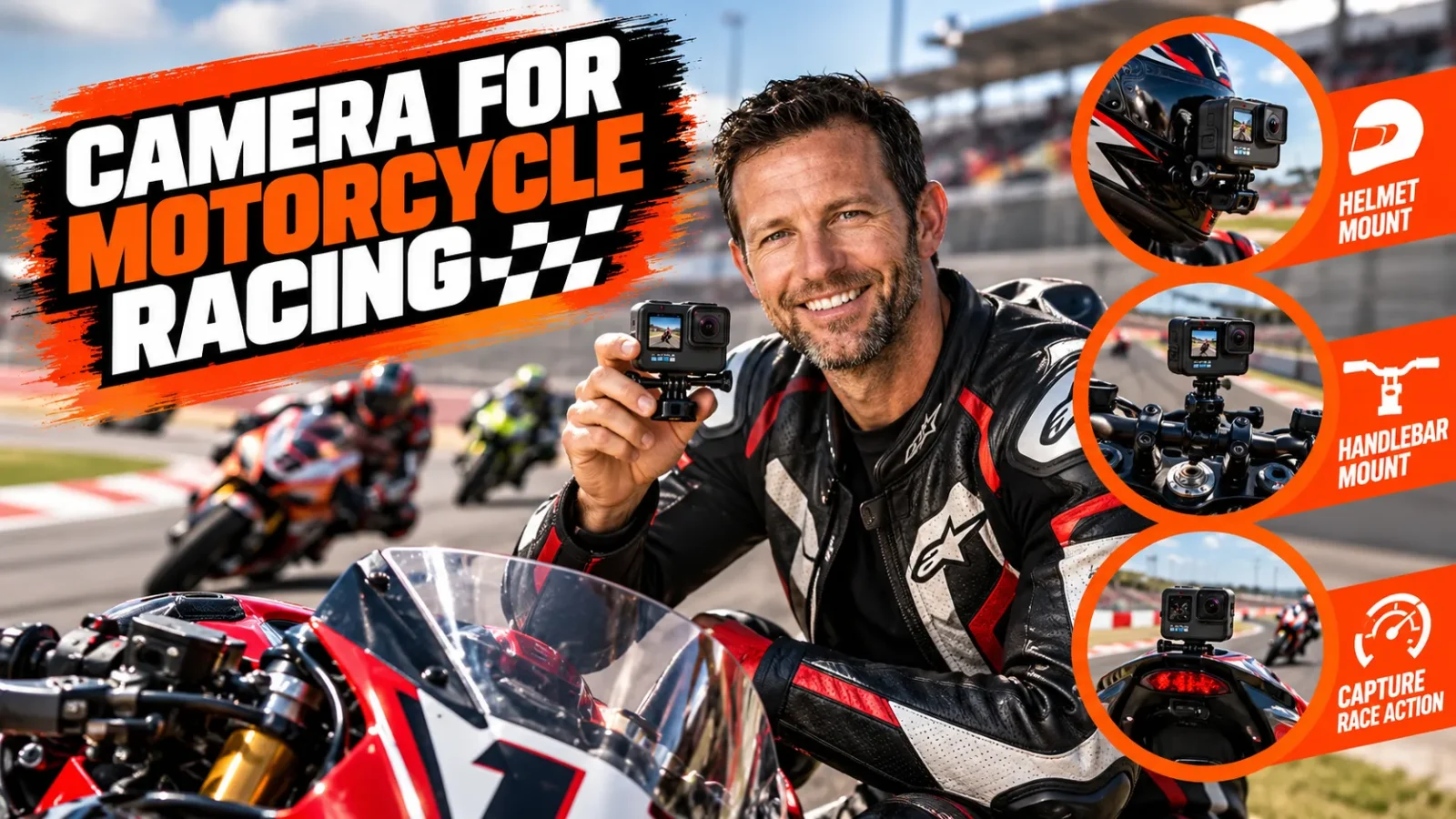
I’ve spent more track days than I can count trying to figure out which camera actually survives a crash, handles 140+ mph vibration, and still gives me footage I’m proud to post. I’ve melted mounts, cracked lenses, and lost more than one camera to a low-side. So when I recommend gear here, it’s because I’ve actually run it on a bike, not just read a spec sheet.
Racing and aggressive track riding put a different kind of stress on a camera than your average commute or canyon carve. You need rock-solid stabilization for high lean angles, reliable heat management for long sessions, and a mounting system that won’t fail at speed. Below are the nine cameras I trust most for exactly that.
- My overall top pick is the GoPro HERO13 Black thanks to its HyperSmooth 6.0 stabilization and modular front screen.
- For the best low-light and dynamic range on track, I lean on the DJI Osmo Action 5 Pro.
- If you want gorgeous color science, the Insta360 Ace Pro 2‘s Leica-tuned sensor is tough to beat.
- Budget riders should look at the Akaso Brave 8 or GoPro HERO12 Black for solid value.
- Whatever camera you pick, your mounting setup matters just as much as the camera itself.
1. GoPro HERO13 Black — Best Overall Camera for Motorcycle Racing
The GoPro HERO13 Black is still my go-to recommendation when someone asks what to strap to their helmet or tail section on a race weekend. It shoots 5.3K60 and 4K120 for gorgeous slow-motion replays of your braking points, and HyperSmooth 6.0 stabilization handles the chatter from a bumpy track surface better than any GoPro before it.
What really sold me on the HERO13 Black is the new HB1 battery and the modular ecosystem, including magnetic swap mounts that let me pull the camera off in seconds between sessions. It’s also got a front-facing screen option, which is huge for framing yourself before you roll onto the grid.
At around $399 body-only, it’s not cheap, but the durability and waterproofing (up to 33ft without a housing) make it worth it. I’ve dropped mine on pavement at a trackday and it just kept recording.
Why I still trust GoPro on track
GoPro’s mounting ecosystem is the biggest reason I keep coming back. Between chest harnesses, helmet mounts, and tripod adapters, I can rig this camera almost anywhere on the bike or my gear without buying third-party adapters.
2. DJI Osmo Action 5 Pro — Best for Low-Light and Dynamic Range
If you ride evening track nights or shoot in shaded paddocks, the DJI Osmo Action 5 Pro genuinely impressed me. Its 1/1.3-inch sensor is noticeably larger than most competitors’, which means cleaner footage in dim garages and under overcast skies at the track.
I also love the dual OLED touchscreens front and back, so I can check framing while it’s mounted on my tail without pulling my phone out. Battery life is another standout — DJI claims up to 240 minutes of 4K30 recording, and in my testing it comfortably outlasted a full day of back-to-back sessions.
Priced around $349, the Osmo Action 5 Pro undercuts the GoPro HERO13 Black while matching or beating it in several areas. It’s become my pick when I know I’ll be filming in mixed lighting throughout the day.
3. Insta360 Ace Pro 2 — Best Image Quality for Race Footage
The Insta360 Ace Pro 2 is co-engineered with Leica, and honestly, you can see it in the color rendering straight out of the camera. Skin tones, track surfaces, and bike liveries all look more natural compared to the punchier, sometimes oversaturated GoPro look.
It uses a 1/1.3-inch sensor with dual-native ISO, which gives it excellent performance in both bright midday track sessions and darker pit lane footage. The flip-up touchscreen is also genuinely useful for vloggers who want to talk to camera before heading out on track.
At roughly $429 for the bundle, it’s a premium purchase, but I think it’s one of the best-looking action cameras I’ve tested for racing content in the last two years.
4. Insta360 X4 — Best 360° Camera for Reviewing Lines and Lean Angles
This one’s a bit different from the rest of the list, but I couldn’t leave it out. The Insta360 X4 captures true 8K 360-degree footage, which means I can reframe my shot *after* the session to follow my exact lean angle or braking marker without worrying about aiming the camera correctly beforehand.
Mounted on a short invisible selfie stick from my tail unit, the X4 makes it look like a drone is following me around the circuit. It’s a fantastic tool not just for content, but genuinely for coaching — I’ve used the reframed footage to analyze my body position lap after lap.
It runs about $499, which is pricier than a standard action cam, but the flexibility in post-production editing is genuinely unmatched by anything else on this list.
5. GoPro HERO12 Black — Best Value Flagship
Since the HERO13 Black launched, the GoPro HERO12 Black has dropped in price to around $299, and it’s still an outstanding racing camera. It shares a lot of DNA with its successor, including HyperSmooth 6.0 and 5.3K60 recording, just without the modular front-screen accessory system.
For riders who mostly mount their camera to a helmet or chase-cam rig and don’t need the extra screen, the HERO12 Black is honestly the smarter buy. I still run mine as a backup camera for second-angle footage during race weekends.
It’s also compatible with the same mounts as newer GoPros, so if you’re researching the best GoPro camera for a motorcycle helmet, this model deserves serious consideration alongside the HERO13.
6. Sony FDR-X3000 — Best Optical Stabilization and Zoom Lens
The Sony FDR-X3000 has been around a while, but I still recommend it because of its Zeiss Tessar lens and genuine optical SteadyShot stabilization, rather than purely digital correction. That hardware-based stabilization makes a real difference on rough, bumpy circuits where digital crop can introduce artifacts.
It also pairs with Sony’s Live-View Remote, a wrist-worn controller that lets you start and stop recording without touching the camera itself — genuinely handy when you’re gloved up on the grid. Battery life is respectable at around 80 minutes of continuous 4K recording.
You’ll find it for around $350, sometimes less if you shop refurbished units. It’s older tech at this point, but the optical stabilization still holds its own against many newer digital-only competitors.
7. Insta360 GO 3S — Best Ultra-Compact Camera for Stealth Mounting
The Insta360 GO 3S is a thumb-sized camera that weighs almost nothing, which makes it my pick when I want a camera mounted somewhere discreet, like the inside of my visor edge or tucked onto a fender without adding drag or weight. It shoots up to 4K30 and includes a small “Action Pod” that doubles as a monitor and extra battery.
Because it’s magnetic, I can snap it onto metal mounts in seconds between sessions, which saves real time in the paddock. It’s not going to out-resolve the bigger sensors on this list, but for size-to-performance ratio, nothing else comes close.
Pricing sits around $399 to $459 depending on the bundle, which feels steep for something this small, but the convenience factor is genuinely worth it for quick-swap setups.
8. DJI Osmo Action 4 — Best Budget-Friendly Previous-Gen Pick
With the Osmo Action 5 Pro now on shelves, the DJI Osmo Action 4 has become a genuine bargain, often found for $259 or less. It still packs that same large 1/1.3-inch sensor for strong low-light performance and offers 4K120 slow motion, which is plenty for most club racers and trackday riders.
I ran the Osmo Action 4 for a full season before upgrading, and it never let me down, even in cold morning sessions where battery performance usually suffers. DJI’s magnetic quick-release mounting system is also compatible across both generations.
If you’re building out your best action camera for motorcycle helmets setup on a budget, this is one of the smartest places to save some money without sacrificing footage quality.
9. Akaso Brave 8 — Best Budget Pick Under $150
Not everyone wants to drop $300-plus on a camera before they even know if they’ll stick with trackside filming, and that’s exactly where the Akaso Brave 8 comes in. It shoots 4K30 with electronic image stabilization, has a front color screen for selfie framing, and comes with a solid mounting kit right out of the box.
I wouldn’t call the footage flagship-quality, colors can look a touch flat and low-light performance is noticeably weaker, but for a first camera or a backup angle, it punches well above its roughly $130 price tag. I’ve handed this to riding buddies who wanted to try filming without a big investment, and they’ve been happy with it.
It’s also genuinely rugged. I’ve had one survive a tip-over in the pits without so much as a scratch on the housing.
What I look for when choosing a race-day camera
After years of testing gear at trackdays, I’ve narrowed my priorities down to a handful of things that actually matter once you’re on track.
Stabilization over resolution
I’ll take smooth, stable 4K footage over shaky 5.3K any day. Vibration from the engine and track surface is relentless, and weak stabilization ruins otherwise great footage fast.
Heat management
Cameras mounted in direct sun on a tail unit or fairing can overheat during long sessions, especially in summer. I always check a camera’s thermal shutdown behavior before committing to it for a full race weekend.
Battery life and swap speed
Between sessions, I need to charge or swap batteries fast. Cameras with quick-swap battery doors or magnetic charging bases save me real pit-lane time.
Getting your mounting setup right
Even the best camera in the world looks bad with a shaky, poorly positioned mount. I’ve learned this the hard way after reviewing footage that looked like it was shot in an earthquake.
For helmet shots, I always recommend checking out a proper guide on the best GoPro mounts for motorcycle helmets before you just slap on whatever came in the box. The right mount angle changes everything about how usable your footage is.
If you’re mounting directly to your shell with adhesive rather than a chin mount or strap system, it’s worth reading up on the best GoPro adhesive mount setup for a motorcycle helmet so you don’t end up with a camera flying off mid-session. I’ve seen it happen to other riders, and it’s not pretty for the camera or anyone riding behind them.
Helmet mount vs. bike mount
I personally run two cameras most weekends: one on my helmet for POV and head-check footage, and one on the tail unit or under the seat for a wider, more cinematic angle. Combining both gives me the most useful footage for reviewing my technique afterward.
Double-check your mount before every session
This sounds obvious, but I check every mount, adhesive pad, and screw before I roll out of pit lane. Vibration loosens things over time, and a camera coming loose at speed is a genuine hazard, not just an expensive loss.
Final thoughts from someone who’s crashed with a camera rolling
My honest advice is this: pick the camera that fits your budget and mounting style, then spend just as much time dialing in your mount as you did choosing the camera. The GoPro HERO13 Black remains my top all-around recommendation, but I genuinely can’t go wrong pointing riders toward the DJI Osmo Action 5 Pro or Insta360 Ace Pro 2 either.
Whatever you choose, get out there, film your sessions, and use that footage to actually improve your riding. That’s the real value in all of this gear beyond just making cool videos.
Frequently Asked Questions
What is the best camera for motorcycle racing on a budget?
The Akaso Brave 8 is my top budget pick, offering EIS stabilization, 4K30 footage, and a rugged build for well under $150, which is ideal if you’re not ready to commit to a premium action cam yet.
Should I mount my racing camera on my helmet or my bike?
I run both when possible. A helmet mount (check out my guide on the best GoPro mounts for motorcycle helmets) gives you head-turn POV footage, while a tail or fairing mount captures stable, cinematic lean-angle shots for review and content.
Is GoPro still the best choice for track days in 2024?
GoPro remains excellent, especially the HERO13 Black, but I genuinely think DJI’s Osmo Action 5 Pro and Insta360’s Ace Pro 2 now match or beat it in low-light and stabilization performance, so it’s worth comparing all three.
Do I need a separate camera for onboard footage versus crash/data review?
Not necessarily, but I prefer using a high-frame-rate camera like the Sony FDR-X3000 or GoPro HERO13 for smooth onboard footage, while a wide-angle 360 camera like the Insta360 X4 is better for reviewing your riding lines and braking points.

Related Articles

6 Best Rear View Cameras for Motorcycle: Riders Who Want Eyes in the Back of Their Head
I've tested the top rear view cameras for motorcycles so you don't have to. Here are my real-world picks for…
Jake Miller
12 min read

8 Best Cameras for Riding Motorcycle in 2026 (Rider-Tested Picks)
I've mounted, crashed, and rain-soaked dozens of cameras on my helmet and bike. Here are the 8 best cameras for…
Jake Miller
9 min read

9 Best Cameras for Motorcycle Travel: My Tested Picks for Long-Haul Rides
I've tested action cams, 360 cameras, and mirrorless bodies on thousands of touring miles. Here are the 9 best cameras…
Jake Miller
12 min read