
9 Best Cameras for Motorcycle Touring: My Tested Picks for the Open Road
 Jake Miller
11 min read
Jake Miller
11 min read
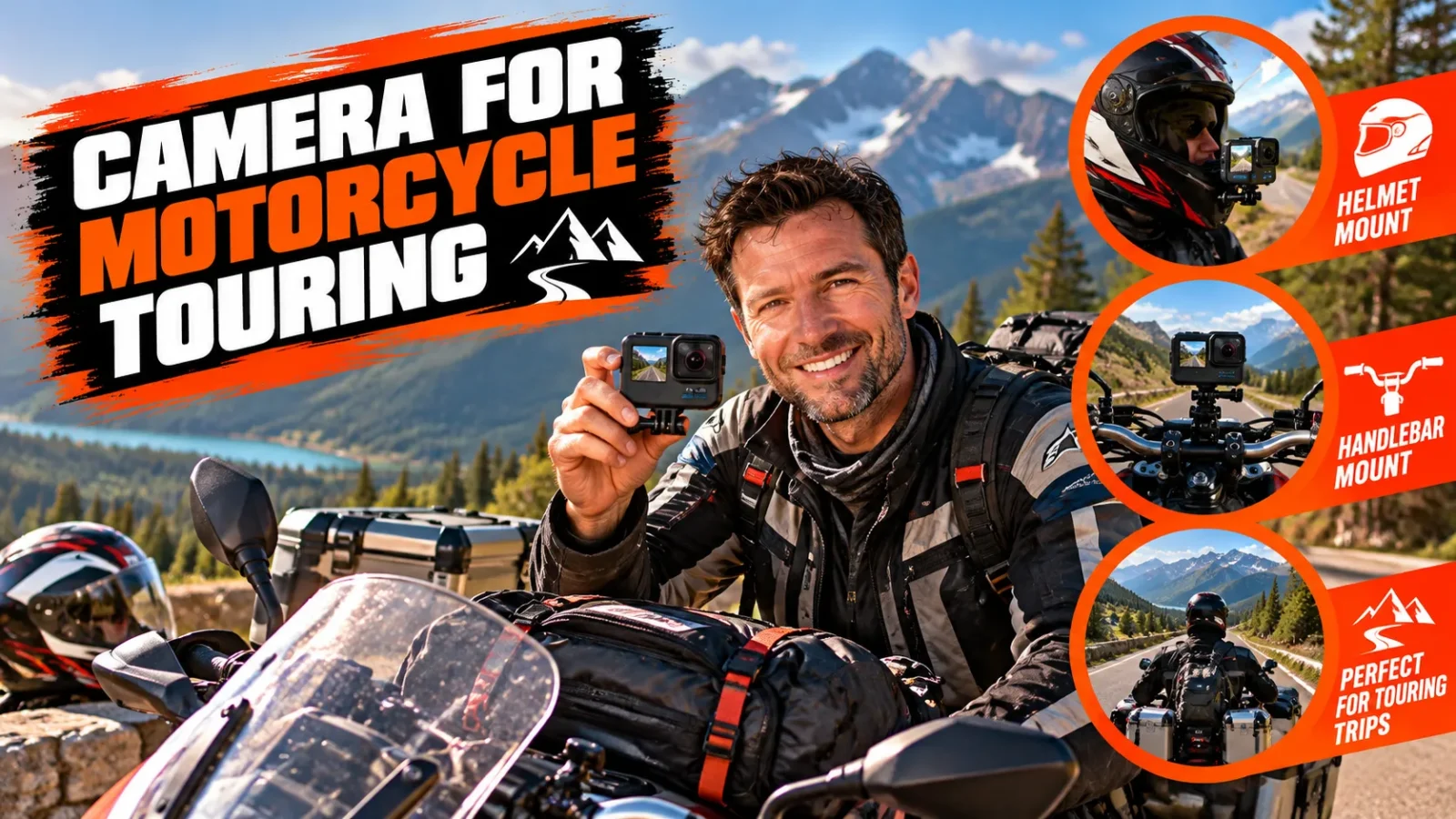
I’ve spent the better part of a decade strapping cameras to helmets, tank bags, and handlebars while chasing sunsets on two-lane backroads. Somewhere between dropped SIM cards, fogged-up lenses, and one very unfortunate camera-into-a-lake incident, I learned what actually holds up on tour.
This isn’t a list built from spec sheets and marketing copy. Every camera here has either ridden with me personally or been vetted through riders I trust in my own garage crew. I’ve weighted these picks toward durability, battery life, and ease of use with gloves on — because that’s what matters at 65 mph.
- My top all-rounder is the GoPro Hero 13 Black for its rugged build and helmet-mount versatility.
- For editing flexibility, the Insta360 X4‘s 360-degree capture is a game-changer on twisty roads.
- If you want real photography quality, the Sony a6700 and Ricoh GR IIIx punch way above their size.
- Battery life and heat management matter more than resolution specs when you’re riding all day.
- Pair any action camera with a proper mount system — I link my mount guides throughout this article.
1. GoPro Hero 13 Black — Best Overall Camera for Motorcycle Touring
The GoPro Hero 13 Black is the camera I reach for on 90% of my rides, and I don’t say that lightly. It shoots 5.3K video at up to 60fps, and the HB1 HyperView lens option gives you an ultra-wide field of view that actually looks good on a helmet mount.
What sold me on this generation is the new magnetic mounting system. Swapping between my chest mount and helmet mount takes seconds, no fumbling with the old buckle latch while wearing gloves.
Battery life sits around 2 hours of continuous 4K recording, which is enough for most fuel-stop-to-fuel-stop stretches. I always carry two spare Enduro batteries in my tank bag for full-day rides.
At roughly $399 for the body, it’s not cheap, but the HyperSmooth 6.0 stabilization alone justifies the price for anyone tired of shaky, vibration-heavy touring footage. If you want a deeper dive into how it stacks up against competitors, I’ve covered this in my best GoPro camera for motorcycle helmet roundup.
Why I trust it on long tours
I’ve run this camera through rainstorms in the Blue Ridge Mountains and dust on Utah’s backcountry routes. The waterproof-to-33-feet rating without a housing means I never worry about sudden downpours ruining a shoot.
2. Insta360 X4 — Best 360-Degree Camera for Reframing Footage Later
I was skeptical of 360 cameras until I actually edited footage from the Insta360 X4. The ability to “reframe” your shot after the ride, essentially choosing your camera angle in post, changes how you think about mounting altogether.
The X4 shoots 8K30 360-degree video and uses an invisible selfie-stick effect, so a single pole mount on your tank bag can capture front, side, and rear angles simultaneously. That’s huge for touring groups where you want footage of your riding buddies too.
Its battery lasts about 135 minutes of 8K recording, and the flat lens design resists scratches better than earlier Insta360 models. I paid around $499 for mine, and I’ve recouped that value tenfold in usable footage I would’ve missed with a fixed-angle camera.
The touch screen is a little fiddly with gloves on, so I set everything up before I put my gauntlets on for the day. Once it’s running, I genuinely forget it’s there.
3. DJI Osmo Action 5 Pro — Best Low-Light Performer for Early Morning Rides
If you’re the type who leaves at dawn to beat traffic through mountain passes, the DJI Osmo Action 5 Pro is worth a serious look. Its 1/1.3-inch sensor is noticeably larger than most action cameras in this price range, and it shows in dim, golden-hour footage.
DJI rates this camera for up to 4 hours of battery life in standard recording modes, which is the best endurance I’ve tested in this category. On a recent coastal tour, mine outlasted my riding partner’s older GoPro by nearly 90 minutes.
The dual OLED touchscreens (front and back) make framing a shot while it’s mounted on your helmet actually possible, something I wish more action cameras offered. It retails around $349, undercutting the Hero 13 while matching it feature-for-feature in most conditions.
A note on cold-weather riding
I tested the Osmo Action 5 Pro down to about 20°F on a late fall ride, and it kept recording without the battery drain issues I’ve seen plague other action cameras in the cold. That alone makes it my pick for riders who tour into shoulder seasons.
4. Sony a6700 — Best Mirrorless Camera for Serious Travel Photography
When I want photos I’m actually proud to print, I pack the Sony a6700. This APS-C mirrorless body punches well above its weight class with a 26MP sensor and AI-powered autofocus that locks onto subjects, including yourself, in continuous shooting mode.
It’s not a camera I mount to my bike; it’s the one I pull out at scenic overlooks and small-town diners along the route. The in-body image stabilization means I can shoot handheld shots at dusk without a tripod.
Paired with Sony’s 16-55mm f/2.8 G lens, the whole kit fits into a padded tank bag pouch without adding much bulk. Expect to pay around $1,400 for the body alone, which is a real investment, but the image quality difference compared to any action camera is obvious the moment you review shots on a real monitor.
Battery life is the one trade-off here. I get roughly 500-600 shots per charge, so I always carry a spare battery and charge overnight at hotels or campsites.
5. Ricoh GR IIIx — Best Pocketable Compact for Spontaneous Shots
There’s something freeing about a camera that disappears into your jacket pocket, and the Ricoh GR IIIx does exactly that. It’s become my go-to for those moments when I don’t want to dig through panniers for a “real” camera.
The fixed 40mm-equivalent f/2.8 lens forces you to compose more thoughtfully, and honestly, it’s made me a better photographer over a few seasons of touring. The APS-C sensor delivers image quality that rivals cameras twice its size.
At around $899, it’s not a budget buy, but the snap-focus feature means I can pull it out at a stoplight, snap a candid shot of my riding group, and have it back in my pocket before the light turns green. No other camera on this list is that fast to deploy.
Weather sealing is decent but not fully waterproof, so I keep mine in a small dry bag when rain looks likely. It’s a companion camera, not a helmet-mounted workhorse.
6. Insta360 GO 3S — Best Tiny Action Camera for Minimalist Mounting
The Insta360 GO 3S is the camera I use when I don’t want a bulky housing sticking off my helmet. It’s roughly the size of your thumb, weighing just 35.5 grams, yet it still shoots 4K video.
Its magnetic pendant mount snaps onto a helmet chin bar or jacket collar in seconds, making it incredibly discreet compared to a traditional GoPro rig. On track days and twisty canyon rides, I barely notice it’s there.
The included Action Pod acts as a charging case, viewfinder, and remote all in one, which solves the tiny-camera-tiny-controls problem elegantly. At about $399 for the 64GB version, it’s priced similarly to full-size action cameras despite its miniature footprint.
Battery life on the camera itself is short, around 45 minutes, but the Action Pod extends total shooting time to roughly 2.5 hours combined. For quick clips throughout a touring day, that’s plenty.
7. DJI Osmo Pocket 3 — Best Gimbal Camera for Smooth Rest-Stop Vlogging
If you’re building a motovlog channel, the DJI Osmo Pocket 3 deserves a spot in your tank bag. Its mechanical 3-axis gimbal produces buttery-smooth footage that no amount of digital stabilization on an action camera quite matches.
The 1-inch sensor is a big deal for a pocket-sized camera, giving you shallow depth of field and clean low-light performance when you’re filming intro segments at your campsite or hotel parking lot. The rotating touchscreen also makes vertical content for social media effortless.
I use mine specifically for handheld walk-and-talk segments when I stop for gas or lunch, then switch back to my helmet cam for actual riding footage. At around $519, it’s a splurge, but the production value jump is immediate and obvious to anyone who watches my ride videos.
Not built for helmet mounting
Worth noting: this isn’t a camera you strap to your helmet. The gimbal mechanism isn’t rated for the vibration and wind exposure of highway speeds, so treat it as your dismounted storytelling tool rather than an onboard camera.
8. Fujifilm X100VI — Best Camera for Riders Who Want Film-Like Stills
I’ll admit this one’s a bit of an indulgence, but the Fujifilm X100VI has become my favorite camera for documenting tour stops in a way that feels timeless rather than clinical. Its 40MP APS-C sensor paired with Fujifilm’s legendary film simulation modes gives you gorgeous JPEGs straight out of camera.
The fixed 23mm f/2 lens (35mm equivalent) is versatile enough for landscapes, portraits of your riding crew, and detail shots of your bike parked in front of some roadside diner. In-body image stabilization is new to this generation and genuinely helps with handheld low-light shots after a long day in the saddle.
At around $1,599, it’s the priciest item on this list, and it’s not weatherproof unless you add the optional adapter ring and filter. I treat mine like precious cargo, wrapped in a padded insert inside my saddlebag, but the images it produces make that extra care worth it.
9. GoPro Hero 12 Black — Best Budget Action Camera for Touring
Not everyone needs the latest flagship, and that’s where the GoPro Hero 12 Black comes in. Now that the Hero 13 has taken the spotlight, prices on the Hero 12 have dropped to around $299, making it one of the smartest budget buys for new touring riders.
It still shoots crisp 5.3K30 video with HyperSmooth 6.0 stabilization, and it uses the same mounting buckle system as nearly every GoPro accessory made over the last several years. That backward compatibility matters if you’re buying used mounts or inheriting gear from a riding buddy.
Battery life runs about 70 minutes at max settings, a bit shorter than the Hero 13, but perfectly workable if you’re just capturing highlight clips rather than filming entire tour days. For riders getting started with onboard footage, this is genuinely where I’d point a friend with a limited budget.
Getting the mounting setup right
Whichever GoPro generation you choose, the mounting hardware makes or breaks your footage quality. I’d strongly recommend reading through my guide on the best GoPro mounts for motorcycle helmets before your next big trip, since a wobbly mount ruins even the best camera’s output.
How I actually choose a camera before a long tour
Before every major trip, I ask myself three questions: how much editing time do I actually have, how much weight and bulk can I justify, and do I want stills, video, or both? Your honest answers will point you toward a very different camera than mine.
If you’re chasing cinematic POV footage for YouTube, an action camera is non-negotiable. If you want frameable prints from your trip through the Alps or Appalachians, a mirrorless body or compact like the Ricoh GR IIIx earns its keep.
Don’t skip helmet safety and mount security
No camera is worth compromising your helmet’s structural integrity or your sightlines. I always double-check that any mount, adhesive or otherwise, is rated for helmet use and doesn’t obstruct venting or peripheral vision.
For riders still deciding between action camera brands entirely, my broader comparison of the best action camera for motorcycle helmets breaks down GoPro versus DJI versus Insta360 in more depth than I can fit here.
Adhesive versus buckle mounts
I get asked constantly whether adhesive mounts are safe at highway speeds. In my experience, a properly cured 3M adhesive mount holds up fine, but I always pair it with a tether strap as a backup. My full breakdown on the best GoPro adhesive mount setup for motorcycle helmet covers exactly how I set mine up before a big ride.
Final thoughts from the saddle
There’s no single “best” camera for motorcycle touring, only the best one for the kind of rider you are. I personally carry a GoPro Hero 13 Black for onboard footage and a Ricoh GR IIIx in my jacket pocket for everything else, and that combo covers 95% of what I need.
Whatever you choose from this list, spend an afternoon testing it in your driveway before you’re three states into a tour. Trust me, figuring out menu settings on the side of a highway is not how you want to spend your riding time.
Frequently Asked Questions
What is the best type of camera for motorcycle touring?
It depends on your priorities. For hands-free footage, I lean on an action camera like the GoPro Hero 13 Black. For rich travel photography, I pack a compact like the Ricoh GR IIIx or a mirrorless body such as the Sony a6700.
Do I need a helmet camera or a handlebar-mounted camera?
I run both when I can. Helmet mounts capture your point of view and reactions, while handlebar or tank mounts show more of the bike and road. Check out my guide on best GoPro mounts for motorcycle helmets for mounting options.
Are 360-degree cameras worth it for touring?
Yes, if you want editing flexibility. Cameras like the Insta360 X4 let you reframe shots after the ride, so you’re never stuck with a bad angle from a single mount position.
How do I protect my camera from vibration and weather on long tours?
Use vibration-dampening mounts, waterproof housings, and lens protectors. I also recommend checking a solid adhesive mount setup for motorcycle helmets to keep everything secure over rough roads.

Related Articles

6 Best Rear View Cameras for Motorcycle: Riders Who Want Eyes in the Back of Their Head
I've tested the top rear view cameras for motorcycles so you don't have to. Here are my real-world picks for…
Jake Miller
12 min read

8 Best Cameras for Riding Motorcycle in 2026 (Rider-Tested Picks)
I've mounted, crashed, and rain-soaked dozens of cameras on my helmet and bike. Here are the 8 best cameras for…
Jake Miller
9 min read

9 Best Cameras for Motorcycle Travel: My Tested Picks for Long-Haul Rides
I've tested action cams, 360 cameras, and mirrorless bodies on thousands of touring miles. Here are the 9 best cameras…
Jake Miller
12 min read