
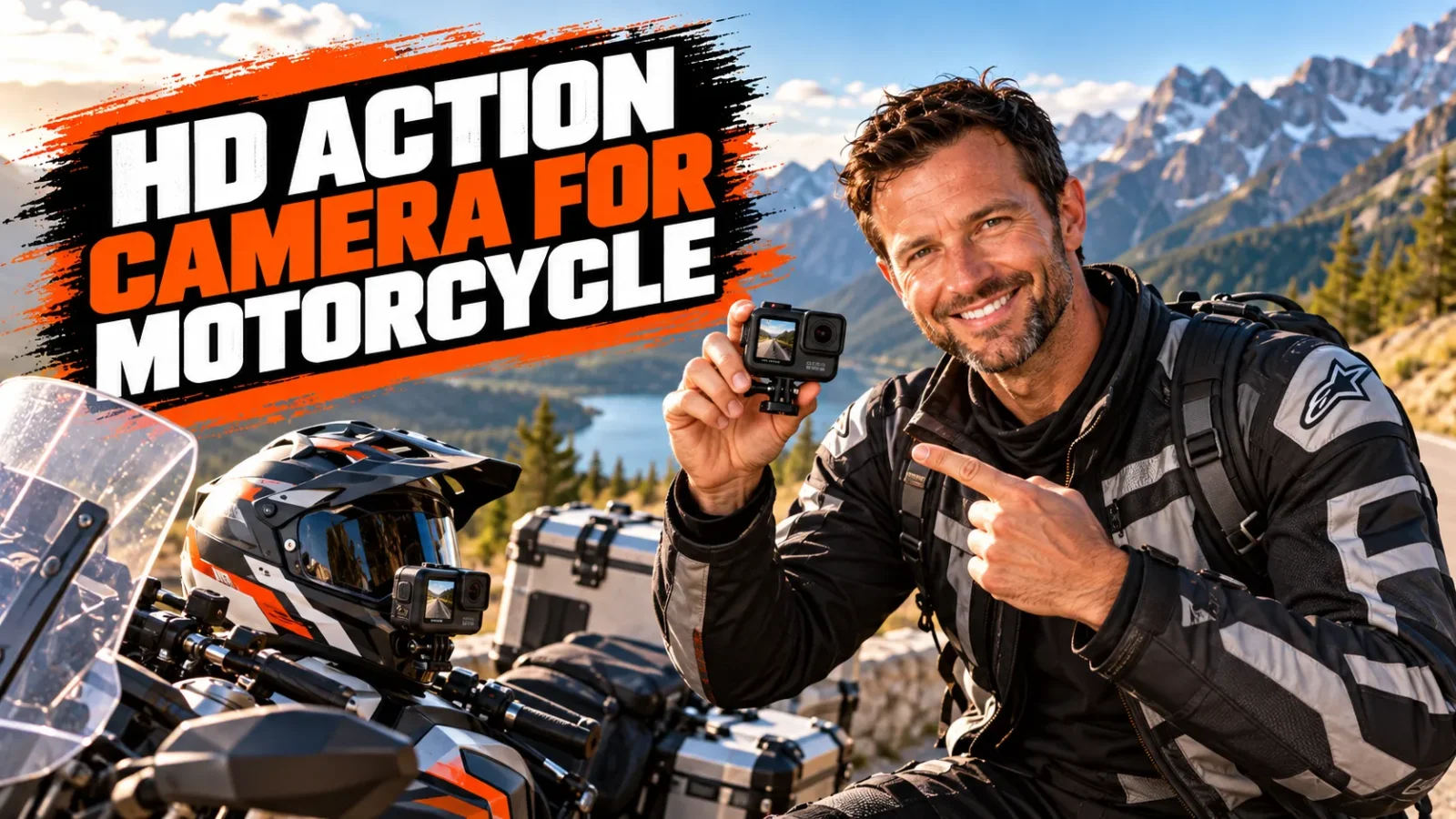
I’ve been strapping cameras to my helmet and bike for years now, and I’ve gone through my fair share of duds. Foggy lenses, dead batteries at the worst moment, footage so shaky it looks like an earthquake compilation — I’ve seen it all.
So when people ask me for the best HD action camera for motorcycle riding, I don’t just recite spec sheets. I tell them what actually survives a season of commuting, canyon carving, and the occasional unexpected gravel encounter.
This list is built from real riding time, not just a quick unboxing. I’ve ranked these based on stabilization, low-light performance, battery life, audio quality, and how well they hold up when mounted to a vibrating, wind-blasted motorcycle for hours at a stretch.
- My overall top pick is the GoPro Hero13 Black for its stabilization, audio, and mounting versatility.
- If you ride a lot at night or dawn, the DJI Osmo Action 5 Pro has the best low-light sensor I’ve tested.
- The Insta360 X4 is unbeatable if you want 360° footage so you can reframe shots after the ride.
- On a tight budget, the Akaso Brave 8 and GoPro Hero12 Black deliver surprisingly solid HD footage for the price.
- Mounting matters as much as the camera itself — I always pair mine with a proper helmet or chin mount setup.
1. GoPro Hero13 Black — Best Overall HD Action Camera for Motorcycle Riding
The GoPro Hero13 Black is what’s currently riding shotgun on my own helmet, and honestly, it’s earned that spot. It shoots up to 5.3K60 and 4K120, and the HyperSmooth 6.0 stabilization makes highway vibration and pothole hits look almost buttery smooth.
What sold me was the new magnetic quick-release mounting system. I can pop the camera off my helmet in seconds without fumbling with tiny screws while wearing gloves — a genuinely huge quality-of-life upgrade over older Hero models.
It’s waterproof to 10 meters without a housing, which is more than enough for riding through a downpour or a sudden car wash of highway spray. Battery life sits around 70-100 minutes of 4K recording, so I always carry a spare for longer rides.
Price runs around $400 for the body, which isn’t cheap, but the image quality and wind-resistant audio (a real pain point on older models) make it worth it. If you want the deep dive on why I rate GoPro so highly for riders, I’ve broken it down further in my guide to the best GoPro camera for motorcycle helmets.
Why I keep coming back to this one
It’s not just the footage quality — it’s the ecosystem. Every mount, adhesive base, and chest harness I’ve bought over the years still fits this camera. That backward compatibility saves me money and hassle.
2. DJI Osmo Action 5 Pro — Best for Low-Light and Night Riding
Night rides used to be a write-off for action cameras — grainy, noisy footage that wasn’t worth reviewing. The DJI Osmo Action 5 Pro changed my mind completely with its 1/1.3-inch sensor, the largest DJI has put in an action cam.
I’ve used it on dusk commutes and it genuinely pulls in more usable light than my GoPro did at the same settings. Streetlights, headlights, and dashboard glow all render with way less noise.
It records 4K at up to 120fps and has a claimed battery life of over 240 minutes in some modes, which is the best endurance I’ve seen in this category. That matters a lot on all-day touring rides where charging isn’t an option.
It’s rated waterproof to 20 meters without a case, and the dual screens (front and back) make framing a helmet shot much easier before you even hit the road. At around $350 for the Adventure Combo, it’s genuinely competitive with GoPro on price and beats it on battery life.
A note on stabilization
DJI’s RockSteady 3.0 and HorizonSteady features are honestly on par with GoPro’s HyperSmooth now. The horizon-leveling trick is especially nice for aggressive lean angles in the twisties — the footage stays level even when your bike clearly isn’t.
3. Insta360 Ace Pro 2 — Best Camera with a Co-Engineered Leica Lens
The Insta360 Ace Pro 2 was a bit of a surprise pick for me. It’s got a Leica-tuned lens and a large 1/1.3″ sensor, and the low-light footage is genuinely impressive for a camera in this price bracket.
It shoots 8K at 30fps and 4K at up to 120fps, with a flip-up touchscreen that’s actually usable with riding gloves on — something I can’t say for every competitor. That screen flexibility makes framing a chin-mount shot much simpler.
Battery life is rated around 100+ minutes of 4K30 recording, and it charges impressively fast with the included fast-charging dock. I found the AI-based color and exposure adjustments handled sudden tunnel-to-daylight transitions better than expected.
At roughly $350-400 depending on the bundle, it’s priced to compete directly with GoPro and DJI, and in dim conditions it genuinely holds its own against both.
4. Insta360 X4 — Best 360° Camera for Motorcycle Footage
If you’ve never shot with a 360° camera, the Insta360 X4 will change how you think about ride footage. It captures everything around you in 8K360, which means you reframe the shot after the ride instead of worrying about aim while riding.
This solves one of my biggest annoyances with traditional action cams: getting home and realizing the mount had drifted an inch and cut off half the action. With the X4, that’s simply not a problem — every direction is recorded.
It mounts on a small selfie-stick-style pole on your helmet or tank, and Insta360’s software automatically “invisibly” stitches the stick out of frame during editing. The end result looks like a drone shot following your bike.
Battery life runs about 135 minutes at 8K30, and it’s waterproof to 15 meters. It costs around $500, which is pricier, but the flexibility in post-production editing makes it a favorite for riders who post a lot of content.
The trade-off to know about
Editing 360 footage takes more time than a standard action cam clip. If you want quick, grab-and-go highlight reels without touching editing software much, a traditional wide-angle camera like the Hero13 might suit your workflow better.
5. GoPro Hero12 Black — Best Value from a Previous Generation
Not everyone needs the latest flagship, and that’s exactly why I still recommend the GoPro Hero12 Black. It dropped in price significantly once the Hero13 launched, and it still shoots gorgeous 5.3K60 footage with HyperSmooth 6.0 stabilization.
I ran this camera on my own bike for over a year, and it handled highway vibration, rain, and dust without a single complaint. Battery life is a bit shorter than newer models, around 70 minutes at 4K, but it’s manageable with a spare.
One underrated upgrade on the Hero12 is native Bluetooth audio support, meaning you can pair it with a headset mic for cleaner voiceovers while riding — a nice touch if you narrate your rides.
At around $300 or less on sale, it’s genuinely one of the best value picks in the category right now, especially if you find a bundle with mounts included.
6. Akaso Brave 8 — Best Budget Pick for New Riders
Not every rider wants to drop $300-400 on a camera before they even know if they’ll stick with recording their rides. That’s where the Akaso Brave 8 comes in — it’s one of the better budget options I’ve actually tested rather than just skimmed on a spec sheet.
It shoots 4K30 and 2.7K60, with electronic image stabilization that, while not GoPro-level, is genuinely watchable for casual ride logs and commute footage. The built-in status screen on the front is a handy touch for framing shots quickly.
It’s waterproof to 10 meters without a case and comes bundled with a surprising number of mounts in the box, which helps offset the low ~$130 price tag. Battery life is roughly 90 minutes, which is solid for the price bracket.
I wouldn’t recommend it for professional content creation, but for a rider dipping their toes into recording rides, it delivers way more than its price suggests.
7. SJCAM SJ10 Pro — Best Alternative Value Brand
The SJCAM SJ10 Pro doesn’t get talked about as much as GoPro or DJI, but it’s earned a spot on my list because of its interchangeable lens system — a rare feature at this price point.
It records 4K60 with a Sony sensor and offers swappable wide-angle and standard lenses, letting you dial in the field of view depending on whether you’re doing helmet or tank mount shots. That flexibility is unusual for a sub-$250 camera.
Stabilization is solid though not quite GoPro-level, and the touchscreen interface is responsive enough to adjust settings quickly at a gas stop. It’s waterproof to 10 meters and includes a magnetic mount adapter in the box.
For riders who want more manual control over their shots without paying flagship prices, the SJ10 Pro is a genuinely underrated pick.
8. Insta360 GO 3S — Best Tiny, Lightweight Option
Sometimes you don’t want a bulky camera on your helmet at all, and that’s where the Insta360 GO 3S shines. It’s a tiny thumb-sized camera that clips onto a magnetic pendant mount, weighing barely over 35 grams.
It shoots up to 4K30 with solid stabilization for its size, and the low profile means it barely affects aerodynamics or helmet balance — something bigger cameras can’t claim. I’ve clipped it to my jacket collar for a totally different riding perspective than a helmet shot.
Battery life is limited given its size, around 45 minutes standalone, but the included Action Pod case extends that significantly and doubles as a more traditional-style camera housing when needed.
At around $400 for the higher storage version, it’s pricier than its size suggests, but the flexibility of mounting locations makes it a fun second camera rather than a primary one.
How I actually test these cameras on a bike
I don’t just record a five-minute parking lot clip and call it a review. I mount each camera through several conditions: highway vibration, canyon switchbacks, rain, and at least one ride during dusk or full dark.
Vibration is the silent killer of action cam footage. A camera that looks amazing in a hand-held test can turn into a jittery mess once it’s bolted to a vibrating motorcycle chassis or helmet shell.
Audio is another thing I pay close attention to. Wind noise at highway speeds ruins a lot of otherwise great footage, so I specifically listen for how well each camera’s wind-reduction algorithm performs above 60 mph.
Mounting matters just as much as the camera
Even the best camera on this list will produce mediocre footage if it’s mounted poorly. I’ve learned this the hard way after losing a whole ride’s footage to a mount that slowly rotated from wind pressure.
If you’re deciding between a chin mount, side mount, or top mount, I’d point you toward my breakdown of the best action camera for motorcycle helmets, which covers placement pros and cons in more depth.
Adhesive mounts are another area where corners get cut. I’ve had cheap 3M knockoffs fail at highway speed, which is a genuinely scary experience. My full setup guide on the best GoPro adhesive mount setup for motorcycle helmet covers exactly which adhesives I trust for long-term use.
And if you’re still deciding between arm mounts, magnetic quick-release bases, or the classic curved adhesive puck, my comparison of the best GoPro mounts for motorcycle helmets walks through which style suits different riding styles and helmet shapes.
Battery life and cold weather: what nobody tells you
Every camera on this list loses a noticeable chunk of battery life in cold weather. I’ve seen batteries that normally last 90 minutes drop to under an hour once temps fall below 40°F.
My workaround is simple: I keep a spare battery in an inside jacket pocket, close to my body heat, and swap it in at a fuel stop. It’s a small habit that’s saved several rides from ending with a dead camera.
If you ride long-distance tours regularly, prioritizing battery life (like the DJI Osmo Action 5 Pro’s excellent endurance) might matter more to you than squeezing out the last bit of resolution.
Storage cards: don’t cheap out here
High frame rate 4K and 5.3K footage eats through storage fast, and a cheap microSD card is one of the most common causes of corrupted or dropped footage that I’ve personally run into.
I always use cards rated V30 or higher, from reputable brands like SanDisk or Lexar. A 128GB or 256GB card is a sensible baseline if you’re shooting in 4K regularly.
It sounds like a minor detail, but I’ve had more ride footage ruined by a slow, unreliable card than by any actual camera malfunction.
My final take
If I had to recommend just one camera from this entire list, it’d still be the GoPro Hero13 Black — the combination of stabilization, mounting ecosystem, and image quality is hard to beat for everyday motorcycle riding.
But the truth is, there’s no single universally “best” answer here. If you ride mostly at night, the DJI Osmo Action 5 Pro is genuinely better for your needs. If you want creative flexibility, the Insta360 X4 opens up editing options nothing else on this list can match.
Whatever you choose, spend just as much thought on your mounting setup as you do on the camera itself. A great camera on a bad mount will let you down eventually — trust me, I’ve been there.
Frequently Asked Questions
What is the best HD action camera for motorcycle riding overall?
In my experience, the GoPro Hero13 Black is the best all-around choice thanks to its HyperSmooth stabilization, wind-resistant audio, and huge mounting ecosystem built for helmets and bikes.
Do I need a helmet mount or a bike mount for my action camera?
Both have their place. Helmet mounts capture where you’re looking (great for close calls), while chin or tank mounts show more of the bike and road. Check out my guide to the best GoPro mounts for motorcycle helmets for specifics.
Are action cameras waterproof enough for riding in the rain?
Most modern models like the GoPro Hero13 Black and DJI Osmo Action 5 Pro are waterproof to 10m or more without a housing, which easily covers heavy rain and highway spray.
Will an action camera drain my phone or bike battery?
No, action cameras run on their own internal batteries. That said, cold weather and 4K/5.3K recording drain them fast, so I always carry a spare battery or a hardwired mount on long rides.

Related Articles

6 Best Rear View Cameras for Motorcycle: Riders Who Want Eyes in the Back of Their Head
I've tested the top rear view cameras for motorcycles so you don't have to. Here are my real-world picks for…
 Jake Miller
12 min read
Jake Miller
12 min read

8 Best Cameras for Riding Motorcycle in 2026 (Rider-Tested Picks)
I've mounted, crashed, and rain-soaked dozens of cameras on my helmet and bike. Here are the 8 best cameras for…
Jake Miller
9 min read

9 Best Cameras for Motorcycle Travel: My Tested Picks for Long-Haul Rides
I've tested action cams, 360 cameras, and mirrorless bodies on thousands of touring miles. Here are the 9 best cameras…
Jake Miller
12 min read