
8 Best Cameras for Motorcycle Track Days: My Tested Picks for Capturing Every Lean Angle
 Jake Miller
11 min read
Jake Miller
11 min read
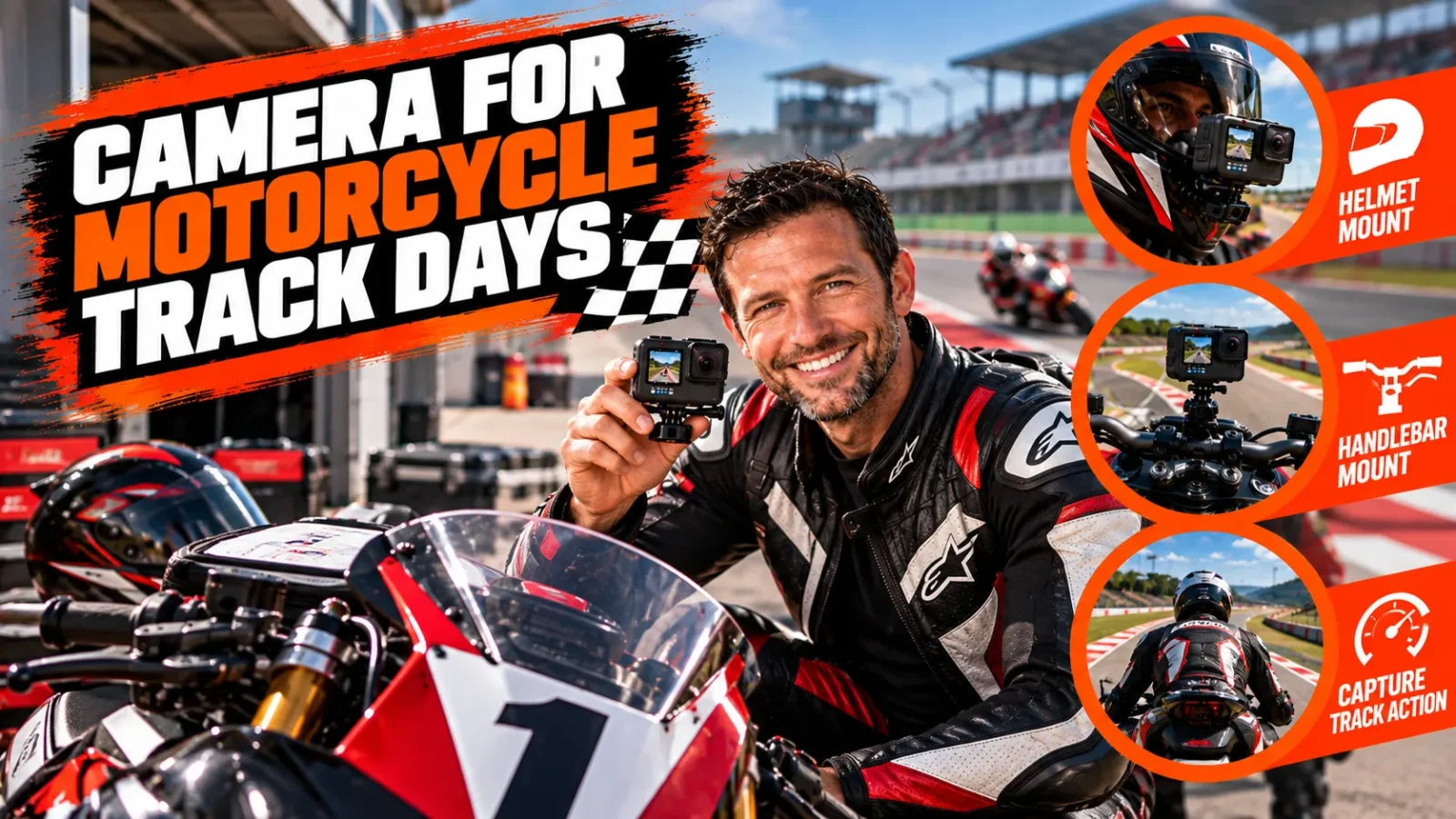
I’ve burned through more memory cards and mount adhesives than I care to admit chasing the perfect track day footage. After years of bolting cameras to helmets, tail sections, and handlebars at circuits from Thunderhill to my local kart-track-turned-trackday-venue, I’ve learned that not every action camera survives a track environment.
Track days are brutal on gear. You’ve got vibration from curbs, heat soak inside a full-face helmet, high-speed airflow, and the very real risk of a get-off putting your camera (and your bike) on the tarmac. The cameras that work great for casual street riding sometimes fall apart under these conditions.
So I put together this list based on what I’ve actually mounted to my own helmet and bike, plus what riding buddies in my track day group swear by. These are the best cameras for motorcycle track days in 2024, covering every budget and use case.
- The GoPro Hero 13 Black remains my top overall pick for its stabilization and modular lens system.
- If you ride evening or twilight sessions, the Insta360 Ace Pro 2‘s low-light sensor is a genuine game-changer.
- Budget-conscious riders should look at the GoPro Hero 12 Black, which still delivers 5.3K60 footage.
- Your mount matters as much as your camera — I’ll cover that later in the article.
- Always pair your camera with a proper high-speed microSD card to avoid dropped frames on long track sessions.
1. GoPro Hero 13 Black — Best Overall Track Day Camera
The GoPro Hero 13 Black is what’s currently bolted to my own helmet, and for good reason. It shoots 5.3K at 60fps, and its HyperSmooth 6.0 stabilization does an excellent job smoothing out curb strikes and mid-corner chatter that would otherwise ruin a lap.
What really sold me on this one is the new magnetic lens mod system. I can swap in the Ultra Wide lens for tight, technical circuits, or the Macro lens for close-up garage shots of my bike getting prepped. That flexibility is rare in an action camera at this price point (around $399.99).
Why it works on track
The GP2 processor handles HDR video well, which matters a lot when you’re riding into low sun on an afternoon session. Battery life with the Enduro pack gets me through a full track day of intermittent recording without a mid-day swap.
If you’re deciding between GoPro generations for your helmet setup, I’ve gone deep on this comparison in my best GoPro camera for motorcycle helmet guide.
2. DJI Osmo Action 5 Pro — Best Stabilization for Bumpy Tracks
I was skeptical of DJI’s action cameras until I ran the Osmo Action 5 Pro back-to-back with my GoPro at a bumpy regional circuit. The RockSteady 3.0 stabilization, combined with HorizonStand leveling, produced footage that looked almost gimbal-smooth even over curbing.
Its larger 1/1.3-inch sensor also handles the transition from bright straights into shaded sections far better than most competitors. The dual front-and-rear OLED screens are genuinely handy for framing shots before you clip it onto your mount.
Battery life that actually lasts a session
DJI claims up to 180 minutes of continuous 4K recording, and in my testing that held up close to real-world numbers. For a full track day with multiple 20-minute sessions, that’s a huge advantage over cameras that need a mid-day recharge.
At roughly $349, it undercuts the Hero 13 Black slightly while matching it feature-for-feature in most categories that matter for trackside filming.
3. Insta360 Ace Pro 2 — Best for Low-Light and Twilight Sessions
Some of my favorite track day memories happen during those late-evening open-pit sessions when the sun is low and the track empties out. That’s exactly where the Insta360 Ace Pro 2 shines — literally.
Co-engineered with Leica, it uses a 1/1.3-inch sensor and an AI chip Insta360 calls “PureVideo” to dramatically reduce noise in dim conditions. I’ve shot footage on this camera at dusk that looked cleaner than daylight clips from cheaper cameras.
8K capture for cropping flexibility
It records up to 8K at 30fps, which gives you enormous cropping room in post-production if you want to punch in on a specific corner or your knee dragging the apex. The flip-up touchscreen also makes framing on a chin mount far easier than guessing blind.
At $449.99, it’s not cheap, but if evening or dawn sessions are part of your regular track day rotation, I think it’s worth the premium.
4. Insta360 X4 — Best 360° Camera for Flexible Reframing
I’ll admit I was hesitant about 360-degree cameras for track use until a friend showed me his footage from the Insta360 X4. Because it captures everything around the camera simultaneously, you can reframe your angle after the fact — meaning you’re never stuck with a bad mount position.
It shoots 360-degree video at up to 8K30, and the “invisible selfie stick” effect (when mounted on a short pole from your tail section) creates a drone-like following shot that makes your bike look incredible mid-corner.
One camera, endless angles
This is genuinely useful if you’re not sure whether you want a chin-mounted POV or a third-person chase view — you decide in the edit, not before you go out. The AI-assisted stabilization also handles vibration remarkably well for a dual-lens design.
At $499.99, it’s pricier than a standard action cam, but the creative flexibility makes it worth considering if you’re building a YouTube channel around your track days.
5. GoPro Hero 12 Black — Best Value Pick
Not everyone needs the newest flagship, and that’s where the GoPro Hero 12 Black comes in. It still shoots 5.3K60 with HyperSmooth stabilization, and it regularly sells for less than the Hero 13 now that the newer model is out.
I ran a Hero 12 Black for over a year of track days before upgrading, and it never let me down. It survived a low-speed tip-over in the pits without a scratch on the lens, which says a lot about GoPro’s housing durability.
Great entry point for new track day riders
If you’re new to track days and not ready to drop $400+ on a camera, this is genuinely my recommendation. You still get 10-bit color and HDR video, which means your footage will hold up well even if you decide to upgrade your editing skills later.
For riders comparing action cameras more broadly, my best action camera for motorcycle helmets guide covers more models across price ranges.
6. Insta360 GO 3S — Best Ultra-Compact, Discreet Option
Some tracks and organizations have started getting picky about large cameras protruding from helmets, citing aerodynamics and safety concerns. That’s where the tiny Insta360 GO 3S becomes genuinely useful.
It’s about the size of your thumb and uses a magnetic mounting pendant, so it sits almost flush against your helmet or leathers. Despite the size, it still records 4K video with FlowState stabilization that holds up surprisingly well at speed.
The Action Pod makes it practical
The included Action Pod acts as a viewfinder, controller, and extra battery pack, solving the main complaint people have about mini cameras — no screen and short battery life. At $459.99 for the 128GB version, it’s a premium price for a camera this small, but the discretion factor is unmatched.
I keep one of these in my track bag specifically for organizations with stricter camera size rules.
7. Sony FDR-X3000 — Best Optical Stabilization and Zoom Lens
The Sony FDR-X3000 has been around a while, but I still see it strapped to plenty of helmets in my track day paddock, and I understand why. Unlike most competitors relying purely on electronic stabilization, it uses an actual gyro sensor for optical SteadyShot stabilization.
That physical stabilization tends to handle high-frequency vibration — like what you feel through the chassis on rough sections of track — a little differently than software-based systems, and some riders swear it produces smoother results at speed.
Solid battery life for endurance sessions
It records 4K at 30fps through a Zeiss Tessar lens and delivers roughly 80 minutes of continuous recording per charge. For riders doing longer endurance-style track days, that stamina is genuinely useful.
At around $400, it’s priced similarly to the newer options on this list, though it’s worth noting the touchscreen and app ecosystem feel dated compared to GoPro or Insta360’s more modern software.
8. SanDisk Extreme PLUS microSDXC — The Essential Companion Card
This one isn’t a camera, but I couldn’t write an honest list without including it. High-bitrate 5.3K and 8K footage will absolutely choke a slow memory card, resulting in dropped frames or corrupted files right when you land your best footage of the day.
The SanDisk Extreme PLUS microSDXC is rated UHS-I U3, V30, A2, with read speeds up to 200MB/s and write speeds up to 130MB/s. That’s fast enough to keep up with every camera on this list without stutter.
Why I never skimp on storage
I’ve had cheap off-brand cards fail mid-session before, and losing footage of a personal best lap stings more than you’d expect. Spend the extra $15-20 for a reputable card — it’s the cheapest insurance policy in your entire camera setup.
How I Actually Choose a Track Day Camera
Picking the best camera for motorcycle track days isn’t just about megapixels or 4K versus 8K specs. I weigh a handful of practical factors every time I’m deciding what to bring to the track.
Stabilization matters more than resolution
A shaky 8K video is still a shaky video. I’d rather have smooth, watchable 4K footage than jittery 8K that makes viewers seasick. This is why I always prioritize cameras with strong electronic or optical stabilization, like the DJI Osmo Action 5 Pro or GoPro Hero 13 Black.
Heat management inside your helmet
Cameras mounted to the chin bar can get surprisingly warm, especially on hot summer track days. I’ve had a camera shut down mid-session from overheating before, which is incredibly frustrating when you’re trying to capture a good run.
Look for cameras with good thermal management specs, and avoid running max resolution settings on the hottest days if you’re prone to this issue.
Battery life across multiple sessions
A typical track day has anywhere from four to eight 20-minute sessions. I need a camera that can realistically get through at least two or three sessions before I need a battery swap or recharge in the pits.
Why Your Mounting Setup Matters Just as Much
I genuinely believe the mount is half the equation when it comes to good track footage. A great camera on a wobbly, poorly-secured mount will still produce shaky, unusable clips.
I’ve experimented with chin mounts, top mounts, and tail-section mounts over the years, and each has trade-offs in terms of stability, field of view, and legality with certain track day organizers. My guide on the best GoPro mounts for motorcycle helmets breaks down exactly which mounts held up best in my own testing.
Adhesive mounts need extra attention on track
If you’re running an adhesive-based mount rather than a bolt-on solution, don’t cheap out here. Track day speeds and vibration will find any weakness in your setup, and I’ve genuinely seen cameras go flying off helmets mid-session from bad adhesive jobs.
I always let adhesive mounts cure for at least 24 hours before track use, and I double-check my setup against the tips in my best GoPro adhesive mount setup for motorcycle helmet article before every season starts.
My Final Take
If I had to recommend just one camera from this entire list, I’d point most riders toward the GoPro Hero 13 Black for its balance of stabilization, resolution, and modular versatility. But honestly, any of these eight options will serve you well depending on your specific priorities.
Whether you’re chasing cinematic low-light shots with the Insta360 Ace Pro 2, want maximum value from the GoPro Hero 12 Black, or need the discreet footprint of the Insta360 GO 3S, the right camera comes down to how and when you ride. Just don’t forget the mount and memory card — they matter just as much as the camera itself.
Frequently Asked Questions
Do I need a special helmet mount for track day cameras?
Yes, I always recommend a secure, vibration-resistant mount rather than the stock adhesive base alone. Check out my breakdown of the best GoPro mounts for motorcycle helmets to find one rated for high-speed use.
Is a chin mount or top mount better for track days?
I prefer a chin mount for stability and a more immersive angle, but a top mount gives a better view of the track ahead. Many riders run both for multi-angle edits, provided their helmet has certified mounting points.
What’s the best memory card for 4K or 5K track footage?
You need a V30-rated or faster card to avoid dropped frames. I personally run a SanDisk Extreme PLUS microSDXC in every camera I own for exactly this reason.
Will vibration from the engine or track surface blur my footage?
It can, which is why stabilization matters so much. Cameras with strong electronic image stabilization, like the DJI Osmo Action 5 Pro or GoPro Hero 13 Black, handle track chatter far better than older models.

Related Articles

6 Best Rear View Cameras for Motorcycle: Riders Who Want Eyes in the Back of Their Head
I've tested the top rear view cameras for motorcycles so you don't have to. Here are my real-world picks for…
Jake Miller
12 min read

8 Best Cameras for Riding Motorcycle in 2026 (Rider-Tested Picks)
I've mounted, crashed, and rain-soaked dozens of cameras on my helmet and bike. Here are the 8 best cameras for…
Jake Miller
9 min read

9 Best Cameras for Motorcycle Travel: My Tested Picks for Long-Haul Rides
I've tested action cams, 360 cameras, and mirrorless bodies on thousands of touring miles. Here are the 9 best cameras…
Jake Miller
12 min read