
8 Best Camera Lenses for Motorcycle Photography That Actually Deliver
 Jake Miller
11 min read
Jake Miller
11 min read
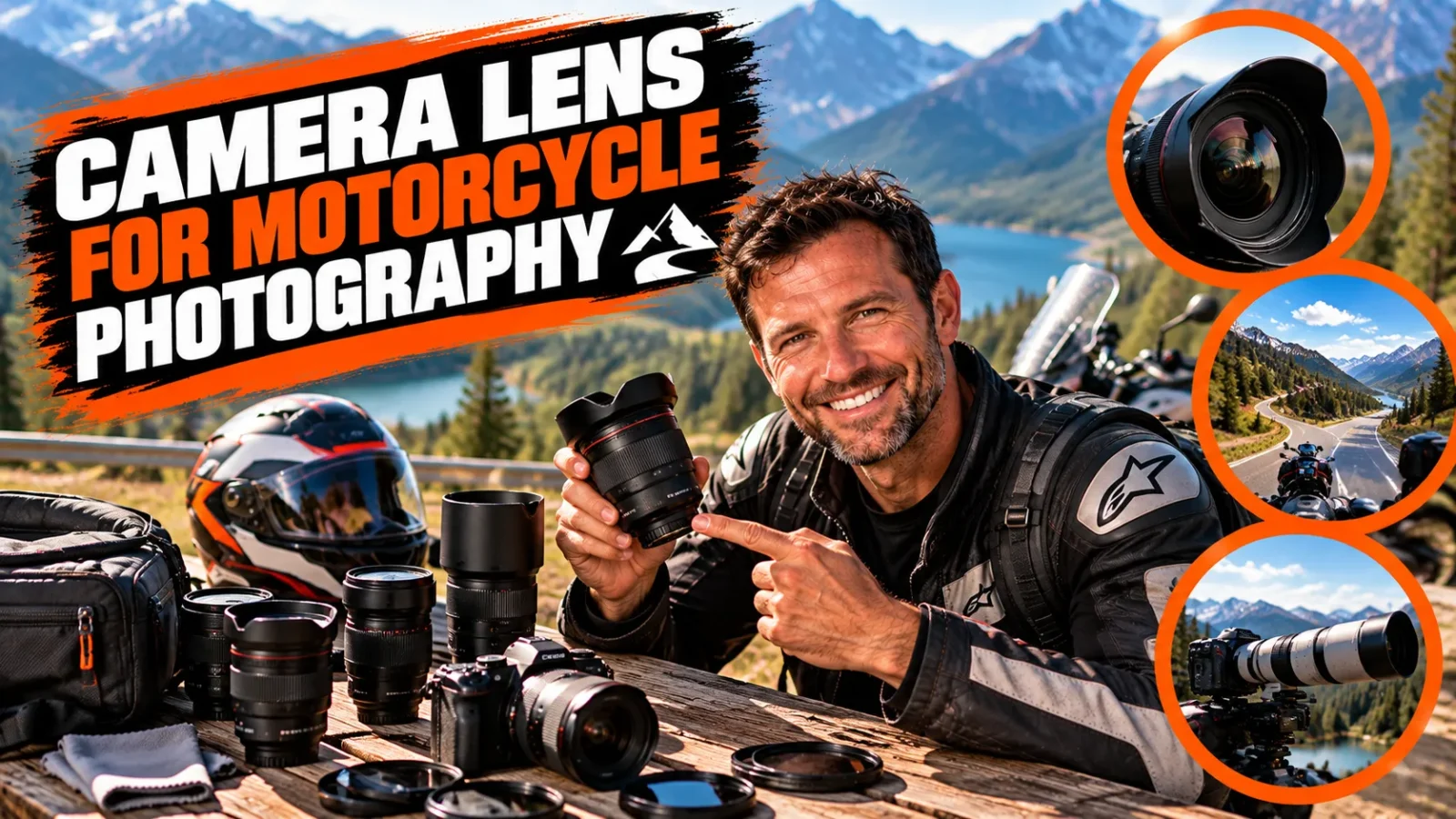
I’ve spent more weekends than I can count crouched on the side of a canyon road or leaning over a trackside fence, waiting for that perfect blur-of-motion shot. Motorcycle photography is brutal on gear. You need fast autofocus, rock-solid stabilization, and reach that lets you stay safely out of the way while still filling the frame.
Over the years I’ve cycled through more lenses than I’d like to admit, chasing that perfect panning shot where the bike is tack-sharp and the background melts into streaks. Some lenses earned a permanent spot in my bag. Others got sold within a month. This list is built from actual shoots — trackdays, canyon carving sessions, and grid walks — not spec-sheet guessing.
- For most riders, a 70-200mm f/2.8 zoom is the single best all-around lens for trackside and roadside motorcycle shots.
- If you shoot from far grandstands or need serious reach, look at super-telephoto zooms like the Sigma 100-400mm or Sony 200-600mm.
- A fast 24-70mm f/2.8 is essential for pit lane, garage, and close-up bike detail shots.
- Budget-conscious shooters can get 90% of the performance from third-party glass by Tamron and Sigma at half the price of first-party L/GM/S lenses.
- If you also want helmet-mounted footage to pair with your still shots, check out my guides to the best GoPro camera for motorcycle helmet setups and the best action camera for motorcycle helmets.
1. Sony FE 70-200mm f/2.8 GM OSS II — Best Overall Lens for Motorcycle Photography
If I could only own one lens for shooting motorcycles, it would be the Sony FE 70-200mm f/2.8 GM OSS II. I’ve used this lens at track days, canyon meetups, and even casual parking lot photoshoots, and it nails focus on moving bikes almost every single time.
What makes it special is the combination of a constant f/2.8 aperture and Sony’s fastest linear autofocus motors. When a bike is coming at me at 80 mph, I need the autofocus to lock instantly and track through the whole pan. This lens does exactly that.
It’s also noticeably lighter than the first-generation version — about 29% lighter — which matters a lot when you’re holding it up for hours at a trackday. Expect to pay around $2,800, which isn’t cheap, but the image quality and AF speed justify it if you shoot motorcycles regularly.
Why I keep reaching for it
The 70-200mm range is the sweet spot for most shooting positions at a track or on a mountain road. You’re rarely right on top of the bike, and you’re rarely a quarter-mile away either. This focal length covers both scenarios comfortably.
2. Canon RF 70-200mm f/2.8L IS USM — Best for Canon Mirrorless Shooters
For my friends shooting Canon, the Canon RF 70-200mm f/2.8L IS USM is the equivalent workhorse. I borrowed one for a full weekend at a local supermoto race and came away genuinely impressed by how compact Canon made this lens compared to the old EF version.
It retracts to a surprisingly small size when not zoomed, which is handy when you’re hiking gear bags along a fence line all day. Autofocus is fast and confident, even tracking riders weaving through chicanes.
Priced around $2,700, it sits right alongside Sony’s GM lens in both cost and performance. If you’re already in the Canon RF ecosystem, there’s really no better choice for motorcycle action shots.
3. Nikon Z 70-200mm f/2.8 VR S — Best for Nikon Mirrorless Bodies
Nikon shooters aren’t left out either. The Nikon Z 70-200mm f/2.8 VR S has become my go-to recommendation whenever a fellow rider asks what to pair with their Z6 III or Z8 for trackday photography.
I tested this lens shooting a flat-track race under stadium lights, and the vibration reduction (VR) system held up impressively well even at slower shutter speeds. That matters a lot when you’re panning at 1/125s to get that motion-blurred wheel effect.
It’s built like a tank, weather-sealed against dust and moisture, which I appreciated when a surprise drizzle hit halfway through a shoot. At roughly $2,600, it’s a serious investment, but the sharpness wide open at f/2.8 makes every frame usable.
4. Sigma 100-400mm f/5-6.3 DG DN OS — Best Value Telephoto Zoom
This is the lens I actually recommend most to newer motorcycle photographers because it hits a rare sweet spot: real reach, solid image quality, and a price that won’t make you wince. The Sigma 100-400mm f/5-6.3 DG DN OS runs about $950 for Sony E and L-mount.
I shot an entire vintage motocross event with this lens from a distance where a 70-200mm just couldn’t get close enough. The extra reach let me isolate riders cleanly against the trees without cropping heavily in post.
It’s not as fast to autofocus as the pro-grade 2.8 zooms, and the variable aperture means you’ll need more light or higher ISO in dim conditions. But for the money, I haven’t found a better telephoto option for motorcycle photography.
Where this lens shines
Rally stages, motocross, and any situation where you can’t physically get close to the action. I also love it for capturing candid rider portraits from across a paddock without them noticing the camera.
5. Tamron 150-500mm f/5-6.7 Di III VC VXD — Best Budget Super-Telephoto
When I need even more reach than the Sigma offers — say, shooting from a grandstand at a MotoGP round — I switch to the Tamron 150-500mm f/5-6.7 Di III VC VXD. It’s available for Sony E and Nikon Z mounts and typically costs around $1,400.
The built-in Vibration Compensation (VC) is genuinely excellent, letting me hand-hold shots at 500mm without a monopod for short bursts. I’ve gotten tack-sharp shots of riders leaned over mid-corner from hundreds of feet away.
It’s a bigger, heavier lens than the 100-400mm options, so it’s not something I’d carry all day on a hike to a remote canyon overlook. But for stadium supercross or grandstand seating at a road race, it’s tough to beat for the price.
6. Sigma 24-70mm f/2.8 DG DN Art — Best Standard Zoom for Pit Lane and Garage Shots
Not every great motorcycle photo is a panning shot at 200mph. Some of my favorite images are close-up detail shots — a mechanic’s hands on a wrench, chrome pipes catching the sunset, a rider’s gloved hand resting on the tank. That’s where the Sigma 24-70mm f/2.8 DG DN Art comes in.
I keep this lens on a second body during trackdays specifically for pit lane and garage shots. It’s sharp corner to corner, handles low garage lighting well thanks to the constant f/2.8 aperture, and costs around $1,100.
It’s also fantastic for environmental portraits of riders next to their bikes. If you only ever shoot telephoto action shots, adding this lens to your bag will genuinely change the variety of your portfolio.
7. Sony FE 200-600mm f/5.6-6.3 G OSS — Best for Distant Trackside and Rally Shooting
For pure reach without sacrificing autofocus speed, the Sony FE 200-600mm f/5.6-6.3 G OSS is my pick when I’m credentialed at a professional race and shooting from designated photographer zones well away from the track surface.
I used this at a national road racing championship where marshals kept photographers a good distance from the apex. This lens let me still fill the frame with riders at full lean, tires smoking, without needing to crop aggressively afterward.
At around $2,000, it’s not a budget lens, but it’s considerably more affordable than Sony’s 400mm and 600mm prime lenses while delivering comparable reach through the zoom range. Autofocus tracking on Sony’s Alpha bodies paired with this lens is genuinely some of the best I’ve used for motorsports.
A note on monopods
Lenses this long get heavy fast over a full day of shooting. I always bring a monopod when using the 200-600mm — my arms simply can’t hold steady framing for six hours straight otherwise.
8. Rokinon/Samyang 85mm f/1.4 — Best Prime for Rider Portraits
Every motorcycle photographer needs at least one great prime lens in the bag, and the Rokinon (Samyang) 85mm f/1.4 has been my quiet favorite for years. It’s available in several mounts and typically sells for around $550, which is a steal for the image quality it produces.
I use this almost exclusively for post-ride portraits — a rider pulling off their helmet, sweat and grin included, with a creamy blurred background behind them. The f/1.4 aperture creates gorgeous subject separation that a zoom lens simply can’t match.
It’s manual focus only on some versions, which took me a bit of practice to get comfortable with for moving subjects. But for static or slow-moving portrait work, that’s rarely an issue, and the price-to-quality ratio is hard to argue with.
How I actually choose which lens to bring
Honestly, my bag depends entirely on the shoot. For canyon roads with my buddies, I bring the Sigma 100-400mm because I’m usually shooting alone from one spot and need flexibility. For sanctioned track events, the 70-200mm f/2.8 comes out because I can move closer to the fence line.
If I know I’ll be far from the action — grandstand seating, a rally stage with restricted access — the longer glass like the Tamron 150-500mm or Sony 200-600mm earns its keep. And I never leave the 24-70mm at home when I know there will be garage or pit access.
Camera body matters too
A great lens paired with a slow-focusing older body will still miss shots. I shoot on bodies with fast eye/subject tracking autofocus, which makes an enormous difference when the “eye” you’re tracking is actually a helmet visor moving at speed.
Helmet-mounted footage pairs perfectly with still photography
Still photos tell part of the story, but I always encourage riders to capture point-of-view footage too. Pairing a great lens setup with the best GoPro camera for motorcycle helmet gives you both the cinematic wide shots and the immersive rider’s-eye perspective in one content package.
If GoPro isn’t your brand of choice, I’ve also put together a breakdown of the best action camera for motorcycle helmets covering DJI, Insta360, and other solid alternatives worth considering.
And whichever camera you choose, mounting it properly matters just as much as the lens does on your main camera. I’ve written detailed guides on the best GoPro mounts for motorcycle helmets and the best GoPro adhesive mount setup for motorcycle helmet if you want your helmet footage to look as stable as your still shots.
Quick tips for actually using these lenses in the field
Master the panning shot
The classic motorcycle photo — sharp bike, blurred background — comes from panning. I set my shutter speed between 1/60s and 1/200s depending on how fast the bike is moving, then physically rotate my whole body to track the rider through the frame.
It takes practice, and I still throw away plenty of blurry keeper attempts every session. But when it works, nothing beats the sense of speed a good pan conveys.
Use back-button focus
Every lens on this list performs best when paired with back-button autofocus rather than the shutter-button focus most cameras default to. It lets me continuously track a moving rider without accidentally refocusing on the background at the moment I press the shutter.
Protect your gear
Trackside dust, rain, and the occasional rock chip are real risks. I always use a lens hood and a basic filter for protection, and I keep a rain cover in my bag even on days that look clear.
My final take
There isn’t a single “best” lens for every rider or every shoot — it genuinely depends on where you’re standing and what story you’re trying to tell. But if I had to point a beginner toward one purchase, it would be a 70-200mm f/2.8, whether that’s the Sony GM, Canon RF, or Nikon Z version for your system.
From there, add a telephoto zoom like the Sigma 100-400mm for reach, and a 24-70mm for the close-up storytelling shots. Build the kit gradually, and you’ll end up with a bag that covers virtually any motorcycle photography situation you’ll encounter.
FAQs
What is the single best lens for shooting motorcycles at a track?
In my experience, a 70-200mm f/2.8 zoom like the
Sony FE 70-200mm f/2.8 GM OSS II or
Canon RF 70-200mm f/2.8L IS USM covers the widest range of trackside shooting positions with fast, reliable autofocus.
Do I need an expensive lens to get good motorcycle photos?
No. Third-party options like the Sigma 100-400mm f/5-6.3 DG DN OS deliver excellent sharpness and reach at roughly a third of the cost of first-party pro zooms.
What focal length is best for panning shots of motorcycles?
I get the most consistent panning shots between 100mm and 300mm, which gives enough compression to isolate the rider while still allowing you to track them smoothly through the frame.
Should I pair my camera lens setup with a helmet camera too?
Absolutely. I always recommend pairing still photography with helmet footage using the best GoPro camera for motorcycle helmet to capture the rider’s point of view alongside your action shots.

Related Articles

6 Best Rear View Cameras for Motorcycle: Riders Who Want Eyes in the Back of Their Head
I've tested the top rear view cameras for motorcycles so you don't have to. Here are my real-world picks for…
Jake Miller
12 min read

8 Best Cameras for Riding Motorcycle in 2026 (Rider-Tested Picks)
I've mounted, crashed, and rain-soaked dozens of cameras on my helmet and bike. Here are the 8 best cameras for…
Jake Miller
9 min read

9 Best Cameras for Motorcycle Travel: My Tested Picks for Long-Haul Rides
I've tested action cams, 360 cameras, and mirrorless bodies on thousands of touring miles. Here are the 9 best cameras…
Jake Miller
12 min read