
9 Best Video Cameras for Motorcycle Helmets I’ve Actually Ridden With
 Jake Miller
11 min read
Jake Miller
11 min read
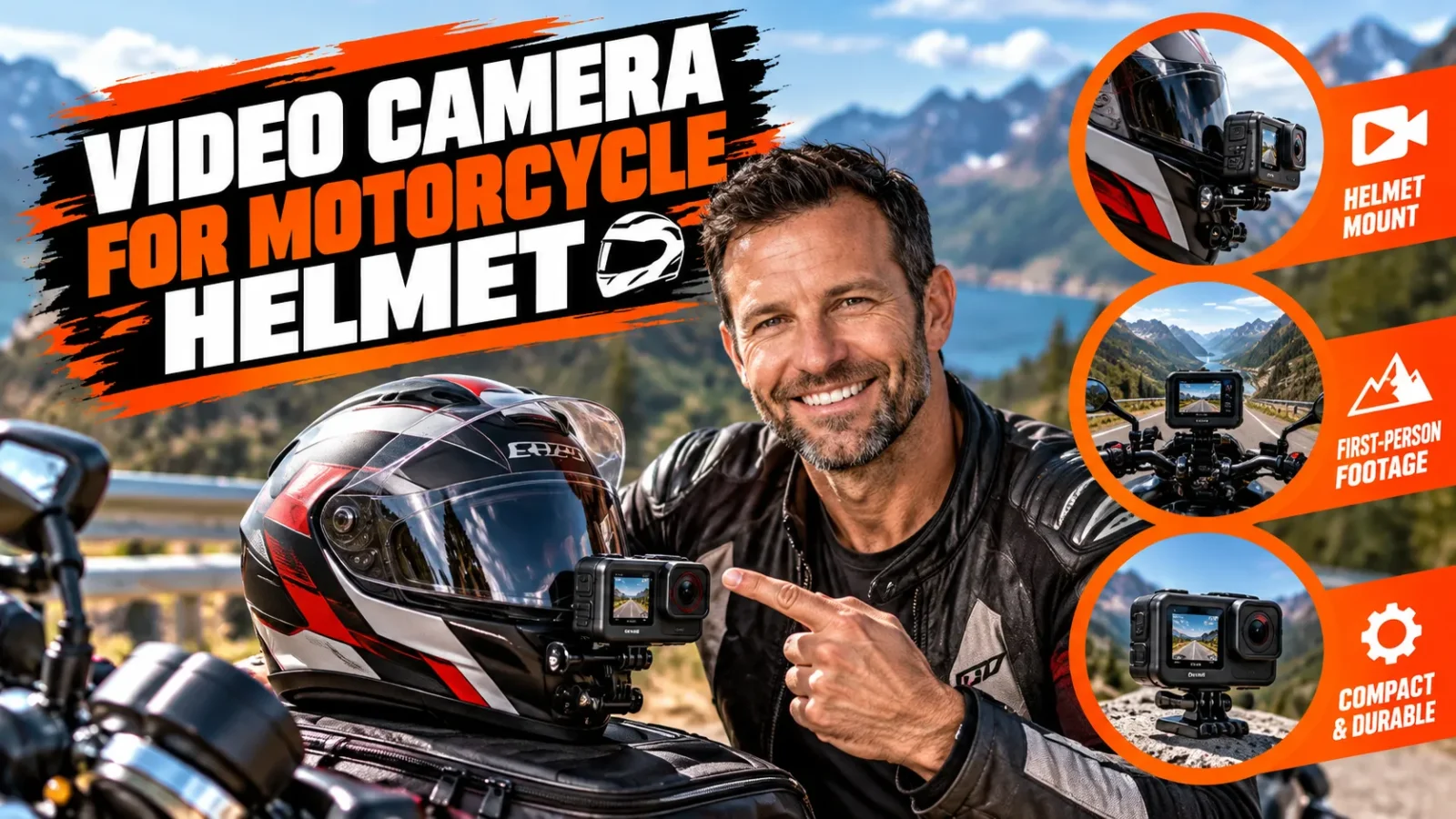
I’ve been strapping cameras to my helmet for years now, mostly to catch scenery on canyon rides, but also because close calls happen and I want proof on file. Somewhere along the way, I went through more cameras than I’d like to admit, chasing better stabilization, better battery life, and footage that doesn’t look like it was shot in a washing machine.
This list is the result of all that trial and error. I’m not just listing spec sheets I found online, I’m telling you what actually held up on real rides, in real wind, at real highway speeds. Let’s get into it.
- My top overall pick is the GoPro HERO13 Black for its stabilization and modular lens options.
- The DJI Osmo Action 5 Pro is the best choice if you ride a lot at dawn, dusk, or night.
- The AKASO Brave 8 is my top budget pick if you’re not ready to drop $300+ on a camera.
- Mount choice matters as much as the camera itself, so I’ve linked my favorite helmet mount setups throughout.
- Purpose-built helmet cameras like the Sena Prism Tube exist too, and they’re worth a look if you want something less bulky.
How I Picked These Cameras
Before I get into the list, I want to be upfront about my criteria. Riding isn’t like mountain biking or skiing, where a bump is the worst vibration you’ll deal with. On a motorcycle, wind noise, engine vibration, and sustained speed all beat up a camera differently.
I weighted these picks based on image stabilization at speed, wind noise handling, battery life on longer rides, and how well the camera pairs with real helmet mounts. I also factored in price, because not everyone wants to spend flagship money just to record their commute.
1. GoPro HERO13 Black — Best Overall Video Camera for Motorcycle Helmets
The GoPro HERO13 Black is still my go-to recommendation when someone asks me what to buy first. It shoots up to 5.3K at 60fps, and the HyperSmooth 6.0 stabilization is genuinely impressive when I’m hitting bumpy backroads at 70 mph.
What sold me on this generation is the new magnetic mounting system. Swapping the HERO13 on and off my helmet takes about two seconds, which matters a lot when I want to move it between my helmet and my bike’s dash mid-ride.
Battery life sits around 100 minutes of continuous 4K recording, which isn’t class-leading but is enough for most day rides if you carry a spare. GoPro also sells interchangeable lenses now, including a macro lens and an anamorphic lens, which is a fun rabbit hole if you like experimenting with your footage.
Price runs around $399 for the body alone. If you want a deeper breakdown of GoPro-specific models for riders, I put together a full comparison of the best GoPro camera for motorcycle helmet use that goes model by model.
Why I Still Recommend It
Honestly, it’s the safest recommendation because GoPro’s ecosystem of mounts, cases, and accessories is massive. If something breaks or you want a new angle, there’s almost always a part for it already made.
2. DJI Osmo Action 5 Pro — Best for Low-Light and Night Riding
I ride a fair amount at dusk during summer, and this is where the DJI Osmo Action 5 Pro pulled ahead of everything else I tested. Its 1/1.3-inch sensor is noticeably larger than most action cameras, and it shows in low-light footage that isn’t grainy or washed out.
DJI rates the battery at up to 4 hours of 4K/30fps recording, and in my own testing I got close to that on a cooler day. That’s a massive jump over most competitors and genuinely useful for longer touring days where you don’t want to swap batteries every hour.
The dual touchscreens (front and back) make framing shots easy without guessing, which I appreciate when I’m fumbling with gloves on. It also has a quick-release magnetic mount similar to GoPro’s, so pairing it with a chin-mount setup is straightforward.
A Few Trade-Offs
The Osmo Action 5 Pro is fantastic, but DJI’s app and software ecosystem is smaller than GoPro’s. If you like tinkering with third-party mounts and accessories, you’ll find fewer options here than with a GoPro.
Price is around $349, which puts it right in competition with the HERO13. If low-light footage matters more to you than mount variety, this is genuinely the better buy.
3. Insta360 X4 — Best 360-Degree Camera for Helmet Mounting
I was skeptical about 360 cameras for a long time, but the Insta360 X4 changed my mind. It captures the entire scene around you in 8K, and then you reframe the shot afterward in the app, which means you don’t have to nail your camera angle before you ride.
This is huge for helmet mounting specifically. Instead of worrying whether your chin mount is angled perfectly, you just record everything and pick your favorite point of view in post-production. I’ve saved footage this way that would’ve been ruined with a fixed-lens camera.
Battery life is roughly 135 minutes of 8K recording, and the camera is rated IPX8 for water resistance, so rain rides aren’t a dealbreaker. It runs about $499, which is pricier than a standard action cam, but you’re essentially getting multiple camera angles from one device.
Editing Takes Extra Time
The catch with 360 cameras is that reframing footage in the app takes longer than just pulling clips off a normal action camera. If you want quick turnaround videos, this adds a step to your workflow.
4. Insta360 Ace Pro 2 — Best Image Quality from a Leica-Tuned Sensor
Insta360 partnered with Leica on this one, and it shows in the color science. The Insta360 Ace Pro 2 produces some of the most natural-looking footage I’ve gotten off any action camera, especially in mixed lighting like tree-covered canyon roads with sun flickering through.
It uses a 1/1.3-inch sensor, similar in size to the DJI Osmo Action 5 Pro, and records up to 8K at 30fps or 4K at 120fps for slow motion. The flip screen is genuinely useful for framing yourself before you start riding.
Battery life comes in around 100-110 minutes depending on resolution, and it charges fast thanks to the included fast-charge dock. Pricing lands around $359 for the standard bundle.
My Take After a Full Riding Season
I used the Ace Pro 2 through an entire summer of rides, and the color accuracy kept impressing me every time I pulled clips onto my laptop. If you care about how your footage actually looks rather than just resolution numbers, this camera deserves serious consideration.
5. Sena Prism Tube WiFi Motorcycle Camera — Best Purpose-Built Helmet Camera
Most cameras on this list were designed for general action sports and adapted for motorcycle use. The Sena Prism Tube was actually built specifically for helmets, and that focus shows in its design.
It’s a slim, cylindrical camera that mounts low-profile to the side of your helmet, which cuts down on wind noise and drag compared to bulkier action cams. It records 1080p at up to 60fps, so it’s not chasing 4K or 8K specs, but the footage is clean and stable for everyday riding documentation.
Where it really stands out is integration with Sena’s communication headsets. If you already run a Sena intercom, pairing the Prism Tube means you can control recording right from your handlebar remote without ever touching the camera itself.
Price sits around $199, making it a solid mid-range option if you want something purpose-built rather than borrowed from the skiing or surfing world.
6. GoPro HERO12 Black — Best Value Flagship
Once the HERO13 launched, prices on the GoPro HERO12 Black dropped, and it’s now one of the smartest buys in this whole list. You still get 5.3K/60fps recording and HyperSmooth 6.0 stabilization, nearly identical to the newer model.
The main differences from the HERO13 are the lack of interchangeable lenses and a slightly smaller touchscreen. For most riders just wanting smooth, high-quality footage without the extra lens ecosystem, none of that matters much.
I’ve mounted this one using both chin mounts and top-of-helmet mounts, and it performed consistently well in both positions. If you’re deciding between mount styles, my full breakdown of the best GoPro mounts for motorcycle helmets covers exactly which style suits different riding styles.
Pricing typically runs around $299 now, which is genuinely a bargain for the performance you’re getting.
7. Insta360 GO 3S — Best Ultra-Compact and Discreet Option
Sometimes I don’t want a big camera bolted to my helmet, especially on group rides where I’d rather not look like I’m filming a documentary. The Insta360 GO 3S solves that. It’s a tiny thumb-sized camera that weighs just over 35 grams.
It shoots 4K at 30fps and clips onto helmets using a small magnetic mount system that’s barely noticeable once it’s attached. Battery life is short on its own, around 45 minutes, but it comes with a charging case that acts as an action pod, extending total shooting time significantly.
This isn’t the camera I’d pick for an all-day tour, but for quick clips, commutes, or days when I want something unobtrusive, it’s become a favorite. It runs about $319 for the standard kit.
Where the Small Size Helps
Less weight on your helmet means less strain on your neck over long rides, and less chance of the mount catching wind and vibrating loose. I’ve had zero issues with this one shaking off, even on rough pavement.
8. AKASO Brave 8 — Best Budget Pick
Not everyone wants to spend $300-plus just to record their morning commute, and I get that. The AKASO Brave 8 has genuinely surprised me for its price point, usually sitting around $130-150.
It records true 4K at 30fps and includes electronic image stabilization that, while not on GoPro’s level, does a respectable job smoothing out road vibration. The touchscreen is responsive enough, and battery life comes in around 90 minutes per charge.
I wouldn’t recommend this as your only camera if content creation is your main goal, but as an entry point to helmet cameras, or as a backup camera for a second angle, it punches well above its price.
Where It Falls Short
Wind noise is more noticeable on the Brave 8 than on pricier options, and low-light footage gets grainy fast. For daytime rides in decent weather, though, it holds up fine.
9. DJI Osmo Action 4 — Best Rugged Backup Option
Even though DJI has moved on to the Action 5 Pro, the Osmo Action 4 is still widely available and has dropped in price, often landing around $250 now. I keep one of these as a backup camera specifically because of its durability.
It’s rated to work in temperatures as low as -4°F, which matters if you ride through colder months like I sometimes do. The 1/1.3-inch sensor still performs well in mixed lighting, and it records 4K at up to 120fps for solid slow-motion clips of canyon corners.
Battery life runs around 160 minutes in ideal conditions, which is excellent for an older model at this price. If you want a dependable second body without spending flagship money twice, this is a smart pick.
Getting the Mount Right Matters Just as Much
Here’s something I learned the hard way: even the best camera on this list will give you shaky, useless footage if it’s mounted poorly. I’ve lost more good moments to a loose mount than to a bad camera.
If you’re leaning toward an adhesive-based setup rather than a full helmet-cam bracket, I’d strongly suggest reading through my guide on the best GoPro adhesive mount setup for motorcycle helmet use before you commit. It covers curved versus flat mounts and which adhesive actually survives highway speeds and temperature swings.
And if you’re still torn between action cameras from different brands entirely, not just GoPro, I compared a wider range of options in my best action camera for motorcycle helmets roundup, which might help narrow things down further.
My Final Thoughts on Choosing a Helmet Camera
If I had to boil this whole list down to one piece of advice, it’s this: buy based on how you actually ride, not based on spec sheets alone. A rider doing weekend canyon carves has very different needs than someone documenting a cross-country tour.
For most people asking me what the best video camera for motorcycle helmet use is, I still point them to the GoPro HERO13 Black first. It’s reliable, well-supported, and forgiving if you’re new to helmet cameras.
But if low-light performance, discreet size, or 360-degree flexibility matter more to your riding style, several other picks on this list will serve you better. I’ve ridden with every single one of these, and none of them are bad choices, just different tools for different rides.
Frequently Asked Questions
Is it legal to mount a camera on a motorcycle helmet?
In most places, yes, but rules vary by country and state. I always recommend checking local traffic laws since some regions restrict helmet modifications that could affect certification, like drilling into the shell.
Does a helmet-mounted camera affect helmet safety?
It can, slightly. Adding weight or a rigid mount to your helmet changes how it moves in a crash. I stick to low-profile, adhesive-based mounts rather than anything bulky or permanently fixed, and check out this adhesive mount setup guide before committing to one.
What’s the best video camera for motorcycle helmet use if I’m on a budget?
The AKASO Brave 8 is my go-to budget recommendation. It shoots solid 4K footage, has real image stabilization, and costs a fraction of a GoPro while still holding up to wind noise and vibration.
Chin mount or top-of-helmet mount for motorcycle riding?
I prefer chin mounts for motorcycles because they capture your hands, the dash, and the road ahead in one frame. Top mounts give a more POV rider’s-eye view but can catch more wind buffeting at highway speeds.

Related Articles

6 Best Rear View Cameras for Motorcycle: Riders Who Want Eyes in the Back of Their Head
I've tested the top rear view cameras for motorcycles so you don't have to. Here are my real-world picks for…
Jake Miller
12 min read

8 Best Cameras for Riding Motorcycle in 2026 (Rider-Tested Picks)
I've mounted, crashed, and rain-soaked dozens of cameras on my helmet and bike. Here are the 8 best cameras for…
Jake Miller
9 min read

9 Best Cameras for Motorcycle Travel: My Tested Picks for Long-Haul Rides
I've tested action cams, 360 cameras, and mirrorless bodies on thousands of touring miles. Here are the 9 best cameras…
Jake Miller
12 min read