
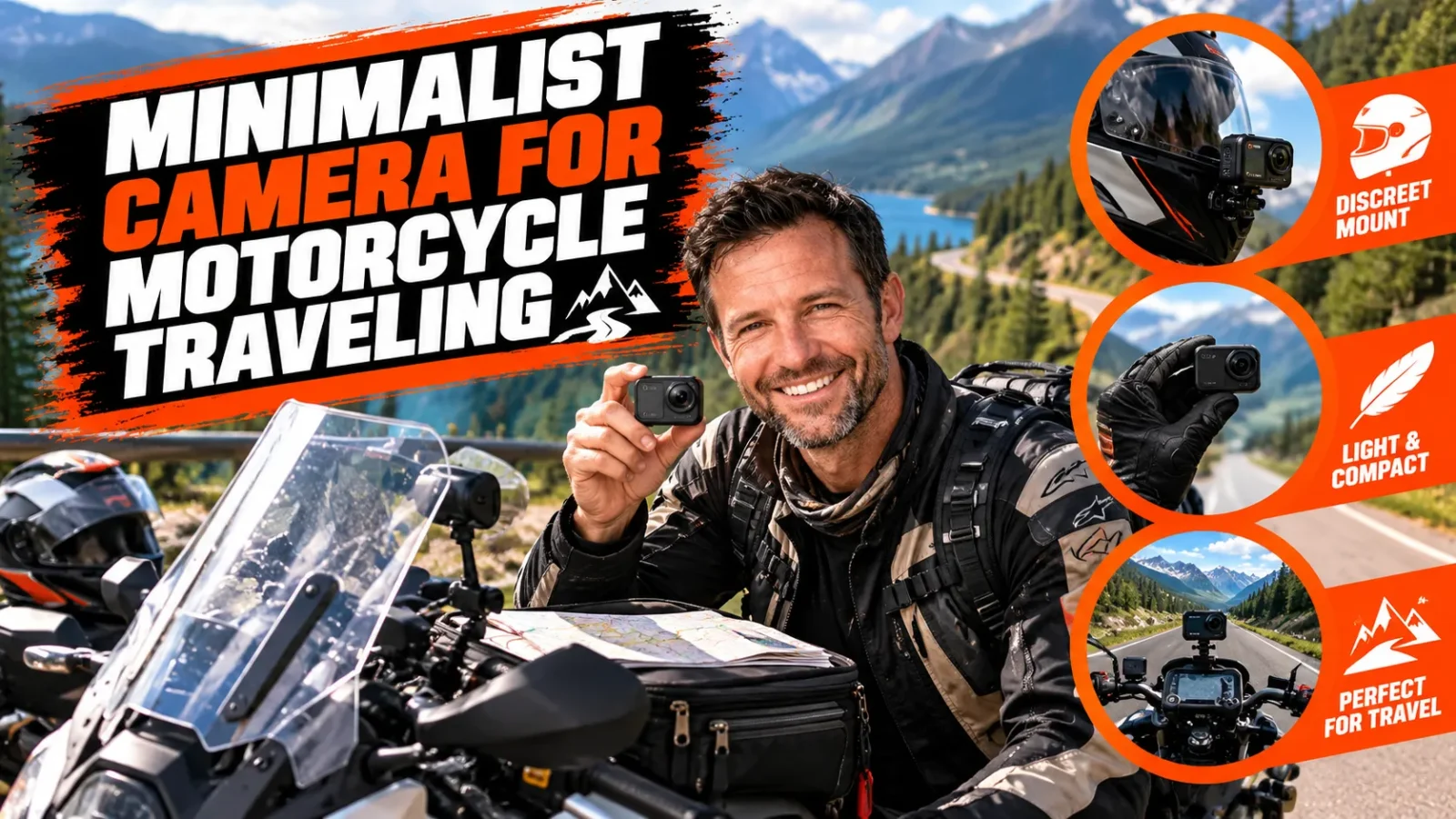
I’ve packed a lot of questionable gear for motorcycle trips over the years, but nothing has taught me the value of minimalism quite like strapping panniers to a bike for a three-week ride. Every ounce matters, every extra case is a hassle, and every gadget needs to earn its spot in my luggage.
Cameras are the worst offenders. I used to bring a full mirrorless kit with two lenses, a tripod, and a bag full of batteries. I don’t do that anymore. Now I look for gear that’s small, tough, and simple enough to use with riding gloves still half-zipped.
This list is built from actual trips, actual drops, actual rain, and actual moments where I fumbled for a camera at a gas station and needed it to just work. These are the cameras I’d genuinely pack again.
- My top all-around pick is the GoPro Hero 13 Black — rugged, waterproof, and versatile enough to replace three separate cameras.
- If you want the smallest possible footprint, the Insta360 Go 3S is basically a thumb-sized camera that clips to your jacket.
- For riders who care about still-photo quality over video, the Ricoh GR IIIx and Fujifilm X100VI are worth the extra bulk.
- Action cameras pair best with a solid mounting setup — check my notes on helmet mounts and adhesive systems below.
- Minimalist doesn’t mean cheap; it means every gram you carry does more than one job.
1. GoPro Hero 13 Black — Best Overall Minimalist Camera for Motorcycle Trips
If I could only bring one camera on a motorcycle trip, it would be the GoPro Hero 13 Black. It’s the camera I keep coming back to because it does everything reasonably well instead of doing one thing perfectly.
It’s waterproof to 33 feet without a case, shoots 5.3K video, and has HyperSmooth stabilization that makes footage from a bumpy backroad look almost gimbal-smooth. That matters a lot when your “tripod” is a vibrating handlebar.
The new modular lens system is what really sold me, though. I can swap in the Ultra Wide lens for tight mountain switchbacks or the Macro lens for detail shots of my bike at a scenic overlook, all without adding a second body to my bag.
Battery life is still the weak point on long riding days, so I always carry one spare. At around $400, it’s not the cheapest option here, but it replaces a GoPro, a point-and-shoot, and a dash cam all in one small box.
If you’re planning to mount it on your helmet, I’ve written a full breakdown of the best GoPro camera for motorcycle helmet setups, which goes deeper into which GoPro models pair best with helmet mounting versus chest or handlebar mounting.
2. Insta360 Go 3S — Best Ultra-Compact “Wearable” Camera
The Insta360 Go 3S is genuinely the smallest camera I’ve ever traveled with. It weighs about 35 grams and is roughly the size of my thumb, which sounds like a gimmick until you actually use it on a bike.
I clip the magnetic pendant to my jacket collar and forget it’s there. No cables, no bulky housing, no extra strap digging into my neck under a helmet. That’s about as minimalist as a camera gets.
Video quality tops out at 2.7K, which won’t blow anyone away on a big screen, but for social clips and quick trip recaps, it’s more than enough. The Action Pod (the charging case) doubles as a tiny touchscreen viewfinder, which is handy for framing shots.
Battery life per charge is short, around 45 minutes of continuous recording, so this isn’t a camera for all-day filming. It’s a camera for capturing bursts of a trip without adding any real weight or bulk to your kit.
Why I still pack it alongside a “real” camera
I treat the Go 3S as a supplement, not a replacement. It captures the candid, in-motion moments that I’d never bother pulling out a bigger camera for, like pulling out of a gas station or waving at another rider.
3. DJI Osmo Action 5 Pro — Best Low-Light Action Camera
The DJI Osmo Action 5 Pro has become my pick for riders who do a lot of dawn or dusk riding, which, let’s be honest, is most of us chasing good light on long trips.
Its 1/1.3-inch sensor is noticeably larger than most action cameras, and it shows in low-light footage. Sunrise departures and golden-hour arrivals at camp look far cleaner than what I get out of most competitors in this size class.
It’s waterproof to 66 feet without a housing, which is double what the GoPro Hero 13 Black offers, and the magnetic quick-release mounting system is genuinely faster to use with gloves on. I’ve swapped it between my helmet and handlebar mount at a fuel stop in under ten seconds.
Battery life is also a standout — DJI claims up to 240 minutes of 4K recording on the extended battery, which held up well during my own testing on an all-day mountain pass ride. At roughly $349 for the standard kit, it undercuts the GoPro slightly while matching it feature-for-feature.
If you’re comparing action cameras generally and not sure which category fits your riding style, my rundown of the best action camera for motorcycle helmets covers more head-to-head detail between DJI, GoPro, and Insta360’s lineups.
4. Ricoh GR IIIx — Best Minimalist Compact for Photography Purists
Not every rider wants video. Some of us just want to pull over, grab a still photo of the bike against a mountain backdrop, and get back on the road. That’s exactly where the Ricoh GR IIIx shines.
It’s a fixed 40mm-equivalent lens compact with an APS-C sensor, which is a genuinely large sensor for something that fits in a jacket pocket. Image quality punches way above its size class, especially for landscape and street-style shots at rest stops.
There’s no viewfinder, no interchangeable lenses, and barely any menu diving required. I appreciate that on the road — I want to point, shoot, and get moving, not fiddle with settings while my bike idles on the shoulder.
It’s not weatherproof, which is its biggest drawback for motorcycle use. I keep mine in a small waterproof pouch in my tank bag and only pull it out when I’m stopped, not while riding. At around $900, it’s a splurge, but the image quality is genuinely in a different league from any action camera on this list.
5. Sony RX100 VII — Best Pocket Camera with Zoom Flexibility
The Sony RX100 VII has been my go-to for years when I want zoom range without carrying an interchangeable-lens system. It packs a 24-200mm equivalent zoom into a body that still fits in a jacket pocket.
That zoom range matters more than people expect on a motorcycle trip. I can shoot a wide shot of the whole group at a scenic pullout, then zoom in for a tight portrait of a riding buddy, all without swapping lenses or gear.
Autofocus is fast and reliable, which helps when you’re trying to grab a shot of a passing landmark before it’s out of view. Image stabilization is solid too, useful for handheld shots taken right after climbing off a bike with slightly shaky hands from vibration.
At close to $1,200, it’s the priciest compact on this list, and it’s still not weatherproof. But if photo quality and zoom flexibility matter more to you than ruggedness, I think it’s worth the investment and the extra care.
6. Insta360 X4 — Best 360 Camera for Reframing Footage Later
The Insta360 X4 solves a problem I ran into constantly with fixed-lens action cameras: forgetting to aim the thing correctly before a great moment happens. With 360-degree capture, you just mount it and reframe the shot later on your phone.
It shoots 8K 360 video, and the “invisible selfie stick” effect means I can mount it on a short pole on my tank bag and get third-person riding shots that look like a drone followed me down the highway. That’s an effect that used to require two people and a chase vehicle.
It’s rated IPX8 waterproof up to 33 feet and handles vibration well when mounted securely. Battery life sits around 135 minutes for 8K recording, which is respectable for the file sizes involved.
The tradeoff is workflow. You have to reframe every clip in the app before it’s a normal-looking video, which takes time I don’t always have on a trip. At about $500, it’s a fun, genuinely different minimalist option rather than a strict GoPro replacement.
7. Fujifilm X100VI — Best Splurge for Serious Image Quality
I hesitated to include the Fujifilm X100VI here because it’s bigger and pricier than everything else on this list, but I couldn’t leave it out. For riders who genuinely care about photography, not just documentation, it’s worth the extra pocket space.
It has a 40-megapixel APS-C sensor, a fixed 23mm f/2 lens, and Fujifilm’s legendary film simulations built right in. I’ve gotten shots straight out of camera on this thing that needed zero editing before posting.
It’s still a “one lens, no accessories” setup, which keeps it in minimalist territory despite the premium price tag of roughly $1,600. In-body image stabilization helps a lot for handheld shots after a long stint in the saddle.
It’s not weatherproof unless you add the optional adapter and filter, which is an extra piece to pack. For me, this camera is for trips where photography is part of the point of the ride, not just a way to remember it happened.
8. Sony ZV-1 II — Best Vlogging Compact for Trip Journaling
If you’re documenting your motorcycle travels for YouTube or just for a personal trip journal, the Sony ZV-1 II is built almost specifically for that use case. It’s compact, lightweight at under 300 grams, and has a flip-out screen made for talking directly to camera.
The 18-50mm equivalent zoom is wider than most compacts, which is genuinely useful for vlogging in tight spaces, like a small motel room or a packed campsite. Background defocus and product-showcase autofocus modes are built in, aimed squarely at creators.
Its built-in directional mic is noticeably better for spoken audio than most action cameras, which tend to pick up wind noise on a bike. I still recommend an external mic for actual riding audio, but for stationary talking segments, it holds up well.
At around $800, it’s a mid-range investment that fills a specific niche. It’s not the camera I’d strap to a helmet, but it’s the one I grab when I want to actually narrate a trip instead of just filming it.
How I actually decide what to pack
After years of over-packing, I’ve settled into a simple rule: one rugged action camera, and optionally one compact for stills, never more than that. Anything beyond two cameras starts to feel like a burden instead of a tool.
I also think about mounting before I think about the camera itself. A great camera with a bad mount is worse than a good camera you can actually trust on rough roads. I always check my setup against my notes on the best GoPro mounts for motorcycle helmets before a big trip, just to make sure everything’s rated for vibration and impact.
A note on adhesive mounts specifically
Adhesive mounts are lighter than bolt-on hardware, but they’re not all created equal, especially in extreme heat or cold. I learned this the hard way when a cheap mount failed on a hot desert highway. Now I only use setups I’ve vetted, like the ones covered in my guide to the best GoPro adhesive mount setup for motorcycle helmets.
Final thoughts on traveling light with a camera
There’s no single “best” answer here, and I say that as someone who’s tried nearly every option on this list on real trips. It genuinely depends on whether you value video, stills, or just the smallest possible footprint in your luggage.
If I had to recommend a starting point for most riders, it’s still the GoPro Hero 13 Black. It’s the camera that covers the widest range of needs with the least amount of compromise.
But if photography is your real passion and you’re willing to baby your gear a bit more, the Ricoh GR IIIx or Fujifilm X100VI will reward you with images the action cameras simply can’t match. Pack light, mount it securely, and get back on the road.
Frequently Asked Questions
What is the best minimalist camera for motorcycle traveling if I only want one camera?
For most riders, I’d point to the GoPro Hero 13 Black. It handles helmet footage, tank-bag time-lapses, and casual photos without forcing you to carry a second body.
Do I need a separate action camera and a ‘real’ camera for motorcycle trips?
Not necessarily. If storytelling matters more to you than ultimate image quality, a single action camera or a pocket compact like the Ricoh GR IIIx can cover 90% of your needs and save serious pack space.
What’s the most weatherproof option for long-distance riding?
Action cameras like the GoPro Hero 13 Black and DJI Osmo Action 5 Pro are natively waterproof and built to survive vibration, rain, and drops, which makes them far more travel-friendly than most compact cameras.
Can I just use my phone instead of buying a dedicated camera?
You can, but a dedicated camera frees up your phone for navigation, gives you better mounting options, and usually survives crashes and rain far better. Pairing it with a good mount, like the ones I cover in my guide to GoPro mounts for motorcycle helmets, makes a huge difference.

Related Articles

6 Best Rear View Cameras for Motorcycle: Riders Who Want Eyes in the Back of Their Head
I've tested the top rear view cameras for motorcycles so you don't have to. Here are my real-world picks for…
 Jake Miller
12 min read
Jake Miller
12 min read

8 Best Cameras for Riding Motorcycle in 2026 (Rider-Tested Picks)
I've mounted, crashed, and rain-soaked dozens of cameras on my helmet and bike. Here are the 8 best cameras for…
Jake Miller
9 min read

9 Best Cameras for Motorcycle Travel: My Tested Picks for Long-Haul Rides
I've tested action cams, 360 cameras, and mirrorless bodies on thousands of touring miles. Here are the 9 best cameras…
Jake Miller
12 min read