
6 Rain-Ready Motorcycle Phone Cases and Holders I’d Trust on the Road
 Jake Miller
12 min read
Jake Miller
12 min read
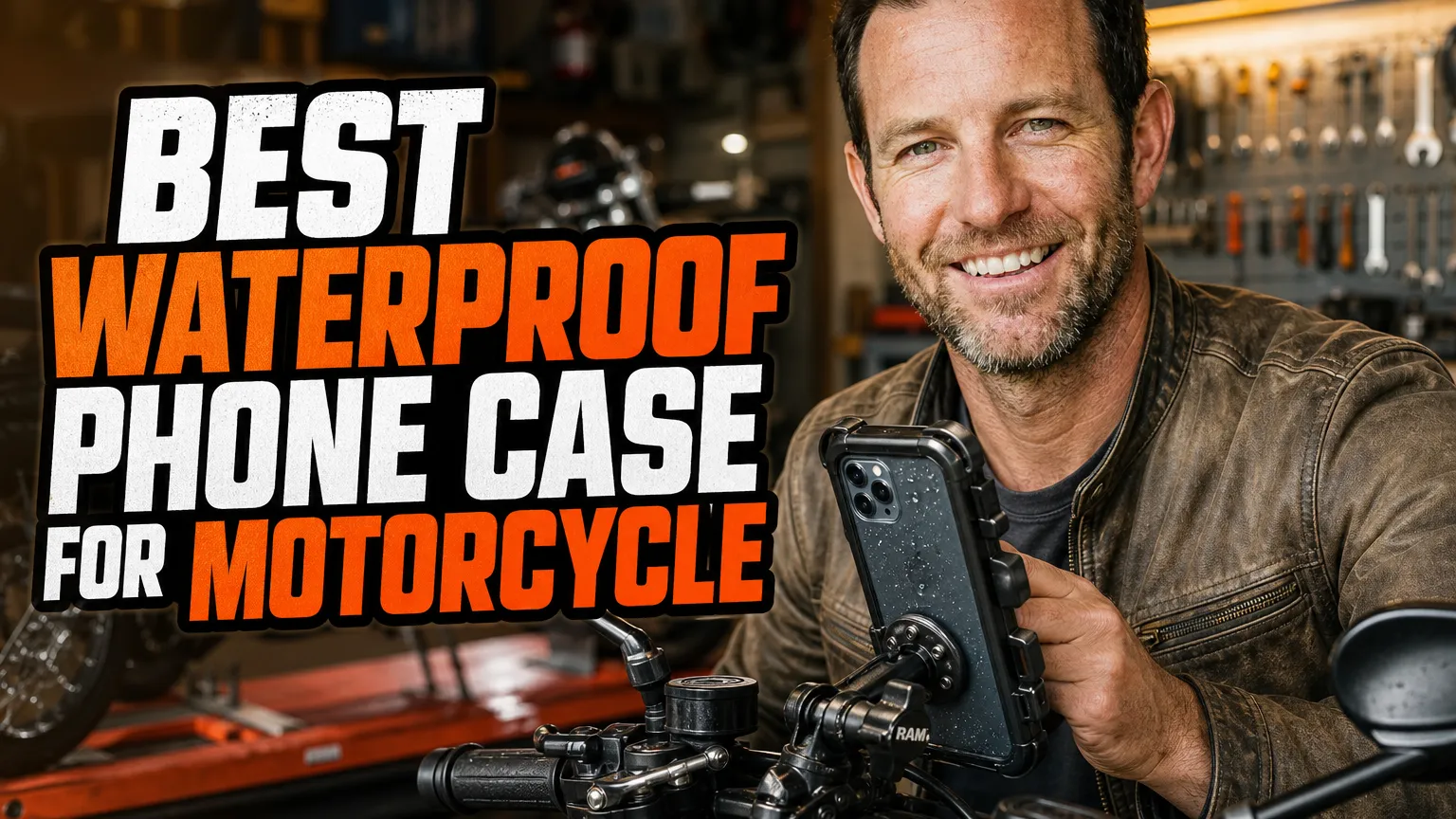
When I’m choosing the best waterproof phone case for motorcycle rides, I look beyond a product’s rain claim. I want a dependable seal or rain cover, a mount that holds securely, and a design that still lets me see and use navigation without making a roadside stop unnecessarily complicated.
I’ve included both fitted phone cases and weatherproof holder-style enclosures because they solve the same on-bike problem in different ways. My picks below cover slim everyday setups, touring-friendly pouches, and a fully waterproof phone case, with clear notes on the trade-offs I’d consider before riding.
- I’d choose SP Connect or Quad Lock for a close-fitting case-and-mount system with an optional rain cover.
- I’d look at the GIVI S958B or Oxford Aqua T8 for an enclosed, pouch-style setup.
- I wouldn’t treat “weatherproof” as permission to submerge a case or ride through every storm without checking its seal.
- I’d use vibration damping where possible and keep an eye on phone temperature when charging.
How I choose a phone case or holder for riding
I start with the difference between a waterproof case and a waterproof holder. A fitted case stays on my phone and can be paired with a motorcycle mount; a holder-style pouch surrounds the phone while it’s mounted. Each approach can help in rain, but neither is automatically right for every bike, phone, or riding style.
I also read the protection wording carefully. A product described as rainproof or weather-resistant may cope with road spray but may not be rated for immersion. When a manufacturer publishes an IP rating, I check what the rating actually covers and whether the case is closed exactly as instructed.
For motorcycle use, mounting matters just as much as the water barrier. I want a firm attachment, a viewing angle I can glance at without losing focus on the road, and a way to avoid leaving my phone exposed to sustained vibration. I also factor in touchscreen usability, camera cutouts, charging access, and whether I can operate the setup with gloves.
1. SP Connect Phone Case with Weather Cover — my pick for a tidy daily setup
I like the SP Connect Phone Case with Weather Cover when I want my phone close to the mount rather than inside a bulky universal pouch. The system uses a phone-specific case with a twist-to-lock connection, while the separate Weather Cover adds a flexible protective layer over the phone for wet rides.
The case is designed to work with SP Connect’s mounting system, so I’d make sure I’m buying the correct case for my exact phone model and the right handlebar or mirror mount for my bike. The Weather Cover is an add-on, not a reason to assume the entire setup is submersible; I treat it as extra weather protection and follow SP Connect’s fit guidance.
What I like, and what I’d check
My favorite part of the SP Connect Phone Case setup is its relatively streamlined feel compared with a large enclosed pouch. The case can stay on the phone off the bike, and the twist-lock mount makes it straightforward to attach or remove the handset when I park.
I’d check that the Weather Cover fits my phone-and-case combination before a long trip. It can also affect touchscreen feel, so I’d test navigation controls while stationary and see whether I can use them reliably with my riding gloves. I’d expect the case and cover together to cost more than a basic universal pouch, with prices varying by phone model and mount bundle.
2. Quad Lock MAG Case with Poncho — my choice for an expandable mounting system
The Quad Lock MAG Case paired with the Quad Lock Poncho is another system I’d consider for regular commuting and touring. The phone-specific case attaches to compatible Quad Lock mounts, and the separate silicone Poncho slips over the front of the phone to help protect it from rain and dirt.
I’d be careful not to confuse the case with the Poncho: they are separate pieces with different jobs. The case provides the attachment point for the mounting system, while the Poncho adds a weather barrier over the screen and controls. I’d check the compatibility details for my phone before ordering, since case shapes and accessories vary between models.
My practical take on the Poncho
I appreciate that I can remove the Poncho when conditions are dry rather than leaving my phone sealed up all day. For navigation in a downpour, that extra front cover is useful, but it may make the screen feel less responsive than it does uncovered. I’d test the buttons and touchscreen on a parked bike before relying on them in traffic.
Quad Lock products can add up in price once I include the case, Poncho, and mount. I see that as a worthwhile investment if I’m already committed to the ecosystem, but I’d compare the complete setup cost rather than judging the case by itself. For any phone-and-mount system, I’d also consider vibration protection and the phone maker’s guidance about motorcycle use.
3. GIVI S958B — my pick for an enclosed touring pouch
The GIVI S958B is a motorcycle smartphone holder with a protective, pouch-style enclosure, rather than a slim case that stays on my phone. I’d consider it when I want the phone surrounded by a cover while it’s on the handlebars, especially for rides where rain and road grime are part of the forecast.
Its main appeal to me is that it combines a phone enclosure with a motorcycle mounting solution. The transparent front lets me view the screen, and the holder is designed for touchscreen operation. As with any pouch, I’d check the maximum device dimensions against my phone, including any case I plan to leave on underneath.
What I’d keep in mind
A pouch can be more protective from direct rain than an uncovered fitted case, but it’s also bulkier and may reduce touchscreen precision. I’d take time to set the viewing angle and make sure the mounting hardware is secure before riding. I’d also check the current GIVI instructions for the product’s water-protection limits rather than treating the word “waterproof” as an immersion guarantee.
The GIVI S958B’s price depends on the retailer and included mounting components. I’d compare what comes in the box with what my handlebars require, since clamp and fit requirements differ between motorcycles. For a dedicated touring setup, I’d value the enclosed design; for quick phone removal at every stop, I might prefer a fitted case system.
4. Oxford Aqua T8 — my pick for a straightforward weatherproof holder
I’d put the Oxford Aqua T8 on my shortlist if I wanted a purpose-built motorcycle phone holder with a cover over the phone, rather than a phone-specific case. Oxford’s Aqua range is designed around wet-weather riding, and the T8 format gives me a contained screen area that I can position on the bike for navigation.
Before buying, I’d verify the current dimensions and compatibility information against my phone. Phone sizes change quickly, and a handset that fits without a case may not fit once I add a rugged cover. I’d also confirm what mounting hardware is included and whether it matches my handlebar diameter or needs an adapter.
Why I’d consider it for regular rides
I like the simplicity of an all-in-one holder: I can place the phone inside, close the cover, and mount the unit without building a case ecosystem around the handset. The trade-off is that an enclosed screen can be less convenient to touch, particularly if I’m wearing gloves or trying to make a precise screen selection.
I’d use the Oxford Aqua T8 for navigation I can set before moving, not as an excuse to interact with my phone while riding. I’d also inspect the closure and cover for wear over time, because a pouch’s weather protection depends on its condition and being closed correctly. Prices vary by retailer, and I’d compare the full package rather than assuming every listing includes the same fittings.
5. RAM Mounts Aqua Box RAM-HOL-AQ6U — my pick for a more enclosed mount
The RAM Mounts Aqua Box RAM-HOL-AQ6U is an enclosure-style option I’d investigate when I want a more substantial holder than a simple phone clamp. The Aqua Box is designed to shield a device behind a clear viewing window, and RAM’s broader mounting system gives me a range of ways to attach compatible hardware to a motorcycle.
I’d check the Aqua Box’s internal dimensions carefully before buying, since a phone’s screen size alone doesn’t tell me whether it will fit. I’d also confirm which mounting components are included in the specific package. RAM parts are often sold in different combinations, so the box, base, and motorcycle attachment may not all be part of a single listing.
My trade-off between protection and convenience
For me, the benefit of the Aqua Box is its enclosed design; the trade-off is added size and a more involved installation compared with a low-profile case. I’d regard it as a weather shield, not assume it is safe to submerge. I’d inspect its closure and follow RAM’s instructions, especially before a long ride in heavy rain.
I’d also think about heat. Any enclosed holder can limit airflow around a phone, and navigation, screen brightness, and charging can all make a handset warmer. If my phone felt hot, I’d stop charging and let it cool rather than keeping it sealed inside a sunny, enclosed case.
6. Catalyst Waterproof Case for iPhone 15 Pro — my pick for a genuinely sealed phone case
For an iPhone 15 Pro owner who wants a fitted case rather than a handlebar pouch, I’d consider the Catalyst Waterproof Case for iPhone 15 Pro. Catalyst’s waterproof cases are designed around a sealed phone-specific shell, and the company lists IP68 water protection for applicable models. I’d confirm the exact rating and use limits for the version I’m buying.
This is the most phone-case-like option on my list: it stays on the handset away from the motorcycle as well as during the ride. That can make it useful if I want one protective case for everyday use and wet-weather trips. However, it doesn’t provide a motorcycle mount by itself, so I’d need to choose a compatible, secure mounting solution separately.
Where I’d use extra caution
I wouldn’t assume the Catalyst Waterproof Case is automatically compatible with a particular handlebar mount. I’d confirm the clamp can hold the case securely without pressing on buttons or interfering with the screen. I’d also consider vibration carefully, because a waterproof case doesn’t protect a phone’s camera from damage associated with prolonged motorcycle vibration.
Waterproof cases for individual phone models can be pricier than a simple pouch, and stock can vary as phone generations change. I’d check that I’m ordering the exact iPhone 15 Pro model and not a similarly named case for a different iPhone. If I ride a different phone, I’d look for a Catalyst case made specifically for that handset rather than trying to adapt this one.
How I match the setup to my riding
For short commutes, I’d lean toward a fitted SP Connect or Quad Lock case if I wanted a quick on-and-off routine. For frequent wet-weather trips, I’d consider adding the matching Weather Cover or Poncho, then test how well I can operate the screen before setting off.
For a long tour, I’d compare the GIVI S958B, Oxford Aqua T8, and RAM Aqua Box based on phone fit, mounting hardware, and how much enclosure I want. I’d prioritize secure mounting and easy visibility over a feature that encourages me to tap through menus while moving.
If I’m planning a route-heavy trip, I’d also think about whether my phone is the right navigation tool for the job. I’ve found it useful to compare dedicated devices in guides to the best waterproof gps for motorcycle and the best gps for adventure motorcycle touring before I decide what belongs on my handlebars.
For a dedicated adventure navigation unit, I’d also read about the tomtom rider 550 best gps for adventure motorcycle riding. If I were planning a much longer trip, I’d compare options in the guide to the best gps for round the world on motorcycle, or look at bike-specific advice for the best motorcycle gps for bmw r1200gsa.
My final checklist before I ride
Before leaving, I check that the phone fits the case or pouch with its everyday cover accounted for. I close every flap and seal as instructed, tug the mount gently to confirm it’s secure, and set my route while parked. If the screen cover makes touch controls unreliable, I’d rather adjust the setup at home than try to manage it on the road.
I also keep water protection in perspective. A rain cover or enclosed holder can reduce exposure, but wear, poor fit, an open port, or a badly closed seal can undermine that protection. I inspect the setup periodically, keep a backup navigation plan for longer rides, and avoid charging a hot phone inside a sealed enclosure.
My overall choice depends on the ride: I’d choose SP Connect or Quad Lock for a compact case-and-mount ecosystem, GIVI or Oxford for a pouch-style enclosure, and the Catalyst Waterproof Case for a phone-specific sealed case paired with a separately verified mount. Whichever I pick, I’d confirm fit, mounting security, and the maker’s water-resistance limits before trusting it on a wet motorcycle trip.
Frequently Asked Questions
Can I use a regular waterproof phone case on a motorcycle?
Yes, but I’d pair it with a secure, vibration-conscious mount. A waterproof case protects against water, while the mount keeps your phone in place and accessible.
Are motorcycle phone pouches fully waterproof?
Not necessarily. I check the product’s stated water protection and closure design, and I never assume a rain-resistant pouch can be submerged.
Can a motorcycle phone mount damage my phone camera?
Vibration can affect some phone cameras, particularly image stabilization systems. I use a vibration-damping mount where available and avoid unnecessarily long exposure on rough roads.
Should I leave my phone charging inside a waterproof case?
I’m cautious about this because charging can add heat, and a sealed case may trap it. I check the case and phone maker’s guidance and stop charging if the phone gets hot.

Related Articles

6 Best Motorcycle Phone Mounts That Keep Your Phone Charged on the Road
Compare six dependable motorcycle phone mounts with wireless or USB charging, including fit, power wiring, vibration protection, weather resistance, and…
Jake Miller
10 min read

5 Best Motorcycle Phone Mounts for Naked Bikes and Open-Cockpit Riding
I compare secure, vibration-conscious phone mounts for naked and touring bikes, with fit notes, real trade-offs, and setup tips for…
Jake Miller
11 min read

7 Best Phone Mounts for Sport Bikes: Secure, Vibration-Smart Picks
Compare secure phone mounts for sport bikes, including clip-on fit, vibration control, case systems, prices, and my practical picks for…
Jake Miller
12 min read