
Are Motorcycle Ignition Coils Interchangeable? What I Learned Swapping Them Myself
 Jake Miller
8 min read
Jake Miller
8 min read
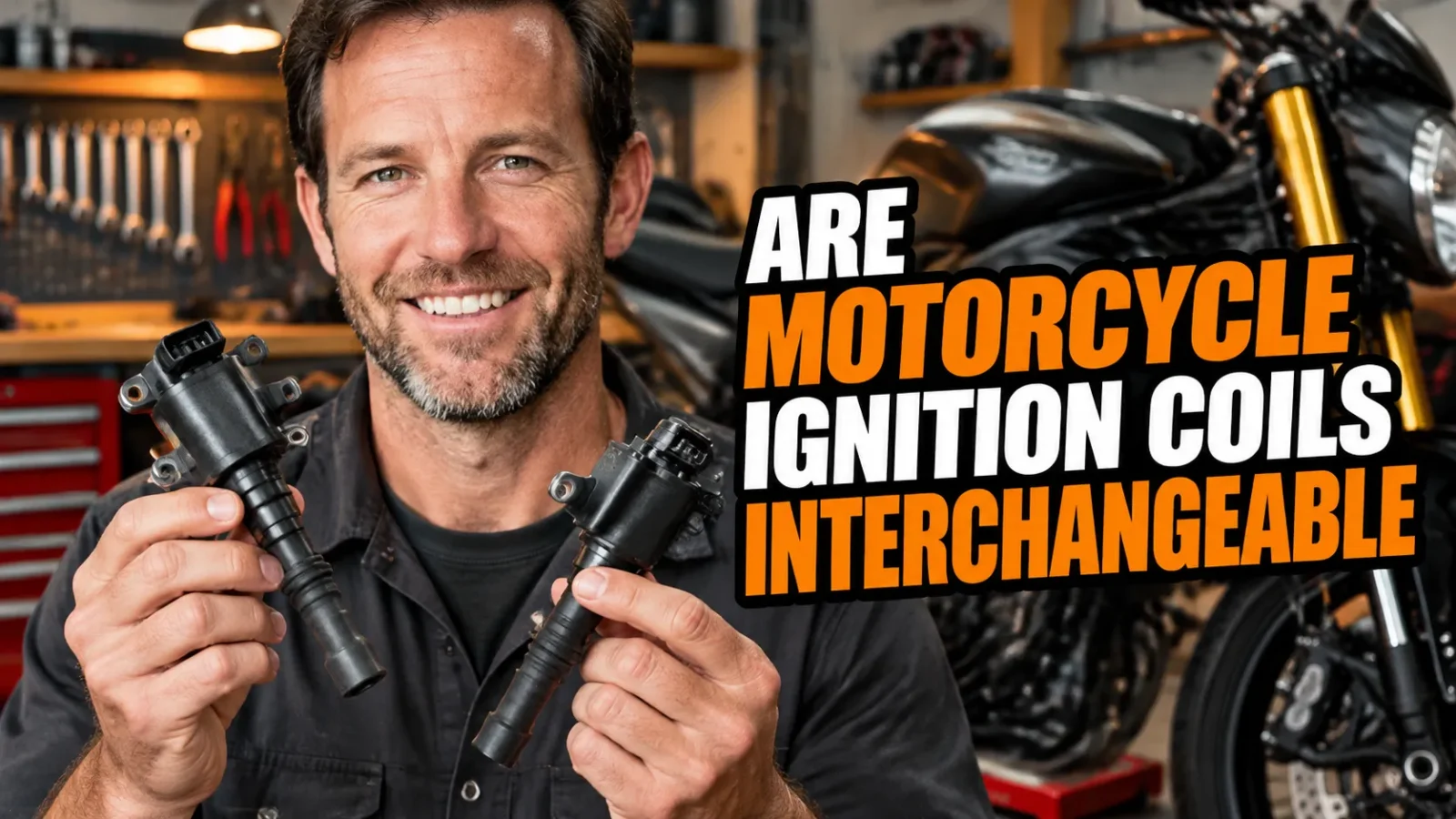
I’ve lost count of how many times a fellow rider has asked me, “Can’t I just grab any coil that fits?” It’s a fair question, especially when a branded replacement costs three times what a generic one does. The honest answer is: sometimes, but not nearly as often as you’d hope.
Ignition systems are one piece of the electrical puzzle, and they depend on a healthy power source. If you’re also sorting out your power supply, my what are the different types of motorcycle batteries ultimate guide pairs nicely with this article. Today, though, I’m focused on coils and what I’ve learned from swapping them across several bikes.
- Ignition coils are not universally interchangeable; resistance, connector, and mounting all matter.
- Matching primary resistance is the single most important spec in my experience.
- Coils from the same family or model range often swap fine; cross-brand swaps are a gamble.
- Always test with a multimeter and check your service manual before installing.
The Short Answer I Give Every Rider
Most of the time, no, you can’t just swap any coil for any other coil. Some coils are interchangeable within a manufacturer’s lineup or between closely related models. Others look identical but behave very differently once they’re wired in.
The danger isn’t always dramatic. A wrong coil might simply run weakly and leave you chasing phantom fuel or carb problems. But in the worst case, it can stress your ignition module or ECU.
So my rule is simple: treat “it fits” and “it works” as two separate questions.
Why Coils Aren’t One-Size-Fits-All
A coil is a small transformer. It takes low battery voltage and steps it up to the tens of thousands of volts needed to jump the spark plug gap. How it does that depends on its internal windings.
Primary and Secondary Resistance
This is where I always start. The primary winding resistance typically ranges from under 1 ohm to around 5 ohms, while the secondary winding is usually in the thousands of ohms.
If the primary resistance of a replacement is much lower than the original, it can draw too much current. That can overheat the coil or fry the ignition driver.
Voltage and System Type
Most modern bikes run a 12-volt system, but older machines and some small bikes use 6 volts. If you’re unsure which you have, I wrote about it in are motorcycle batteries 12v or 6v. A coil designed for one system won’t perform properly on the other.
Points, CDI, and Transistorized Systems
Ignition type matters enormously. Points-based coils, CDI coils, and transistorized (TCI) coils are designed for different input signals. I’ve seen riders install a points-style coil on a CDI bike and wonder why there was no spark.
Even the “same” looking coil can be built for a completely different ignition architecture.
The Physical Stuff: Fit, Connectors, and Mounting
Before electrical specs, there are the practical headaches. A coil can match electrically and still be a nightmare to install.
Connectors and Wiring
Connector shape and pin layout vary widely. I’ve had to splice connectors in a pinch, and while it can work, it adds a failure point. Poor splices in a vibrating frame are an invitation to intermittent problems.
Coil-on-Plug vs. Remote Coils
Modern bikes often use pencil-style coil-on-plug units sitting directly on the spark plug. Older bikes use remote coils with a high-tension lead. These two designs are not interchangeable without significant modification.
Mounting and Clearance
Mounting tabs, bracket spacing, and body size all differ. I once found a coil with perfect specs that simply wouldn’t clear the frame tube. Measure twice before you order.
When Swapping Actually Works
It isn’t all bad news. There are situations where I’ve swapped coils happily and never looked back.
- Same model, different year: Often identical, but verify part numbers.
- Sibling models: Bikes sharing an engine platform frequently share coils.
- Cylinder-to-cylinder swaps: On a multi-cylinder bike, coils from the same set are normally interchangeable between cylinders. That’s a handy diagnostic trick.
- Quality aftermarket equivalents: Reputable brands publish cross-reference tables for this very reason.
The cylinder-swap trick is one of my favorites. If a misfire follows the coil when you move it to another cylinder, you’ve found your culprit without spending a dime.
How I Verify a Coil Before Installing It
I never trust a part number on a listing alone. Here’s the quick process I follow every time.
Step 1: Check the Service Manual
Your manual lists the expected primary and secondary resistance. This is the benchmark everything else gets measured against.
Step 2: Measure With a Multimeter
Set your meter to ohms and test across the primary terminals, then the secondary (usually from a terminal to the plug cap or output). Compare your readings to the manual’s range.
Don’t forget that temperature affects resistance, so test at a consistent temperature if you can.
Step 3: Inspect the Physical Condition
Look for cracks, melted housings, or corrosion on the terminals. A coil with a healthy resistance reading can still arc through a hairline crack under load.
Step 4: Test the Spark
After installing, I check for a strong, blue-white spark. A weak orange or yellow spark often points to a coil, plug wire, or voltage problem.
Don’t Forget the Power Supply
I’ve seen riders replace perfectly good coils when the real problem was a tired battery. Low voltage during cranking starves the ignition system and creates weak spark.
If your battery is aging, it’s worth reading up on your options. I’ve covered are gel motorcycle batteries better and are lithium ion motorcycle batteries if you’re weighing a switch.
It also helps to understand the basics of your charging system. My piece on are motorcycle batteries ac or dc unveiling the truth explains why your ignition sees clean DC power (or doesn’t) and where problems can creep in.
Using Car or Other Vehicle Coils on a Bike
This is a topic that comes up constantly, usually from riders on a budget or restoring an older machine. I understand the temptation, because automotive coils are cheap and plentiful.
My honest take: it can work, but I rarely recommend it. Car coils are usually larger, may have different resistance, and aren’t designed for the heavy vibration a motorcycle endures.
The Risks I Worry About
- Incorrect resistance leading to overheating or driver damage
- Different spark energy that may not suit your engine
- Bulky housings that don’t fit or mount securely
- Reliability concerns under constant vibration
If you’re determined to try it, verify resistance first and make sure your ignition system can handle the load. And accept that you’re venturing into experimental territory.
Choosing a Quality Replacement
When a coil does fail, I’d rather buy the right part once than gamble twice. OEM coils are the safest bet, but quality aftermarket options can offer excellent value.
If you’re shopping around, my roundup of the best ignition coil for motorcycle options is a good place to start. I focus on reliability, fitment, and real-world performance.
What I Look For
- A published resistance spec that matches my bike’s requirement
- Confirmed compatibility with my exact model and year
- Solid build quality, including sealed housings and sturdy terminals
- A reputable seller with a clear return policy
Mistakes I See Riders Make
After years around bikes, a few errors come up again and again. Avoiding them can save you money and frustration.
Buying on Looks Alone
Two coils can be visually identical and electrically different. Always compare specs, not photos.
Mixing Coils in a Set
Replacing a single coil with a different type on a multi-cylinder engine can create uneven spark. I prefer replacing coils in matched sets, or at least using the exact same part number.
Ignoring Plug Wires and Caps
A new coil won’t fix a cracked plug cap or a worn lead. Resistor-type caps also affect the system, so make sure you haven’t doubled up on resistance.
Skipping the Test
It takes five minutes with a multimeter. I’ve never regretted checking, but I’ve definitely regretted skipping it.
Signs Your Coil Is Failing
Before you shop, make sure the coil is really the problem. In my experience, these are the common symptoms:
- Hard starting, especially when the engine is warm
- Misfiring or stumbling under load
- Rough idle or sudden stalling
- Reduced power and poor fuel economy
- Intermittent no-spark conditions
Heat is the usual enemy. A coil that works cold but fails once the engine warms up is a classic pattern I’ve run into more than once.
My Final Take
So, are motorcycle ignition coils interchangeable? Only when the specs, connectors, and ignition type all line up. Within the same model family or a verified cross-reference, swapping is usually safe. Beyond that, you’re rolling the dice.
My advice is to lean on your service manual, test with a multimeter, and buy from sources that publish real specifications. A few minutes of homework protects your ignition system and keeps you riding instead of troubleshooting.
If you’ve got a coil swap story of your own, good or bad, I’d love to hear it. We all learn faster from each other’s garage adventures, and I’m still collecting plenty of my own.
Frequently Asked Questions
Can I use a car ignition coil on my motorcycle?
Sometimes, but it is rarely a good idea. Car coils differ in size, resistance, and connector type, and many are not built to handle a motorcycle’s vibration. I only recommend it for experienced riders who have verified the primary resistance and spark output.
What happens if I install the wrong ignition coil?
A mismatched coil can cause weak spark, misfires, hard starting, or even a damaged ignition module or ECU. The risk is highest when the primary resistance is much lower than the original coil.
Can I replace one coil on a multi-cylinder bike with a different brand?
You can if the specs match closely, but I always recommend replacing coils in matched sets. Mixing coils with different resistance values can cause uneven spark and rough running.
How do I know if my ignition coil is bad?
Common signs include misfires, rough idle, hard starting, poor fuel economy, and a weak or missing spark. You can confirm with a multimeter by checking primary and secondary resistance against your service manual.

Related Articles

How to Fix a Short Circuit on a Motorcycle: A Rider’s Step-by-Step Guide
Learn how to find and repair a motorcycle short circuit step by step, from blown fuses to chafed wires, with…
Jake Miller
11 min read

What Does a CDI Unit Do on a Motorcycle? Purpose, Symptoms and Fixes
Wondering what a CDI does on your bike? I explain how the capacitor discharge ignition works, signs of failure, testing…
Jake Miller
10 min read

How to Test a 6 Volt Motorcycle Battery and Charging System (Step-by-Step)
Learn how to test a 6 volt motorcycle battery and charging system step by step, with multimeter readings, load tests,…
Jake Miller
10 min read