
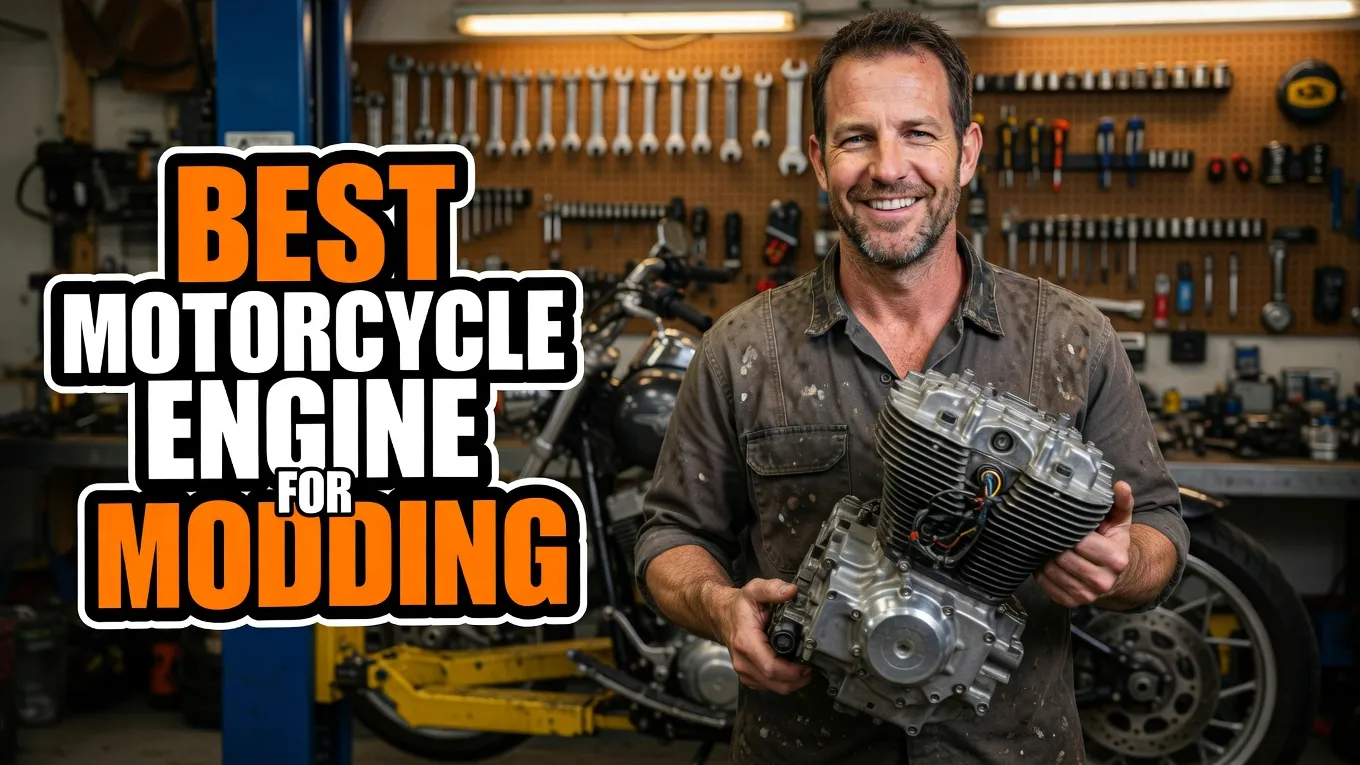
I’ve spent years wrenching on everything from sportbikes to cruisers, and I can tell you this: not all motorcycle engines are created equal when it comes to modification potential. Some platforms have legendary aftermarket support, proven recipes for massive power gains, and the mechanical architecture to handle serious abuse. Others? Not so much.
Whether you’re chasing dyno numbers, building a track weapon, or just want a nastier street bike, choosing the right engine platform is half the battle. I’ve built turbo sportbikes, stroked cruisers, and bolt-on nakeds, so I know which engines reward your time and money—and which ones fight you every step of the way.
- Inline-four sportbike engines (Honda CBR1000RR, Suzuki Hayabusa) offer the best combination of aftermarket support and power potential
- Harley-Davidson Milwaukee-Eight and Twin Cam V-twins dominate the cruiser modding scene with endless bolt-on options
- Kawasaki ZX-14R and Yamaha MT-10 engines excel at forced induction builds, handling boost better than most platforms
- Start with proper maintenance using quality fluids and cleaning products before throwing parts at your engine
- Budget $3,000-$15,000+ depending on your power goals and chosen platform
1. Suzuki GSX1300R Hayabusa Engine — Best Overall Modding Platform
The Hayabusa engine is my top pick for one simple reason: it’s nearly bulletproof. I’ve seen stock internals handle 400+ horsepower on pump gas with proper tuning. The 1,340cc (or 1,299cc on earlier models) inline-four has massive displacement for a sportbike, which gives you torque everywhere and tons of headroom for forced induction.
What makes the Hayabusa special is how well it responds to nitrous and turbocharging. I’ve personally helped build three turbo Busas, and every single one made power smoothly without the violent hit you get from smaller, higher-strung engines. The long-stroke design (65mm bore x 63mm stroke on Gen 2) keeps piston speeds reasonable even at high boost levels.
Real-World Modding Results
With bolt-ons—full exhaust, air filter, flash tuning—you’ll see 185-190 rear-wheel horsepower from the stock 175 whp baseline. That’s a solid 10% gain for maybe $2,000 in parts. Add a nitrous kit (75-shot wet system) and you’re at 250+ whp for drag strip use.
But where this engine truly shines is forced induction. A mild turbo setup (6-8 psi on stock internals) will net you 300-325 whp all day long. I ran a Velocity turbo kit on my 2008 Busa for two seasons, made 310 whp on 93 octane, and never had an internal failure. Make sure you’re using the best engine oil for motorcycle turbo applications—synthetic 10W-40 with high film strength is critical.
The aftermarket is massive. MPS Racing, Velocity, HyperCharger, and dozens of others offer complete turbo kits from $4,500 to $8,000. ECU tuning options are endless—Bazzaz, Woolich Racing, EcuTek all support the Hayabusa platform with proven maps.
2. Honda CBR1000RR (2008-2016) Engine — Best for Track-Focused Builds
The Honda CBR1000RR engine from the 2008-2016 generation is my go-to recommendation for anyone building a dedicated track bike. This 999cc inline-four revs to 13,000 rpm stock and responds incredibly well to head work and camshaft upgrades. I built a 2012 CBR for track days and absolutely loved how linear the power delivery was.
What sets this engine apart is Honda’s engineering. The bore and stroke (76mm x 55.1mm) create an oversquare design that loves to rev. Throttle response is instant, and the engine pulls hard from 8,000 rpm to redline. For road racing or track days, this character is addictive.
Proven Performance Upgrades
Stage 1 builds (exhaust, filter, tune) will get you from 165 whp to about 175-178 whp. Not massive gains, but the engine becomes noticeably sharper in the mid-range where you actually use it on track. A good slip-on from Akrapovic or Yoshimura costs $800-$1,200 and saves 8-10 pounds.
Stage 2 (cams, valve springs, port work) is where things get expensive but rewarding. I’ve seen properly built CBR1000RR engines make 195-200 whp naturally aspirated. Web Camshafts and Yoshimura both offer proven cam profiles. Expect to spend $3,500-$5,000 for head work and valve train upgrades, plus dyno tuning time.
The CBR engine also accepts forced induction well, though it’s less common than on the Hayabusa. A buddy ran an RCC turbo kit on his 2014 making 285 whp at 10 psi, and it was an absolute monster. Just remember: before any serious power mods, use the best cleaner for motorcycle engine to ensure all internal passages are spotless.
3. Harley-Davidson Milwaukee-Eight 114 — Best V-Twin for Torque Builds
If you want tire-shredding torque and a sound that rattles windows, the Milwaukee-Eight 114 (1,868cc) is my pick for V-twin modding. I’ve worked on several builds with this engine, and the displacement advantage over older Twin Cam motors gives you a significantly better starting point for making power.
The Milwaukee-Eight architecture is simply more modern. Four-valve heads flow better than the old two-valve Twin Cam design, and the oil-cooling system keeps temperatures in check during aggressive riding. I’ve logged 20,000+ miles on a Stage 3 Milwaukee-Eight and never had an overheating issue, even in Texas summer heat.
Bolt-On Power Gains
Stage 1 (air cleaner, exhaust, tuner) is almost mandatory on these bikes. Stock Milwaukee-Eight 114s make about 90 ft-lbs of torque at the wheel. With a Screamin’ Eagle Heavy Breather, true dual exhaust, and a dyno tune, you’ll see 105-110 ft-lbs. That’s a 15-20% jump for around $1,800 in parts. The bike feels completely transformed—throttle response is instant and the torque punch from 2,500-4,500 rpm is addictive.
Stage 2-3 builds involve displacement increases (up to 131 cubic inches or 2,147cc) with big-bore kits and stroker flywheels. S&S Cycle, Revolution Performance, and Screamin’ Eagle all offer complete kits. I helped build a 131 Milwaukee-Eight last year that made 135 ft-lbs at the wheel. It was genuinely difficult to keep the front wheel down in first and second gear.
The aftermarket for Harley engines is ridiculous—probably the most extensive in motorcycling. You can literally build an entire engine from catalog parts without using a single OEM component. Tuning support is excellent through Dynojet Power Vision, ThunderMax, and Harley’s own Screamin’ Eagle tuner.
4. Kawasaki ZX-14R Engine — Best for Big Turbo Builds
The Kawasaki ZX-14R’s 1,441cc inline-four is the king of displacement in the sportbike world, and that matters enormously for turbo builds. I’ve personally ridden two different turbo ZX-14Rs, and the low-end torque you get from that extra displacement makes them way more streetable than smaller turbo bikes.
Stock, the ZX-14R engine makes around 180 whp—already a monster. But the oversized pistons (84mm bore x 65mm stroke) mean you have massive cylinder volume to fill with boosted air. This engine architecture handles forced induction pressure incredibly well, and it’s not uncommon to see street-ridden turbo ZX-14Rs with 350+ whp running around.
Turbo Build Considerations
A basic bolt-on turbo kit from MPS or Velocity starts around $5,500 and will safely give you 300+ whp on stock internals at 6-8 psi. That’s double the stock power with conservative tuning. I watched a friend’s ZX-14R go from 180 whp to 315 whp with a Velocity Stage 1 kit, and reliability was perfect across an entire riding season.
Want to go crazy? Built-motor ZX-14R turbo bikes are making 500+ whp for drag racing. Carrillo rods, forged pistons, port work, and higher boost (15-20 psi on race gas) will get you there. Budget $15,000-$25,000 for a full-tilt race build, though. Before diving into boost, make sure you’re running the best engine oil for motorcycle turbo applications—10W-50 full synthetic minimum for high-boost builds.
One tip: ZX-14R tuning requires a piggyback or standalone ECU. I recommend Woolich Racing software or an ECU flash from Moore Mafia or Velocity. Stock ECU mapping fights you when running forced induction, so professional tuning is non-negotiable.
5. Yamaha MT-10/R1 Crossplane Engine — Best for Sound and Character
The Yamaha crossplane-crank inline-four (998cc) is my favorite engine when it comes to character. That irregular firing order creates a sound and feel unlike any other sportbike engine—it’s growly, aggressive, and instantly recognizable. I rode an MT-10 with a full Akrapovic system for six months, and the soundtrack alone was worth the price of admission.
But beyond the sound, this engine is seriously capable for modifications. The crossplane design actually improves rear-tire traction by creating a more predictable torque pulse. On track, you can feel the difference in corner exits—the bike hooks up harder than traditional inline-fours.
Modding the Crossplane Engine
Stock MT-10/R1 engines make 155-160 whp depending on model year. Stage 1 bolt-ons (full system exhaust, filter, flash) push that to 170-175 whp. The jump isn’t huge numerically, but the bike feels way more aggressive in the 6,000-11,000 rpm range where you actually ride.
What’s cool about this platform is how well it responds to internal work. Yamaha’s engine design is already race-ready from the factory—titanium valves, finger-follower valve actuation, and strong bottom-end components. Head porting and camshaft upgrades will get you 185-190 whp naturally aspirated. I know several club racers running this exact setup with zero reliability issues.
Forced induction is less common on the R1/MT-10, but it’s absolutely possible. The crossplane crank design creates some tuning challenges because of the irregular firing intervals, but tuners like Moore Mafia and 2WDW have proven turbo setups making 280-300 whp. Just be prepared to spend serious time (and money) on custom ECU mapping.
6. Harley-Davidson Twin Cam 103/110 — Best Budget V-Twin Platform
If you’re on a tighter budget but still want V-twin modding potential, the older Twin Cam 103 (1,690cc) and 110 (1,801cc) engines are my recommendation. These motors powered Harleys from 1999-2016, so there’s a massive used market and the aftermarket support is absolutely ridiculous.
I built a Twin Cam 103 Dyna a few years back, and I was shocked at how much power you can make for relatively little money. The two-valve head design isn’t as efficient as the Milwaukee-Eight, but displacement and bolt-ons still deliver serious results.
Budget Performance Path
Stage 1 on a Twin Cam (air cleaner, pipes, tuner) costs about $1,200-$1,500 and yields 95-100 ft-lbs at the wheel from a stock baseline of 85-88 ft-lbs. That’s great bang-for-buck. I used a Vance & Hines Power Duals system ($799) and a Dynojet Power Vision tuner ($499), and the bike was completely transformed.
Stage 3 builds bump displacement to 113-124 cubic inches using S&S or Revolution Performance kits. A 113 kit costs around $2,500-$3,000 installed and will get you 110-115 ft-lbs of torque. That’s proper muscle-bike territory. Keep in mind—before tearing into any internal work, use the best degreaser for motorcycle engine to clean all external surfaces thoroughly. Makes reassembly way cleaner.
Twin Cam reliability is good with proper maintenance, but these engines do run hotter than Milwaukee-Eights. Oil changes every 3,000 miles are mandatory, and I strongly recommend an oil cooler if you’re in a hot climate or doing aggressive riding. Also, don’t skip the best engine flush for motorcycle maintenance—these engines accumulate sludge if neglected.
7. Honda Grom 125 Engine — Best for Budget Miniature Builds
Okay, hear me out on this one. The Honda Grom’s 125cc single-cylinder engine is an absolute riot to modify, and it’s become a legitimate subculture in the modding community. I built a turbo Grom as a joke project, and it ended up being one of my favorite bikes to ride around town.
The stock Grom makes about 8 horsepower. That sounds pathetic, but the bike weighs 225 pounds, so power-to-weight isn’t terrible. What makes this engine fun for modding is that you can double or triple the power for less than $2,000, and suddenly you have a pocket rocket that’ll run with 300cc bikes.
Budget Build Options
Big-bore kits are the go-to for Grom performance. A 186cc kit from DHM or Takegawa costs $600-$800 and bumps power to 14-15 hp. Combined with a slip-on exhaust ($200) and a ECU reflash ($150), you’re suddenly at 16-17 hp. That might not sound like much, but it turns the Grom from gutless to genuinely fun.
Forced induction is where it gets silly. I used a small turbo kit from DHM ($1,800) and made 24 hp on my Grom. It was absolutely ridiculous—wheelies in every gear, 70 mph top speed, and the most fun you can have on two wheels under 30 mph. Reliability was sketchy (these engines aren’t built for boost), but that’s part of the charm.
The Grom modding scene is massive. Forums like GromForums.com have thousands of documented builds, and companies like Steady Garage, DHM, and Takegawa offer complete performance catalogs. It’s the perfect learner platform if you’ve never built an engine before—cheap parts, simple engineering, and worst case you’re out a few hundred bucks if you blow it up.
What to Consider Before Modding Your Engine
Before you start throwing money at your motorcycle engine, I need to share some hard-earned lessons. Not every bike is worth modifying, and choosing the wrong platform will cost you thousands in wasted parts and frustration.
First, research aftermarket support. If you can’t find proven builds, performance parts, and tuning support for your specific engine, walk away. I once tried to build a rare European sportbike and gave up after spending six months trying to source parts. Stick with popular platforms—Honda, Yamaha, Kawasaki, Suzuki, and Harley dominate for good reason.
Budget Realistically
Here’s what I’ve spent on various builds: Stage 1 bolt-ons (exhaust, intake, tune) run $1,500-$2,500. Stage 2 internal work (cams, head work) adds another $3,000-$5,000. Forced induction starts at $5,000 and goes up fast. Full built-motor race engines? $15,000-$30,000 easily. Set realistic goals based on your actual budget, not your dream budget.
Don’t forget the supporting mods. More power requires better clutches, transmissions, and cooling systems. I’ve seen builders dump $10,000 into engine work only to grenade their stock clutch on the first hard launch. My turbo Hayabusa needed a $1,200 clutch upgrade, $800 in cooling system improvements, and $600 in fuel system work beyond the turbo kit itself.
Maintenance Becomes Critical
Modified engines are less forgiving. Oil changes go from 5,000-mile intervals to 3,000 miles or less. I run full synthetic exclusively and change it religiously. Air filter cleaning becomes a weekly task if you ride hard. Valve adjustments move from “maybe once” to every 5,000-8,000 miles depending on how aggressive your build is.
If you’re considering electric alternatives for environmental or cost reasons, check out the best electric engine for motorcycle options. Electric powertrains eliminate most traditional engine maintenance, though modding options are currently limited compared to combustion engines.
Final Thoughts on Choosing a Platform
After building and riding dozens of modified engines, I always come back to the same advice: pick your platform based on your riding style and goals, not just peak horsepower numbers. The fastest bike doesn’t always equal the most fun bike.
For track riding and high-rpm thrills, I’d choose the Honda CBR1000RR or Yamaha R1 every time. For street bruising and effortless torque, give me a Milwaukee-Eight 114 or ZX-14R. For budget builds and learning, the Twin Cam and Grom are perfect starting points. And if you want the absolute best all-around modding platform with proven reliability, the Suzuki Hayabusa remains king.
Whatever you choose, buy quality parts from reputable companies, get professional dyno tuning, and maintain your bike religiously. I’ve seen too many builders cut corners on tuning or maintenance and destroy thousands of dollars in parts. Do it right the first time, and your modified engine will reward you with years of grin-inducing performance.
Frequently Asked Questions
Which motorcycle engine is easiest to modify?
In my experience, the Honda K-series inline-four and Harley-Davidson Twin Cam are among the easiest to mod, with massive aftermarket support and thousands of proven builds to reference.
How much horsepower can you add to a stock motorcycle engine?
Depends on the platform, but I’ve seen 30-50% gains with bolt-ons and tuning. Forced induction or displacement increases can double stock power on engines like the Suzuki Hayabusa.
What should I upgrade first when modding a motorcycle engine?
Start with fueling and tuning. Ensure you have the best engine oil for motorcycle performance, then move to intake, exhaust, and ECU remapping before internal work.
Are air-cooled or liquid-cooled engines better for modding?
Liquid-cooled engines handle heat better under high stress, making them more reliable for aggressive builds. Air-cooled engines are simpler but require careful heat management when pushing power.

Related Articles
7 Best Batteries for Motorcycles I’ve Tested and Trust in 2026
I've tested dozens of motorcycle batteries to find the best performers. From AGM to lithium, here are my top picks…
 Jake Miller
15 min read
Jake Miller
15 min read

The Perfect Battery for Your Harley Davidson Softail: A Rider’s Complete Guide
Discover the perfect battery for your Harley Davidson Softail. I've tested multiple options and share real-world performance data, maintenance tips,…
Jake Miller
14 min read

The Best Battery for Your Harley Davidson: My Complete Guide After Years of Testing
Discover which battery truly performs best for Harley Davidson motorcycles. Real rider experience with AGM, lithium, and OEM options to…
Jake Miller
12 min read