
How to Charge a Motorcycle Battery Without a Charger: 6 Methods That Actually Work
 Jake Miller
13 min read
Jake Miller
13 min read
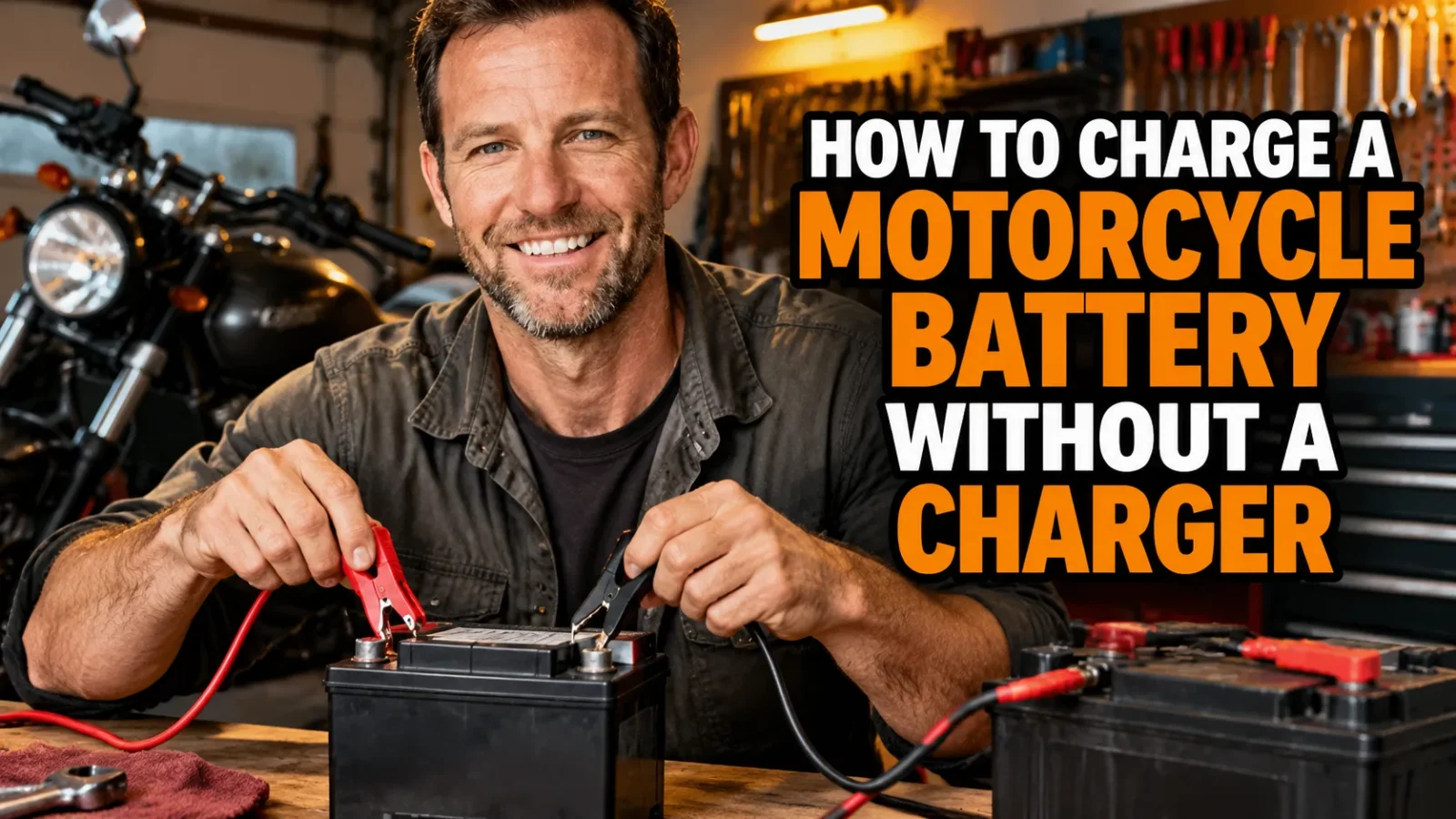
I’ve been riding motorcycles for over a decade, and there’s nothing more frustrating than turning the key only to hear that dreaded clicking sound. Your battery’s dead, you need to get somewhere, and of course—you don’t have a charger handy.
The good news? I’ve learned several reliable methods to charge a motorcycle battery without a dedicated charger. Some are quick fixes to get you rolling, while others can actually restore your battery’s charge over time.
In this guide, I’ll walk you through six proven techniques I’ve used myself, plus some important safety tips you absolutely need to know before attempting any of these methods.
- Jump-starting from a car or another motorcycle provides immediate power but doesn’t fully charge your battery
- Running your motorcycle for 30-60 minutes allows the bike’s charging system to replenish battery charge
- A car battery charger can work if used on the lowest setting (2 amps or less) with careful monitoring
- Solar panels, laptop chargers, and DIY methods exist but require proper voltage regulation to avoid damage
- Always wear safety gear and never attempt to charge a visibly damaged or leaking battery
Understanding Your Motorcycle Battery Before You Start
Before I jump into the charging methods, let me share something I learned the hard way: not all motorcycle batteries are created equal. Understanding what type you have makes a huge difference in which charging method will work best.
Most modern motorcycles use 12-volt batteries, but they come in different varieties. Lead-acid batteries are the traditional type, while AGM (Absorbed Glass Mat) and lithium-ion batteries are becoming increasingly common on newer bikes.
I’ve found that AGM batteries are more forgiving with alternative charging methods, while lithium batteries require more careful voltage management. If you’re not sure what type you have, check your owner’s manual or look at the label on the battery itself.
When Your Battery Is Beyond Charging
Here’s a reality check from my experience: sometimes your battery just can’t be saved. If your battery is more than 3-4 years old, has visible corrosion, shows cracks, or feels unusually hot to the touch, it might be time for a replacement rather than a charge.
I once spent two hours trying to charge an old battery using the methods below, only to realize later that the cells were sulfated beyond recovery. Learn from my mistake—test your battery voltage first with a multimeter if possible.
Method 1: Jump-Starting from Another Vehicle
This is my go-to method when I need to get moving fast. I’ve jump-started my bike from cars, trucks, and other motorcycles countless times. It’s quick, effective, and gets you back on the road in minutes.
The key difference between jumping from a car versus another motorcycle is the amperage involved. Car batteries pack significantly more power, which can potentially harm your bike’s electrical system if you’re not careful.
Jump-Starting from a Car (The Safe Way)
I always follow these steps when using a car battery to jump my motorcycle:
First, make absolutely sure the car engine is OFF. This is critical. A running car alternator produces too much voltage for a motorcycle’s smaller electrical system and can fry your bike’s electronics. I learned this from a mechanic after nearly making this costly mistake myself.
Connect the positive (red) jumper cable to your motorcycle’s positive battery terminal first, then connect the other end to the car’s positive terminal. Next, connect the negative (black) cable to the car’s negative terminal, and the other end to an unpainted metal part of your motorcycle’s frame—not directly to the battery’s negative terminal.
Wait about 3-5 minutes to let some charge flow, then try starting your motorcycle. Once it fires up, remove the cables in reverse order. Let your bike run for at least 30 minutes so the charging system can replenish the battery.
Jump-Starting from Another Motorcycle
This method is safer because both batteries are similar in capacity. I use the same cable connection procedure, but with another bike, you can actually start the donor motorcycle after connecting the cables to provide a stronger boost.
Just remember: remove the cables before revving either engine. I’ve seen sparks fly when people forget this step, and it’s not pretty.
Method 2: Using Your Bike’s Charging System
Once you’ve got your motorcycle running (whether through jump-starting or push-starting), your bike’s built-in charging system takes over. The stator acts as a generator, and the regulator/rectifier converts AC power to DC power to charge your battery while you ride.
In my experience, this is the most natural way to recharge your battery without a dedicated charger. The question is: how long does it take to charge a 12v motorcycle battery while riding?
How Long You Need to Ride
I’ve found that riding for 30-60 minutes at highway speeds (with RPMs above 3000) will partially recharge a weak battery. If your battery was only mildly discharged, an hour-long ride should get you back to a healthy charge level.
However, if your battery was completely dead, it might take several rides or a few hours of continuous running to fully charge. The charging system is designed to maintain charge, not rapidly recover deeply discharged batteries.
Here’s a tip I use: after jump-starting, I avoid short trips for the rest of the day. Each time you start the engine, you drain the battery a bit. Give your charging system time to recover that loss plus add more charge back.
Signs Your Charging System Isn’t Working
Sometimes the problem isn’t just the battery—it’s the charging system itself. I check for these warning signs: headlights dimming at idle, electrical accessories cutting out, or the battery repeatedly dying after riding.
If you suspect charging system problems, test the voltage at the battery terminals while the engine is running. You should see 13.5-14.5 volts at 2000-3000 RPM. Anything lower suggests your stator or regulator/rectifier might be failing.
Method 3: Using a Car Battery Charger (With Caution)
I’ll be honest—this method makes me nervous, but I’ve used it successfully when I had no other option. A battery charger for car and motorcycle use can work, but only if you follow strict precautions.
Car battery chargers are designed for batteries with much higher amp-hour ratings than motorcycle batteries. Using one improperly can overcharge, overheat, or even cause your motorcycle battery to explode. I’m not exaggerating—I’ve seen the aftermath.
The Safe Setup
If you must use a car battery charger, only use the lowest amperage setting available—ideally 2 amps or less. Many modern chargers have a “motorcycle” or “small battery” mode specifically for this purpose.
I connect the charger to the battery terminals (positive to positive, negative to negative) while the battery is disconnected from the motorcycle if possible. This prevents potential voltage spikes from reaching your bike’s electronics.
Set a timer and check the battery every 30 minutes. Feel the battery casing—if it’s getting warm to the touch, disconnect immediately. I usually limit charging sessions to 2-3 hours maximum with this method.
For what it’s worth, investing in a proper best battery charger for a motorcycle is one of the smartest purchases I’ve made. They’re specifically designed with the right charging profiles and automatic shut-off features that prevent damage.
Method 4: Solar Panel Charging
This is my favorite method for maintaining battery charge when my bike sits unused for extended periods. Solar trickle chargers are affordable, safe, and completely automatic once you set them up.
I use a small 12-volt solar panel (5-10 watts is sufficient) with a built-in charge controller. The charge controller is essential—it prevents overcharging when the sun is strong and automatically stops charging when the battery is full.
Setting Up Solar Charging
My setup is embarrassingly simple. I place the solar panel where it gets direct sunlight—either on my bike’s seat or on the ground nearby. The panel connects directly to the battery terminals or through the SAE connector if my battery has one.
Solar charging is slow. We’re talking a full day of sunlight to recover a moderately discharged battery. But here’s why I love it: it’s a true “set it and forget it” solution that acts like a best trickle charger for motorcycle battery applications.
I leave my solar panel connected during winter storage, and my battery stays topped off without any intervention. No more dead batteries after months of sitting idle.
Solar Charging Limitations
Let’s be real—solar won’t help you in an emergency. If your battery is dead right now and you need to ride in an hour, solar isn’t your answer. It’s a maintenance tool, not a rescue tool.
Also, cloudy climates (like where I used to live in the Pacific Northwest) make solar charging frustratingly slow. You need consistent, direct sunlight for this method to be practical.
Method 5: DIY Laptop or Power Supply Charging
I’ve used this method exactly twice in desperate situations, and both times I was extremely careful. You can theoretically charge a 12V motorcycle battery using a DC power supply like a laptop charger or adjustable power supply, but the risks are high if you don’t know what you’re doing.
The critical requirement is that your power supply must output approximately 13.8-14.4 volts DC and be capable of current limiting. Most laptop chargers output 19V or higher, which will damage your battery.
The Process (For Advanced DIYers Only)
I only recommend this if you’re comfortable with electronics. You’ll need a multimeter to verify voltage and an adjustable DC power supply or a voltage regulator circuit to step down the voltage to safe levels.
Connect the positive output to the positive battery terminal and negative to negative. Start with very low current (0.5-1 amp) and monitor the battery temperature constantly. If it gets warm, stop immediately.
Honestly? Unless you’re stranded in the wilderness with electronic components and skills, skip this method. The risk of overcharging, overheating, or short-circuiting far outweighs the benefits. A proper charger for dead motorcycle battery situations is worth every penny.
Method 6: Push-Starting Your Bike
This isn’t technically charging the battery, but it gets your engine running so your charging system can take over. I’ve push-started my bike more times than I can count, and it works great for manual transmission motorcycles.
Here’s my technique: Turn the ignition on, pull in the clutch, and put the bike in second gear (not first—second provides better momentum). Get the bike rolling as fast as you can—either by pushing it yourself downhill or having friends help push you.
Once you’re moving at a decent pace (running speed), quickly release the clutch while giving a slight twist of the throttle. The engine should turn over and catch. Immediately pull the clutch back in to prevent stalling.
Push-Starting Limitations
This only works with manual transmission motorcycles. If you ride an automatic scooter or bike with CVT transmission, push-starting won’t work—the transmission needs engine power to engage.
Also, if your battery is completely dead (like, zero volts), push-starting might not work because your ignition system needs some power to create the spark. You might need just enough charge to fire the spark plugs.
Safety Precautions I Never Skip
After years of working with motorcycle batteries, I’ve developed some non-negotiable safety rules. Batteries contain sulfuric acid and can produce explosive hydrogen gas—I’ve seen batteries vent and even rupture when mishandled.
Always wear safety glasses and gloves when working with batteries. Battery acid burns are no joke, and I’ve gotten small splashes on my skin that hurt for days.
Work in a well-ventilated area, preferably outdoors. Never smoke or create sparks near a battery being charged. I keep a spray bottle of baking soda solution nearby to neutralize any acid spills immediately.
Warning Signs to Stop Immediately
If your battery starts hissing, bubbling excessively, swelling, or getting hot to the touch, disconnect everything immediately and move away. These are signs of thermal runaway or overcharging, and in extreme cases, the battery can explode.
I once saw a battery case crack open from overcharging, spewing acid everywhere. Since then, I never leave a charging battery unattended, regardless of the method I’m using.
Maintaining Your Battery to Avoid Future Dead Battery Situations
The best way to charge a battery without a charger is to not need to charge it in the first place. I’ve learned that proper maintenance prevents 90% of battery problems.
I check my battery terminals monthly for corrosion and clean them with a wire brush and baking soda solution. Tight, clean connections ensure your charging system works efficiently and your starter gets maximum power.
During winter or extended storage periods, I either use a solar panel or disconnect the negative terminal to prevent parasitic drain. Even when off, your motorcycle’s clock, alarm, and ECU draw tiny amounts of current that will eventually drain the battery.
When to Replace vs. Recharge
I use a simple rule: if my battery repeatedly dies despite proper charging and maintenance, or if it’s more than 4 years old, I replace it rather than fight with it. Batteries have a finite lifespan, and old batteries lose their ability to hold charge.
A quality motorcycle battery costs $50-150 depending on your bike. Considering the hassle and potential damage from repeatedly jump-starting or using improvised charging methods, replacement often makes more financial sense.
My Personal Recommendations
After trying all these methods multiple times over the years, here’s what I actually do now: I keep jumper cables in my bike’s storage compartment for emergencies, and I own a proper smart charger that I use for maintenance charging.
For emergency situations, jump-starting from another vehicle (car or motorcycle) is my preferred method. It’s fast, relatively safe when done correctly, and gets me mobile again so my bike’s charging system can take over.
For long-term maintenance, I rely on either a quality automatic battery tender or my solar panel setup. Both methods keep my battery healthy without requiring me to remember to charge it manually.
The DIY methods involving laptop chargers or improvised power supplies? I save those for absolute emergencies only, and even then, I proceed with extreme caution and constant monitoring.
Final Thoughts on Charging Without a Charger
Look, I’ve been in tight spots where knowing these alternative charging methods saved my ride. Whether it’s jump-starting from a kind stranger’s car or letting my bike idle for an hour in a parking lot, these techniques work when you need them.
That said, none of these methods replace owning a proper battery charger designed for motorcycles. The peace of mind knowing I can safely, fully, and correctly charge my battery is worth the modest investment.
If your battery is consistently dying, address the root cause rather than constantly improvising charging solutions. Check your charging system, look for parasitic drains, and consider whether your battery has simply reached the end of its life.
Ride safe, keep those batteries topped off, and may you never hear that dreaded clicking sound when you turn the key. And if you do? Now you’ve got six proven methods to get back on the road.
Frequently Asked Questions
Can I charge my motorcycle battery with a car battery?
Yes, you can charge a motorcycle battery using a car battery through jump-starting or using jumper cables. Just make sure the car engine is OFF during the process to avoid overcharging the smaller motorcycle battery with excessive voltage.
How long does it take to charge a motorcycle battery without a charger?
Using a running motorcycle engine, it typically takes 30-60 minutes of riding to partially recharge a depleted battery. Jump-starting provides immediate power but doesn’t fully charge the battery. For a complete charge using alternative methods, expect 4-8 hours depending on the battery’s condition.
Can I use a car battery charger on my motorcycle?
Yes, but with caution. Use only the lowest amperage setting (2 amps or less) and monitor closely. Car chargers designed for larger batteries can overcharge and damage smaller motorcycle batteries. A dedicated motorcycle battery charger is always safer.
Will riding my motorcycle charge a dead battery?
Riding will charge a weak or partially discharged battery, but a completely dead battery may not charge effectively while riding. The motorcycle’s charging system (stator and regulator/rectifier) is designed to maintain battery charge, not revive deeply discharged batteries.

Related Articles

Scooters vs Motorcycles: My Honest, First-Hand Comparison After Riding Both for Years
After thousands of miles on both scooters and motorcycles, I break down cost, comfort, maintenance, and safety to help you…
Jake Miller
10 min read

7 Scooters That Look Like Motorcycles for Riders Who Want Style and Storage
Explore my top 7 scooters that look like motorcycles, from adventure crossovers like the Honda X-ADV to sporty maxis like…
Jake Miller
9 min read

How Long Do Honda Motorcycles Last? My 20-Year Owner’s Reality Check
Discover how long Honda motorcycles really last from an owner with 100k+ miles of experience. Learn maintenance secrets, high-mileage examples,…
Jake Miller
10 min read