
Are Spoked Motorcycle Wheels Dangerous? A Rider’s Honest Safety Breakdown
 Jake Miller
8 min read
Jake Miller
8 min read
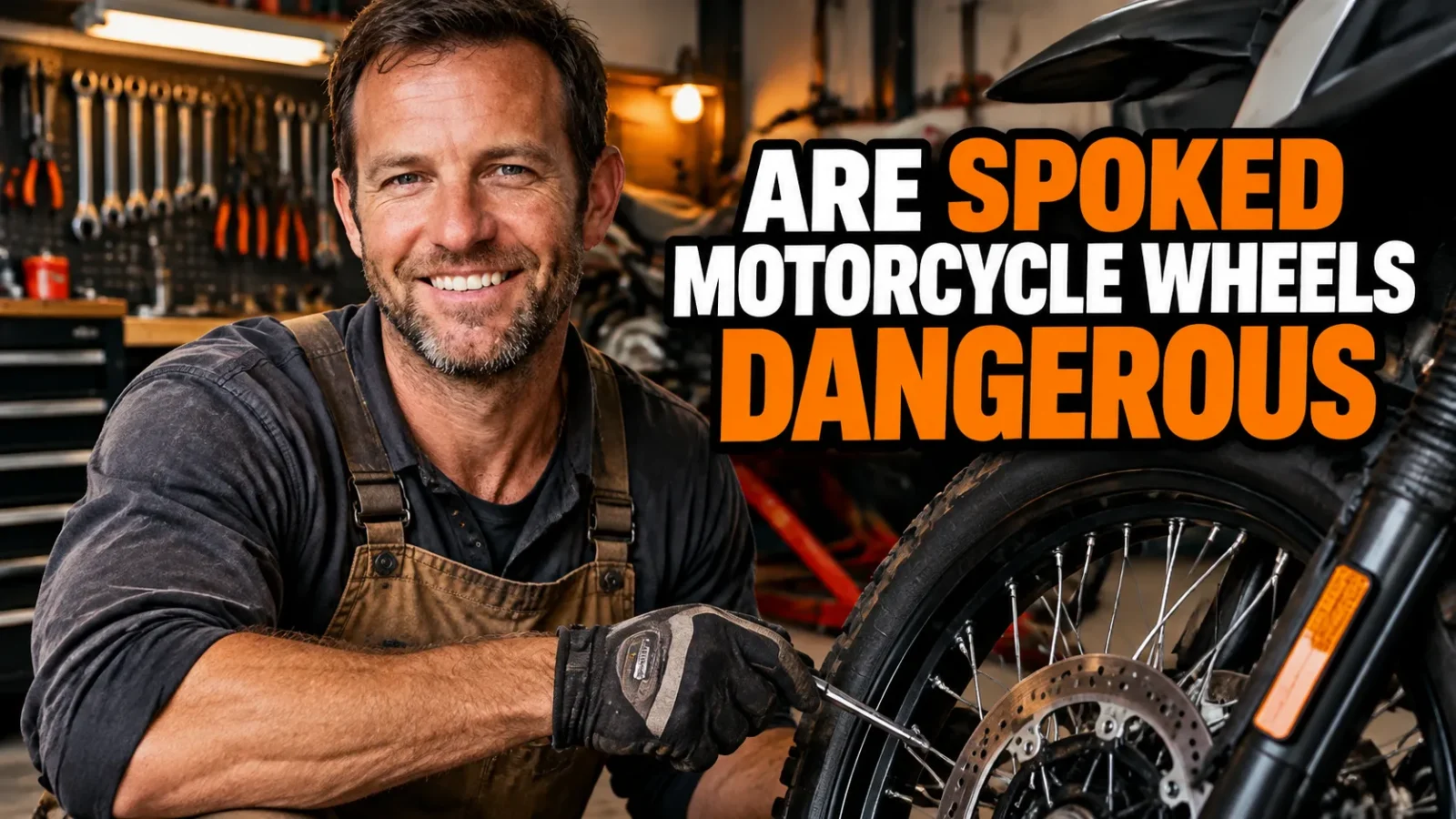
Every few months, someone at a gas station corners me with the same question: “Aren’t those spoked wheels risky?” It’s a fair thing to wonder. Spokes look delicate next to a chunky cast alloy wheel, and the internet is full of strong opinions on both sides.
I’ve ridden both kinds for years, on pavement, gravel, and some roads that probably shouldn’t count as roads. So here’s my honest, practical take on whether spoked wheels deserve their reputation, where the real risks hide, and how I keep mine safe.
- Spoked wheels are not inherently dangerous; they’re used on everything from adventure bikes to cruisers.
- The real risk is neglect: loose spokes, rust, and unchecked rim trueness.
- Most spoked wheels use tubes, so punctures deflate slowly but need more repair effort.
- A broken spoke is usually a warning, not a catastrophe, if you act on it quickly.
- Spokes shine off-road and on rough roads; cast wheels win on low maintenance.
The Short Answer From My Garage
No, spoked wheels are not dangerous by design. Manufacturers fit them to bikes that cover enormous distances and carry heavy loads, and those wheels meet the same safety standards as any other. If they were a hidden hazard, we’d see them vanish from showroom floors.
That said, “not dangerous” is not the same as “no responsibility.” A spoked wheel asks more of its owner. If you ignore it, it will eventually let you know, sometimes loudly.
I’ve found that most of the scary stories I hear trace back to poor upkeep or the wrong wheel for the job, not the spokes themselves.
How a Spoked Wheel Actually Works
Tension, not brute strength
A spoked wheel is a tensioned structure. The hub hangs from the rim, held by dozens of thin steel spokes pulled tight. The load travels through the spokes in a way that spreads stress across the whole wheel.
This design is surprisingly forgiving. It flexes slightly under impact and absorbs shocks that might crack a rigid casting. That’s a big reason dirt bikes and adventure bikes depend on it.
Why spoke count and layout matter
More spokes generally means more load sharing and more redundancy. If you’re curious about the details, I wrote up how many spokes on a motorcycle wheel are typical and why the number differs between bikes.
The takeaway for safety: a wheel with its full complement of properly tensioned spokes is a strong, resilient piece of engineering. Problems start when tension drifts or spokes go missing.
The Genuine Risks I Take Seriously
Loose or uneven spoke tension
New spoked wheels settle in. Spokes can loosen over the first few hundred miles, and they can loosen again after hard riding or impacts. Uneven tension makes the rim wobble and puts extra stress on individual spokes.
I check tension by gently tapping each spoke with a metal tool and listening. A healthy spoke gives a clear, consistent note, while a loose one sounds dull. It takes two minutes and could prevent a lot of trouble.
Broken spokes
A snapped spoke is the thing everyone worries about. In my experience it isn’t an instant disaster. The wheel typically stays rideable, but it may go out of true and feel odd under braking.
Still, one broken spoke shifts load onto its neighbors, which makes further failures more likely. Don’t keep riding hard on a wheel with a broken spoke. Slow down, get it home, and fix it properly.
Rust and corrosion
Steel spokes and nipples rust, especially if you ride in winter or near the coast. Corrosion weakens the metal and can seize the nipples, making adjustment impossible. I’ve seen wheels that looked fine at a glance but were rotting where the spokes meet the hub.
Regular washing, drying, and a light coat of protectant make a real difference. Stainless spokes cost more but resist this problem well.
Tubes and slow-leak surprises
Most traditional spoked rims need inner tubes because the spoke nipples pass through the rim and create air leak paths. That has pros and cons. A puncture in a tubed tire tends to deflate more gradually than a blowout, but a pinch flat or a damaged rim tape can cause trouble.
Tire choice matters here too. If you’re comparing options, my notes on the best micheline sport tire for motorcycle use are a good starting point, and I also dug into michelin commander 3 problems that cruiser riders sometimes run into.
What About Tubeless Spoked Wheels?
This is where I see the most confusion. Some modern bikes do come with tubeless spoked wheels, but they’re built differently. The spokes either attach to the rim’s outer flange or use sealed nipples to hold air.
If your bike has this setup, great. If it doesn’t, don’t try to convert a standard spoked rim to tubeless with sealant and hope for the best. I’ve heard enough horror stories to say that plainly.
Check your owner’s manual or the rim markings. If it says tubeless, you’re good. If it says tube-type, run a tube.
Spoked vs. Cast: An Honest Comparison
Where spoked wheels win
- Impact tolerance: They flex and can often be trued after a hit that would crack or bend a cast wheel.
- Trail repairs: You can fix a bent rim or swap a spoke in the field with basic tools.
- Off-road suitability: Long-travel suspension and rough terrain pair naturally with spokes.
- Classic looks: On a retro or cruiser build, nothing else looks right.
Where cast wheels win
- Low maintenance: No tension checks, no truing, no nipples to seize.
- Easy cleaning: A quick wipe and you’re done.
- Tubeless by default: Simpler tire changes and puncture handling.
- Precision on pavement: Rigid construction suits high-performance road riding.
Notice that “safety” isn’t on either list as a clear winner. Both are safe when maintained and used for what they’re designed for. The question is which fits your riding and your willingness to do the upkeep.
Front Wheels, Sizing, and Handling
Another thing that comes up is whether spoked wheels change how a bike handles. The wheel type itself matters less than diameter, weight, and tire profile. Many adventure and dual-sport bikes pair a larger front wheel with a smaller rear for better obstacle handling.
If that sounds odd, I explained why is the front wheel bigger on motorcycle designs in a separate guide. The short version is that a larger front wheel rolls over bumps and holes more smoothly, which is a safety plus off the pavement.
Don’t Forget the Hub and Bearings
When people worry about wheel safety, they fixate on spokes and forget what sits at the center. Wheel bearings carry the load, and worn ones cause play, noise, and in the worst case a seized wheel.
If you’ve never checked yours, I’d start with my guide on how long do wheel bearings last on a motorcycle. Bearing condition affects both spoked and cast wheels, so it’s worth adding to your routine either way.
My Pre-Ride Spoked Wheel Routine
I keep it simple so I actually do it. Here’s what I run through regularly:
- Visual check: Look for bent, missing, or visibly loose spokes and any rust at the nipples.
- Tap test: Tap each spoke and listen for dull or inconsistent tones.
- Spin test: Lift the wheel and spin it, watching the rim for wobble or hop.
- Bearing play: Grab the wheel and try to rock it side to side. Any slop deserves attention.
- Tire and tube condition: Check pressure, tread, and the valve stem, which can creep on tube-type setups.
After any hard impact, such as a pothole, curb, or off-road landing, I do the whole routine again. It’s cheap insurance.
Who Should Choose Spoked Wheels?
I’d recommend them if you…
Ride off-road, tour on rough roads, or own a bike where the style matters. You’ll also enjoy them if you like hands-on maintenance and don’t mind spending a little time with a spoke wrench.
I’d steer away if you…
Want to jump on the bike and never think about wheel maintenance, or you ride mostly smooth pavement at high speed and prefer tubeless convenience. A cast wheel will probably make you happier.
There’s no shame in either choice. The best wheel is the one you’ll actually look after.
Common Myths I Want to Clear Up
“Spokes will snap without warning.” Rarely. They usually give hints first, like a clicking sound, a wobble, or loose tension.
“Cast wheels never fail.” They can crack or bend, and a cracked casting is harder to repair than a bent spoked rim.
“Spoked wheels are too weak for heavy bikes.” Plenty of big touring and adventure machines run them with two-up loads and luggage. Proper spoke gauge and tension handle it fine.
Final Thoughts
After years of riding on both, I’m confident saying that spoked wheels are a smart, proven design, not a hidden danger. They reward riders who pay attention and punish those who don’t, which is true of plenty of things on a motorcycle.
Keep spokes tight, rims true, bearings healthy, and tires matched to the wheel type. Do that, and a spoked wheel will carry you safely for a very long time.
If you’re still on the fence, try spending a weekend with a bike that has them. I suspect you’ll come away with more respect, and fewer worries, than you expected.
Frequently Asked Questions
Are spoked motorcycle wheels less safe than cast wheels?
Not inherently. Both designs are used on production bikes and pass the same safety standards. Spoked wheels need more regular maintenance, while cast wheels can crack on hard impacts. A well-maintained spoked wheel is perfectly safe.
What happens if a spoke breaks while riding?
Usually the wheel stays true enough to ride slowly to a safe stop, because the remaining spokes share the load. You will likely feel a wobble or clicking. Replace the spoke promptly and check the tension of its neighbors.
Can spoked wheels be tubeless?
Yes, but only if designed for it. Some modern bikes use tubeless-compatible spoked rims with sealed nipples or an outer-rim spoke design. Never run a standard spoked rim without a tube unless the manufacturer says it is approved.
How often should I check my spoked wheels?
I check spoke tension and rim trueness before every long trip and at each service interval, and give a quick visual and tap test every few rides, especially after off-road use or hitting a pothole.

Related Articles

8 Best Cruiser Motorcycle Tires for Street Riding: My Real-World Picks
I rank the 8 best cruiser motorcycle tires for street riding, from Michelin to Pirelli, with real notes on grip,…
Jake Miller
9 min read

8 Best Michelin Motorcycle Tires for Every Riding Style (Tested Picks)
Looking for the best Michelin motorcycle tires? I break down my 8 favorite models for sport, touring, adventure, cruiser, and…
Jake Miller
9 min read

Yamaha Tire Pressure Guide: The Right PSI for Safer, Smoother Rides
Learn the right tire pressure for your Yamaha, from sportbikes to cruisers and dirt bikes. Check, adjust and maintain PSI…
Jake Miller
9 min read