
8 Best Motorcycle Shoes for Summer: Cool, Protected, and Actually Comfortable
 Jake Miller
10 min read
Jake Miller
10 min read
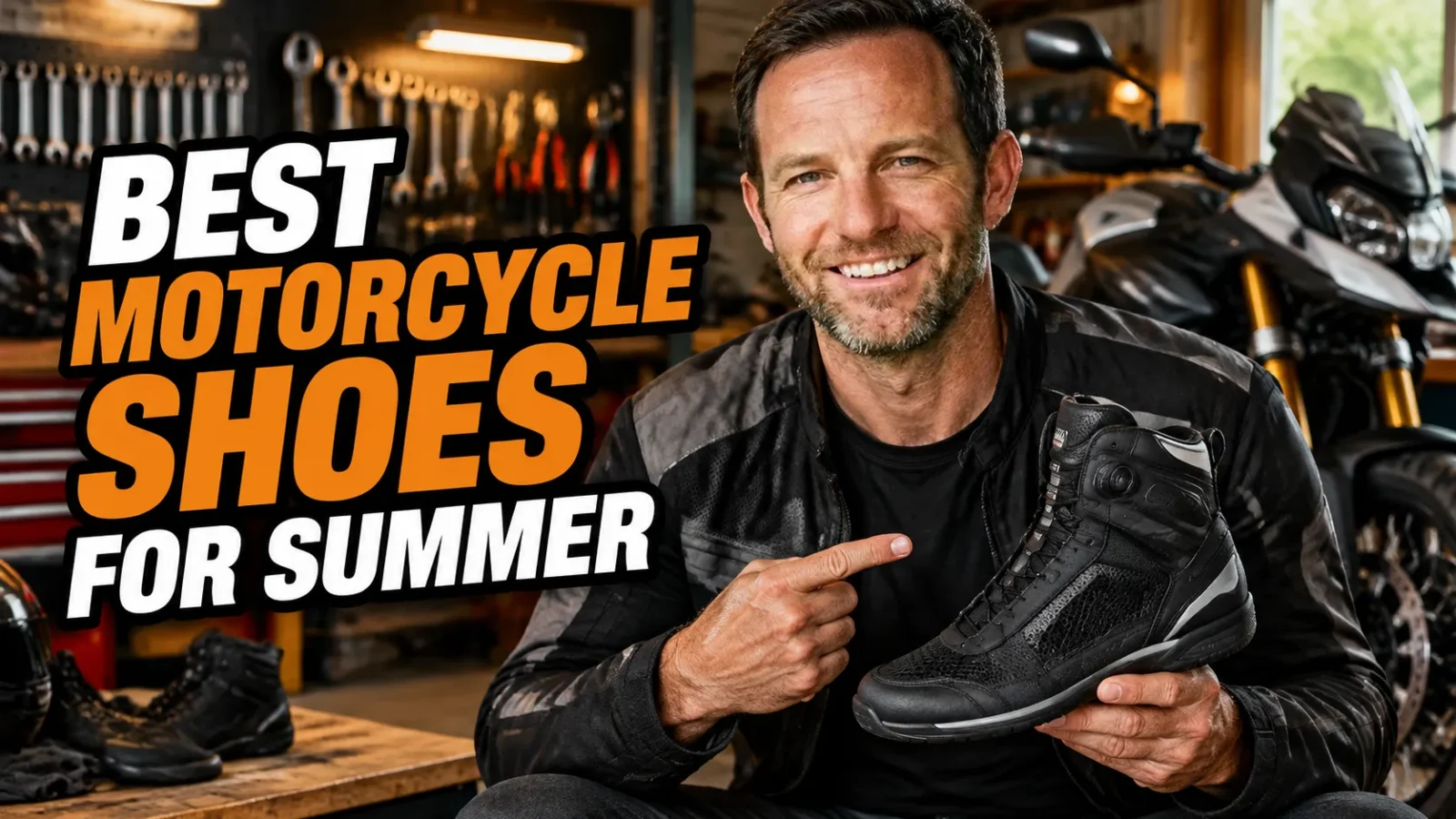
Every June I make the same mistake, and every June I regret it. I pull on my tall, Gore-Tex-lined touring boots for a 30-minute blast to a coffee shop, and by the time I park, my socks are wet in a way that has nothing to do with rain. It took me three summers to admit it: above about 30°C, a proper short riding shoe beats a boot every single time.
But there’s a catch. The summer shoe market is stuffed with sneakers that look the part and protect like a pair of flip-flops. I’ve bought those too. So I spent the last few seasons rotating through mesh shoes, leather-and-mesh hybrids, and sneaker-style options, riding everything from city commutes to 400 km days, to figure out which ones actually breathe and which ones actually protect.
If you’re still deciding between shoes and taller boots, start with my Ultimate Guide to Motorcycle Boots — it explains the coverage trade-offs before you spend a cent. Once you’ve settled on a short shoe, the eight picks below are the ones I keep coming back to.
- My overall pick is the Alpinestars Faster-3 Rideknit — a CE-certified woven mesh shoe that flows air and still has real armor.
- For pure airflow on the hottest days, the Icon Tarmac 3 is hard to beat, but it sacrifices some durability.
- Never buy a summer shoe without CE certification to EN 13634, a reinforced toe box, and rigid ankle inserts.
- Budget shoppers should look at the Alpinestars Sektor v2; premium buyers at the Dainese York Air.
- Shoes are for commuting and short rides — for touring and off-road, step up to taller boots.
What I Actually Look For in a Summer Riding Shoe
After enough disappointing purchases, I stopped shopping by looks and started shopping by three criteria. If a shoe fails any of them, I don’t care how good it looks with jeans.
Ventilation That Works While You’re Moving
Mesh only helps when air passes through it. That means the panels need to sit on the sides and top of the foot, not just in a decorative stripe. I also check whether the tongue and insole are perforated, because a breathable upper on a solid, non-breathable footbed just traps sweat.
Protection Ratings, Not Marketing Words
I want to see CE certification to EN 13634 printed on the label, plus a reinforced toe box, a rigid heel counter, and molded ankle inserts. “Reinforced” and “protective” mean nothing on a spec sheet without the standard behind them. This is exactly the same test I apply when I’m writing about the best motorcycle boots for beginners — the certification is the floor, not the ceiling.
Grip and Feel on the Pegs
Thin, flexible soles give me better feel for the shifter and rear brake, which matters more in stop-start city traffic than on the open road. But too thin and my feet ache after an hour. I want a rubber compound that grips a wet peg and a sole stiff enough to spread pressure across the footbed.
1. Alpinestars Faster-3 Rideknit — Best Overall Summer Riding Shoe
If I had to keep one pair and sell the rest, it would be the Faster-3 Rideknit. The “Rideknit” upper is a woven, seamless mesh that Alpinestars developed for exactly this purpose, and it’s the single most effective breathable upper I’ve worn in a riding shoe.
Underneath the knit, though, it’s a genuine piece of protective gear. The Faster-3 Rideknit is CE certified to EN 13634:2017, with a reinforced toe box, a TPU heel counter, dual-density ankle protection, and Alpinestars’ TPF transverse protection frame built into the sole structure. I’ve also found the replaceable EVA footbed surprisingly comfortable on long days.
Price-wise, I’ve seen it hovering in the $170 to $200 range depending on colorway and sales. Sizing has been true to my normal street shoe size across three pairs. The laces tuck into an elastic loop on the tongue, which sounds trivial until you’ve had a lace snag a footpeg at a traffic light.
2. Dainese York Air — Best Premium Pick
The York Air is what I reach for when I want something that looks like a proper leather shoe and still moves air. Dainese builds it from cowhide leather paired with large mesh panels, so you get abrasion resistance on the high-wear zones and ventilation where you need it most.
Protection is where the Dainese pedigree shows. There are rigid TPU inserts at the heel and ankle, reflective detailing on the back, and a rubber sole with a tread pattern that actually bites on slick pavement. The York Air is the pair I’d wear to a meeting where I don’t want to look like I just stepped off a race bike.
It runs around $200 to $230, which is the most I’d comfortably spend on a summer shoe. My honest caveat: the leather shell means it breathes noticeably less than an all-mesh design. On a 35°C day in slow traffic, I’d rather have the Faster-3 Rideknit. On a 25°C day, the York Air wins on looks and durability.
3. TCX Street Air — Best Commuter Shoe
The Street Air is my default recommendation for anyone riding to work. TCX builds it from bycast leather and mesh, and the result looks enough like a casual sneaker that I’ve worn it straight into an office without changing shoes.
It’s CE certified, with a reinforced toe and heel, molded ankle cups, and a sole that’s stiff enough to feel stable on the pegs. The lacing system is simple, which I appreciate because it’s easy to cinch tight over the ankle without a wrestling match.
Expect to pay roughly $150 to $180. TCX sizing runs slightly generous in my experience, so if you’re between sizes, I’d go down rather than up. These are also the shoes I hand to friends who ask me about their first pair of proper riding footwear.
4. Alpinestars Sektor v2 — Best Budget Option
Not everyone wants to drop two hundred dollars on a summer shoe, and the Sektor v2 is the pick I give when budget is the deciding factor. It uses a microfiber and mesh upper, keeps the TPU ankle protection, and carries CE certification, all for around $110 to $130.
You give up the knit upper and some of the refinement of the Faster-3, but you do not give up the certification or the reinforced structure. I’ve used a pair as my “beater” shoes for short errands and parking-lot practice, and they’ve held up fine across two summers.
The one thing I’d flag is that the Sektor v2 breathes well but not brilliantly. If your commute is 40 minutes of stop-and-go in full sun, I’d stretch to the Faster-3 Rideknit instead. For shorter hops, it’s excellent value.
5. Icon Tarmac 3 — Most Breathable
When the forecast says 38°C and I still want to ride, the Tarmac 3 is what I grab. Icon leans hard into airflow here, with a heavily ventilated mesh chassis that moves more air than anything else on this list.
Protection comes from a reinforced toe box, a molded heel structure, and internal ankle inserts. Icon has always had a slightly aggressive, street-focused design language, and the Tarmac 3 fits that mold — it looks fast even standing still.
Pricing sits around $140 to $160. My honest trade-off note: all that mesh means less abrasion resistance than leather-backed options, and the upper will scuff and fade faster if you’re hard on your gear. I treat mine as a hot-weather specialist rather than a daily driver.
6. REV’IT! Specter 2 — Best Street Style
REV’IT! does urban gear better than almost anyone, and the Specter 2 is a great example. It’s a low-profile leather and textile shoe that reads as a normal casual sneaker from ten feet away, which is exactly what I want when I’m riding into town.
Inside, you get SEESOFT ankle protection, a thermoformed heel and toe, and a reinforced sole structure. REV’IT! gear generally runs on the premium side, and the Specter 2 typically lands around $200 to $230.
I find it slightly less airy than the mesh-heavy picks above, but the leather and textile mix handles scuffs and repeated wear far better. If you want one pair that works for summer commuting and looks good doing it, this is a strong contender.
7. TCX Ikasu Air — Best Sneaker-Style Shoe
The Ikasu Air is the pair I recommend to riders who flat-out refuse to wear anything that looks like technical gear. TCX uses a suede and mesh upper with a sneaker silhouette, and honestly, most people don’t clock it as motorcycle equipment.
It’s CE certified, with reinforced toe and heel zones and molded ankle protection, and the sole has enough grip for wet pavement. Airflow is genuinely good thanks to the mesh side panels, though it’s a notch behind the Tarmac 3 in raw ventilation.
Price is usually around $140 to $165. I’d call it the best-looking option here, and the one I’ve most often seen worn off the bike at a café stop.
8. Alpinestars Stella Faster-3 Rideknit — Best for Women Riders
Too many brands just shrink a men’s shoe and call it a women’s model. Alpinestars doesn’t do that with the Stella line — the Stella Faster-3 Rideknit uses a women’s-specific last, so the fit through the heel and instep is genuinely different from the standard version.
It shares the Rideknit woven upper, the CE certification, the reinforced toe box, and the TPU heel and ankle protection of the men’s shoe. In practice, that means the same airflow and the same protection level, just in a shape that actually fits.
Expect around $170 to $195. If you’re a woman rider who’s been making do with a men’s pair two sizes down, this is the upgrade I’d make first.
A Quick Note on Shoes vs. Boots
I love summer shoes, but I’m not going to pretend they’re a substitute for full-height boots. The ankle coverage is shorter, the shin protection is minimal, and the sole is more flexible.
For commuting, city riding, and short weekend blasts, that’s a trade I’ll happily make in July. For long tours or anything involving dirt, I switch to something taller — my roundup of the best motorcycle boots for adventure riding covers what I wear when the terrain gets loose.
And if you’re trying to work out how much coverage you personally need, the honest answer is in the question I get asked most: what are the best boots for motorcycle riding? It depends entirely on your riding, not on what looks coolest.
If you’d rather have more airflow and more coverage than a shoe can offer, my list of the best motorcycle boots for summer is the natural next step — those give you the height without the sweat.
Final Thoughts From Someone Who’s Bought Too Many Pairs
If you take one thing from this, let it be the certification. A mesh shoe with CE certification to EN 13634, a reinforced toe box, and rigid ankle inserts is real protective gear. A mesh shoe without them is a fashion item with a gear-shaped logo.
My shortlist: the Alpinestars Faster-3 Rideknit for most riders, the Dainese York Air if you want premium materials, the TCX Street Air for commuting, the Alpinestars Sektor v2 if budget rules, and the Icon Tarmac 3 for brutal heat.
Two Small Habits That Make Summer Shoes Last
First, rotate two pairs if you ride daily. Sweat-soaked shoes never fully dry overnight, and that’s what kills the liner and the glue. Second, pull the insoles out after every ride and let everything air-dry in the shade.
When they do get genuinely grimy, my guide on how to clean motorcycle boots applies to shoes just as well — mild soap, soft brush, no soaking, no direct sun. I’ve stretched the life of a pair by two full seasons just by doing that once a month.
Summer riding is supposed to feel good. Get the airflow right, keep the protection real, and you’ll actually enjoy the ride instead of counting the minutes until you can peel your footwear off.
Frequently Asked Questions
Are motorcycle shoes safe enough for summer riding?
Yes, as long as they carry CE certification to EN 13634. Look for a reinforced toe box, a rigid heel cup, and molded ankle inserts. Something like the Alpinestars Faster-3 Rideknit gives real abrasion protection without roasting your feet.
Do mesh motorcycle shoes really hold up in a crash?
Mesh is usually backed with abrasion-resistant textile or Kevlar-style liners, and the impact protection comes from the plastic and foam inserts underneath, not the outer skin. I still avoid the cheapest no-name mesh shoes, because that inner layer is where budget brands cut corners.
Can I wear motorcycle shoes instead of full boots?
For commuting and short summer rides, absolutely. For highway touring or off-road work, I switch to taller boots. My Ultimate Guide to Motorcycle Boots breaks down which coverage level suits which kind of riding.
How do I stop summer riding shoes from smelling terrible?
Rotate two pairs, pull the insoles out after every ride, and let them dry in the shade rather than in direct sun. My guide on how to clean motorcycle boots covers the full routine, including what not to do with leather panels.

Related Articles

10 Best Tennis Shoes for Motorcycle Riding: Honest Picks From a Rider Who Tried Them
I tested the best tennis shoes for motorcycle riding to find out what actually works behind the bars, plus the…
Jake Miller
10 min read

11 Best Footwear Options for Motorcycle Riding, Ranked by a Rider Who’s Worn Them All
I've put thousands of miles on moto boots. Here are the 11 best footwear options for motorcycle riding, from track-ready…
Jake Miller
10 min read

10 Best Non Riding Shoes That Actually Work on a Motorcycle
I have ridden thousands of miles in shoes that were never designed for a bike. Here are the best non…
Jake Miller
13 min read