
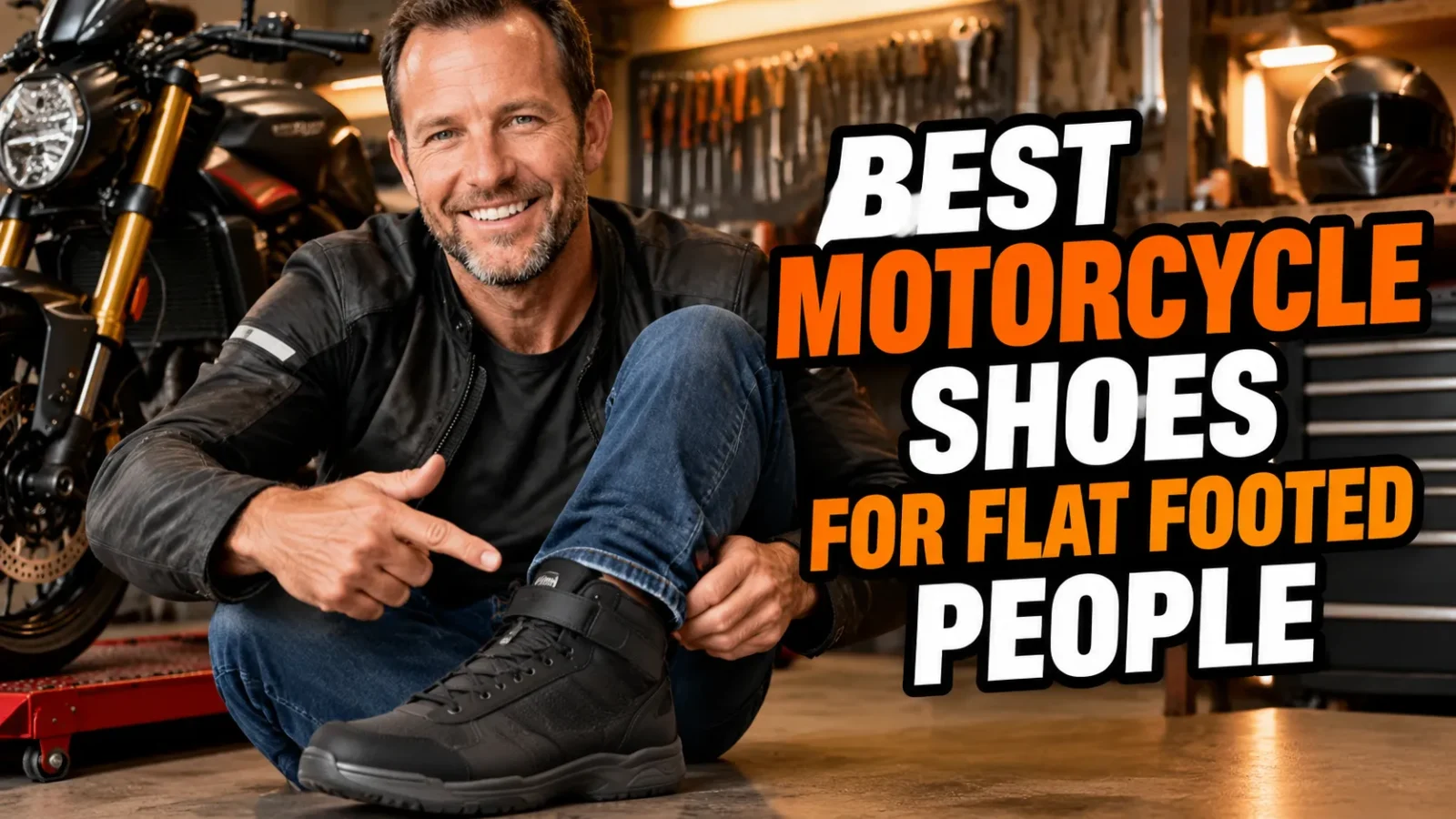
I have flat feet. Not “slightly low arches” flat feet — the kind where a podiatrist looks at my wet footprint, pauses, and says “huh.” For years that meant every motorcycle boot I bought turned into a torture device somewhere around mile 50. My arches burned, my knees ached, and I’d quietly end up riding in sneakers, which is exactly the wrong answer when you go down the road on your side.
Then I stopped buying boots based on how they looked in photos and started buying them based on insoles, lasts, and shank stiffness. That single change fixed about 90% of my problems.
What follows is the result. These are eight real boots and riding shoes I’ve either owned, borrowed for a few hundred miles, or tested back-to-back against each other. If you want the deeper background on construction, protection standards, and materials first, my Ultimate Guide to Motorcycle Boots is the place to start.
- The single biggest win for flat feet is a removable insole — it lets you fit a real orthotic.
- My overall pick is the Daytona Burdit GTX; my value pick is the Alpinestars Sektor Vented.
- A stiff shank and a roomy toe box matter more than brand name or price tag.
- Italian boots usually run narrow — if your flat feet came with wide feet, size up half a step.
What Flat Feet Actually Need From a Riding Shoe
Flat feet collapse inward under load. On a bike you’re loading your arches constantly — through the pegs, through the shifter, through the rear brake — and a soft, flexible boot lets that collapse happen all day long.
So the first thing I look for is a stiff shank. A firm midsole stops your arch from rolling and spreads pressure across the whole foot instead of one hotspot. Flexible “lifestyle” boots feel great in the shop and awful after an hour of riding.
Second is a removable insole. This is non-negotiable for me now. If the stock footbed is glued in, the boot is off my list no matter how good it looks.
Third is volume and width. Flat feet are often wide feet, and a pinched toe box will wreck your day faster than a bad arch. I always check that I can wiggle my toes with the boot done up tight.
1. Daytona Burdit GTX — Best Overall for Flat Feet
If I could only own one boot, it would be this. The Daytona Burdit GTX is a short-cut German touring boot with a Gore-Tex membrane, and it’s the most genuinely comfortable motorcycle footwear I’ve put on.
The reason is simple: Daytona builds its boots around a removable insole and a last that actually has room in it. I pulled the stock footbed out on day one, dropped in my orthotic, and rode six hours without thinking about my feet once. That had literally never happened before.
Protection is serious too. It’s CE certified to EN 13634, with a reinforced toe cap, a plastic ankle guard, and a proper shank under the arch. The full-grain leather upper is thick without being stiff, and the Gore-Tex liner is the real thing — my pair has stayed dry through hours of proper rain.
Two catches. First, price: expect to pay north of $500. Second, Daytona’s real party trick — you can send the boots back to the factory for resoling and refurbishment. That’s why I stopped wincing at the cost. These are a ten-year boot.
2. TCX Street 3 WP — Best Everyday Riding Shoe
The TCX Street 3 WP is the shoe I recommend to almost every flat-footed rider who wants something they can wear off the bike. It looks like a casual leather shoe, but it’s a proper CE certified riding boot underneath.
The upper is full-grain leather with TCX’s T-Dry waterproof membrane, and there’s a moulded ankle insert plus reinforced toe and heel counters. The sole has a dedicated shifter pad, which saves your left boot from getting shredded.
Here’s the bit that matters for us: TCX fits a “Comfort Fit” footbed that lifts straight out, and the boot’s interior volume is generous. My orthotic slid in with zero trimming. The last also runs slightly wider than most Italian brands, which is rare and welcome.
At roughly $180–200 it’s the sweet spot of price, protection, and genuine all-day comfort. If you’re new to riding gear generally, it also sits comfortably on my list of the Best Motorcycle Boots for Beginners.
3. Alpinestars Faster-3 Rideknit — Best Hot-Weather Shoe
Summer is where flat feet suffer most, because sweaty feet slide and sliding feet collapse. The Alpinestars Faster-3 Rideknit solves that with a knitted upper that breathes like a running shoe.
Airflow through the knit is excellent — I’ve worn these in 95°F traffic and my feet stayed dry, which meant they stayed stable on the pegs. Alpinestars also fits a removable anatomical EVA footbed lined with Lycra, so swapping in an orthotic takes seconds.
Protection is solid for a short shoe: CE certified, TPU heel counter, TPR toe slider, and a reinforced shifter zone. It’s lighter and more flexible than a leather boot, so I treat it as a commuting and day-ride shoe rather than a touring one.
One honest note — knit uppers stretch over time. If you’re between sizes, go up rather than hoping it breaks in perfectly.
4. Klim Outlander GTX — Best Adventure-Ready Option
For riders who actually walk when they get there, the Klim Outlander GTX is the one I reach for. It’s a Gore-Tex boot with a genuinely wide toe box and a hiking-boot silhouette, and the current version uses a BOA dial closure instead of laces.
That BOA system is a bigger deal for flat feet than it sounds. Instead of tying laces to one tension, you dial in even pressure across the whole instep — no pinch point over the arch, no loosening halfway through a ride.
Inside there’s a removable OrthoLite insole, which is one of the better stock footbeds in the category. It’s CE certified with reinforced toe and heel, and the sole has real tread for off-bike walking. Expect around $380.
If your riding involves gravel roads and fire trails, pair it with the advice in my guide to the Best Motorcycle Boots for Adventure Riding.
5. REV’IT! Pioneer GTX — Best Touring Boot
The REV’IT! Pioneer GTX is a full-height touring boot with a Gore-Tex membrane, a full-grain leather upper, and CE certification to EN 13634. It’s the boot I’d take on a multi-day trip in mixed weather.
It has a side-entry zipper plus a Velcro flap, which makes it easy to get on and off with an orthotic already fitted — that matters more than you’d think when you’re doing it six times a day on tour.
The footbed lifts out, and there’s enough internal volume to accommodate a moderate orthotic without crushing your instep. The sole is stiff under the arch, which is exactly what a collapsing foot needs on long days.
My one caveat: REV’IT! lasts run a touch narrow. If your flat feet are also wide, size up half a step. Around $330.
6. Forma Swift Dry — Best Mid-Range Waterproof Shoe
Forma is an Italian brand that doesn’t get enough credit, largely because its lasts are noticeably roomier than the big-name competition. The Forma Swift Dry is a short waterproof riding shoe built on exactly that roomier platform.
You get a full-grain leather upper, a waterproof membrane, CE certification, and TPU ankle protection. The sole is thick and grippy with a good heel drop, which helps keep my foot from rolling inward.
Because the boot is cut a little more generously, the stock insole comes out and a full-length orthotic drops in without any pressure on the top of my foot. That combination at roughly $180–200 is hard to beat.
It’s also a great second pair — the kind of boot you wear for the daily commute and don’t mind scuffing up.
7. Dainese Metractive Air — Best Lightweight Urban Shoe
When I want something that looks like a trainer but behaves like gear, I grab the Dainese Metractive Air. It’s a perforated urban riding shoe with a ground micro-injection sole and a TPU heel insert, CE certified for riding use.
The airflow is genuinely good, and the platform underfoot is flat and wide rather than narrow and curved — which is exactly the shape a flat foot wants. Dainese keeps the stock footbed thin, and it lifts out, so there’s real room for a proper orthotic without squeezing your instep.
It’s around $230, which is steep for a shoe that looks this casual. But the build quality is excellent and the sole has held up far better than I expected after a full season of commuting.
Downside: minimal shin coverage, and no waterproofing. This is a dry-weather city shoe, full stop.
8. Alpinestars Sektor Vented — Best Budget Pick
Not everyone wants to spend $500 on their first pair, and the Alpinestars Sektor Vented is what I point budget-conscious flat-footed riders toward. It’s roughly $130–140 and it gets the fundamentals right.
Microfibre upper with mesh vents, TPR toe and heel sliders, CE certification, and — crucially — a replaceable anatomical EVA footbed with a Lycra lining. That last point is why it makes this list at all. At this price, most shoes have a glued-in insole that can’t be swapped.
The Sektor isn’t as stiff as the Daytona or the REV’IT!, so I’d not choose it for 500-mile days. But for commuting, weekend blasts, and building up your riding muscles, it does the job without wrecking your arches.
Insoles: Where the Real Fix Actually Happens
Removable beats everything
I’ll say it one more time because it’s the whole ballgame: a removable insole is the single most important feature on this list. Every boot above has one. A boot without one is a boot you’ll eventually resent.
Once the stock footbed is out, you’ve got options. Off-the-shelf arch supports from Superfeet, Powerstep, or Currex cost $40–60 and fix a surprising amount. Custom orthotics from a podiatrist are better still, but check they’re low-profile enough to fit inside a riding boot.
What I actually run
I rotate a Superfeet Carbon in the Daytona for long days and a Powerstep Pinnacle in the TCX Street 3 for commuting. Both are thin enough that they don’t lift my heel out of the boot’s heel cup, which is the failure mode to watch for.
If a new insole makes your heel sit higher than the boot’s ankle padding, it’s too thick. Take it out and try a thinner one.
Why Not Just Wear Work Boots?
Plenty of flat-footed riders tell me they just wear work boots because they’re comfortable and cheap. I get the appeal, and I’ve done it. But there’s a real difference in ankle coverage, sole grip on pegs, and how the sole behaves when it’s covered in oil — I go through the whole comparison in motorcycle boots vs work boots.
Short version: work boots are built for standing on flat surfaces, not for shifter feel or sliding down asphalt. Your arches might thank you, but your ankles won’t.
Keeping Them Alive (and Comfortable)
A stiff, well-supported boot only stays that way if you look after it. Salt, road grime, and dried mud all break down leather and compress the foam in your insole over time.
I rinse and re-condition my leather boots every few weeks in winter, and I pull the insoles out to dry after every wet ride. If you want a proper routine, this walkthrough on how to clean motorcycle boots covers it step by step.
My Honest Verdict
If you have flat feet and you’re only buying one pair, buy the Daytona Burdit GTX. It’s expensive, it’s heavy, and it’s the only boot I’ve owned that I forget I’m wearing. The removable insole and the resoling service make the price make sense over a decade.
If that’s out of reach, the TCX Street 3 WP gets you 80% of the comfort for a third of the money, and the Alpinestars Sektor Vented gets you in the door for under $150.
And if you’re still weighing up what actually matters in a riding boot — protection ratings, materials, sole construction — start with my breakdown of what are the best boots for motorcycle riding. Get the insole right and the rest of the boot suddenly works a lot better.
Frequently Asked Questions
What should a flat-footed rider look for in a motorcycle shoe?
Prioritise a removable insole so you can drop in your own orthotic, a stiff shank to stop arch collapse, and a roomy toe box. A wide last matters more than brand name.
Can I just wear my normal orthotics inside motorcycle boots?
Sometimes, but only if the boot’s stock footbed lifts out cleanly and there’s enough vertical volume. Boots like the Daytona Burdit GTX and TCX Street 3 WP are the easiest swaps I’ve tried.
Are flat motorcycle shoes less protective than full boots?
Generally yes. Short riding shoes give up some shin and calf coverage, so they suit commuting and short rides. For touring or adventure work, look at a taller CE certified boot instead.
Do I need to size up if I have flat, wide feet?
Often, yes. Italian brands in particular run narrow, so going half a size up and adding an insole is a common fix. Always check that the toe box doesn’t pinch when you shift.

Related Articles

10 Best Tennis Shoes for Motorcycle Riding: Honest Picks From a Rider Who Tried Them
I tested the best tennis shoes for motorcycle riding to find out what actually works behind the bars, plus the…
 Jake Miller
10 min read
Jake Miller
10 min read

11 Best Footwear Options for Motorcycle Riding, Ranked by a Rider Who’s Worn Them All
I've put thousands of miles on moto boots. Here are the 11 best footwear options for motorcycle riding, from track-ready…
Jake Miller
10 min read

10 Best Non Riding Shoes That Actually Work on a Motorcycle
I have ridden thousands of miles in shoes that were never designed for a bike. Here are the best non…
Jake Miller
13 min read