
9 Best Cowboy Boots for Motorcycle Riding You Can Actually Ride and Walk In
 Jake Miller
11 min read
Jake Miller
11 min read
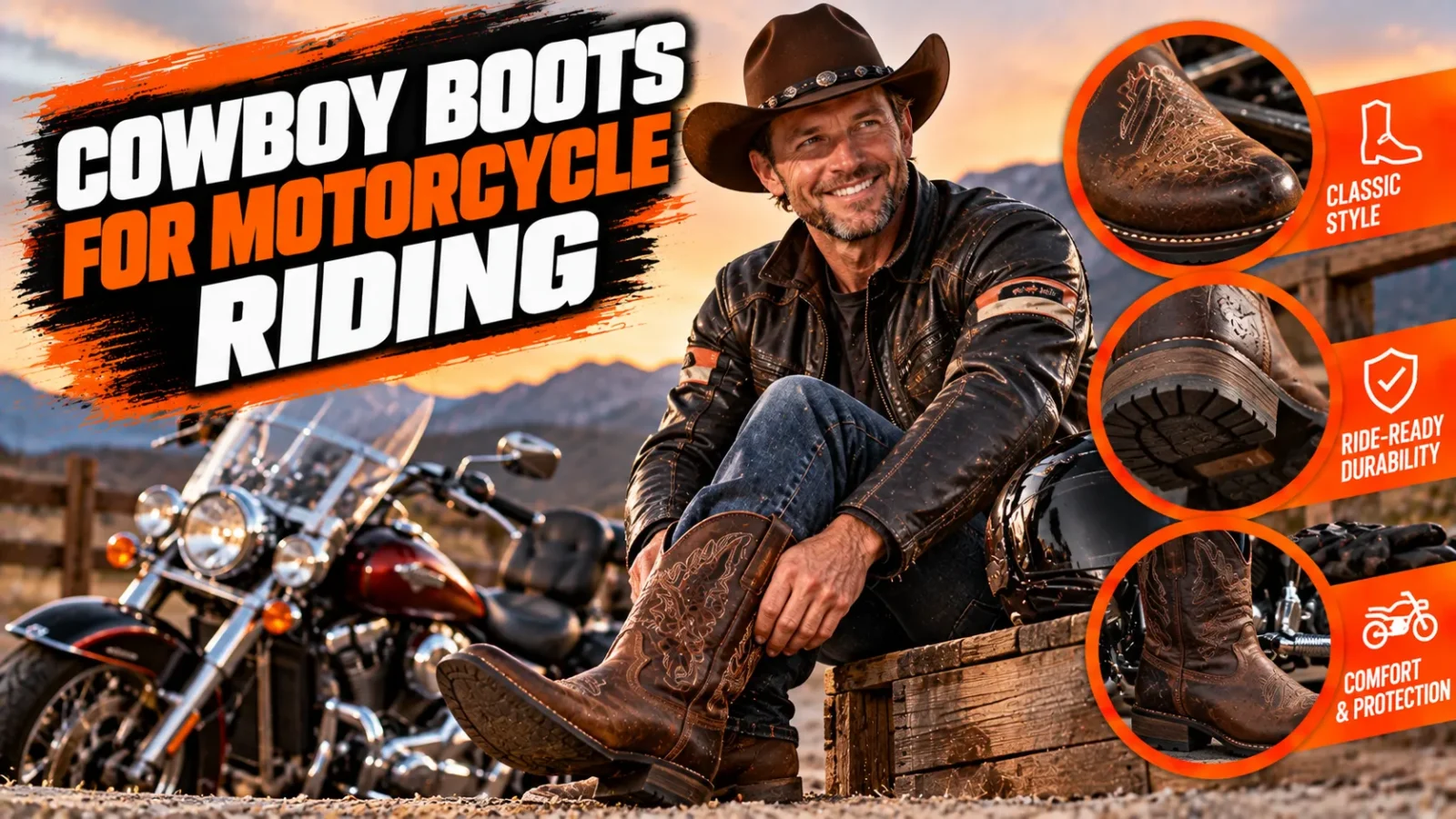
I’ve ridden in everything from full-blown adventure boots to sneakers I probably shouldn’t have worn. But there’s something about pulling on a good pair of cowboy boots before swinging a leg over a cruiser or bobber that just feels right.
The stacked heel hooks the peg, the leather looks incredible with jeans, and honestly, they’re some of the most comfortable boots I own off the bike too.
That said, not every pair of Western boots is built for the demands of shifting, braking, and standing on pegs for hours. I’ve tested a bunch over the years, and I want to walk you through the ones that actually hold up.
If you want the deeper technical breakdown of boot construction and safety ratings, my Ultimate Guide to Motorcycle Boots is a great companion read to this list.
- My overall favorite is the Ariat Rambler — it balances comfort, shifter durability, and classic Western style.
- For genuine bad-weather protection, the Dan Post Cowboy Certified Waterproof and Double H Domestic ICE Roper won’t let you down.
- If you need steel toe protection for daily commuting or work, grab the Twisted X Steel Toe Western Work Boot.
- Budget-conscious riders should look at the Durango Rebel or Justin Stampede — both perform way above their price tag.
- A 1 to 1.5 inch heel with a snug ankle shaft is the sweet spot for comfortable shifting and peg control.
1. Ariat Rambler — Best Overall Cowboy Boot for Riding
The Ariat Rambler is the pair I recommend most often when riders ask me where to start. It’s got a full-grain leather foot with a duratread outsole that grips pegs way better than most Western boots I’ve tried.
The heel sits right around 1.5 inches, which is tall enough for that classic cowboy look but low enough that shifting feels natural within a few rides. I’ve put a couple thousand miles on mine and the stitching hasn’t budged.
Price-wise, you’re looking at roughly $130-$150, which is very reasonable for the quality. They also run in wide sizing, which matters if you wear thicker socks on longer rides.
Standout feature: the ATS (Advanced Torque Stability) footbed genuinely reduces foot fatigue on long highway stretches, something most cowboy boots completely ignore.
2. Dan Post Cowboy Certified Waterproof — Best for Wet Weather Riding
If you ride through unpredictable weather like I do, the Dan Post Cowboy Certified Waterproof boot is worth the investment. It uses a genuine waterproof membrane sealed into the leather, not just a water-resistant coating.
I’ve ridden through a couple of surprise downpours in these and my socks stayed completely dry. That’s rare for a Western boot, most just aren’t designed with sealed seams.
They run around $180-$220, which is a step up in price, but if you commute in all conditions, it pays for itself. The leather shaft also gives solid ankle coverage, which helps if you’re comparing them against options in my best motorcycle riding boots roundup.
Standout feature: a cushioned orthotic footbed that actually rivals dedicated riding boots for all-day comfort.
Why waterproofing matters more than people think
A lot of riders don’t think about water until it’s already inside their boot. Leather that isn’t properly treated soaks through fast, and wet leather against your skin for hours is miserable and can cause blisters.
I always tell new riders: if you commute regardless of forecast, spend the extra money on a sealed membrane boot like the Dan Post. It’s a small cost against a genuinely uncomfortable ride home.
3. Twisted X Steel Toe Western Work Boot — Best for Protection
When I need real toe protection, whether I’m riding to a job site or just want extra peace of mind in traffic, I reach for the Twisted X Steel Toe Western Work Boot. It’s ASTM-rated for impact and compression, something almost no cowboy boot offers.
The steel toe cap is discreet too, it doesn’t look bulky like a traditional work boot. You still get the tapered Western silhouette with a 1.25-inch heel.
At around $150-$170, it’s priced fairly for a boot doing double duty as both work gear and moto gear. If your commute doubles as a work commute, this is one of the smartest overlaps you can make.
Standout feature: the CellStretch insole technology, which flexes with your foot and genuinely reduces pressure points during long shifts (on the bike or on your feet).
4. Justin Stampede — Best Budget Classic
The Justin Stampede is proof you don’t need to spend a fortune to get a reliable riding boot. I’ve had riding buddies wear these for years of daily commuting without major wear issues.
They’re built with a leather upper and a traditional 1.5-inch stacked heel, ideal for hooking onto pegs. The J-Flex comfort system in the sole makes them surprisingly comfortable for something this affordable.
At roughly $100-$120, this is one of the best entry points if you’re cowboy-boot-curious but not ready to commit big money. It’s a smart pick if you’re also weighing the best work boots for motorcycle riding against a Western option.
Standout feature: the classic pull-straps make these incredibly easy to get on and off after a long ride.
5. Durango Rebel — Best Value Pick
The Durango Rebel is another budget-friendly option, and honestly one of the more rugged-looking boots on this list. I like the slightly wider toe box, which gives a bit more room for foot swelling on hot rides.
The full-grain leather holds up well against exhaust heat, and the outsole has decent oil and slip resistance, useful if you’re parking on gravel or gas station concrete regularly.
You’ll find these for around $110-$140 depending on the colorway. For the price, the quality-to-cost ratio is hard to beat, especially for riders just building out their gear collection.
Standout feature: the removable footbed lets you swap in your own orthotic insert if you need extra arch support for longer rides.
6. Chippewa 1901 Heritage Boot — Best Full-Grain Leather Build
I’ll be honest, the Chippewa 1901 is one of my favorite boots period, not just for riding. The leather is thick, American-tanned, and genuinely improves with age, developing a patina that most synthetic boots simply can’t replicate.
The Goodyear welt construction means this boot is resoleable, so it’s a long-term investment rather than a disposable pair. I’ve had mine resoled once already after a few years of regular wear.
Expect to pay $300-$350, which puts it in premium territory, but the craftsmanship justifies it. If you want a boot that ages like a good jacket, this is the one.
Standout feature: the Vibram outsole option offers noticeably better grip on wet pegs and pavement compared to standard leather soles.
7. Lucchese Rudy — Best Premium/Luxury Option
If you want a boot that looks as good in the garage as it does at a cookout, the Lucchese Rudy is about as premium as cowboy boots get. Handcrafted in Texas, the leather quality here is genuinely a different tier.
The heel and toe are proportioned in a way that makes shifting surprisingly intuitive, better than I expected from a boot this dressy. It’s not marketed as a moto boot, but the construction quality translates well to riding use.
Pricing sits around $400-$500, so this is very much a splurge item. I wouldn’t recommend it as your only pair, but if you want one boot that turns heads at every bike night, this is it.
Standout feature: the leather sole option can be resoled with rubber for better grip if you plan to ride in them regularly.
8. Corral Distressed Embroidered Boot — Best Style Statement
Sometimes you just want a boot that looks incredible with your leather jacket, and the Corral Distressed Embroidered Boot checks that box without sacrificing too much function. The distressed leather finish hides scuffs way better than smooth leather, which matters if you’re leaning your bike against curbs often.
The embroidered detailing is genuinely eye-catching, and I’ve gotten more compliments on these than almost any other boot I own. Underneath the style, there’s still a solid leather sole and 1.5-inch heel doing the actual work.
Priced around $200-$250, these sit in the mid-range. They’re a great option if you ride a cruiser or bobber where style is as much a part of the build as performance.
Standout feature: the goatskin leather is noticeably softer and more flexible right out of the box, no painful break-in period.
9. Double H Domestic ICE Roper — Best All-Weather Roper Style
Roper-style boots have a lower heel, and the Double H Domestic ICE Roper is my pick if you prefer that flatter stance for better peg feel. The ICE technology sole is designed for slip resistance in cold and wet conditions, a genuine advantage if you ride into fall and winter.
The rounder toe box gives more room for thicker socks, and the leather is domestically sourced and tanned, which shows in the overall durability. I’ve worn mine through a full winter of commuting without any seam failure.
Expect to pay $220-$260. It’s on the higher end for a roper, but the all-weather performance makes it worth it if you ride year-round rather than just in fair weather.
Standout feature: the moisture-wicking lining keeps your feet noticeably drier on long, sweaty summer rides too.
How I Actually Judge a Cowboy Boot for Riding
I don’t just look at how a boot looks in a photo. I think about heel height, ankle coverage, sole grip, and how the leather holds up against heat radiating off the engine or exhaust.
Heel height and shifting comfort
Anything between 1 and 1.5 inches tends to work best. Too flat and you lose peg-hooking grip; too tall and finding neutral becomes a guessing game.
Ankle coverage versus flexibility
A taller shaft gives more protection in a slide, but it can also restrict ankle movement needed for smooth shifting. I usually look for a boot that hits mid-calf without feeling stiff.
Sole material and grip
Leather soles look classic but get slippery fast on wet pegs or pavement. I lean toward rubber or Vibram outsoles whenever the boot offers that option.
Cowboy Boots vs. Other Riding Boot Styles
Cowboy boots aren’t the only style worth considering, and depending on your riding, another category might actually suit you better. If you’re doing longer off-road stints, I’d point you toward my breakdown of the Best Motorcycle Boots for Adventure Riding instead.
Riders who want a more tactical, low-profile look often gravitate toward the options in my best combat boots for motorcycle riding guide. Both offer more built-in ankle armor than most Western boots.
And if you’re shopping specifically for a smaller fit and narrower shaft, I’d also check out my picks for the best motorcycle riding boots for women, since sizing and shaft width can make a big difference in comfort.
My Final Take
If I had to grab just one pair off this list for daily riding, I’d go with the Ariat Rambler every time. It balances comfort, durability, and that unmistakable Western look without asking you to compromise much on shifting or grip.
But your riding style should really drive the decision. Wet climate rider? Go with the Dan Post Cowboy Certified Waterproof. Need real toe protection? The Twisted X Steel Toe has you covered. Whatever you pick, break it in before a long ride, your feet will thank you.
Frequently Asked Questions
Are cowboy boots actually safe for motorcycle riding?
Many cowboy boots offer decent ankle coverage and a stacked heel that helps grip the peg, but most lack the reinforced ankle support and shifter padding found in dedicated riding boots. For serious mileage, I’d point you toward my Ultimate Guide to Motorcycle Boots, but for cruiser and around-town riding, a solid pair like the Ariat Rambler works well.
What heel height is best for shifting a motorcycle in cowboy boots?
I look for a heel between 1 and 1.5 inches. Anything taller makes it harder to find the shifter smoothly, and anything flatter reduces the peg-hooking grip that cowboy boots are known for.
Will motorcycle exhaust heat damage my cowboy boots?
It can, especially with cheaper synthetic leather. I always recommend full-grain leather boots like the Chippewa 1901 or Justin Stampede since they hold up far better against radiant heat from pipes and headers.
Are square-toe or round-toe cowboy boots better for shifting gears?
I personally prefer a round or slightly pointed toe for shifting since it slides under the lever more precisely. Square-toe boots work fine too, but you’ll want to practice finding neutral before you hit the highway.

Related Articles

9 Best Motorcycle Boots for Hiking That Actually Work Off the Bike
I tested and researched the top hybrid motorcycle boots for hiking. Here are 9 real picks that protect on the…
Jake Miller
11 min read

9 Best Non-Motorcycle Boots for Cruisers That Still Ride Right
Not into moto-specific boots? I break down 9 real, non-motorcycle boots that hold up on cruisers—tough leather, good grip, and…
Jake Miller
13 min read

8 Best Boots for Motorcycle Safety Instructors Who Stand, Walk, and Ride All Day
I've spent years teaching MSF courses—here are the 8 best boots for motorcycle safety instructors that balance protection, comfort, and…
Jake Miller
9 min read