
10 Best Riding Glasses for Motorcycle Riders — Real Picks I’d Buy Again
 Jake Miller
10 min read
Jake Miller
10 min read
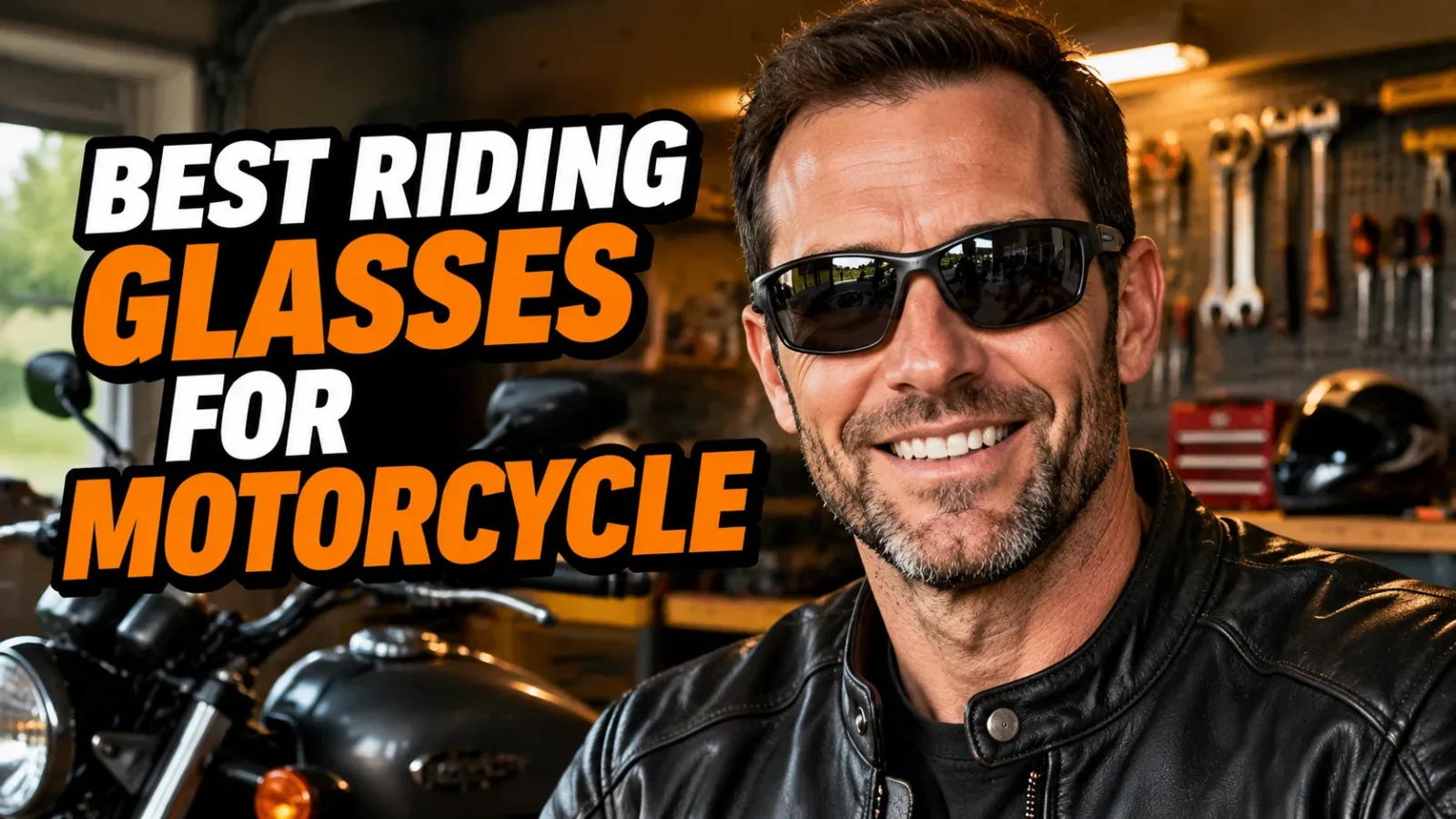
I’ve burned through more pairs of riding glasses than I care to admit. Over the last six seasons I’ve ridden with $12 gas-station wraparounds, $250 photochromic setups, and everything in between — and I’ve learned that the wrong pair can ruin a ride faster than a bad tank of fuel.
Wind is the real enemy. At 70 mph, even a small gap between the frame and your cheek turns into a constant stream that makes your eyes water, which makes you squint, which makes you tired. By hour three, you’re miserable.
Comfort is a system, too. If my eyes are streaming and my tailbone is screaming, the ride is over. That’s why I treat eye protection and a proper Best Motorcycle Seat upgrade as two halves of the same project.
Below are the ten pairs I’d actually recommend to a friend, based on real road time — not spec sheets.
- My overall pick is the Wiley X AirRage — ANSI-rated, with a removable foam gasket that kills wind at highway speed.
- For dry, watery eyes nothing beats the 7eye by Panoptx Chubasco and its AirShield seal.
- Under a full-face helmet, Flying Eyes wins because of its flat, flexible temples.
- On a budget, the Tifosi Crit and Edge Khor G2 deliver 90% of the performance for a third of the price.
- Photochromic lenses are the single best upgrade if you ride from dawn into dusk.
What I Actually Look For in Riding Glasses
Before the list, here’s the short version of my filter. Three things matter more than brand or looks: lens safety, wind sealing, and how the glasses sit under a helmet.
Impact Rating Comes First
I won’t ride with anything that isn’t shatter-resistant. Polycarbonate is the standard, and if the glasses carry an ANSI Z87.1+ rating, even better — that means they’ve passed a high-velocity impact test.
Cheap fashion lenses can shatter into sharp fragments. That’s not a risk I’m willing to take at 60 mph with a truck kicking up gravel.
Wind Sealing and the Foam Gasket Question
A gasket — the thin foam ring that presses against your face — is the difference between “wind-resistant” and “wind-proof.” I run a gasket on long highway days and go gasket-free around town.
Helmet Fit and Temple Thickness
Thick plastic temples plus a snug helmet equal a headache within 30 minutes. If you wear a full-face lid, look for thin or flexible arms.
This is also where your seating position matters. Riders who’ve dropped their bike to flat-foot comfortably — often with a Best Motorcycle Seat for Short Riders — sit slightly more upright, which changes the angle the wind hits your face.
1. Wiley X AirRage — Best Overall for Serious Riders
If I had to own one pair, it’s the Wiley X AirRage. It’s the pair I grab for 400-mile days because it does almost everything well.
The AirRage is built on a wrap-around frame with shatterproof Selenite polycarbonate lenses that meet ANSI Z87.1+ standards. That rating isn’t marketing fluff — it’s a real high-mass and high-velocity impact test.
The best feature, though, is the removable facial cavity seal. That foam gasket clips on in about five seconds and blocks wind, dust and pollen completely. On a naked bike at 75 mph, it’s transformative.
Wiley X sells the AirRage with interchangeable lenses and a leash cord, and pricing generally lands between $90 and $140 depending on the lens package. I’ve had mine for three seasons with zero complaints.
2. 7eye by Panoptx Chubasco — Best for Wind and Dry Eyes
If your eyes water constantly — or if you’ve been told you have dry eye — stop reading and buy the 7eye Chubasco. Nothing else in this list seals this well.
7eye (formerly Panoptx) built its reputation on the AirShield, a patented foam gasket that creates a near-complete microclimate around your eye. The Chubasco is one of the more aggressive wrap shapes in that lineup.
What I love is the lens variety. You can get the Chubasco with photochromic lenses, polarized lenses, or a range of fixed tints. 7eye also offers prescription inserts, which is rare in true riding eyewear.
Expect to pay $130 to $210. That’s steep, but riders with chronic eye issues tell me it’s the only thing that works for them.
3. Bobster Renegade II — Best Photochromic Convertible
The Bobster Renegade II is the pair I recommend to anyone who leaves before sunrise and gets home after dark. It’s a convertible design that works as glasses or goggles.
The photochromic lens is the headline. It darkens in bright sun and clears as light fades, so you’re not swapping lenses at a roadside pull-off. It also has an anti-fog coating, which actually holds up.
Bobster ships it with two sets of temples plus a goggle strap and removable foam, so you can run it open or sealed. Pricing is refreshingly sane at roughly $60 to $95.
My only gripe is that the photochromic transition is slower than premium brands. On a fast sunset, you’ll notice the lag.
4. Flying Eyes Golden Eagle — Best Under a Full-Face Helmet
Flying Eyes solved a problem nobody else took seriously: glasses that disappear under a helmet. The Golden Eagle is the model I keep coming back to.
The temples are ultra-thin and flexible, so they slide between the helmet liner and your head without digging in. I can wear these for six hours and forget they’re on. Pilots love them for the same reason.
The lenses are shatterproof and available polarized, and Flying Eyes offers prescription options. Wind protection is good but not gasket-level, so I’d skip these for open-face highway riding.
They run about $180 to $260. It’s a lot, but helmet comfort is worth it if you ride daily.
5. Oakley Fuel Cell — Best Everyday Look That Still Blocks Wind
Some days I want riding glasses that don’t look like riding glasses. The Oakley Fuel Cell is my pick for that mood.
It uses Oakley’s O Matter frame material and Plutonite lenses, which filter 100% of UVA, UVB and UVC. The wrap is generous enough to cut most wind, and the Prizm lens options genuinely improve contrast on grey asphalt.
It’s not gasketed, so it won’t seal like the 7eye or Wiley X. But for around-town riding and short commutes, it’s excellent.
Expect $150 to $210. If you want the same optics with more coverage, look at the Holbrook or Flak 2.0 XL in the same family.
6. 100% Speedcoupe — Best Sport Performance Pick
The 100% Speedcoupe is what I wear when I’m moving fast and sweating. It’s the lightest pair on this list and the one I trust for aggressive riding.
100% is a genuine motocross and cycling brand, and it shows. The Speedcoupe has a hydrophobic and oleophobic lens coating that sheds sweat and rain, plus venting that keeps fog at bay.
It ships with interchangeable lenses, and the lens swap is tool-free — a nice touch when you’re standing in a parking lot at golden hour.
Pricing sits around $120 to $180. For dual-sport riders, this is the sweet spot. If you’re on something like a KLX250 and doing a lot of standing on the pegs, a best motorcycle seats for kawasaki klx250 upgrade pairs beautifully with a light, grippy pair of shades.
7. Tifosi Crit — Best Value Under $100
The Tifosi Crit is the pair I hand to friends who don’t want to spend $200 on sunglasses. It punches way above its price.
The frame is Grilamid TR-90, which is light and flexible. Lenses are polycarbonate, and Tifosi includes three interchangeable options in the box. Hydrophilic rubber nose and temple pads actually get grippier when you sweat.
It’s not ANSI rated and there’s no gasket, so it’s a fair-weather, fair-speed choice. But at $70 to $95 with three lenses, it’s absurd value.
I’ve ridden the Crit on 200-mile days and never once thought about my eyes. That’s the highest compliment I can give eyewear.
8. Ryders Eyewear Seventh — Best Interchangeable Lens System
Ryders is a Canadian brand that doesn’t get enough attention, and the Seventh is their do-everything model. I keep a pair in my top case as a backup.
The TR90 frame is light, the nose pad is adjustable, and Ryders includes three lenses with anti-fog coating. The swap mechanism is one of the smoother ones I’ve used.
Wind coverage is decent — not gasket-level, but noticeably better than a fashion frame. At $80 to $115, it’s a solid mid-tier option.
If you ride in variable light all day, this interchangeable setup saves you from carrying three separate pairs.
9. Edge Eyewear Khor G2 — Best Safety-Rated Bargain
Here’s the sleeper pick. The Edge Khor G2 is technically industrial safety eyewear, but it’s become a favorite among dual-sport and adventure riders.
It carries ANSI Z87.1+ and military MCEPS ratings, plus Edge’s Vapor Shield anti-fog coating. Polarized versions are available, and the wrap is aggressive enough to block serious wind.
The best part is the price: roughly $30 to $55. That’s less than a tank of fuel for genuinely certified protection.
If you’re riding gravel and eating dust, this is what I’d buy. Cheap enough to scratch, tough enough to trust.
10. Serengeti Velocity — Best Photochromic Driving Lenses
The Serengeti Velocity is the pair I reach for on long highway slogs where the light keeps changing. Serengeti’s Spectral Control photochromic technology is genuinely a step above the rest.
These use mineral glass lenses rather than polycarbonate, which gives noticeably crisper optics. They darken and lighten quickly and handle glare better than almost anything else I’ve tried.
The tradeoff is weight and cost. Glass is heavier, and the Velocity runs $180 to $260. It’s also not impact-rated the way Wiley X or Edge glasses are.
For touring riders chasing horizons, though, the optical clarity is worth every dollar.
Long-Ride Comfort Is About More Than Your Eyes
I’ve made this mistake: I spent $200 on premium riding glasses and then rode 600 miles on a stock seat. By the end, my eyes were fine and everything else hurt.
Eye fatigue compounds with body fatigue. When your eyes water, you tense your neck and shoulders, and that tension travels straight down your spine.
If you’re planning serious mileage on a big V-twin, a proper best motorcycle seat for harley touring does more for your overall endurance than any lens upgrade.
Smaller bikes benefit too. A Best Seat for Harley Sportster transform a buzzy bar-hopper into something you can genuinely tour on.
And if you’re tall, the stock seat may be forcing your knees up into the wind stream, which changes your helmet angle and where the air hits your face. A Best Motorcycle Seat for Tall Riders can fix that geometry in an afternoon.
How to Choose Without Overthinking It
Match the Lens to Your Riding Hours
If you only ride in daylight, a fixed tint is fine and cheaper. If your rides start or end in low light, pay for photochromic — it’s the single upgrade I’d never give up.
Decide on a Gasket Before You Shop
Gaskets seal brilliantly but run warmer and can fog if you stop moving. Open frames breathe better but let wind past the edges. I own both and switch by season.
Check Your Helmet First
Bring your helmet when you try glasses on. If the temples press against your temples through the liner, you’ll hate them by mile 40 no matter how good the lenses are.
Final Thoughts
If you want one answer: buy the Wiley X AirRage. It’s the best all-rounder on this list and the pair I’d replace first if mine disappeared tomorrow.
If wind and dryness are your problem, go 7eye Chubasco. If you live under a full-face helmet, go Flying Eyes. If you’re budget-conscious, the Tifosi Crit and Edge Khor G2 will serve you honestly for years.
Whatever you pick, treat eye protection as essential gear — not an accessory. Your eyes are the one part of your riding kit that doesn’t heal back to new.
Frequently Asked Questions
Do I really need special glasses for riding a motorcycle?
Not strictly, but regular fashion sunglasses let wind and debris past the frame edges at highway speed. Purpose-built riding glasses use wrap-around frames, shatter-resistant lenses and often a foam gasket so your eyes stop streaming after 20 minutes.
Are photochromic riding glasses worth the extra money?
If you ride through dawn, dusk or long tunnels, yes. A photochromic lens like the one on the Bobster Renegade II darkens in sun and clears at night, so you can carry one pair instead of two.
Can I wear riding glasses under a full-face helmet?
Absolutely, but the temples matter more than the lens. Look for flat, flexible arms such as those on Flying Eyes glasses, which slide between the helmet liner and your head without creating pressure points.
What lens tint is best for night riding?
Clear or a very light yellow. Anything darker cuts contrast and makes headlights and road debris harder to read. I keep a clear lens in my tank bag for exactly this reason.

Related Articles

10 Best Sunglasses for Motorcycle Riding, Ranked by a Rider Who’s Worn Them All
I've ridden thousands of miles in wind, glare and bugs. Here are the 10 best sunglasses for motorcycle riding, from…
Jake Miller
9 min read

10 Best Safety Glasses for Riding Motorcycle at Night (Rider Tested)
I tested 10 pairs of night riding glasses to find the clearest, most fog-free options for motorcycle riding after dark,…
Jake Miller
12 min read

8 Best Ray-Bans for Motorcycle Riding: What Actually Works Under a Helmet
After years of riding in Ray-Bans, I ranked the 8 best pairs for motorcycling, from helmet-friendly Aviators to wind-blocking wraps,…
Jake Miller
10 min read