
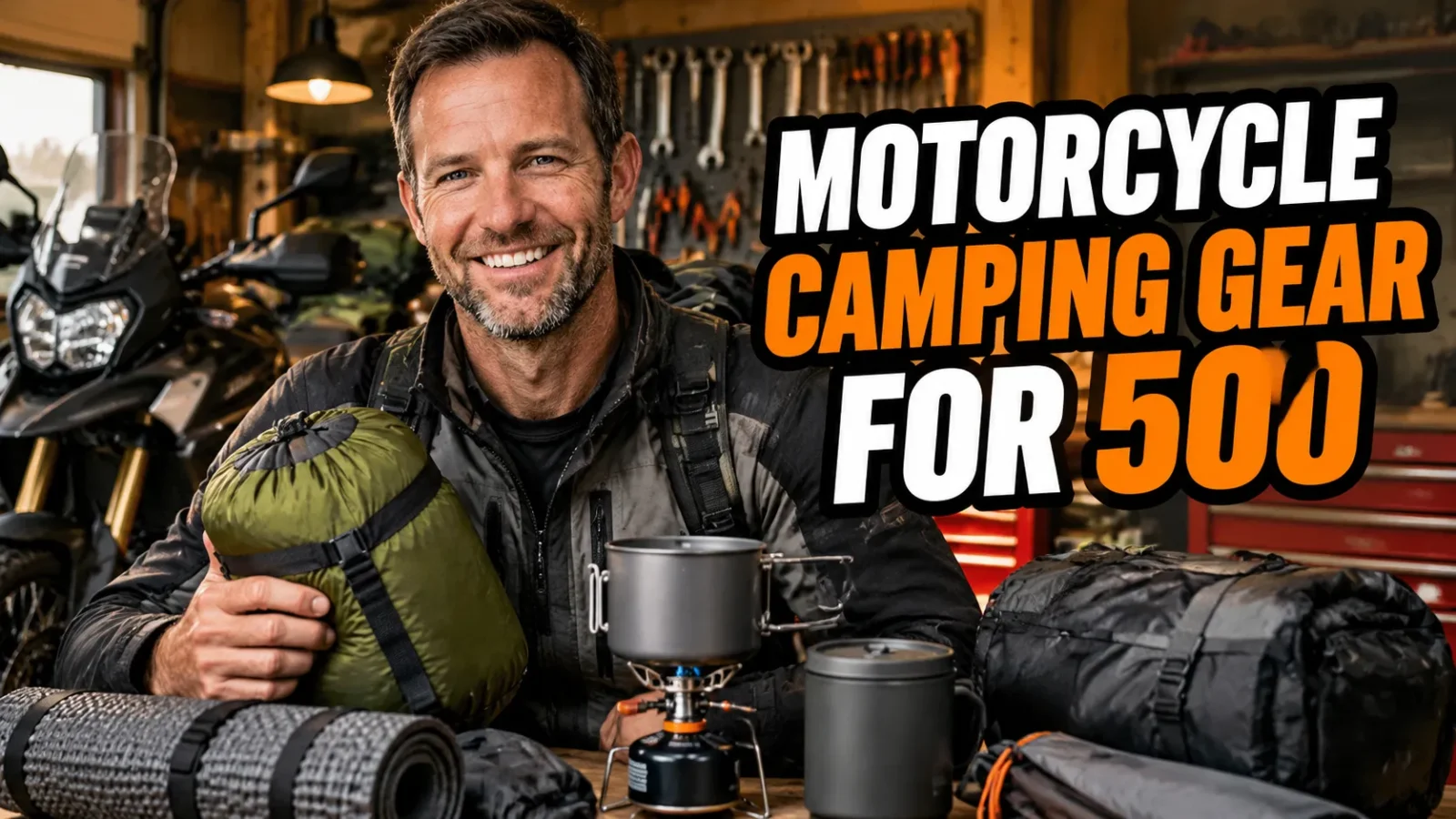
I have been strapping tents to the tails of motorcycles for years now, and I still remember the sticker shock of my first “real” camping trip. Bike luggage alone can eat a whole paycheck if you let it. So when a friend asked me to build a complete moto-camping setup for around $500, I took it as a challenge.
The good news is that $500 buys a genuinely capable kit in 2025. You will not get ultralight titanium everything, and you will not get a name-brand four-season mountaineering tent. But you can absolutely sleep warm, dry, and comfortable at a campground 300 miles from home.
One thing I learned the hard way: gear fails on the road, not in your driveway. That is why I treat my bike’s electrical and lubrication systems with the same care as my camping kit. If you are prepping for a long trip, start with this guide to what are the different types of motorcycle batteries ultimate guide so a dead battery never strands you at a campsite. Then come back here and build your loadout.
How I Built This $500 Kit
I split my budget into three tiers. Shelter and sleep get the most money because that is where discomfort actually hurts. Waterproofing comes second, because rain destroys everything. Cooking and comfort come last, and that is where I lean on cheap-but-proven budget gear.
Roughly, my allocation looks like this: about $150 for a tent, $100 for a sleeping bag, $60 for a pad, $80 for luggage and dry bags, and the remaining $110 for stove, cookset, chair, and small extras. Prices move around with sales, so treat these as ballpark figures.
I always buy from brands with real warranties. Cheap gear that breaks on night one is not cheap.
1. REI Co-op Groundbreaker 2 — Best Tent for the Money
The Groundbreaker 2 is the tent I recommend to every rider who asks me where to start. It is a freestanding two-person dome, which means I can pitch it on hard-packed gravel or rocky ground without staking it out first. On a motorcycle, that flexibility matters more than shaving ounces.
REI lists it at around $139 to $159 depending on sales. It weighs a little over 5 pounds packed, which is heavy for backpacking but totally fine on a bike. The bathtub floor keeps groundwater out, and the full-coverage rainfly has kept me dry through some genuinely ugly Ozark thunderstorms.
Setup takes me about five minutes solo. Two poles, clip the body, throw the fly, done. After a 400-mile day, that speed is worth more than gram-counting.
2. Kelty Cosmic 20 Sleeping Bag — My Cold-Weather Workhorse
The Kelty Cosmic 20 is my pick for the sleeping bag slot, and it has been for years. It uses 550-fill duck down, which packs down small enough to jam into a saddlebag or a 20-liter dry bag. The temperature rating is Comfort 20°F / Limit 7°F, which is honest for three-season camping.
Retail is usually around $130 to $160, but Kelty runs sales constantly and I have seen it near $100. The draft collar and hood cinch keep warm air trapped where it belongs. The 60-inch shoulder girth is roomy enough that I do not feel like a wrapped burrito.
If you run hot, drop to a 30-degree bag and save both weight and money. If you camp in the Rockies in May, this 20-degree rating is the floor, not the ceiling.
3. Klymit Static V Sleeping Pad — Cheap, Light, and Reliable
The Klymit Static V is the pad I hand to friends who “don’t want to spend much on a pad.” It weighs about 18 ounces, inflates in roughly ten breaths, and costs somewhere between $50 and $70 depending on the colorway and sales.
The V-shaped chambers are not a gimmick. They cradle you and stop the slip-and-slide feeling you get on smooth rectangular pads. The R-value is 1.3, which is fine for summer. Below 40°F, I add a closed-cell foam pad underneath, or step up to the insulated Static V.
Packed size is about the size of a one-liter bottle. It disappears into a pannier. For a $500 total build, this is exactly the kind of sensible compromise I want.
4. Jetboil Flash Cooking System — Fast Coffee, Minimal Fuel
I resisted the Jetboil Flash for years because I thought it was overpriced. Then I used one on a cold morning in Utah and understood immediately. It boils half a liter in about 100 seconds, and the insulated cozy means I can hold it while I drink.
Street price is around $110 to $130. That is a big chunk of a $500 budget, so if money is tight, the Jetboil Zip at roughly $80 is my alternate recommendation. The Flash’s push-button igniter and integrated pot make it a one-piece system that lives in a single saddlebag pocket.
Fuel is the other half of the story. I carry one 100-gram isobutane canister for a three-day trip and usually come home with gas left over. That efficiency is why I stopped carrying a heavy white-gas stove.
5. GSI Outdoors Pinnacle Dualist Cookset — For Real Meals
If you want to actually cook rather than just boil water, the GSI Pinnacle Dualist is my recommendation. It is a nested two-person set with a 1.8-liter pot, two bowls, two insulated mugs, and two folding sporks. Everything nests inside the pot, which is the whole point on a motorcycle.
It runs around $70 to $85. The Teflon-coated pot cleans up easily, and the strainer lid is genuinely useful for pasta. I have made everything from instant ramen to a surprisingly decent backcountry chili in this thing.
It does not come with a stove, so pair it with the Jetboil or a cheap pocket rocket. Together they take up less space than a single helmet.
6. Nemo Chipper Camp Chair — A Luxury I Refuse to Skip
Purists will tell you a chair is dead weight. I disagree. After eight hours in the saddle, sitting on the ground with my back against a tree is miserable, and the Nemo Chipper fixes that for about $100 and just over 2 pounds.
The Chipper uses a clever design where the seat doubles as the carry bag, and it packs down to roughly the size of a water bottle. It sets up in seconds with shock-corded aluminum poles. I have used mine for three seasons with zero issues.
Yes, this pushes my budget. That is why I buy budget gear everywhere else. A chair is the single biggest comfort upgrade per dollar in my whole kit.
7. Wolfman Rocky Mountain Saddle Bags — Luggage That Survives Dirt
Wolfman makes some of the toughest moto luggage on the market, and the Rocky Mountain Saddle Bags are the classic choice for dual-sport and adventure riders. They use ballistic nylon with a waterproof liner and mount via a stable, strap-based system that does not flop at highway speed.
Pricing runs roughly $220 to $280 new, which blows the budget alone. My honest advice: buy these used on forums, or start with cheaper soft bags and upgrade later. I ran a $60 pair of generic dry-bag saddlebags for two seasons before I could afford Wolfman, and they got me to plenty of campsites.
What I love about the Wolfman design is the low center of gravity. Keeping weight off the tail keeps the bike’s handling predictable when you are loaded down.
8. Sea to Summit Lightweight Dry Sack — The Cheapest Insurance You Can Buy
I do not care how waterproof your panniers claim to be. I put everything soft inside a Sea to Summit Lightweight Dry Sack, and it has saved me more than once. These run about $20 to $30 for a 13-liter and use a fully taped, seam-sealed construction with a roll-top closure.
The 13-liter size is my sweet spot for a sleeping bag and a change of clothes. For a full trip, I carry one 20-liter and one 8-liter. They weigh almost nothing and compress down to nothing when empty.
If there is one item on this list I would never leave home without, it is this one. Rain finds a way into everything else.
9. Blackstone Adventure Ready Griddle 17″ — Group Cooking Wildcard
This one is a wildcard, and I will be upfront: it is heavy and it is not for solo trips. But if you ride with a group and want to cook real food at camp, the Blackstone 17-inch Adventure Ready griddle is a blast. It runs around $100 to $130 and runs on a one-pound propane bottle.
I have cooked burgers, eggs, and pancakes for six people on one of these. The stainless steel burners and rolled steel top are the same construction as the full-size home units. It just weighs about 25 pounds, so it only makes sense if you have hard panniers and a passenger-free bike.
For most riders, I would skip it and put the money toward the tent. But for a two-bike trip with a buddy who has luggage space, it turns a cold camp dinner into a genuine event.
How This Kit Fits Together
Total it up honestly: tent at $150, bag at $120, pad at $60, Jetboil at $110, cookset at $75, chair at $100, dry bags at $50. That is $665 before luggage, which is over budget.
So here is my real recommendation. Cut the chair to a $35 budget option, swap the Jetboil Flash for the $80 Zip, and use generic saddlebags for season one. That brings you to roughly $500, and you upgrade piece by piece as you ride more.
Also, do not forget the boring maintenance stuff before a big trip. Fresh oil is cheap insurance for a loaded bike grinding up mountain passes. I keep a note on my phone with the best motor oil for 4 stroke motorcycle options I trust, and I check it before every long haul.
If you ride an older bike, you may also want to look at the top engine oil for 4 stroke motorcycle picks, since heavy loads and heat are hard on tired engines.
Riders in hot climates face a different set of problems, and the best engine oil for 4 stroke motorcycle in india guide covers the viscosity and heat considerations that matter there. Knowing what is the best engine oil for 4 stroke motorcycle for your specific model beats guessing at a gas station shelf.
And when you are ready to settle on one brand for good, my overall best engine oil for motorcycle roundup is where I send most people.
Packing Strategy for a Loaded Bike
Weight distribution is everything. I put heavy items like the stove, fuel, and tools as low and as close to the center of the bike as possible. Light bulk like the sleeping bag and pad goes on top or in a tail bag.
Never strap anything to the handlebars or front fender. I learned that lesson with a tank bag that shifted at 70 mph, and it was terrifying.
I also do a fully loaded test ride before every big trip. Twenty minutes around town with the bike packed tells me more than an hour of planning at the kitchen table.
Final Thoughts
You do not need $2,000 of gear to camp off a motorcycle. You need a dry place to sleep, a warm bag, a way to boil water, and luggage that stays put. Everything else is preference.
Start with the tent, the bag, and the dry bags. Add the stove and chair next season. Buy used where you can, and check forums before you pay retail.
Then ride somewhere far, pitch your tent, and remember why you spent the money in the first place. That first quiet morning at a campsite with coffee in hand is worth every dollar.
Frequently Asked Questions
Can I really get all my motorcycle camping gear for $500?
Yes, if you prioritize shelter, sleep, and water protection first. Spend the most on your tent and sleeping bag, then go budget on the stove, cookset, and small accessories.
What is the most important piece of motorcycle camping gear?
In my experience it is a waterproof luggage system. Wet gear ruins a trip faster than anything else, so lock down dry bags before upgrading anything else.
Is a hammock or a tent better for motorcycle camping?
Hammocks are lighter and faster to pitch, but only work where there are trees. A freestanding tent works everywhere, which is why I recommend one as your primary shelter.
How do I keep my gear light enough for a smaller motorcycle?
Aim for 15 to 20 pounds of total camping gear. Choose a 2 to 3 pound tent, a 2 pound sleeping bag, and pack clothing in compression dry bags instead of hard panniers.

Related Articles

7 Best 1-Person Tents for Motorcycle Adventures: Lightweight Shelters Tested for the Road
I've pitched these 7 one-person motorcycle tents across thousands of miles. From Big Agnes to MSR, here's the best 1…
 Jake Miller
10 min read
Jake Miller
10 min read

9 Best Budget Tents for Motorcycle Touring That Actually Survive the Road
I've slept in cheap tents across 30,000+ touring miles. Here are 9 genuinely good budget tents for motorcycle touring, with…
Jake Miller
10 min read

7 Best 2-Person Tents for Motorcycle Camping: Packable Shelters I Actually Trust
I've pitched these 7 two-person tents on real moto trips. From Big Agnes to MSR, here's what actually fits in…
Jake Miller
10 min read