
8 Best Oils for Motorcycle Transmissions (What I Actually Run in My Own Bikes)
 Jake Miller
10 min read
Jake Miller
10 min read
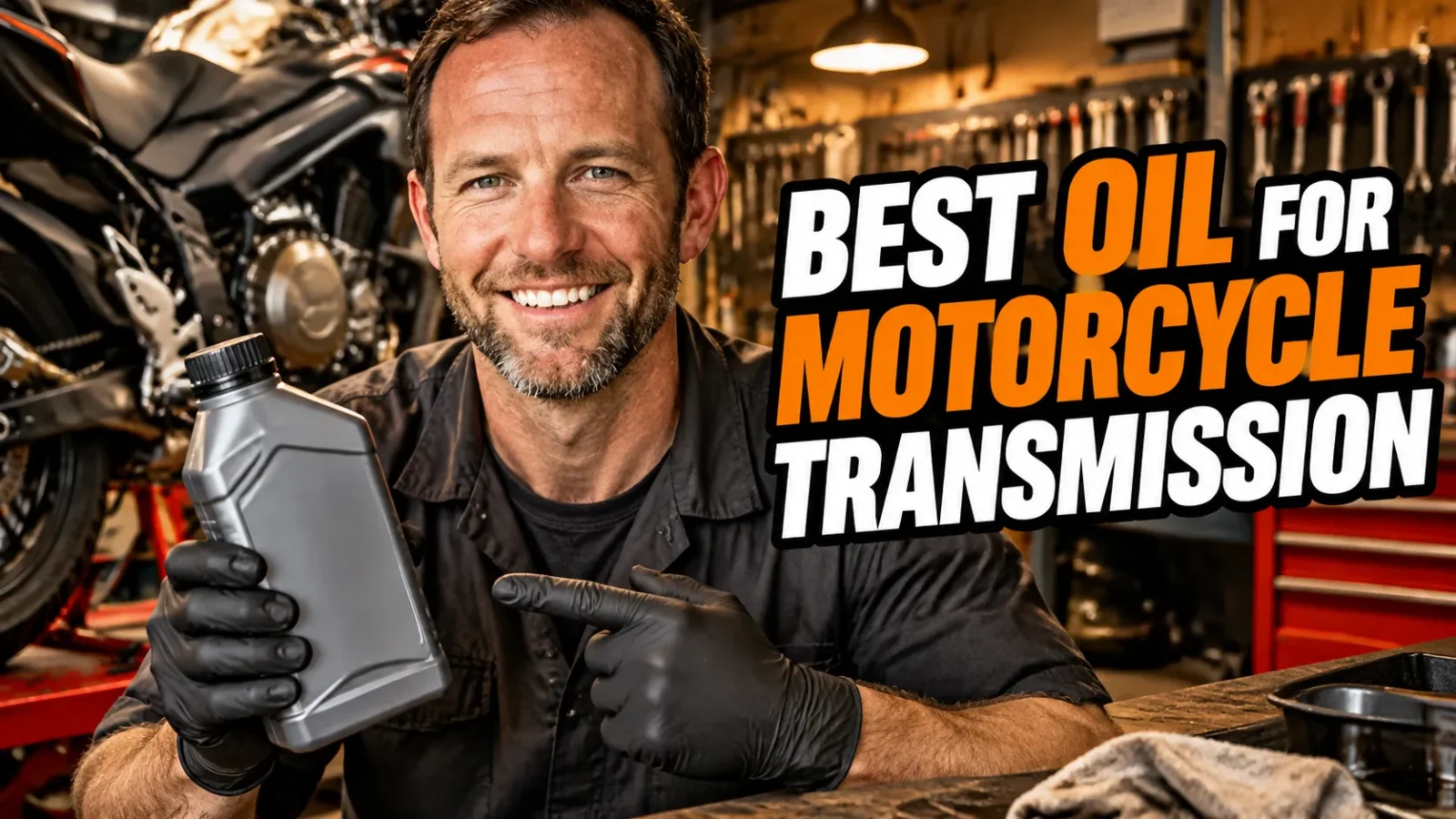
I’ve been wrenching on my own bikes for close to twenty years, and no fluid question starts more arguments in the garage than transmission oil. Ask five riders what they run and you’ll get five confident, completely different answers.
Here’s what I learned the hard way: there is no single best oil for motorcycle transmission duty, because there is no single kind of motorcycle transmission. A wet-clutch CBR600 and a Harley six-speed Cruise Drive have almost nothing in common internally, and pouring the same bottle into both is a mistake I made exactly once.
So this list is organized around what actually matters — which transmission you’re feeding. I’ve run every one of these oils in my own bikes or in customer bikes at the shop, and I’ll tell you plainly which ones I’d buy again and which are only worth it in specific applications.
- Most Japanese and European bikes share one sump, so your “transmission oil” is just a JASO MA2 engine oil — my pick is Motul 7100 4T.
- Bikes with a separate gearbox (Harley Big Twins, BMW boxers, many two-strokes) need a dedicated gear oil, not engine oil.
- For big V-twin gearboxes I keep coming back to Red Line V-Twin with ShockProof and Bel-Ray Gear Saver 80W-90.
- The rating matters more than the viscosity: JASO MA/MA2 for wet clutches, GL-4 or GL-5 for standalone gearboxes.
- Never put moly-fortified oil in a wet clutch. It will slip, and you will blame the clutch when it’s the oil.
First, Work Out Which Transmission You Actually Own
I always ask this before recommending anything. It takes thirty seconds and saves you a clutch job.
Shared-Sump Bikes With a Wet Clutch
This covers the vast majority of motorcycles on the road: most Hondas, Yamahas, Suzukis, Kawasakis, Triumphs, KTMs, and pretty much every sportbike and standard. One oil supply lubricates the engine, the gearbox, and the clutch all at once.
On these bikes, you do not buy transmission oil. You buy a good engine oil with a JASO MA or MA2 rating. That rating is the manufacturer’s way of telling you the additive package won’t make a wet clutch slip. If you want the deep version of why that matters, I wrote about how does a wet clutch work and it explains the friction modifier problem better than I can in a paragraph.
Separate Gearboxes
Harley-Davidson Big Twins with the Cruise Drive six-speed, BMW boxers, Moto Guzzi V-twins, most two-strokes, and a handful of dry-clutch Ducatis keep their transmission oil in its own case. Those take actual gear oil — usually 75W-140 or 80W-90 — and the priorities are different: shear stability, gear tooth cushioning, and heat resistance rather than clutch compatibility.
Get this distinction wrong and nothing else on this list matters. I’ve seen a guy dump GL-5 gear oil into a shared-sump inline-four and wonder why his clutch was slipping two miles later.
1. Motul 7100 4T 10W-40 — Best Overall for Wet-Clutch Bikes
If your bike has a shared sump, this is the oil I recommend most often and the one sitting in my own garage right now. Motul 7100 4T is a 100% ester-based synthetic with a JASO MA2 rating, and ester base stocks are genuinely more shear-stable than the hydrocracked stuff most budget oils use.
Why does shear stability matter for a transmission? Because your gearbox is literally chewing the oil between gear teeth all day. A cheap oil shears down out of grade, and you feel it as notchy, vague shifting around the 2,000-mile mark. The 7100 holds its viscosity noticeably longer — I’ve run it to 4,000 miles in a CBR and the shift quality was still crisp.
It’s available in 10W-40, 10W-50, 15W-50, and 5W-40, so there’s a grade for almost everything. Expect to pay roughly $14 to $17 a quart, which is the main knock against it. It’s not cheap, but I’ve never regretted it.
2. Honda GN4 10W-40 — Best Value OEM Pick
I know recommending a factory-branded oil feels boring, but Honda GN4 is genuinely good and it’s about half the price of the boutique synthetics. It’s a petroleum-based 4-stroke oil with a JASO MA rating, and Honda formulated it knowing it would be lubricating the transmission in everything from a Rebel 500 to a Gold Wing.
I ran GN4 in a CB500X for two full seasons of commuting and the transmission never gave me a reason to complain. Shift feel is a notch behind the Motul, and it shears down faster, but at $8 to $10 a quart you can afford to change it more often — which honestly is the smarter play on a commuter bike anyway.
One Warning About Honda’s Other Oil
Do not confuse GN4 with HP4M. The “M” stands for molybdenum, and that moly-fortified oil is meant for bikes with a dry clutch or a separate transmission. Put it in a wet-clutch bike and you’re asking for slip. I’ve watched it happen.
3. Bel-Ray Gear Saver 80W-90 — Best Dedicated Gearbox Oil for Big Twins
Now we’re into the separate-gearbox world, and Bel-Ray Gear Saver is the old reliable. It’s an 80W-90 gear oil blended specifically for motorcycle transmissions, and it’s been the default recommendation in Harley circles for decades for good reason.
What I like is how predictable it is. Cold shifts into first are a little clunky until the case warms up, but once it’s hot, Gear Saver is smooth and quiet and it doesn’t foam. It’s also cheap enough — around $12 to $14 a quart — that I don’t feel bad about dumping it every 10,000 miles.
It’s not the quietest option for a big V-twin and it’s not a full synthetic, so if you’re chasing maximum gear whine reduction, keep reading. But as a baseline, this is the oil I measure everything else against.
4. Red Line V-Twin Transmission Oil with ShockProof — Best for Harley Big Twin Gearboxes
This is the one I run in my own Touring bike’s six-speed, and the difference was immediate. Red Line’s V-Twin Transmission Oil with ShockProof is a 75W-140 that uses a unique formulation — Red Line calls it a “semi-solid” — that clings to gear teeth and actually cushions the contact instead of just coating it.
In practice, that means the fifth-gear whine on my 103 cubic-inch motor dropped noticeably, and neutral became easier to find when hot. It’s a genuinely different feel, not marketing.
If you’re chasing noise or a stubborn gearbox, it’s worth the $20-plus a quart. That said, if you’re already dealing with grinding or a gear that won’t stay engaged, oil won’t fix it — you may be looking at harley davidson transmission problems that need actual parts, not fluid.
While You’re In There
Any time I change transmission oil on a Big Twin, I check the clutch. A dragging clutch makes a perfectly good transmission feel broken, and clutch adjustment on harley davidson is a fifteen-minute job that fixes more “transmission problems” than any oil ever will.
5. Motul Gear 300 75W-90 — Best Ester-Based Performance Gear Oil
Gear 300 is a full-ester, 100% synthetic gear oil rated API GL-4 and GL-5, and it’s the oil I reach for in BMW boxers, Triumphs with separate gearboxes, and anything where I want maximum film strength under load.
The ester base means it holds viscosity under extreme shear and has a naturally high flash point, so it doesn’t cook off in a hot gearbox on a summer traffic crawl. Cold shifting is genuinely good for a 75W-90 too, which is not something I say often about gear oils.
It’s priced like the premium product it is — roughly $22 to $28 a liter — and it’s not for wet clutches, so keep it away from your shared-sump bike. But in a standalone gearbox, I don’t think there’s a better all-rounder.
6. Maxima MTL-R Transmission Fluid — Best Budget V-Twin Fluid
Maxima MTL-R is a petroleum-based transmission lubricant blended specifically for V-twin gearboxes, and it’s the value pick I hand to riders who want better than generic gear oil without spending Red Line money.
It’s around $10 to $12 a quart, it handles heat well, and it’s formulated to work with the wet clutch on bikes like Indian and Victory models where the clutch and transmission share a case. That’s an important distinction — a lot of V-twin “transmission fluids” aren’t clutch-compatible, and MTL-R is.
Shift quality is good, not exceptional. If you’re on a budget and doing frequent changes, this is a smart, honest choice. If you want the last word in smoothness, spend the extra ten bucks.
7. Amsoil Synthetic V-Twin Transmission Fluid — Best Long-Drain-Interval Synthetic
I started using Amsoil’s V-Twin Transmission Fluid on a friend’s recommendation and it’s earned a permanent spot in my rotation. It’s a full synthetic 75W-140 engineered for Harley six-speeds, and its big selling point is drain intervals — Amsoil rates it well beyond what most conventional fluids can handle.
In real terms, that means I can go a full season between changes on a bike I ride 6,000 miles a year. It runs cool, it’s quiet, and it doesn’t thin out on long highway runs in July the way cheaper fluids do.
At roughly $18 to $20 a quart it sits between Bel-Ray and Red Line on price. If you rack up big miles and hate crawling under the bike, the extended interval math works out in your favor.
8. Motorex Boxer 75W-140 — Best for BMW Boxer Gearboxes
BMW boxers are their own animal, and Motorex built this oil for them. It’s a 75W-140 synthetic gear oil developed specifically for BMW’s gearbox and final drive requirements, and it’s the fluid I trust in my R-series bikes.
Boxer gearboxes are known for a distinctive clunk into first, and this won’t eliminate it entirely — nothing will, that’s just how they’re built. What it does do is keep the shift action consistent hot and cold and protect the final drive, which is the expensive part.
It’s $20 to $26 a liter and you’ll usually need to order it rather than grab it off a shelf. For a BMW owner, that’s a fair trade for peace of mind.
How I’d Choose Between Them
If you’ve scrolled this far and just want a decision, here’s how I’d break it down.
Shared-Sump Bike, Daily Riding
Buy Motul 7100 4T in your bike’s spec grade. If you’re cost-conscious or doing high mileage, Honda GN4 is a perfectly respectable substitute and you can change it twice as often for the same money.
Harley Big Twin, Separate Gearbox
Start with Red Line V-Twin with ShockProof if noise bothers you, Amsoil Synthetic V-Twin if you want long intervals, and Bel-Ray Gear Saver if you want cheap and proven. All three are correct answers.
BMW, Triumph, KTM With Separate Gearboxes
Motul Gear 300 75W-90 covers almost all of it, with Motorex Boxer 75W-140 as the BMW-specific pick.
Final Thoughts
The single biggest mistake I see isn’t picking the wrong brand — it’s picking the wrong category. Sort out whether your transmission shares oil with the engine, and the rest of the decision gets easy.
From there, buy a JASO MA2 oil for wet-clutch bikes or a GL-4/GL-5 gear oil for standalone gearboxes, change it on schedule, and adjust your clutch when it starts feeling off. That combination has kept every bike I’ve owned shifting cleanly for two decades, and I don’t expect that to change.
Frequently Asked Questions
Can I use gear oil in my motorcycle transmission?
Only if your bike has a separate gearbox that does not share oil with the engine or clutch. On a shared-sump bike with a wet clutch, gear oil will ruin the clutch plates. Use a JASO MA or MA2 rated engine oil instead.
Is 75W-140 better than 80W-90 for a Harley transmission?
For most Harley Big Twins, yes. The heavier 75W-140 synthetics like Red Line V-Twin with ShockProof and Amsoil Synthetic V-Twin quiet down gear whine and protect the gears better under heat. An 80W-90 like Bel-Ray Gear Saver is a solid, cheaper alternative.
Do I really need JASO MA2 oil for a wet clutch?
If your engine and transmission share oil, yes. JASO MA and MA2 oils are formulated with friction modifiers that let a wet clutch grip properly. Standard car oils with moly additives can cause clutch slip, which is why I avoid anything not JASO rated.
How often should I change motorcycle transmission oil?
On a shared-sump bike, every engine oil change. On a separate gearbox, I change it every 10,000 to 20,000 miles, or annually on a low-mileage bike. If you ride hard or tow, shorten that interval.

Related Articles

Motorcycle Chain Keeps Getting Loose? Why It Happens and How I Finally Fixed It
Motorcycle chain keeps getting loose no matter how often you adjust it? I break down the causes, from worn sprockets…
Jake Miller
10 min read

Loose Motorcycle Chain Symptoms: 9 Warning Signs I Learned the Hard Way
Loose motorcycle chain? I walk through the symptoms I've felt and heard, how to measure slack in 5 minutes, and…
Jake Miller
11 min read

Motorcycle Clutch Problems Symptoms: 9 Warning Signs I Wish I’d Caught Sooner
Slipping, dragging, or a mushy lever? I break down the real motorcycle clutch problems symptoms I've found on my own…
Jake Miller
10 min read